%20--%3e%3csvg%20version='1.0'%20id='Layer_1'%20xmlns='http://www.w3.org/2000/svg'%20xmlns:xlink='http://www.w3.org/1999/xlink'%20x='0px'%20y='0px'%20viewBox='0%200%20755.52%20814.35'%20style='enable-background:new%200%200%20755.52%20814.35;'%20xml:space='preserve'%3e%3cstyle%20type='text/css'%3e%20.st0{fill:%231ae5ce;stroke:%231ae5ce;stroke-width:7;stroke-miterlimit:10;}%20.st1{fill:%23FFFFFF;stroke:%231ae5ce;stroke-width:7;stroke-miterlimit:10;}%20.st2{fill:%231ae5ce;stroke:%23FFFFFF;stroke-width:7;stroke-miterlimit:10;}%20.st3{fill:%23FFFFFF;stroke:%23FFFFFF;stroke-width:6;stroke-miterlimit:10;}%20%3c/style%3e%3cg%20id='Dark_Logo_00000159431215648494653180000015900878925932721032_'%3e%3cpath%20id='shield_00000152259091539869183100000001926543869452564382_'%20class='st0'%20d='M711.13,173.42%20c-3.37-49.07-38.92-44.9-75.96-52.18c-67.4-13.25-130.47-34.47-192.36-63.92c-22.48-10.7-41.88-25.74-65.05-26.28%20c-23.17,0.54-42.58,15.59-65.05,26.28c-61.89,29.45-124.95,50.68-192.36,63.92c-37.04,7.28-72.59,3.11-75.96,52.18%20c-1.55,22.6,0.34,46.4,1.05,68.92c5.99,190.78,52.91,345.39,206.27,466.46c29.71,23.46,74.51,55.8,108.84,70.75%20c5.99,2.61,11.7,3.73,17.21,3.75c5.51-0.02,11.22-1.14,17.21-3.75c34.33-14.95,79.12-47.3,108.84-70.75%20c153.37-121.07,200.28-275.68,206.27-466.46C710.79,219.82,712.68,196.02,711.13,173.42z'/%3e%3cpath%20id='magnifyingglass_00000073685934697636024790000000342567780940956808_'%20class='st1'%20d='M648.78,624.21l-96.64-104.65%20c34.89-40.63,55.98-93.46,55.98-151.21c0-128.27-103.98-232.24-232.24-232.24S143.63,240.08,143.63,368.35%20s103.98,232.24,232.24,232.24c48.87,0,94.21-15.11,131.62-40.89l97.18,105.24c11.25,12.18,30.24,12.93,42.42,1.69l0,0%20C659.27,655.38,660.03,636.39,648.78,624.21z'/%3e%3ccircle%20id='ellipse_00000129904010550392394720000017056154833629780114_'%20class='st2'%20cx='375.87'%20cy='368.35'%20r='181.21'/%3e%3cpath%20id='dollarsign_00000057140127156649725250000003772530148495155891_'%20class='st3'%20d='M362.91,492.03v-23.91%20c0-2.01-1.58-3.69-3.59-3.77c-18.49-0.78-37.12-5.4-49.4-11.83c-1.75-0.92-2.53-3.01-1.76-4.84l5.87-13.89%20c0.86-2.02,3.23-2.88,5.2-1.89c12.94,6.52,30.45,11.44,49.18,11.44c26.02,0,43.6-12.73,43.6-30.43c0-17.08-14.29-27.63-41.4-36.95%20c-37.37-12.42-60.46-26.7-60.46-53.72c0-24.97,20.29-44.11,52.22-49.51c1.8-0.31,3.11-1.89,3.11-3.72v-24.35%20c0-2.09,1.69-3.78,3.78-3.78h15.16c2.09,0,3.78,1.69,3.78,3.78v22.71c0,2.01,1.58,3.67,3.58,3.77c17.85,0.92,30.88,4.75,40.61,9.1%20c1.92,0.86,2.79,3.09,1.94,5.01l-6.08,13.6c-0.85,1.91-3.09,2.77-4.99,1.91c-8.37-3.8-22.38-8.95-42.75-8.95%20c-28.21,0-38.84,14.28-38.84,26.7c0,16.15,13.56,24.22,45.44,35.4c37.74,13.04,56.79,29.19,56.79,56.82%20c0,23.85-19.05,46.23-54.78,52.3c-1.8,0.31-3.11,1.89-3.11,3.72v25.28c0,2.09-1.69,3.78-3.78,3.78h-15.53%20C364.6,495.81,362.91,494.12,362.91,492.03z'/%3e%3c/g%3e%3c/svg%3e)
Tunneled catheter removal (e.g. Hickman removal) General Surgery
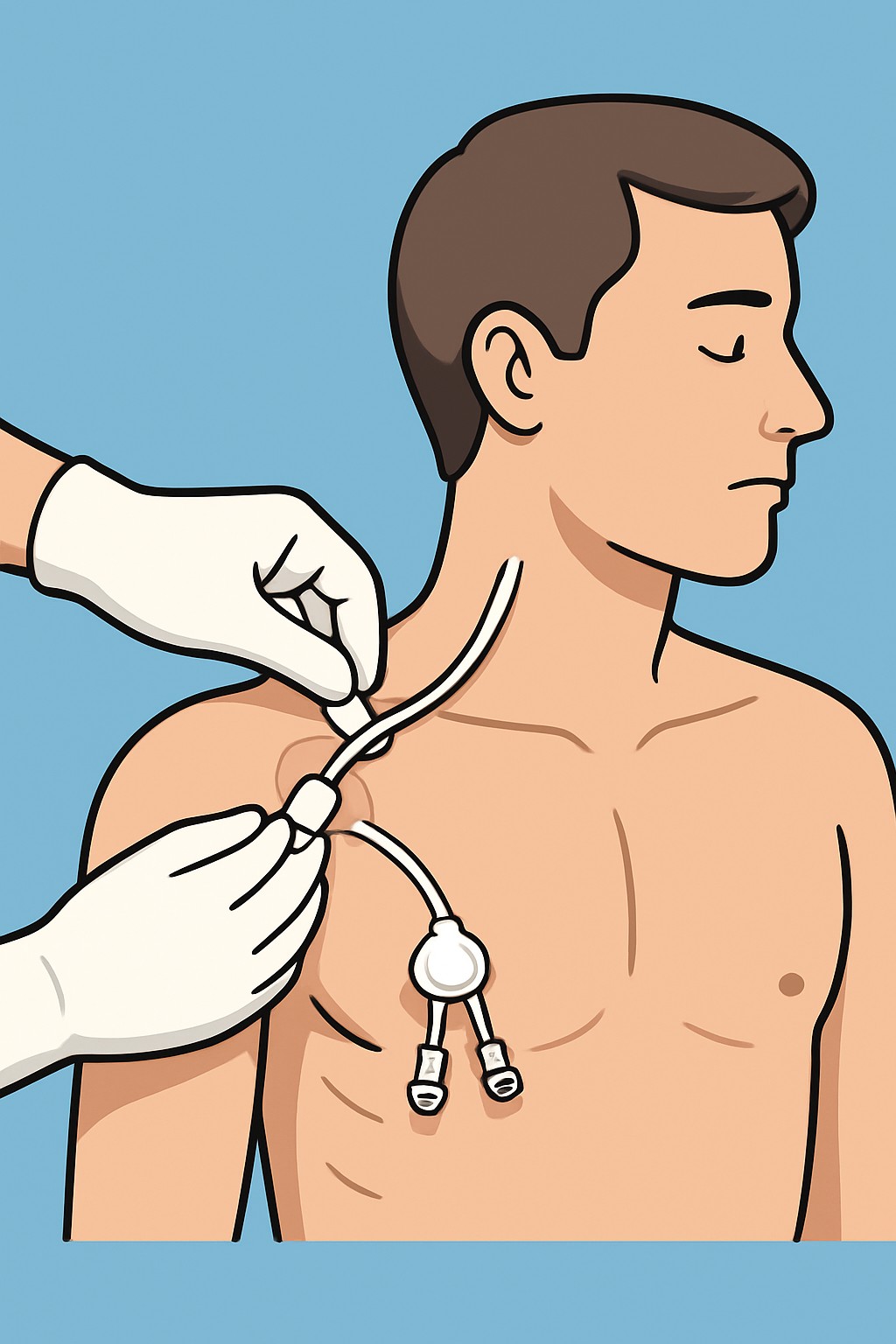
A tunneled catheter is a soft tube placed under the skin into a large vein for long-term access.
Overview
A tunneled catheter is a soft tube placed under the skin into a large vein for long-term access. Brands include Hickman, Broviac, and Groshong catheters. The tube has a small cuff under the skin that helps hold it in place and lowers infection risk. Removal is a minor procedure done when the catheter is no longer needed or is causing problems. It is often performed by an interventional radiologist or surgeon using local numbing medicine. The clinician frees the cuff, gently removes the catheter, and closes the skin with pressure and, if needed, a stitch or adhesive strip.
Also known as: Hickman catheter removal, Broviac removal, Groshong removal, Tunneled central line removal
Preparation & Next Steps
Everything you need to know before and after your procedure
Before Care
- Confirm the appointment location, arrival time, and check-in steps
- Bring a list of all medicines and supplements, including any blood thinners
- Tell the team about allergies, bleeding problems, or prior line infections
- Ask about fasting or a ride home if sedation may be used at your facility
- Wear loose, comfortable clothing that allows access to the chest area
- Plan your schedule to limit heavy activity the day of removal
- Have recent lab results available if your clinician requested coagulation tests
- Clean the skin with a regular shower the night before or morning of the procedure
- Bring photo ID, insurance information, and a form of payment if required
- Arrange help with childcare, pets, or work tasks for the day of the procedure if needed
After Care
- Leave the pressure dressing in place as instructed to keep the site clean and dry
- Keep the site dry for the first day; avoid swimming and soaking until healed
- Limit heavy lifting (for example, over 10 lb) and strenuous upper body activity for 24 to 48 hours
- Expect mild soreness or bruising; use simple comfort measures as advised by your care team
- Check the site daily for increasing redness, warmth, swelling, drainage, or fever and contact a clinician if these appear
- If bleeding occurs, apply firm pressure with a clean cloth and contact the clinic if it does not stop
- Avoid tight clothing or straps that rub the site until the skin has closed
- Follow instructions about when to remove any outer dressing or when stitches or adhesive strips will come off
- Resume routine medicines per your care plan; ask the clinic if you have questions about blood thinners
- Attend any scheduled follow-up or imaging if the care team requested it
Clinical Information
Important medical details about this procedure
Indications
- Catheter no longer needed
- Catheter-related infection
- Catheter malfunction or blockage
- Damage or break in the catheter
- Persistent skin irritation or tunnel infection
- Blood clot related to the catheter
- Pain, discomfort, or catheter migration
Alternatives
- Catheter exchange over a guidewire if ongoing venous access is still needed
- Catheter salvage protocols for selected infections when appropriate
- Switching to a different access device (implanted port or peripheral IV) when suitable
- Observation for minor issues if they resolve and the catheter is still required
Risks
- Bleeding or bruising at the removal site
- Infection at the skin or in the bloodstream
- Air embolism (air entering the vein) if the tract is not sealed promptly
- Damage to nearby blood vessels or tissues
- Retained cuff or small catheter fragment
- Scar formation or skin irritation
- Pain or discomfort during or after the procedure
Contraindications
- Uncontrolled bleeding or severe clotting disorders
- Hemodynamic instability
- Extensive local infection requiring operating room removal
- Catheter still needed for essential therapy
Recovery Timeline
What to expect during your recovery
Most people return to light activities the same day and normal routines within a few days. The skin puncture usually seals quickly, and the site typically heals over 7 to 10 days.
Typical Range
1–7 days
Return to Work
1–3 days
Recovery Milestones
Light walking and routine indoor activities with the dressing kept dry
Resume desk work if comfortable; avoid heavy lifting and vigorous upper body activity
Gradually increase activity as soreness improves; keep the site clean and dry
Most daily activities without restrictions once the skin is healed and closed
Frequently Asked Questions
Common questions and expert answers about this procedure
How is a tunneled catheter removed?
How is a tunneled catheter removed?
The skin is cleaned and numbed. The cuff is freed through a small incision or gentle dissection, then the catheter is pulled out. Pressure is applied and the skin is closed with a dressing and sometimes a stitch or adhesive strip.
Will I be awake?
Will I be awake?
Many removals use local anesthesia to numb the area. Some centers offer sedation for comfort, depending on the situation and facility policies.
How long does removal take?
How long does removal take?
The procedure itself often takes 15 to 30 minutes, though total visit time is longer due to preparation and observation.
Does it hurt?
Does it hurt?
You may feel pressure or brief pulling. Local numbing medicine reduces pain. Mild soreness or bruising afterward is common.
What are signs of a problem after removal?
What are signs of a problem after removal?
Worsening redness, warmth, swelling, pus, fever, or bleeding that does not stop with pressure are concerning. Contact a clinician if these occur.
Will I need stitches?
Will I need stitches?
Some sites are closed with an adhesive strip or skin glue; others may need a small stitch. Your team will explain how and when it is removed, if used.
Can the cuff be left behind?
Can the cuff be left behind?
If the cuff is firmly attached, a small piece may rarely be left in place without harm. The decision depends on comfort and infection risk.
Is imaging needed after removal?
Is imaging needed after removal?
Imaging is not routine. It may be used if there is concern for a retained fragment, ongoing infection, or other complication.
References
Medical literature and sources