%20--%3e%3csvg%20version='1.0'%20id='Layer_1'%20xmlns='http://www.w3.org/2000/svg'%20xmlns:xlink='http://www.w3.org/1999/xlink'%20x='0px'%20y='0px'%20viewBox='0%200%20755.52%20814.35'%20style='enable-background:new%200%200%20755.52%20814.35;'%20xml:space='preserve'%3e%3cstyle%20type='text/css'%3e%20.st0{fill:%231ae5ce;stroke:%231ae5ce;stroke-width:7;stroke-miterlimit:10;}%20.st1{fill:%23FFFFFF;stroke:%231ae5ce;stroke-width:7;stroke-miterlimit:10;}%20.st2{fill:%231ae5ce;stroke:%23FFFFFF;stroke-width:7;stroke-miterlimit:10;}%20.st3{fill:%23FFFFFF;stroke:%23FFFFFF;stroke-width:6;stroke-miterlimit:10;}%20%3c/style%3e%3cg%20id='Dark_Logo_00000159431215648494653180000015900878925932721032_'%3e%3cpath%20id='shield_00000152259091539869183100000001926543869452564382_'%20class='st0'%20d='M711.13,173.42%20c-3.37-49.07-38.92-44.9-75.96-52.18c-67.4-13.25-130.47-34.47-192.36-63.92c-22.48-10.7-41.88-25.74-65.05-26.28%20c-23.17,0.54-42.58,15.59-65.05,26.28c-61.89,29.45-124.95,50.68-192.36,63.92c-37.04,7.28-72.59,3.11-75.96,52.18%20c-1.55,22.6,0.34,46.4,1.05,68.92c5.99,190.78,52.91,345.39,206.27,466.46c29.71,23.46,74.51,55.8,108.84,70.75%20c5.99,2.61,11.7,3.73,17.21,3.75c5.51-0.02,11.22-1.14,17.21-3.75c34.33-14.95,79.12-47.3,108.84-70.75%20c153.37-121.07,200.28-275.68,206.27-466.46C710.79,219.82,712.68,196.02,711.13,173.42z'/%3e%3cpath%20id='magnifyingglass_00000073685934697636024790000000342567780940956808_'%20class='st1'%20d='M648.78,624.21l-96.64-104.65%20c34.89-40.63,55.98-93.46,55.98-151.21c0-128.27-103.98-232.24-232.24-232.24S143.63,240.08,143.63,368.35%20s103.98,232.24,232.24,232.24c48.87,0,94.21-15.11,131.62-40.89l97.18,105.24c11.25,12.18,30.24,12.93,42.42,1.69l0,0%20C659.27,655.38,660.03,636.39,648.78,624.21z'/%3e%3ccircle%20id='ellipse_00000129904010550392394720000017056154833629780114_'%20class='st2'%20cx='375.87'%20cy='368.35'%20r='181.21'/%3e%3cpath%20id='dollarsign_00000057140127156649725250000003772530148495155891_'%20class='st3'%20d='M362.91,492.03v-23.91%20c0-2.01-1.58-3.69-3.59-3.77c-18.49-0.78-37.12-5.4-49.4-11.83c-1.75-0.92-2.53-3.01-1.76-4.84l5.87-13.89%20c0.86-2.02,3.23-2.88,5.2-1.89c12.94,6.52,30.45,11.44,49.18,11.44c26.02,0,43.6-12.73,43.6-30.43c0-17.08-14.29-27.63-41.4-36.95%20c-37.37-12.42-60.46-26.7-60.46-53.72c0-24.97,20.29-44.11,52.22-49.51c1.8-0.31,3.11-1.89,3.11-3.72v-24.35%20c0-2.09,1.69-3.78,3.78-3.78h15.16c2.09,0,3.78,1.69,3.78,3.78v22.71c0,2.01,1.58,3.67,3.58,3.77c17.85,0.92,30.88,4.75,40.61,9.1%20c1.92,0.86,2.79,3.09,1.94,5.01l-6.08,13.6c-0.85,1.91-3.09,2.77-4.99,1.91c-8.37-3.8-22.38-8.95-42.75-8.95%20c-28.21,0-38.84,14.28-38.84,26.7c0,16.15,13.56,24.22,45.44,35.4c37.74,13.04,56.79,29.19,56.79,56.82%20c0,23.85-19.05,46.23-54.78,52.3c-1.8,0.31-3.11,1.89-3.11,3.72v25.28c0,2.09-1.69,3.78-3.78,3.78h-15.53%20C364.6,495.81,362.91,494.12,362.91,492.03z'/%3e%3c/g%3e%3c/svg%3e)
Umbilical hernia repair (open) General Surgery
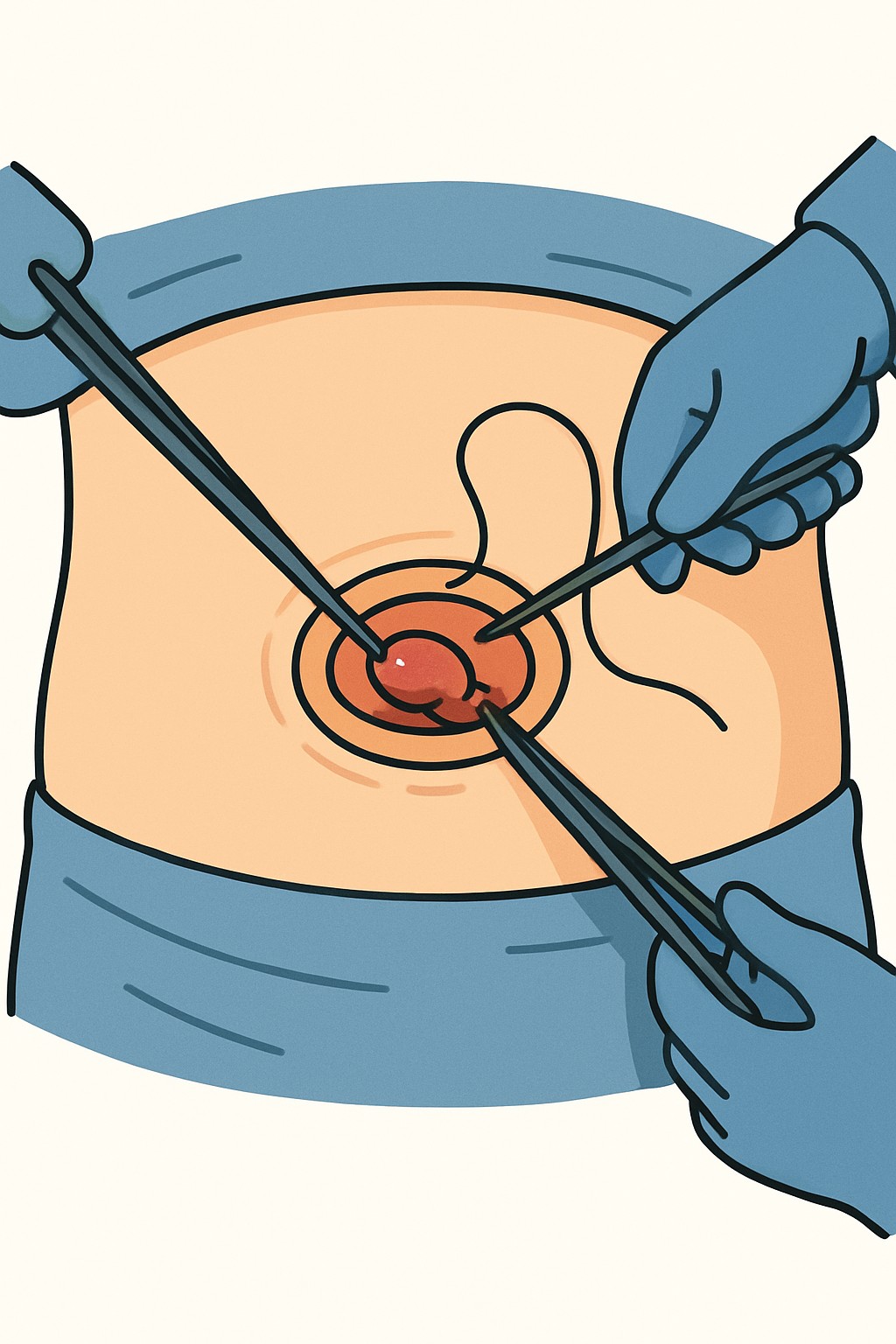
Open umbilical hernia repair is surgery to fix a hole or weak spot near the belly button where tissue or intestine can bulge out.
Overview
Open umbilical hernia repair is surgery to fix a hole or weak spot near the belly button where tissue or intestine can bulge out. The surgeon makes a small incision near the navel, places the bulging tissue back in place, and closes the defect with stitches. A mesh patch may be added to strengthen the area, especially for larger hernias. It is done to relieve symptoms like pain or a noticeable bulge and to reduce the risk of complications such as the hernia getting stuck or blood flow being cut off. Adults with symptomatic or enlarging hernias commonly have repair. Some small, painless hernias may be observed in select cases.
Also known as: Open umbilical herniorrhaphy, Open umbilical hernioplasty, Umbilical hernia surgery
Preparation & Next Steps
Everything you need to know before and after your procedure
Before Care
- Complete a preoperative evaluation and review your medical history, allergies, and prior surgeries
- Provide an up-to-date list of all medicines and supplements, including any blood thinners
- Follow fasting and medication instructions from the surgical team on the day of surgery
- Arrange a responsible adult for transportation and help at home after anesthesia
- Plan time off work and help with heavy chores, lifting, childcare, and pet care
- Avoid shaving the surgical area; shower the night before or morning of surgery as instructed
- Do not wear jewelry, lotions, or piercing hardware on the day of surgery
- Bring photo ID, insurance information, and any required paperwork
- If you use devices such as a CPAP, ask whether to bring them on the day of surgery
- Ask about smoking cessation and steps to reduce coughing or constipation before surgery
After Care
- Keep the incision clean and dry; follow dressing and shower instructions from your care team
- Use pain control as directed and avoid driving while taking opioid pain medicines
- Walk short distances several times a day to reduce stiffness and lower blood clot risk
- Avoid heavy lifting or straining until your clinician says activity can increase
- Support your abdomen with a small pillow when coughing or sneezing for comfort
- Prevent constipation with fluids, fiber, and stool softeners if recommended by your clinician
- Watch for fever, spreading redness, warmth, foul drainage, worsening pain, or a bulge that does not reduce and contact a clinician if these occur
- Check the incision daily for increasing swelling or fluid collection
- Keep follow-up appointments to review healing and discuss activity progression
- Ask when you can return to work, exercise, swimming, and bathing based on healing
Clinical Information
Important medical details about this procedure
Indications
- Painful or enlarging umbilical bulge
- Hernia that does not reduce easily
- Skin irritation or cosmetic concerns around the navel
- Prior episodes of the hernia getting stuck (incarceration)
- Risk of strangulation (compromised blood flow)
- Recurrent hernia after prior repair
Alternatives
- Watchful waiting for small, minimally symptomatic hernias
- Laparoscopic umbilical hernia repair
- Abdominal binder use for short-term support (does not fix the hernia)
- Weight management, smoking cessation, and treating chronic cough or constipation to reduce strain
Risks
- Bleeding or infection
- Seroma or hematoma (fluid or blood collection)
- Injury to nearby structures such as bowel
- Anesthesia-related risks
- Chronic pain or numbness at the incision
- Hernia recurrence
- Wound healing problems or scarring
- Mesh-related complications such as infection or discomfort when mesh is used
- Blood clots in the legs or lungs
Contraindications
- Active skin or soft tissue infection at the surgical site
- Uncontrolled bleeding disorder
- Unstable heart or lung conditions that make anesthesia unsafe
- Severe uncontrolled medical illness
- Pregnancy when elective repair can be delayed
Recovery Timeline
What to expect during your recovery
Most people resume light daily activities within several days and gradually increase activity over 2 to 4 weeks. Heavier lifting and strenuous exercise often wait longer, depending on healing and job demands.
Typical Range
7–21 days
Return to Work
3–14 days
Recovery Milestones
Walk short distances indoors and perform basic self-care
Shower if permitted and do light household tasks
Return to desk work or school if pain is controlled
Increase walking and light exercise as comfortable
Consider resuming strenuous exercise and heavy lifting if cleared by your clinician
Frequently Asked Questions
Common questions and expert answers about this procedure
What happens during an open umbilical hernia repair?
What happens during an open umbilical hernia repair?
A small cut is made near the belly button. The bulging tissue is placed back into the abdomen, and the opening is closed with stitches. A mesh patch may be added to reinforce the area.
Is mesh always used?
Is mesh always used?
Mesh is commonly used in adult repairs, especially for larger defects, to strengthen the repair and help lower recurrence. Small hernias may be closed with stitches alone.
What kind of anesthesia is used?
What kind of anesthesia is used?
Open repair is often done with general anesthesia. Some centers may use regional or local anesthesia with sedation, depending on the case and facility.
How long does the surgery take?
How long does the surgery take?
Many open umbilical hernia repairs take under an hour, but the total time at the facility is longer due to check-in, anesthesia, and recovery.
When can I return to normal activities?
When can I return to normal activities?
Light activities usually resume within a few days. Strenuous exercise and heavy lifting often wait several weeks and are guided by your follow-up visit.
What are warning signs after surgery?
What are warning signs after surgery?
Fever, worsening pain, spreading redness, foul drainage, vomiting, a bulge that will not go back in, or trouble passing gas or stool are reasons to contact a clinician.
Will the hernia come back?
Will the hernia come back?
Recurrence can happen. Factors like heavy lifting, smoking, obesity, chronic cough, and wound infection can increase risk. Mesh may reduce recurrence for some hernias.
Do children with umbilical hernias need surgery right away?
Do children with umbilical hernias need surgery right away?
Many small umbilical hernias in young children close on their own over time. Surgery is considered if the hernia is large, symptomatic, or does not close as the child grows.
References
Medical literature and sources