%20--%3e%3csvg%20version='1.0'%20id='Layer_1'%20xmlns='http://www.w3.org/2000/svg'%20xmlns:xlink='http://www.w3.org/1999/xlink'%20x='0px'%20y='0px'%20viewBox='0%200%20755.52%20814.35'%20style='enable-background:new%200%200%20755.52%20814.35;'%20xml:space='preserve'%3e%3cstyle%20type='text/css'%3e%20.st0{fill:%231ae5ce;stroke:%231ae5ce;stroke-width:7;stroke-miterlimit:10;}%20.st1{fill:%23FFFFFF;stroke:%231ae5ce;stroke-width:7;stroke-miterlimit:10;}%20.st2{fill:%231ae5ce;stroke:%23FFFFFF;stroke-width:7;stroke-miterlimit:10;}%20.st3{fill:%23FFFFFF;stroke:%23FFFFFF;stroke-width:6;stroke-miterlimit:10;}%20%3c/style%3e%3cg%20id='Dark_Logo_00000159431215648494653180000015900878925932721032_'%3e%3cpath%20id='shield_00000152259091539869183100000001926543869452564382_'%20class='st0'%20d='M711.13,173.42%20c-3.37-49.07-38.92-44.9-75.96-52.18c-67.4-13.25-130.47-34.47-192.36-63.92c-22.48-10.7-41.88-25.74-65.05-26.28%20c-23.17,0.54-42.58,15.59-65.05,26.28c-61.89,29.45-124.95,50.68-192.36,63.92c-37.04,7.28-72.59,3.11-75.96,52.18%20c-1.55,22.6,0.34,46.4,1.05,68.92c5.99,190.78,52.91,345.39,206.27,466.46c29.71,23.46,74.51,55.8,108.84,70.75%20c5.99,2.61,11.7,3.73,17.21,3.75c5.51-0.02,11.22-1.14,17.21-3.75c34.33-14.95,79.12-47.3,108.84-70.75%20c153.37-121.07,200.28-275.68,206.27-466.46C710.79,219.82,712.68,196.02,711.13,173.42z'/%3e%3cpath%20id='magnifyingglass_00000073685934697636024790000000342567780940956808_'%20class='st1'%20d='M648.78,624.21l-96.64-104.65%20c34.89-40.63,55.98-93.46,55.98-151.21c0-128.27-103.98-232.24-232.24-232.24S143.63,240.08,143.63,368.35%20s103.98,232.24,232.24,232.24c48.87,0,94.21-15.11,131.62-40.89l97.18,105.24c11.25,12.18,30.24,12.93,42.42,1.69l0,0%20C659.27,655.38,660.03,636.39,648.78,624.21z'/%3e%3ccircle%20id='ellipse_00000129904010550392394720000017056154833629780114_'%20class='st2'%20cx='375.87'%20cy='368.35'%20r='181.21'/%3e%3cpath%20id='dollarsign_00000057140127156649725250000003772530148495155891_'%20class='st3'%20d='M362.91,492.03v-23.91%20c0-2.01-1.58-3.69-3.59-3.77c-18.49-0.78-37.12-5.4-49.4-11.83c-1.75-0.92-2.53-3.01-1.76-4.84l5.87-13.89%20c0.86-2.02,3.23-2.88,5.2-1.89c12.94,6.52,30.45,11.44,49.18,11.44c26.02,0,43.6-12.73,43.6-30.43c0-17.08-14.29-27.63-41.4-36.95%20c-37.37-12.42-60.46-26.7-60.46-53.72c0-24.97,20.29-44.11,52.22-49.51c1.8-0.31,3.11-1.89,3.11-3.72v-24.35%20c0-2.09,1.69-3.78,3.78-3.78h15.16c2.09,0,3.78,1.69,3.78,3.78v22.71c0,2.01,1.58,3.67,3.58,3.77c17.85,0.92,30.88,4.75,40.61,9.1%20c1.92,0.86,2.79,3.09,1.94,5.01l-6.08,13.6c-0.85,1.91-3.09,2.77-4.99,1.91c-8.37-3.8-22.38-8.95-42.75-8.95%20c-28.21,0-38.84,14.28-38.84,26.7c0,16.15,13.56,24.22,45.44,35.4c37.74,13.04,56.79,29.19,56.79,56.82%20c0,23.85-19.05,46.23-54.78,52.3c-1.8,0.31-3.11,1.89-3.11,3.72v25.28c0,2.09-1.69,3.78-3.78,3.78h-15.53%20C364.6,495.81,362.91,494.12,362.91,492.03z'/%3e%3c/g%3e%3c/svg%3e)
Dilation and curettage (endometrial tissue sampling) Gynecologic Surgery
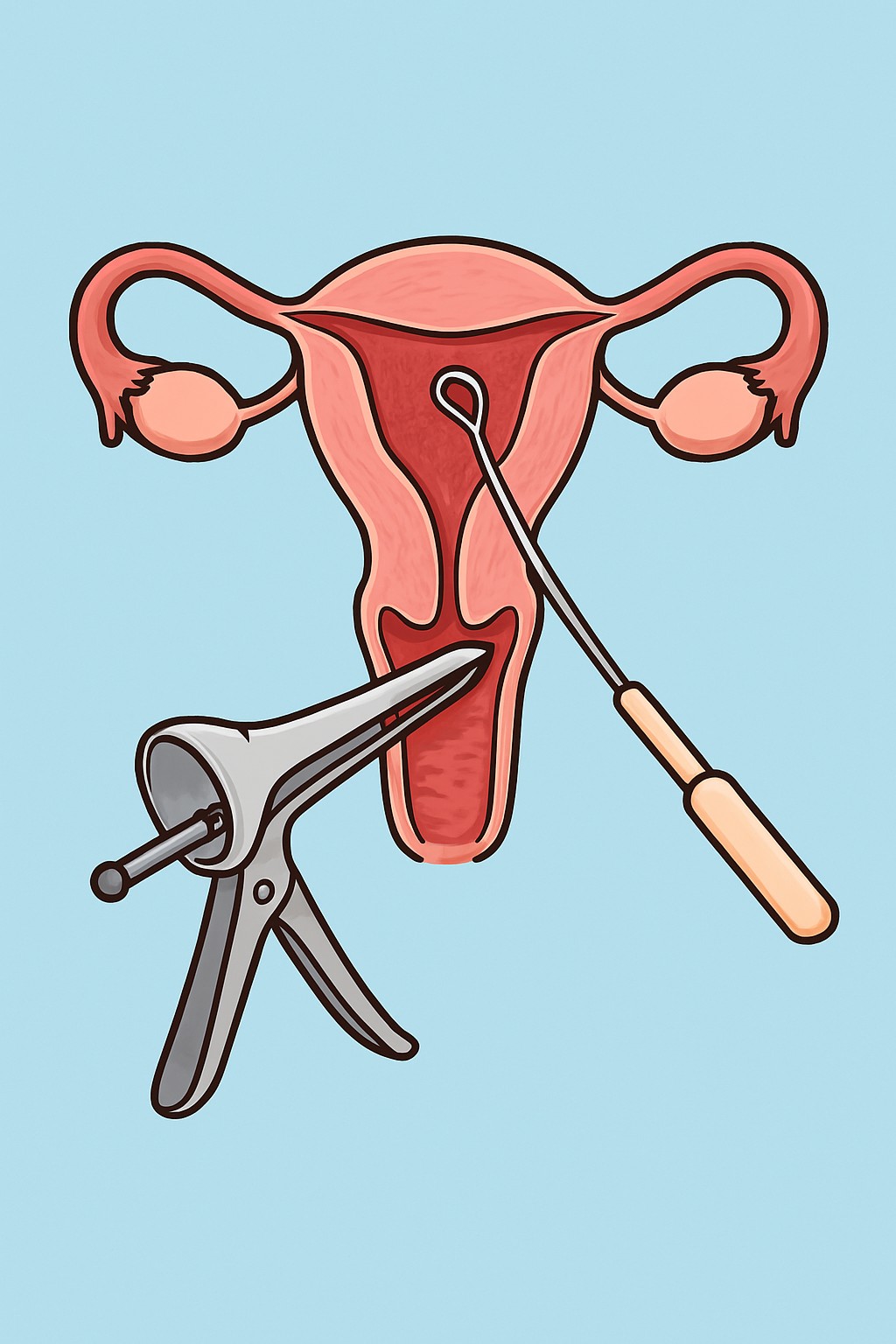
Dilation and curettage, often called D&C, is a procedure to gently open the cervix (the opening to the uterus) and remove a small amount of tissue from the lining of the uterus (endometrium).
Overview
Dilation and curettage, often called D&C, is a procedure to gently open the cervix (the opening to the uterus) and remove a small amount of tissue from the lining of the uterus (endometrium). The tissue is sent to a lab to look for causes of bleeding or other problems. A D&C may also be used to remove tissue after a miscarriage or to treat certain types of abnormal bleeding. It can be done in a clinic or hospital. Pain control may include local anesthesia, sedation, or general anesthesia, depending on the setting and plan.
Also known as: D&C, Uterine curettage, Endometrial sampling, Endometrial curettage
Preparation & Next Steps
Everything you need to know before and after your procedure
Before Care
- Confirm the reason for the procedure and any tests that will be performed on the tissue
- Review the anesthesia or sedation plan and follow any fasting instructions provided by the facility
- Arrange a ride home if sedation or anesthesia is planned
- Bring a current list of all medicines and supplements, including any blood thinners or antiplatelet drugs
- Share allergies, prior reactions to anesthesia, and relevant medical or surgical history
- Ask how menstrual timing may affect scheduling and whether a pregnancy test will be done
- Plan for simple pain control after the procedure using over-the-counter options if advised by your care team
- Have sanitary pads available for expected light bleeding or spotting after the procedure
- Follow any instructions about avoiding food, drink, or vaginal products before the procedure
- Confirm how and when you will receive pathology results and who to contact with questions
After Care
- Expect mild cramping and light bleeding or spotting for a few days; use pads rather than internal products unless told otherwise
- Rest on the day of the procedure and increase activity as you feel able
- Avoid inserting anything into the vagina, including intercourse and douching, until your care team says it is safe
- Use pain relievers as directed on the label or by your clinician; avoid medicines you were told to hold
- Drink fluids and eat light meals until any nausea from anesthesia resolves
- Do not drive, operate machinery, or sign important documents until sedation effects have worn off
- Track bleeding amount and any clots; note patterns to share at follow-up
- Know how results will be delivered and when to expect them; call if results are delayed beyond the stated timeframe
- Contact a clinician for heavy bleeding (such as soaking a pad in an hour), fever or chills, severe or worsening pain, foul-smelling discharge, or fainting
- Schedule follow-up if advised to review results and next steps
Clinical Information
Important medical details about this procedure
Indications
- Abnormal uterine bleeding
- Postmenopausal bleeding
- Evaluation for endometrial hyperplasia or cancer
- Removal of retained tissue after miscarriage or childbirth
- Removal or sampling of endometrial polyps
- Management of incomplete or missed miscarriage
Alternatives
- Office endometrial biopsy (pipelle)
- Hysteroscopy with directed biopsy
- Medication to pass tissue after miscarriage (medical management)
- Watchful waiting when safe and appropriate
- Hormonal therapy for heavy periods (such as progestins or hormonal IUD)
- Tranexamic acid for heavy menstrual bleeding
- Suction aspiration in suitable cases
Risks
- Cramping and light bleeding
- Infection
- Heavy bleeding
- Uterine perforation
- Cervical injury
- Scar tissue inside the uterus (Asherman syndrome, rare)
- Reaction to anesthesia or sedation
Contraindications
- Known or suspected viable pregnancy when the goal is not pregnancy management
- Active pelvic infection
- Uncorrected bleeding or clotting disorders
- Severe medical instability requiring a different care setting
Recovery Timeline
What to expect during your recovery
Most people feel ready for light activities within 1 to 2 days. Spotting and mild cramps can last a few days. Return to regular routines varies by anesthesia used and job demands.
Typical Range
1–7 days
Return to Work
1–3 days
Recovery Milestones
Rest, short walks indoors, and fluids while sedation wears off
Light daily activities at home; manage mild cramps with comfort measures
Most routine tasks; spotting typically decreases
Return to desk work if feeling well and no longer affected by sedation
Follow-up review of pathology results as arranged
Frequently Asked Questions
Common questions and expert answers about this procedure
What happens during a D&C?
What happens during a D&C?
The cervix is gently dilated and a small amount of the uterine lining is removed with suction or a curette. The tissue is sent to a lab for analysis.
How long does the procedure take?
How long does the procedure take?
The procedure itself usually takes less than 30 minutes. Plan extra time for check-in, anesthesia, and recovery.
Will I be awake or asleep?
Will I be awake or asleep?
Pain control can include local anesthesia with or without sedation, or general anesthesia. The approach depends on the setting and plan.
Is a D&C the same as an endometrial biopsy?
Is a D&C the same as an endometrial biopsy?
Both collect tissue from the uterine lining. An office endometrial biopsy uses a thin tube and often collects a smaller sample, while a D&C typically collects a larger sample in a procedural setting.
What bleeding is normal after a D&C?
What bleeding is normal after a D&C?
Light bleeding or spotting for a few days is common. Heavy bleeding, large clots, or dizziness should prompt a call to a clinician.
Can a D&C affect fertility?
Can a D&C affect fertility?
Most people do not have long-term fertility problems. Rarely, scar tissue (Asherman syndrome) can form and may affect periods or fertility.
When will I get results?
When will I get results?
Pathology results are often available within about a week, depending on the lab. Clinics share results by portal, phone call, or follow-up visit.
References
Medical literature and sources