%20--%3e%3csvg%20version='1.0'%20id='Layer_1'%20xmlns='http://www.w3.org/2000/svg'%20xmlns:xlink='http://www.w3.org/1999/xlink'%20x='0px'%20y='0px'%20viewBox='0%200%20755.52%20814.35'%20style='enable-background:new%200%200%20755.52%20814.35;'%20xml:space='preserve'%3e%3cstyle%20type='text/css'%3e%20.st0{fill:%231ae5ce;stroke:%231ae5ce;stroke-width:7;stroke-miterlimit:10;}%20.st1{fill:%23FFFFFF;stroke:%231ae5ce;stroke-width:7;stroke-miterlimit:10;}%20.st2{fill:%231ae5ce;stroke:%23FFFFFF;stroke-width:7;stroke-miterlimit:10;}%20.st3{fill:%23FFFFFF;stroke:%23FFFFFF;stroke-width:6;stroke-miterlimit:10;}%20%3c/style%3e%3cg%20id='Dark_Logo_00000159431215648494653180000015900878925932721032_'%3e%3cpath%20id='shield_00000152259091539869183100000001926543869452564382_'%20class='st0'%20d='M711.13,173.42%20c-3.37-49.07-38.92-44.9-75.96-52.18c-67.4-13.25-130.47-34.47-192.36-63.92c-22.48-10.7-41.88-25.74-65.05-26.28%20c-23.17,0.54-42.58,15.59-65.05,26.28c-61.89,29.45-124.95,50.68-192.36,63.92c-37.04,7.28-72.59,3.11-75.96,52.18%20c-1.55,22.6,0.34,46.4,1.05,68.92c5.99,190.78,52.91,345.39,206.27,466.46c29.71,23.46,74.51,55.8,108.84,70.75%20c5.99,2.61,11.7,3.73,17.21,3.75c5.51-0.02,11.22-1.14,17.21-3.75c34.33-14.95,79.12-47.3,108.84-70.75%20c153.37-121.07,200.28-275.68,206.27-466.46C710.79,219.82,712.68,196.02,711.13,173.42z'/%3e%3cpath%20id='magnifyingglass_00000073685934697636024790000000342567780940956808_'%20class='st1'%20d='M648.78,624.21l-96.64-104.65%20c34.89-40.63,55.98-93.46,55.98-151.21c0-128.27-103.98-232.24-232.24-232.24S143.63,240.08,143.63,368.35%20s103.98,232.24,232.24,232.24c48.87,0,94.21-15.11,131.62-40.89l97.18,105.24c11.25,12.18,30.24,12.93,42.42,1.69l0,0%20C659.27,655.38,660.03,636.39,648.78,624.21z'/%3e%3ccircle%20id='ellipse_00000129904010550392394720000017056154833629780114_'%20class='st2'%20cx='375.87'%20cy='368.35'%20r='181.21'/%3e%3cpath%20id='dollarsign_00000057140127156649725250000003772530148495155891_'%20class='st3'%20d='M362.91,492.03v-23.91%20c0-2.01-1.58-3.69-3.59-3.77c-18.49-0.78-37.12-5.4-49.4-11.83c-1.75-0.92-2.53-3.01-1.76-4.84l5.87-13.89%20c0.86-2.02,3.23-2.88,5.2-1.89c12.94,6.52,30.45,11.44,49.18,11.44c26.02,0,43.6-12.73,43.6-30.43c0-17.08-14.29-27.63-41.4-36.95%20c-37.37-12.42-60.46-26.7-60.46-53.72c0-24.97,20.29-44.11,52.22-49.51c1.8-0.31,3.11-1.89,3.11-3.72v-24.35%20c0-2.09,1.69-3.78,3.78-3.78h15.16c2.09,0,3.78,1.69,3.78,3.78v22.71c0,2.01,1.58,3.67,3.58,3.77c17.85,0.92,30.88,4.75,40.61,9.1%20c1.92,0.86,2.79,3.09,1.94,5.01l-6.08,13.6c-0.85,1.91-3.09,2.77-4.99,1.91c-8.37-3.8-22.38-8.95-42.75-8.95%20c-28.21,0-38.84,14.28-38.84,26.7c0,16.15,13.56,24.22,45.44,35.4c37.74,13.04,56.79,29.19,56.79,56.82%20c0,23.85-19.05,46.23-54.78,52.3c-1.8,0.31-3.11,1.89-3.11,3.72v25.28c0,2.09-1.69,3.78-3.78,3.78h-15.53%20C364.6,495.81,362.91,494.12,362.91,492.03z'/%3e%3c/g%3e%3c/svg%3e)
Hysterectomy (Abdominal) Gynecologic Surgery
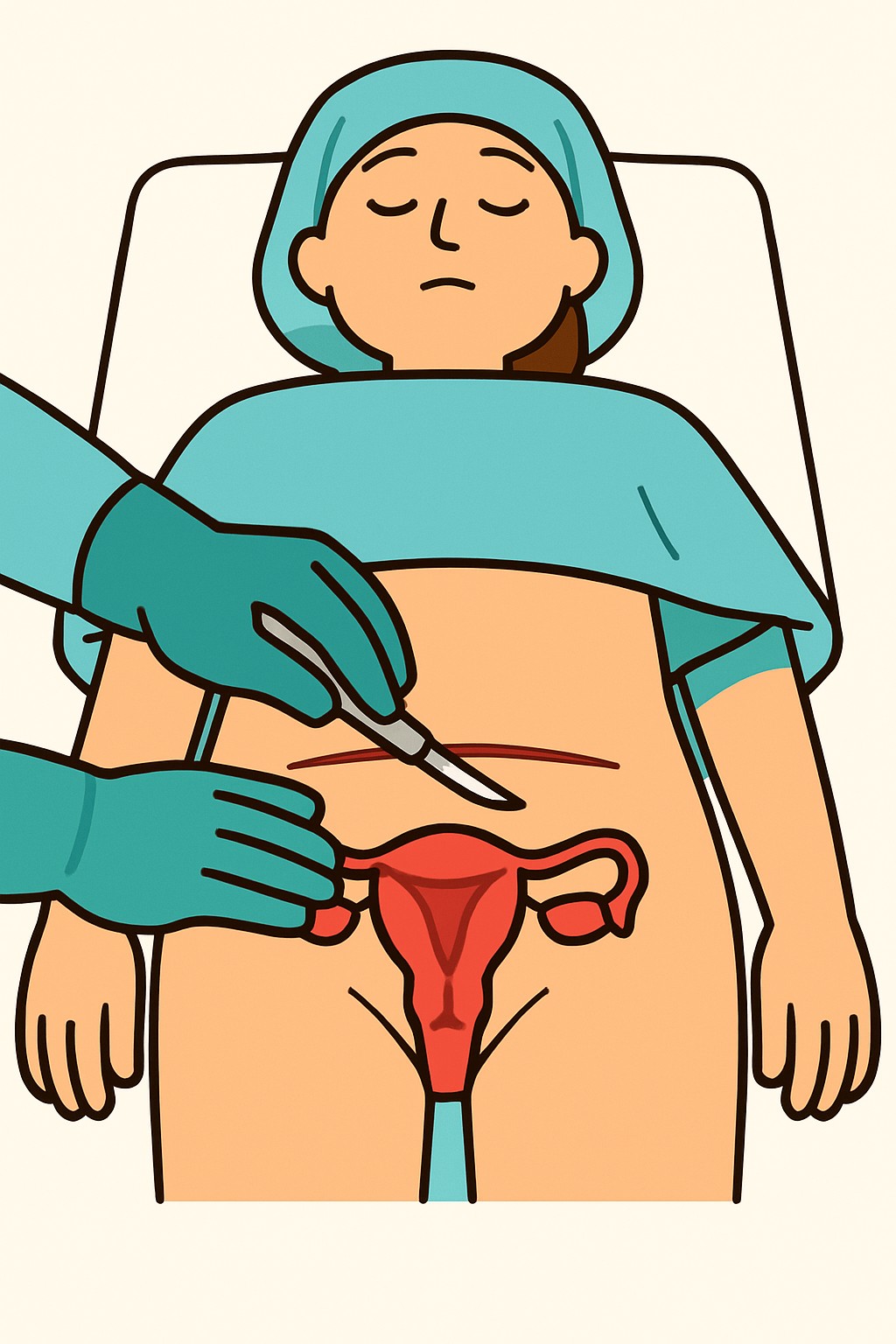
An abdominal hysterectomy is surgery to remove the uterus through an incision in the lower belly.
Overview
An abdominal hysterectomy is surgery to remove the uterus through an incision in the lower belly. The incision may be horizontal or vertical, and the procedure is done under general anesthesia. Depending on the reason for surgery, the cervix, fallopian tubes, or ovaries may also be removed. This approach is often chosen when the uterus is large, when pelvic scarring or other conditions make minimally invasive surgery difficult, or when cancer is suspected or confirmed. The goals are to relieve symptoms such as heavy bleeding or pain, treat disease, and prevent complications.
Also known as: Open hysterectomy, Total abdominal hysterectomy, TAH, Open uterine removal
Preparation & Next Steps
Everything you need to know before and after your procedure
Before Care
- Complete your preoperative evaluation and any ordered lab tests or imaging.
- Provide an up-to-date list of all medicines and supplements, including blood thinners and herbal products.
- Follow instructions about which medicines to stop or adjust before surgery.
- Follow fasting instructions for anesthesia on the day of surgery.
- Perform pre-surgery skin cleansing as directed to lower infection risk.
- Arrange a ride home and help with daily tasks for the first few days.
- Plan time off work and household support for the recovery period.
- Pack your photo ID, insurance card, and a written list of allergies and medicines.
- If a bowel preparation is ordered, follow the written instructions.
- Prepare your home by placing essentials within easy reach and setting out loose, comfortable clothing.
After Care
- Keep the incision clean and dry, and follow instructions on bandages and showering.
- Take pain medicines and any other prescriptions as instructed by your care team.
- Walk several times a day, starting with short distances, to support circulation and bowel function.
- Avoid heavy lifting, strenuous exercise, and driving until your care team says it is safe.
- Do not use tampons, douche, or have vaginal intercourse until cleared by your clinician.
- Drink fluids, eat fiber-rich foods, and use a bowel plan if recommended to prevent constipation.
- Monitor the incision and vaginal discharge; some light bleeding or spotting can be normal.
- Attend follow-up visits to check healing and review any pathology results.
- Contact your clinician for fever of 100.4 F (38 C) or higher, increasing redness or warmth at the incision, foul drainage, heavy vaginal bleeding, severe or worsening pain, trouble urinating, leg or calf swelling, chest pain, or shortness of breath.
Clinical Information
Important medical details about this procedure
Indications
- Uterine fibroids causing pain, pressure, or heavy bleeding
- Abnormal or heavy uterine bleeding not controlled with other treatments
- Adenomyosis
- Endometriosis not improved with other treatments
- Uterine, cervical, or ovarian cancer or precancer
- Uterine prolapse
- Chronic pelvic pain linked to uterine disease
Alternatives
- Vaginal or laparoscopic hysterectomy
- Myomectomy to remove fibroids while keeping the uterus
- Uterine artery embolization for fibroids
- Hormonal therapy or levonorgestrel IUD
- Endometrial ablation for heavy bleeding
- Watchful waiting when safe
Risks
- Bleeding that may require a transfusion
- Infection at the incision or inside the pelvis
- Injury to bladder, ureters, or bowel
- Blood clots in the legs or lungs
- Adverse reaction to anesthesia
- Pain, scarring, or adhesions
- Early menopause symptoms if ovaries are removed
- Hernia at the incision site
Contraindications
- Unstable heart or lung disease that makes anesthesia unsafe
- Uncontrolled bleeding or clotting disorders
- Active pelvic or systemic infection not yet treated
- High risk for poor wound healing not optimized
- Desire for future pregnancy when surgery is for a benign condition
Recovery Timeline
What to expect during your recovery
Most people are up and walking the day of or the day after surgery. Recovery after an abdominal hysterectomy often takes several weeks, with a gradual return to normal activities.
Typical Range
28–42 days
Return to Work
14–42 days
Recovery Milestones
Sit up and take short walks with assistance as needed
Increase walking indoors and practice gentle mobility
Resume light daily tasks that do not strain the incision
Extend walking time and ease into light activities
Gradual return toward most normal activities if healing is uncomplicated
Frequently Asked Questions
Common questions and expert answers about this procedure
How is an abdominal hysterectomy different from laparoscopic or vaginal hysterectomy?
How is an abdominal hysterectomy different from laparoscopic or vaginal hysterectomy?
It uses a larger incision in the lower belly to remove the uterus. This approach may be chosen for a large uterus, extensive scarring, or when cancer is suspected, and it usually has a longer recovery.
Will I still have periods or be able to get pregnant after this surgery?
Will I still have periods or be able to get pregnant after this surgery?
Removing the uterus stops menstrual periods and means you cannot carry a pregnancy. If the ovaries are kept, you will not enter menopause right away; if they are removed, menopause starts after surgery.
How long is the hospital stay?
How long is the hospital stay?
Many people stay 1 to 2 days after an abdominal hysterectomy, but the exact stay varies based on health and what is found during surgery.
Where will the scar be?
Where will the scar be?
There is usually a horizontal bikini-line incision or a vertical midline incision. The choice depends on your anatomy and the reason for surgery.
What parts might be removed besides the uterus?
What parts might be removed besides the uterus?
The cervix may be removed (total hysterectomy) or left in place (supracervical). The fallopian tubes are often removed, and the ovaries may be removed or kept based on your condition.
When can I drive or have sex again?
When can I drive or have sex again?
Timing varies. Many people wait several weeks and until a clinician confirms healing. Ask at your follow-up visit for guidance based on your recovery.
Will I still need Pap tests after a hysterectomy?
Will I still need Pap tests after a hysterectomy?
Screening needs depend on whether the cervix was removed and your past results. National guidelines vary by history, so confirm your plan with your clinician.
What are pathology results and when do they come back?
What are pathology results and when do they come back?
The removed tissue is examined under a microscope. Results are typically available soon after surgery, often within 1 to 2 weeks.
References
Medical literature and sources