%20--%3e%3csvg%20version='1.0'%20id='Layer_1'%20xmlns='http://www.w3.org/2000/svg'%20xmlns:xlink='http://www.w3.org/1999/xlink'%20x='0px'%20y='0px'%20viewBox='0%200%20755.52%20814.35'%20style='enable-background:new%200%200%20755.52%20814.35;'%20xml:space='preserve'%3e%3cstyle%20type='text/css'%3e%20.st0{fill:%231ae5ce;stroke:%231ae5ce;stroke-width:7;stroke-miterlimit:10;}%20.st1{fill:%23FFFFFF;stroke:%231ae5ce;stroke-width:7;stroke-miterlimit:10;}%20.st2{fill:%231ae5ce;stroke:%23FFFFFF;stroke-width:7;stroke-miterlimit:10;}%20.st3{fill:%23FFFFFF;stroke:%23FFFFFF;stroke-width:6;stroke-miterlimit:10;}%20%3c/style%3e%3cg%20id='Dark_Logo_00000159431215648494653180000015900878925932721032_'%3e%3cpath%20id='shield_00000152259091539869183100000001926543869452564382_'%20class='st0'%20d='M711.13,173.42%20c-3.37-49.07-38.92-44.9-75.96-52.18c-67.4-13.25-130.47-34.47-192.36-63.92c-22.48-10.7-41.88-25.74-65.05-26.28%20c-23.17,0.54-42.58,15.59-65.05,26.28c-61.89,29.45-124.95,50.68-192.36,63.92c-37.04,7.28-72.59,3.11-75.96,52.18%20c-1.55,22.6,0.34,46.4,1.05,68.92c5.99,190.78,52.91,345.39,206.27,466.46c29.71,23.46,74.51,55.8,108.84,70.75%20c5.99,2.61,11.7,3.73,17.21,3.75c5.51-0.02,11.22-1.14,17.21-3.75c34.33-14.95,79.12-47.3,108.84-70.75%20c153.37-121.07,200.28-275.68,206.27-466.46C710.79,219.82,712.68,196.02,711.13,173.42z'/%3e%3cpath%20id='magnifyingglass_00000073685934697636024790000000342567780940956808_'%20class='st1'%20d='M648.78,624.21l-96.64-104.65%20c34.89-40.63,55.98-93.46,55.98-151.21c0-128.27-103.98-232.24-232.24-232.24S143.63,240.08,143.63,368.35%20s103.98,232.24,232.24,232.24c48.87,0,94.21-15.11,131.62-40.89l97.18,105.24c11.25,12.18,30.24,12.93,42.42,1.69l0,0%20C659.27,655.38,660.03,636.39,648.78,624.21z'/%3e%3ccircle%20id='ellipse_00000129904010550392394720000017056154833629780114_'%20class='st2'%20cx='375.87'%20cy='368.35'%20r='181.21'/%3e%3cpath%20id='dollarsign_00000057140127156649725250000003772530148495155891_'%20class='st3'%20d='M362.91,492.03v-23.91%20c0-2.01-1.58-3.69-3.59-3.77c-18.49-0.78-37.12-5.4-49.4-11.83c-1.75-0.92-2.53-3.01-1.76-4.84l5.87-13.89%20c0.86-2.02,3.23-2.88,5.2-1.89c12.94,6.52,30.45,11.44,49.18,11.44c26.02,0,43.6-12.73,43.6-30.43c0-17.08-14.29-27.63-41.4-36.95%20c-37.37-12.42-60.46-26.7-60.46-53.72c0-24.97,20.29-44.11,52.22-49.51c1.8-0.31,3.11-1.89,3.11-3.72v-24.35%20c0-2.09,1.69-3.78,3.78-3.78h15.16c2.09,0,3.78,1.69,3.78,3.78v22.71c0,2.01,1.58,3.67,3.58,3.77c17.85,0.92,30.88,4.75,40.61,9.1%20c1.92,0.86,2.79,3.09,1.94,5.01l-6.08,13.6c-0.85,1.91-3.09,2.77-4.99,1.91c-8.37-3.8-22.38-8.95-42.75-8.95%20c-28.21,0-38.84,14.28-38.84,26.7c0,16.15,13.56,24.22,45.44,35.4c37.74,13.04,56.79,29.19,56.79,56.82%20c0,23.85-19.05,46.23-54.78,52.3c-1.8,0.31-3.11,1.89-3.11,3.72v25.28c0,2.09-1.69,3.78-3.78,3.78h-15.53%20C364.6,495.81,362.91,494.12,362.91,492.03z'/%3e%3c/g%3e%3c/svg%3e)
Hysteroscopy with biopsy (uterine scope) Gynecologic Surgery
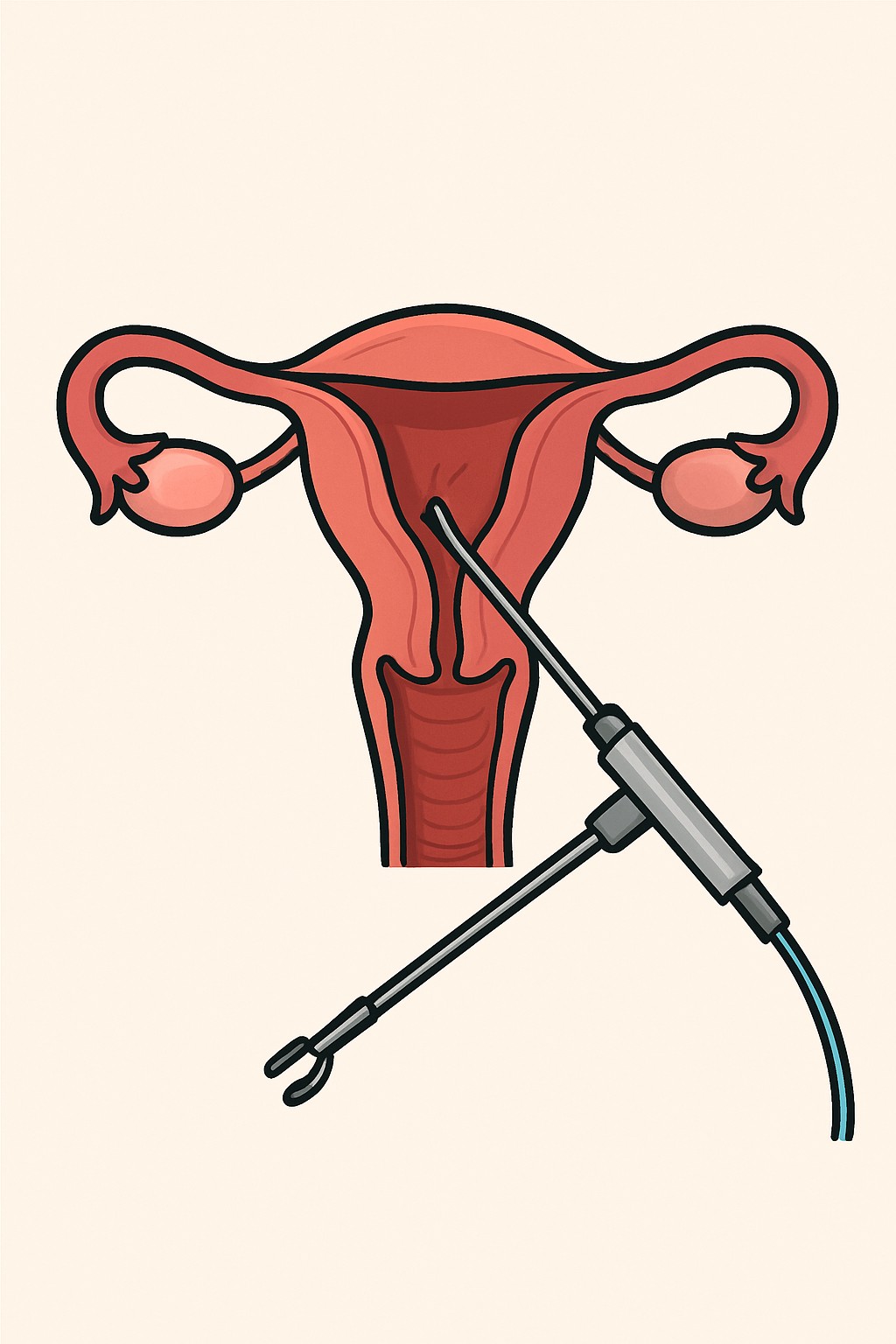
A hysteroscopy with biopsy uses a thin, lighted scope passed through the vagina and cervix to look inside the uterus.
Overview
A hysteroscopy with biopsy uses a thin, lighted scope passed through the vagina and cervix to look inside the uterus. A small sample of tissue (biopsy) is taken from the uterine lining so it can be examined under a microscope. This procedure helps find causes of abnormal bleeding, polyps, fibroids, scarring, or structural problems. It may be done in a clinic or surgical center with local anesthesia, sedation, or general anesthesia, depending on the setting and your care plan.
Also known as: Diagnostic hysteroscopy, Endometrial biopsy with hysteroscopy, Uterine scope, Hysteroscopic biopsy
Preparation & Next Steps
Everything you need to know before and after your procedure
Before Care
- Confirm logistics: where to check in, expected length of visit, and who will contact you after the procedure
- Review medicines with the care team, including blood thinners, diabetes medicines, and supplements
- Follow any instructions about eating and drinking if sedation or anesthesia is planned, and arrange a ride home if you will not be fully alert afterward
- A pregnancy test is commonly done on the day of the procedure; bring a list of menstrual timing if relevant
- Avoid vaginal creams, douching, or intercourse shortly before the visit if instructed by the clinic
- Take over-the-counter pain relief only if approved by your care team; do not exceed package directions
- Bring a photo ID, insurance card, a method of payment if required, and a current medication and allergy list
- Wear comfortable clothing and bring a sanitary pad for light bleeding after the procedure
- Ask the clinic about timing of biopsy results and how you will receive them
After Care
- Expect mild cramping and light spotting; use sanitary pads rather than tampons at first
- Rest the day of the procedure and increase activity as you feel able
- If you received sedation or anesthesia, avoid driving, operating machinery, or signing important documents for the advised period
- Take pain relief as directed on the label or by your care team; avoid exceeding recommended doses
- Avoid putting anything in the vagina (tampons, douching, intercourse) until your clinician says it is safe
- Drink fluids, eat light meals at first, and resume your usual diet as tolerated
- Monitor bleeding; light bleeding or spotting is common for a short time
- Contact a clinician if you have fever, chills, worsening or severe pain, foul-smelling discharge, heavy bleeding (such as soaking a pad in an hour), or symptoms that concern you
- Review biopsy results when available and discuss next steps or follow-up appointments
Clinical Information
Important medical details about this procedure
Indications
- Abnormal uterine bleeding or bleeding after menopause
- Suspected uterine polyps or fibroids
- Evaluation of infertility or repeated pregnancy loss
- Suspected uterine adhesions (scar tissue)
- Follow-up of abnormal imaging or biopsy results
- Locating or removing a displaced intrauterine device (IUD)
Alternatives
- Watchful waiting when appropriate
- Pelvic ultrasound
- Saline infusion sonohysterography (ultrasound with saline)
- Endometrial biopsy in the office without a scope
- Dilation and curettage (D&C)
- Medication management for heavy bleeding
- Hormonal intrauterine device for bleeding control
Risks
- Cramping and light vaginal bleeding
- Infection
- Uterine perforation (a small hole in the uterus)
- Cervical injury
- Allergic reaction or side effects from anesthesia or fluids
- Fluid imbalance from the liquids used to expand the uterus
Contraindications
- Known or suspected pregnancy
- Active pelvic infection
- Heavy ongoing bleeding that prevents a safe view
- Known cervical or uterine cancer without a specific plan for evaluation
Recovery Timeline
What to expect during your recovery
Most people resume light activities the same day and return to normal routines within a few days. Cramping and light spotting usually improve quickly.
Typical Range
1–3 days
Return to Work
1–3 days
Recovery Milestones
Go home the same day and walk short distances indoors
Manage mild cramps with rest and over-the-counter pain relief as directed
Resume work and normal daily activities if feeling well
Gradually return to usual exercise if bleeding and cramps have eased
Frequently Asked Questions
Common questions and expert answers about this procedure
What happens during a hysteroscopy with biopsy?
What happens during a hysteroscopy with biopsy?
A thin scope is passed through the cervix to view the uterus. The uterus is gently expanded with fluid. A small sample of the lining is taken for lab analysis.
Is it done in an office or an operating room?
Is it done in an office or an operating room?
It can be done in a clinic with local measures or in a surgical center with sedation or anesthesia. The setting depends on equipment, comfort, and the plan.
Will it hurt?
Will it hurt?
Cramping and pressure are common during and shortly after the procedure. Discomfort is usually short-lived and often relieved with simple pain medicine.
How long does the procedure take?
How long does the procedure take?
The procedure itself often takes 10 to 30 minutes. Plan extra time for check-in, consent, recovery, and discharge.
Can I drive myself home?
Can I drive myself home?
If you receive sedation or anesthesia, you typically need a responsible adult to drive you home. Driving may be fine after an office procedure without sedation.
How soon will biopsy results be ready?
How soon will biopsy results be ready?
Pathology results are often available within several days to about two weeks, depending on the lab. The clinic will share results and next steps.
Will this affect my ability to get pregnant?
Will this affect my ability to get pregnant?
Hysteroscopy is used to diagnose and sometimes treat problems that affect fertility. Serious complications that could affect fertility are uncommon.
Are there activity restrictions after the procedure?
Are there activity restrictions after the procedure?
Light activity is usually fine. Avoid tampons, douching, or intercourse until the care team confirms it is safe.
References
Medical literature and sources