%20--%3e%3csvg%20version='1.0'%20id='Layer_1'%20xmlns='http://www.w3.org/2000/svg'%20xmlns:xlink='http://www.w3.org/1999/xlink'%20x='0px'%20y='0px'%20viewBox='0%200%20755.52%20814.35'%20style='enable-background:new%200%200%20755.52%20814.35;'%20xml:space='preserve'%3e%3cstyle%20type='text/css'%3e%20.st0{fill:%231ae5ce;stroke:%231ae5ce;stroke-width:7;stroke-miterlimit:10;}%20.st1{fill:%23FFFFFF;stroke:%231ae5ce;stroke-width:7;stroke-miterlimit:10;}%20.st2{fill:%231ae5ce;stroke:%23FFFFFF;stroke-width:7;stroke-miterlimit:10;}%20.st3{fill:%23FFFFFF;stroke:%23FFFFFF;stroke-width:6;stroke-miterlimit:10;}%20%3c/style%3e%3cg%20id='Dark_Logo_00000159431215648494653180000015900878925932721032_'%3e%3cpath%20id='shield_00000152259091539869183100000001926543869452564382_'%20class='st0'%20d='M711.13,173.42%20c-3.37-49.07-38.92-44.9-75.96-52.18c-67.4-13.25-130.47-34.47-192.36-63.92c-22.48-10.7-41.88-25.74-65.05-26.28%20c-23.17,0.54-42.58,15.59-65.05,26.28c-61.89,29.45-124.95,50.68-192.36,63.92c-37.04,7.28-72.59,3.11-75.96,52.18%20c-1.55,22.6,0.34,46.4,1.05,68.92c5.99,190.78,52.91,345.39,206.27,466.46c29.71,23.46,74.51,55.8,108.84,70.75%20c5.99,2.61,11.7,3.73,17.21,3.75c5.51-0.02,11.22-1.14,17.21-3.75c34.33-14.95,79.12-47.3,108.84-70.75%20c153.37-121.07,200.28-275.68,206.27-466.46C710.79,219.82,712.68,196.02,711.13,173.42z'/%3e%3cpath%20id='magnifyingglass_00000073685934697636024790000000342567780940956808_'%20class='st1'%20d='M648.78,624.21l-96.64-104.65%20c34.89-40.63,55.98-93.46,55.98-151.21c0-128.27-103.98-232.24-232.24-232.24S143.63,240.08,143.63,368.35%20s103.98,232.24,232.24,232.24c48.87,0,94.21-15.11,131.62-40.89l97.18,105.24c11.25,12.18,30.24,12.93,42.42,1.69l0,0%20C659.27,655.38,660.03,636.39,648.78,624.21z'/%3e%3ccircle%20id='ellipse_00000129904010550392394720000017056154833629780114_'%20class='st2'%20cx='375.87'%20cy='368.35'%20r='181.21'/%3e%3cpath%20id='dollarsign_00000057140127156649725250000003772530148495155891_'%20class='st3'%20d='M362.91,492.03v-23.91%20c0-2.01-1.58-3.69-3.59-3.77c-18.49-0.78-37.12-5.4-49.4-11.83c-1.75-0.92-2.53-3.01-1.76-4.84l5.87-13.89%20c0.86-2.02,3.23-2.88,5.2-1.89c12.94,6.52,30.45,11.44,49.18,11.44c26.02,0,43.6-12.73,43.6-30.43c0-17.08-14.29-27.63-41.4-36.95%20c-37.37-12.42-60.46-26.7-60.46-53.72c0-24.97,20.29-44.11,52.22-49.51c1.8-0.31,3.11-1.89,3.11-3.72v-24.35%20c0-2.09,1.69-3.78,3.78-3.78h15.16c2.09,0,3.78,1.69,3.78,3.78v22.71c0,2.01,1.58,3.67,3.58,3.77c17.85,0.92,30.88,4.75,40.61,9.1%20c1.92,0.86,2.79,3.09,1.94,5.01l-6.08,13.6c-0.85,1.91-3.09,2.77-4.99,1.91c-8.37-3.8-22.38-8.95-42.75-8.95%20c-28.21,0-38.84,14.28-38.84,26.7c0,16.15,13.56,24.22,45.44,35.4c37.74,13.04,56.79,29.19,56.79,56.82%20c0,23.85-19.05,46.23-54.78,52.3c-1.8,0.31-3.11,1.89-3.11,3.72v25.28c0,2.09-1.69,3.78-3.78,3.78h-15.53%20C364.6,495.81,362.91,494.12,362.91,492.03z'/%3e%3c/g%3e%3c/svg%3e)
Laparoscopic oophorectomy (ovary removal) Gynecologic Surgery
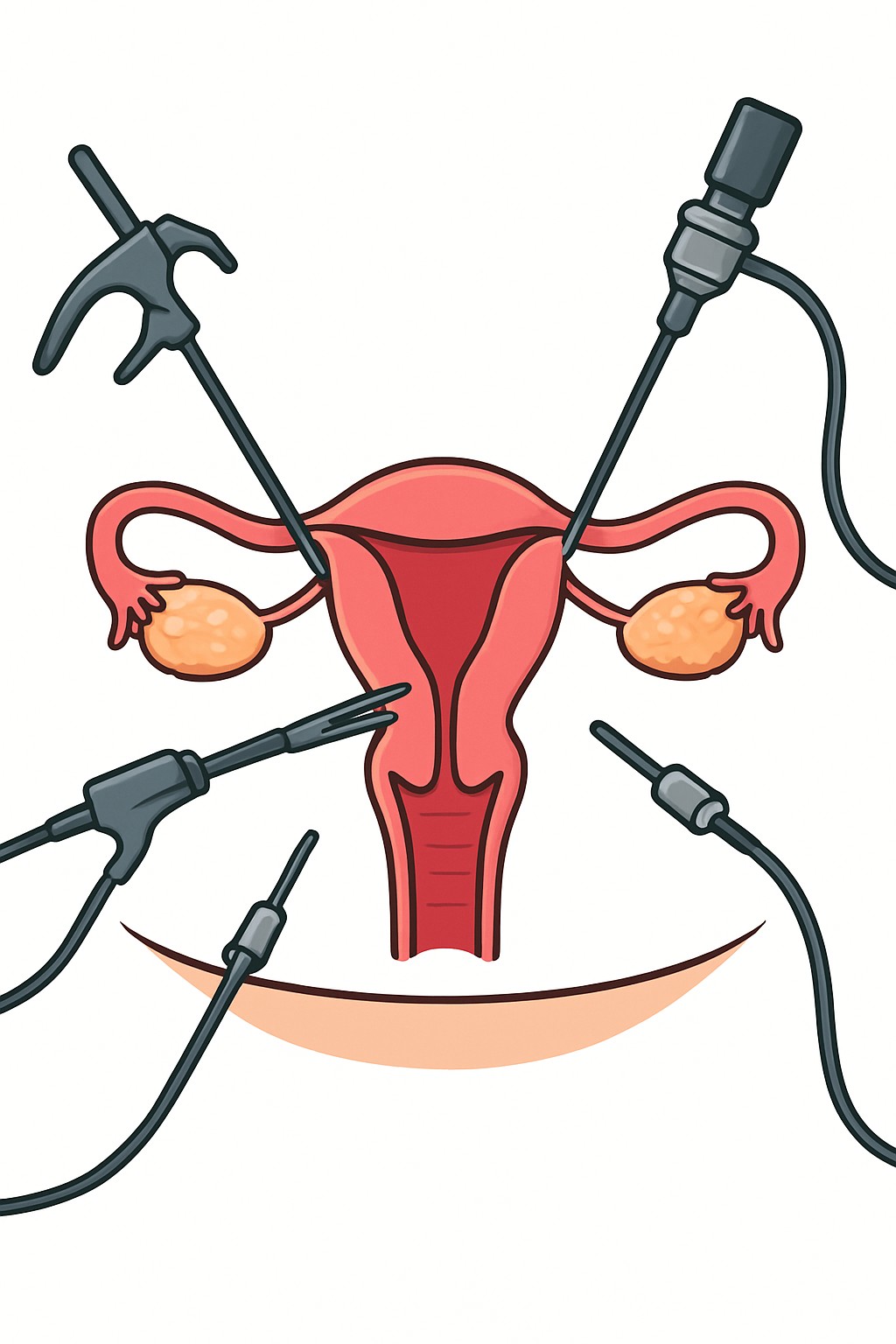
Laparoscopic oophorectomy is a minimally invasive surgery to remove one ovary (unilateral) or both ovaries (bilateral) using small incisions and a camera.
Overview
Laparoscopic oophorectomy is a minimally invasive surgery to remove one ovary (unilateral) or both ovaries (bilateral) using small incisions and a camera. The belly is gently inflated with gas to create space so the surgeon can see and work. It is done for several reasons, such as large or complex ovarian cysts, torsion (twisting), endometriosis, infections that do not improve, suspected ovarian cancer, or to reduce cancer risk in people with certain genetic mutations.
Also known as: Laparoscopic ovary removal, Oophorectomy (laparoscopic), Laparoscopic salpingo-oophorectomy
Preparation & Next Steps
Everything you need to know before and after your procedure
Before Care
- Confirm which ovary or both are planned for removal and why
- Review your current medicines and supplements with the surgical team, including any blood thinners or herbal products
- Ask about pre-op tests such as bloodwork, pregnancy testing, or imaging
- Follow the surgery center’s instructions about eating, drinking, and medicine timing before anesthesia
- Arrange a ride home and an adult to stay with you the first night
- Plan time off work and help at home for the first few days
- Pack your ID, insurance card, a list of medicines, and comfort items like loose clothing
- Ask what to do with contact lenses, piercings, and personal devices on the day of surgery
- Discuss fertility considerations if you hope to become pregnant in the future
- Confirm how and when you will receive pathology results and the follow-up plan
After Care
- Keep incision sites clean and dry as instructed; watch for redness, drainage, or opening
- Take pain medicines only as directed on the label or by your care team
- Walk short distances several times a day to support circulation and reduce stiffness
- Avoid heavy lifting and strenuous exercise until your surgeon clears you
- You may have mild shoulder or upper belly gas pain from the laparoscopy; gentle movement often helps
- Expect light vaginal spotting; use pads rather than tampons until cleared
- Do not drive while taking opioid pain pills or if you feel dizzy
- Resume showering when permitted; avoid soaking in tubs, pools, or hot tubs until incisions heal
- Schedule and attend your follow-up visit to review recovery and pathology results
- Contact a clinician if you develop fever, worsening pain, heavy bleeding, trouble urinating, chest pain, or shortness of breath
Clinical Information
Important medical details about this procedure
Indications
- Large, complex, or persistent ovarian cysts
- Ovarian torsion (twisted ovary)
- Endometriosis with severe symptoms or damage to the ovary
- Tubo-ovarian abscess not responding to treatment
- Suspected or confirmed ovarian cancer
- Risk-reducing surgery for BRCA1/BRCA2 or similar mutations
- Recurrent painful or symptomatic ovarian masses
Alternatives
- Watchful waiting with repeat imaging when appropriate
- Medicines such as hormonal therapy to suppress cysts or endometriosis
- Ovarian cystectomy (removing the cyst and preserving the ovary)
- Detorsion (untwisting) and ovarian preservation when feasible
- Open abdominal surgery (laparotomy) when laparoscopy is not suitable
Risks
- Bleeding or infection
- Injury to nearby organs such as bowel, bladder, ureter, or blood vessels
- Blood clots in the legs or lungs
- Adverse reactions to anesthesia
- Conversion to open surgery if needed for safety
- Scar tissue (adhesions) or chronic pelvic pain
- Hormone changes or immediate menopause if both ovaries are removed
Contraindications
- Severe heart or lung disease that makes laparoscopy unsafe
- Inability to tolerate general anesthesia
- Uncontrolled bleeding disorder
- Extensive prior abdominal scarring where laparoscopy is not advisable
- Suspected widespread cancer where open surgery may be preferred
Recovery Timeline
What to expect during your recovery
Most people are up and walking the day of surgery. Many return to light activities within 1 to 2 weeks. Full recovery and heavier activity may take several weeks, depending on your health and job demands.
Typical Range
7–14 days
Return to Work
7–14 days
Recovery Milestones
Walk indoors for short periods and do light self-care
Shower if permitted; keep incisions gently patted dry
Increase light household activities as tolerated
Return to desk or remote work if pain is controlled and no lifting is required
Resume most normal activities if cleared by your surgeon; avoid heavy lifting until fully healed
Frequently Asked Questions
Common questions and expert answers about this procedure
What is the difference between unilateral and bilateral oophorectomy?
What is the difference between unilateral and bilateral oophorectomy?
Unilateral means one ovary is removed. Bilateral means both ovaries are removed, which causes immediate menopause if you have not yet reached it.
How is this different from salpingo-oophorectomy or cystectomy?
How is this different from salpingo-oophorectomy or cystectomy?
Oophorectomy removes the ovary. Salpingo-oophorectomy removes the ovary and fallopian tube. Cystectomy removes only the cyst, keeping the ovary.
Will I still have periods or be able to get pregnant?
Will I still have periods or be able to get pregnant?
If one ovary remains and the uterus is intact, periods and natural pregnancy are often still possible. Removing both ovaries stops ovulation and causes infertility.
How big are the incisions?
How big are the incisions?
Laparoscopic incisions are usually several small cuts, often 0.25 to 0.5 inches (0.6 to 1.3 cm), including one near the navel.
How long will I stay in the hospital?
How long will I stay in the hospital?
Many people go home the same day. Some stay one night based on recovery, pain control, or other health factors.
Will I need hormone therapy if both ovaries are removed?
Will I need hormone therapy if both ovaries are removed?
Hormone therapy is often discussed after both ovaries are removed before natural menopause. The decision depends on age, symptoms, and personal risks.
Can this be done with robotic assistance?
Can this be done with robotic assistance?
Yes. Robotic-assisted laparoscopy uses similar small incisions. The choice depends on surgeon preference, equipment, and case details.
What happens to the ovary that is removed?
What happens to the ovary that is removed?
The tissue is typically sent to a lab (pathology) to confirm the diagnosis and check for unexpected findings.
References
Medical literature and sources