%20--%3e%3csvg%20version='1.0'%20id='Layer_1'%20xmlns='http://www.w3.org/2000/svg'%20xmlns:xlink='http://www.w3.org/1999/xlink'%20x='0px'%20y='0px'%20viewBox='0%200%20755.52%20814.35'%20style='enable-background:new%200%200%20755.52%20814.35;'%20xml:space='preserve'%3e%3cstyle%20type='text/css'%3e%20.st0{fill:%231ae5ce;stroke:%231ae5ce;stroke-width:7;stroke-miterlimit:10;}%20.st1{fill:%23FFFFFF;stroke:%231ae5ce;stroke-width:7;stroke-miterlimit:10;}%20.st2{fill:%231ae5ce;stroke:%23FFFFFF;stroke-width:7;stroke-miterlimit:10;}%20.st3{fill:%23FFFFFF;stroke:%23FFFFFF;stroke-width:6;stroke-miterlimit:10;}%20%3c/style%3e%3cg%20id='Dark_Logo_00000159431215648494653180000015900878925932721032_'%3e%3cpath%20id='shield_00000152259091539869183100000001926543869452564382_'%20class='st0'%20d='M711.13,173.42%20c-3.37-49.07-38.92-44.9-75.96-52.18c-67.4-13.25-130.47-34.47-192.36-63.92c-22.48-10.7-41.88-25.74-65.05-26.28%20c-23.17,0.54-42.58,15.59-65.05,26.28c-61.89,29.45-124.95,50.68-192.36,63.92c-37.04,7.28-72.59,3.11-75.96,52.18%20c-1.55,22.6,0.34,46.4,1.05,68.92c5.99,190.78,52.91,345.39,206.27,466.46c29.71,23.46,74.51,55.8,108.84,70.75%20c5.99,2.61,11.7,3.73,17.21,3.75c5.51-0.02,11.22-1.14,17.21-3.75c34.33-14.95,79.12-47.3,108.84-70.75%20c153.37-121.07,200.28-275.68,206.27-466.46C710.79,219.82,712.68,196.02,711.13,173.42z'/%3e%3cpath%20id='magnifyingglass_00000073685934697636024790000000342567780940956808_'%20class='st1'%20d='M648.78,624.21l-96.64-104.65%20c34.89-40.63,55.98-93.46,55.98-151.21c0-128.27-103.98-232.24-232.24-232.24S143.63,240.08,143.63,368.35%20s103.98,232.24,232.24,232.24c48.87,0,94.21-15.11,131.62-40.89l97.18,105.24c11.25,12.18,30.24,12.93,42.42,1.69l0,0%20C659.27,655.38,660.03,636.39,648.78,624.21z'/%3e%3ccircle%20id='ellipse_00000129904010550392394720000017056154833629780114_'%20class='st2'%20cx='375.87'%20cy='368.35'%20r='181.21'/%3e%3cpath%20id='dollarsign_00000057140127156649725250000003772530148495155891_'%20class='st3'%20d='M362.91,492.03v-23.91%20c0-2.01-1.58-3.69-3.59-3.77c-18.49-0.78-37.12-5.4-49.4-11.83c-1.75-0.92-2.53-3.01-1.76-4.84l5.87-13.89%20c0.86-2.02,3.23-2.88,5.2-1.89c12.94,6.52,30.45,11.44,49.18,11.44c26.02,0,43.6-12.73,43.6-30.43c0-17.08-14.29-27.63-41.4-36.95%20c-37.37-12.42-60.46-26.7-60.46-53.72c0-24.97,20.29-44.11,52.22-49.51c1.8-0.31,3.11-1.89,3.11-3.72v-24.35%20c0-2.09,1.69-3.78,3.78-3.78h15.16c2.09,0,3.78,1.69,3.78,3.78v22.71c0,2.01,1.58,3.67,3.58,3.77c17.85,0.92,30.88,4.75,40.61,9.1%20c1.92,0.86,2.79,3.09,1.94,5.01l-6.08,13.6c-0.85,1.91-3.09,2.77-4.99,1.91c-8.37-3.8-22.38-8.95-42.75-8.95%20c-28.21,0-38.84,14.28-38.84,26.7c0,16.15,13.56,24.22,45.44,35.4c37.74,13.04,56.79,29.19,56.79,56.82%20c0,23.85-19.05,46.23-54.78,52.3c-1.8,0.31-3.11,1.89-3.11,3.72v25.28c0,2.09-1.69,3.78-3.78,3.78h-15.53%20C364.6,495.81,362.91,494.12,362.91,492.03z'/%3e%3c/g%3e%3c/svg%3e)
LEEP (cervical lesion excision) Gynecologic Surgery
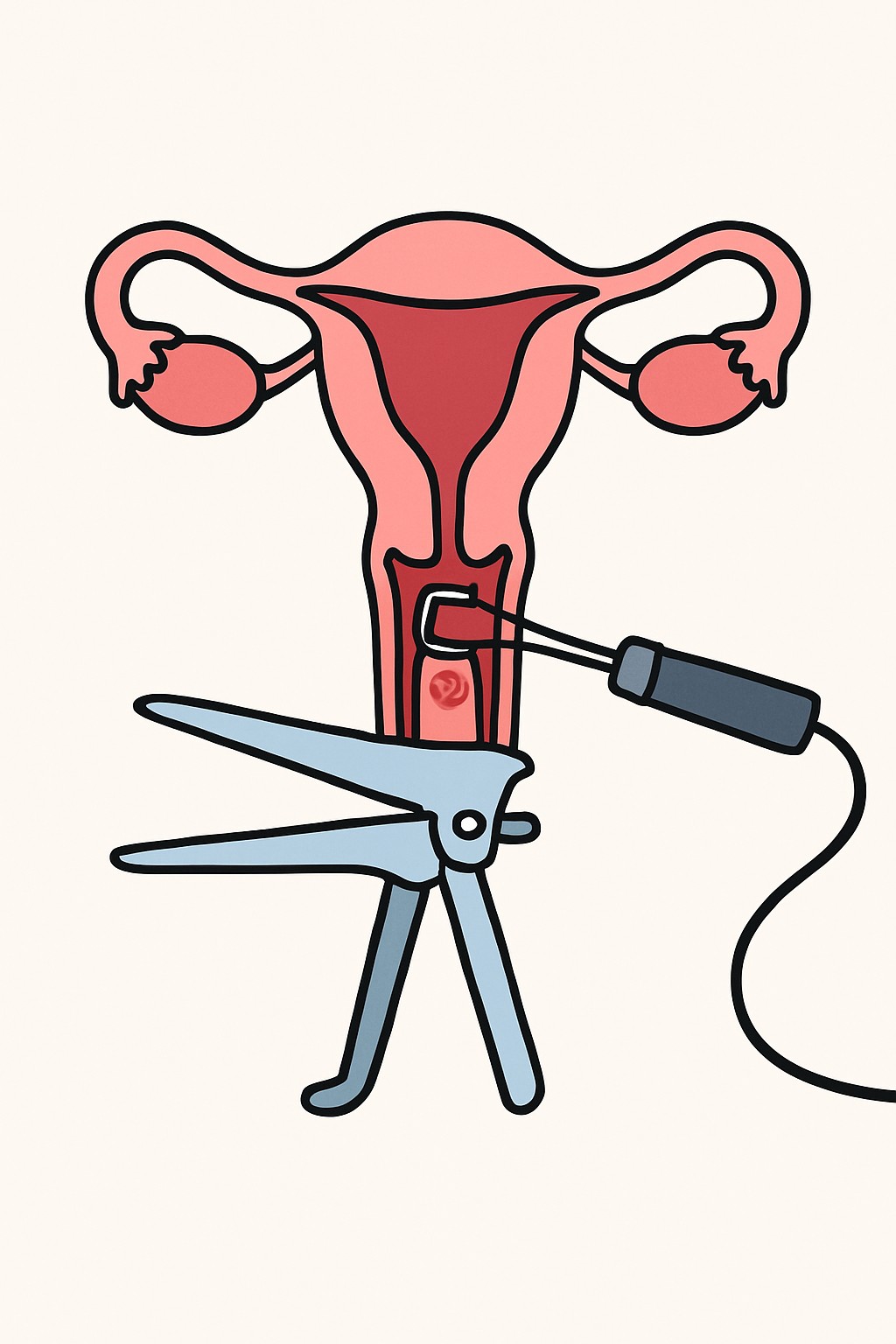
LEEP stands for Loop Electrosurgical Excision Procedure.
Overview
LEEP stands for Loop Electrosurgical Excision Procedure. It uses a thin, electrically heated wire loop to remove a small layer of abnormal tissue from the surface of the cervix. The tissue is then sent to a lab to confirm the diagnosis and check if all the abnormal cells were removed. It is commonly done in a clinic with local anesthesia. LEEP both treats precancerous changes and provides a larger sample for diagnosis when prior tests show significant abnormalities.
Also known as: Loop electrosurgical excision procedure, Cervical LEEP, LEEP excision
Preparation & Next Steps
Everything you need to know before and after your procedure
Before Care
- Review your recent Pap, HPV, and biopsy results and bring any reports if available
- Confirm allergies, bleeding history, and any implanted devices with the clinic
- Follow any instructions about eating, drinking, and medicines on the day of the procedure
- Ask whether to avoid vaginal products or intercourse for a set time before the visit
- Arrange a ride if sedation is planned or if you prefer not to drive after the procedure
- Plan for the visit to take extra time for paperwork, the procedure, and observation
- Bring a sanitary pad for expected spotting or discharge afterward
- Wear comfortable clothing that is easy to change and allows easy bathroom access
- Clarify how results will be shared and whether a follow up appointment is scheduled
- Check your insurance benefits and any prior authorization requirements with the clinic
After Care
- Expect mild cramping, watery discharge, and light bleeding or spotting for days to weeks
- Use sanitary pads instead of tampons unless your clinician advises otherwise
- Follow instructions about activity limits, such as avoiding intercourse and vaginal products for a period
- Take over the counter pain relievers as directed by your clinician for cramping
- Rest the day of the procedure and return to normal light activities as you feel able
- Avoid heavy lifting and high intensity exercise until your clinician says it is safe
- Keep the area clean and avoid douching
- Arrange follow up to review pathology results and discuss next steps
- Contact the clinic for heavy bleeding (for example, soaking a pad in an hour), fever, severe pain, or foul smelling discharge
- Report any tissue passage or large clots to the clinic
Clinical Information
Important medical details about this procedure
Indications
- Precancerous cervical cell changes such as CIN 2 or CIN 3
- High grade abnormal Pap test results
- Persistent high risk HPV with abnormal findings
- Abnormal colposcopy or biopsy that needs excision
- Unsatisfactory colposcopy when high grade changes are suspected
- Adenocarcinoma in situ evaluation and treatment per clinician plan
Alternatives
- Close surveillance with repeat Pap, HPV testing, and colposcopy
- Cryotherapy to destroy abnormal surface cells
- Laser ablation of abnormal tissue
- Cold knife cone biopsy for a larger excision
- Deferring treatment during pregnancy when appropriate and safe
Risks
- Cramping and discomfort during or after the procedure
- Bleeding or spotting, sometimes needing treatment
- Infection at the cervix
- Scar tissue or cervical narrowing that can affect periods or exams
- Need for repeat treatment if margins are not clear
- Small increase in risk of preterm birth in future pregnancies
- Reactions to local anesthesia or electrosurgery
Contraindications
- Known pregnancy when benefits do not clearly outweigh risks
- Active pelvic infection
- Uncontrolled bleeding disorder
- Allergy to local anesthetics or materials used
- Findings that suggest invasive cancer requiring a different approach
Recovery Timeline
What to expect during your recovery
Most people return to normal light activities within 1 to 3 days. Spotting or discharge can last for 1 to 3 weeks, and the cervix generally heals over several weeks.
Typical Range
7–28 days
Return to Work
1–3 days
Recovery Milestones
Rest and manage cramping; take short walks as comfortable
Resume desk work or light daily activities if you feel up to it
Light walking; avoid vigorous exercise until instructed
Gradually increase activity; most people feel less discharge and spotting
Most routine exercise can resume when cleared by your clinician
Frequently Asked Questions
Common questions and expert answers about this procedure
What happens during a LEEP?
What happens during a LEEP?
A speculum is placed, the cervix is numbed, and a thin wire loop removes a small layer of abnormal tissue. Bleeding is controlled, and the tissue goes to a lab.
How long does LEEP take and will it hurt?
How long does LEEP take and will it hurt?
The procedure usually takes about 10 to 20 minutes. You may feel pressure or cramping despite local anesthesia. Discomfort typically improves within a day or two.
Why would I need a LEEP instead of just a biopsy?
Why would I need a LEEP instead of just a biopsy?
LEEP removes a wider, shallow layer to both treat abnormal cells and provide a larger sample to confirm the diagnosis and margin status.
Will LEEP affect future pregnancy?
Will LEEP affect future pregnancy?
Most people can become pregnant after LEEP. There is a small increase in risk of preterm birth, especially with larger or repeated excisions.
When will I get my results?
When will I get my results?
Pathology results are typically ready within about 1 to 2 weeks, but timing depends on the lab and clinic process.
Can I drive myself home after LEEP?
Can I drive myself home after LEEP?
If only local anesthesia is used, many people drive themselves. If sedation is used or you feel unwell, having a driver is safer.
What are signs to contact the clinic after LEEP?
What are signs to contact the clinic after LEEP?
Heavy bleeding, severe pain, fever, or foul smelling discharge are reasons to contact the clinic for guidance.
What if the margins are not clear?
What if the margins are not clear?
Your clinician may recommend closer follow up testing or another treatment, depending on the lab report and your overall results.