%20--%3e%3csvg%20version='1.0'%20id='Layer_1'%20xmlns='http://www.w3.org/2000/svg'%20xmlns:xlink='http://www.w3.org/1999/xlink'%20x='0px'%20y='0px'%20viewBox='0%200%20755.52%20814.35'%20style='enable-background:new%200%200%20755.52%20814.35;'%20xml:space='preserve'%3e%3cstyle%20type='text/css'%3e%20.st0{fill:%231ae5ce;stroke:%231ae5ce;stroke-width:7;stroke-miterlimit:10;}%20.st1{fill:%23FFFFFF;stroke:%231ae5ce;stroke-width:7;stroke-miterlimit:10;}%20.st2{fill:%231ae5ce;stroke:%23FFFFFF;stroke-width:7;stroke-miterlimit:10;}%20.st3{fill:%23FFFFFF;stroke:%23FFFFFF;stroke-width:6;stroke-miterlimit:10;}%20%3c/style%3e%3cg%20id='Dark_Logo_00000159431215648494653180000015900878925932721032_'%3e%3cpath%20id='shield_00000152259091539869183100000001926543869452564382_'%20class='st0'%20d='M711.13,173.42%20c-3.37-49.07-38.92-44.9-75.96-52.18c-67.4-13.25-130.47-34.47-192.36-63.92c-22.48-10.7-41.88-25.74-65.05-26.28%20c-23.17,0.54-42.58,15.59-65.05,26.28c-61.89,29.45-124.95,50.68-192.36,63.92c-37.04,7.28-72.59,3.11-75.96,52.18%20c-1.55,22.6,0.34,46.4,1.05,68.92c5.99,190.78,52.91,345.39,206.27,466.46c29.71,23.46,74.51,55.8,108.84,70.75%20c5.99,2.61,11.7,3.73,17.21,3.75c5.51-0.02,11.22-1.14,17.21-3.75c34.33-14.95,79.12-47.3,108.84-70.75%20c153.37-121.07,200.28-275.68,206.27-466.46C710.79,219.82,712.68,196.02,711.13,173.42z'/%3e%3cpath%20id='magnifyingglass_00000073685934697636024790000000342567780940956808_'%20class='st1'%20d='M648.78,624.21l-96.64-104.65%20c34.89-40.63,55.98-93.46,55.98-151.21c0-128.27-103.98-232.24-232.24-232.24S143.63,240.08,143.63,368.35%20s103.98,232.24,232.24,232.24c48.87,0,94.21-15.11,131.62-40.89l97.18,105.24c11.25,12.18,30.24,12.93,42.42,1.69l0,0%20C659.27,655.38,660.03,636.39,648.78,624.21z'/%3e%3ccircle%20id='ellipse_00000129904010550392394720000017056154833629780114_'%20class='st2'%20cx='375.87'%20cy='368.35'%20r='181.21'/%3e%3cpath%20id='dollarsign_00000057140127156649725250000003772530148495155891_'%20class='st3'%20d='M362.91,492.03v-23.91%20c0-2.01-1.58-3.69-3.59-3.77c-18.49-0.78-37.12-5.4-49.4-11.83c-1.75-0.92-2.53-3.01-1.76-4.84l5.87-13.89%20c0.86-2.02,3.23-2.88,5.2-1.89c12.94,6.52,30.45,11.44,49.18,11.44c26.02,0,43.6-12.73,43.6-30.43c0-17.08-14.29-27.63-41.4-36.95%20c-37.37-12.42-60.46-26.7-60.46-53.72c0-24.97,20.29-44.11,52.22-49.51c1.8-0.31,3.11-1.89,3.11-3.72v-24.35%20c0-2.09,1.69-3.78,3.78-3.78h15.16c2.09,0,3.78,1.69,3.78,3.78v22.71c0,2.01,1.58,3.67,3.58,3.77c17.85,0.92,30.88,4.75,40.61,9.1%20c1.92,0.86,2.79,3.09,1.94,5.01l-6.08,13.6c-0.85,1.91-3.09,2.77-4.99,1.91c-8.37-3.8-22.38-8.95-42.75-8.95%20c-28.21,0-38.84,14.28-38.84,26.7c0,16.15,13.56,24.22,45.44,35.4c37.74,13.04,56.79,29.19,56.79,56.82%20c0,23.85-19.05,46.23-54.78,52.3c-1.8,0.31-3.11,1.89-3.11,3.72v25.28c0,2.09-1.69,3.78-3.78,3.78h-15.53%20C364.6,495.81,362.91,494.12,362.91,492.03z'/%3e%3c/g%3e%3c/svg%3e)
Uterine Dilation & Curettage (D&C) Gynecologic Surgery
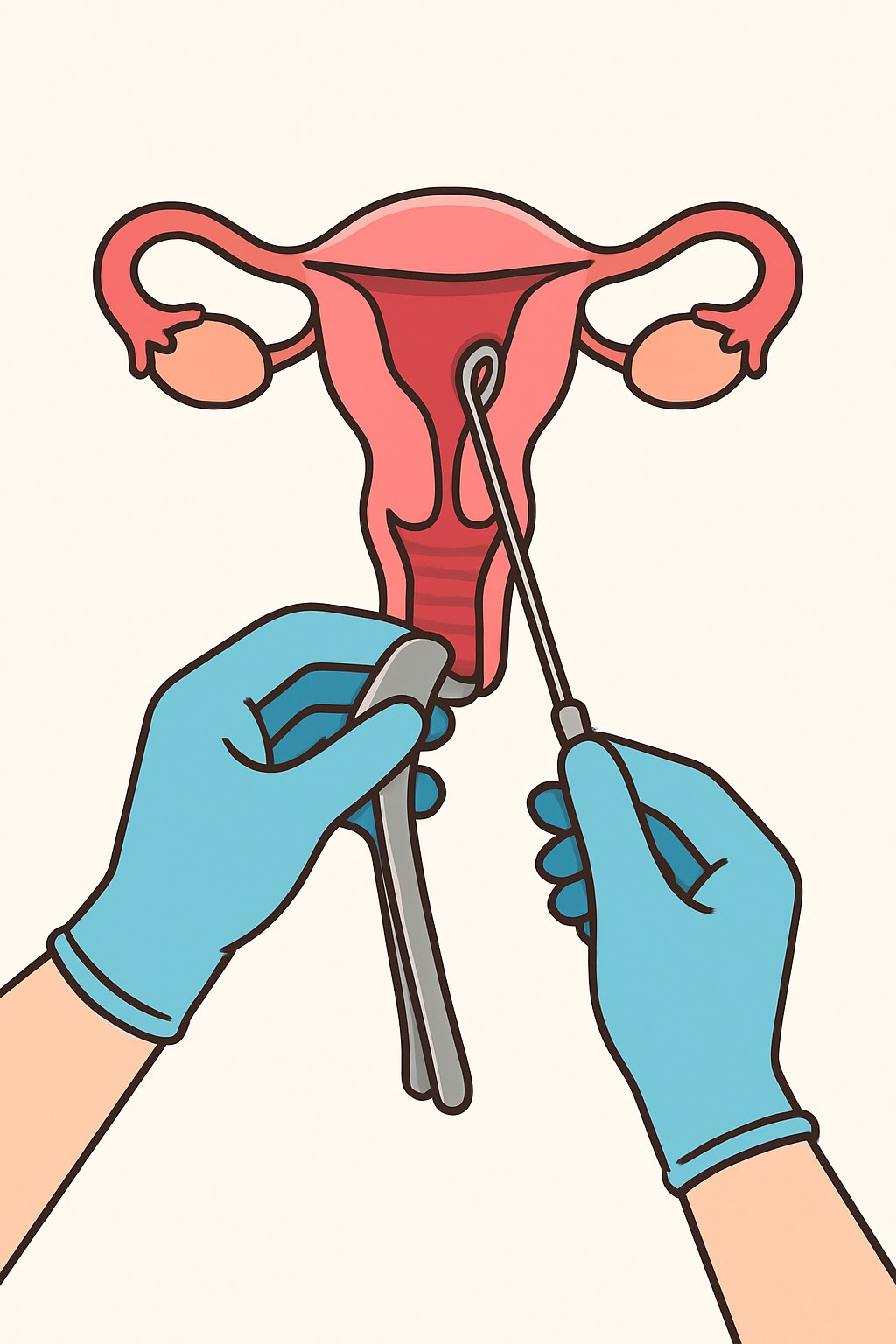
Uterine dilation and curettage (D&C) is a procedure where the cervix is gently opened (dilated) and tissue is removed from the lining of the uterus (curettage).
Overview
Uterine dilation and curettage (D&C) is a procedure where the cervix is gently opened (dilated) and tissue is removed from the lining of the uterus (curettage). Removal is done with a small suction device and/or a curette, a thin instrument used to scrape or scoop tissue. It is used to diagnose or treat problems in the uterus and to manage pregnancy tissue after miscarriage or certain other conditions. Samples may be sent to a lab to check for causes of bleeding or other concerns.
Also known as: D&C, D and C, Dilation and curettage, Uterine curettage
Preparation & Next Steps
Everything you need to know before and after your procedure
Before Care
- Confirm the reason for the procedure and whether tissue will be sent to a lab
- Review current medicines, allergies, and bleeding history with the care team
- Ask about managing blood thinners, diabetes medicines, or herbal supplements
- Follow anesthesia instructions on eating and drinking before the procedure
- Arrange a ride home if sedation or anesthesia will be used
- Plan for 1–2 days of lighter activities afterward
- Have sanitary pads available at home
- Complete any requested tests, such as a pregnancy test, blood count, or ultrasound
- Bring a photo ID, insurance card, and a list of medicines and doses
After Care
- Expect cramping and light bleeding or spotting; pads are commonly used
- Avoid placing anything in the vagina until the care team says it is safe
- Take pain relief medicines only as directed by your clinician or on the label
- Rest the day of the procedure and increase activity as you feel able
- Watch for heavy bleeding, fever, worsening pain, or foul-smelling discharge and contact a clinician if these occur
- Review pathology or lab results when they are available and discuss next steps
- Follow instructions about bathing, driving after sedation, and return to sexual activity
- Schedule follow-up to discuss healing and any ongoing treatment plan
Clinical Information
Important medical details about this procedure
Indications
- Abnormal uterine bleeding
- Evaluation of possible endometrial problems (such as hyperplasia or cancer)
- Management of miscarriage or retained pregnancy tissue
- Removal of polyps or small growths in the uterine lining
- Treatment of molar pregnancy (with specialist guidance)
- Collecting tissue for diagnosis when office biopsy is not possible or inconclusive
Alternatives
- Watchful waiting (expectant management) in some miscarriage cases
- Medical management of miscarriage with medicines
- Office endometrial biopsy
- Hysteroscopy-directed biopsy or polyp removal
- Hormonal therapy or other medicines for abnormal bleeding
- Insertion of a hormonal intrauterine device for bleeding control
Risks
- Bleeding
- Infection
- Reaction to anesthesia or sedation
- Uterine perforation (a small hole in the uterus)
- Cervical injury
- Incomplete removal of tissue requiring repeat treatment
- Intrauterine adhesions (scar tissue, sometimes called Asherman syndrome)
- Injury to nearby organs (very rare)
Contraindications
- Known viable intrauterine pregnancy when preservation is intended
- Active pelvic infection
- Uncontrolled bleeding or clotting disorder
- Severe medical instability that prevents safe anesthesia or sedation
Recovery Timeline
What to expect during your recovery
Most people are up and walking the same day and return to normal activities within a few days. Light bleeding or spotting can occur for several days.
Typical Range
1–7 days
Return to Work
1–3 days
Recovery Milestones
Walk and perform basic self-care with light activity
Resume light household tasks and desk work as tolerated
Gradually return to regular activities if symptoms are improving
Most people feel close to baseline and follow up on lab or pathology results
Frequently Asked Questions
Common questions and expert answers about this procedure
What happens during a D&C?
What happens during a D&C?
The cervix is dilated and tissue is removed from the uterine lining using suction and/or a small instrument called a curette. The tissue may be sent to a lab.
Is anesthesia used?
Is anesthesia used?
Many D&Cs use light sedation or general anesthesia. Some are done with local anesthesia and pain control medicines. The approach depends on setting and preference.
How long does a D&C take?
How long does a D&C take?
The procedure itself often takes 10–20 minutes. Plan extra time for check-in, anesthesia, and recovery monitoring.
How much bleeding is normal afterward?
How much bleeding is normal afterward?
Light bleeding or spotting for several days is common. Heavy bleeding, passing large clots, fever, or severe pain are reasons to contact a clinician.
Will a D&C affect future fertility?
Will a D&C affect future fertility?
Most people do not have long-term effects. Rarely, scar tissue (adhesions) can form and may affect periods or fertility.
What is the difference between D&C and hysteroscopy?
What is the difference between D&C and hysteroscopy?
Hysteroscopy uses a small camera to see inside the uterus. A D&C removes tissue without direct camera guidance, though the two can be combined.
When will results be ready?
When will results be ready?
If tissue is sent to a lab, results are often available within about 1–2 weeks, depending on the lab.
Can a D&C be done in an office?
Can a D&C be done in an office?
Some cases are done in an office or ambulatory center, especially diagnostic procedures. Others are done in a hospital based on clinical needs.
References
Medical literature and sources