%20--%3e%3csvg%20version='1.0'%20id='Layer_1'%20xmlns='http://www.w3.org/2000/svg'%20xmlns:xlink='http://www.w3.org/1999/xlink'%20x='0px'%20y='0px'%20viewBox='0%200%20755.52%20814.35'%20style='enable-background:new%200%200%20755.52%20814.35;'%20xml:space='preserve'%3e%3cstyle%20type='text/css'%3e%20.st0{fill:%231ae5ce;stroke:%231ae5ce;stroke-width:7;stroke-miterlimit:10;}%20.st1{fill:%23FFFFFF;stroke:%231ae5ce;stroke-width:7;stroke-miterlimit:10;}%20.st2{fill:%231ae5ce;stroke:%23FFFFFF;stroke-width:7;stroke-miterlimit:10;}%20.st3{fill:%23FFFFFF;stroke:%23FFFFFF;stroke-width:6;stroke-miterlimit:10;}%20%3c/style%3e%3cg%20id='Dark_Logo_00000159431215648494653180000015900878925932721032_'%3e%3cpath%20id='shield_00000152259091539869183100000001926543869452564382_'%20class='st0'%20d='M711.13,173.42%20c-3.37-49.07-38.92-44.9-75.96-52.18c-67.4-13.25-130.47-34.47-192.36-63.92c-22.48-10.7-41.88-25.74-65.05-26.28%20c-23.17,0.54-42.58,15.59-65.05,26.28c-61.89,29.45-124.95,50.68-192.36,63.92c-37.04,7.28-72.59,3.11-75.96,52.18%20c-1.55,22.6,0.34,46.4,1.05,68.92c5.99,190.78,52.91,345.39,206.27,466.46c29.71,23.46,74.51,55.8,108.84,70.75%20c5.99,2.61,11.7,3.73,17.21,3.75c5.51-0.02,11.22-1.14,17.21-3.75c34.33-14.95,79.12-47.3,108.84-70.75%20c153.37-121.07,200.28-275.68,206.27-466.46C710.79,219.82,712.68,196.02,711.13,173.42z'/%3e%3cpath%20id='magnifyingglass_00000073685934697636024790000000342567780940956808_'%20class='st1'%20d='M648.78,624.21l-96.64-104.65%20c34.89-40.63,55.98-93.46,55.98-151.21c0-128.27-103.98-232.24-232.24-232.24S143.63,240.08,143.63,368.35%20s103.98,232.24,232.24,232.24c48.87,0,94.21-15.11,131.62-40.89l97.18,105.24c11.25,12.18,30.24,12.93,42.42,1.69l0,0%20C659.27,655.38,660.03,636.39,648.78,624.21z'/%3e%3ccircle%20id='ellipse_00000129904010550392394720000017056154833629780114_'%20class='st2'%20cx='375.87'%20cy='368.35'%20r='181.21'/%3e%3cpath%20id='dollarsign_00000057140127156649725250000003772530148495155891_'%20class='st3'%20d='M362.91,492.03v-23.91%20c0-2.01-1.58-3.69-3.59-3.77c-18.49-0.78-37.12-5.4-49.4-11.83c-1.75-0.92-2.53-3.01-1.76-4.84l5.87-13.89%20c0.86-2.02,3.23-2.88,5.2-1.89c12.94,6.52,30.45,11.44,49.18,11.44c26.02,0,43.6-12.73,43.6-30.43c0-17.08-14.29-27.63-41.4-36.95%20c-37.37-12.42-60.46-26.7-60.46-53.72c0-24.97,20.29-44.11,52.22-49.51c1.8-0.31,3.11-1.89,3.11-3.72v-24.35%20c0-2.09,1.69-3.78,3.78-3.78h15.16c2.09,0,3.78,1.69,3.78,3.78v22.71c0,2.01,1.58,3.67,3.58,3.77c17.85,0.92,30.88,4.75,40.61,9.1%20c1.92,0.86,2.79,3.09,1.94,5.01l-6.08,13.6c-0.85,1.91-3.09,2.77-4.99,1.91c-8.37-3.8-22.38-8.95-42.75-8.95%20c-28.21,0-38.84,14.28-38.84,26.7c0,16.15,13.56,24.22,45.44,35.4c37.74,13.04,56.79,29.19,56.79,56.82%20c0,23.85-19.05,46.23-54.78,52.3c-1.8,0.31-3.11,1.89-3.11,3.72v25.28c0,2.09-1.69,3.78-3.78,3.78h-15.53%20C364.6,495.81,362.91,494.12,362.91,492.03z'/%3e%3c/g%3e%3c/svg%3e)
Alpha-fetoprotein (AFP) tumor marker test Laboratory Test
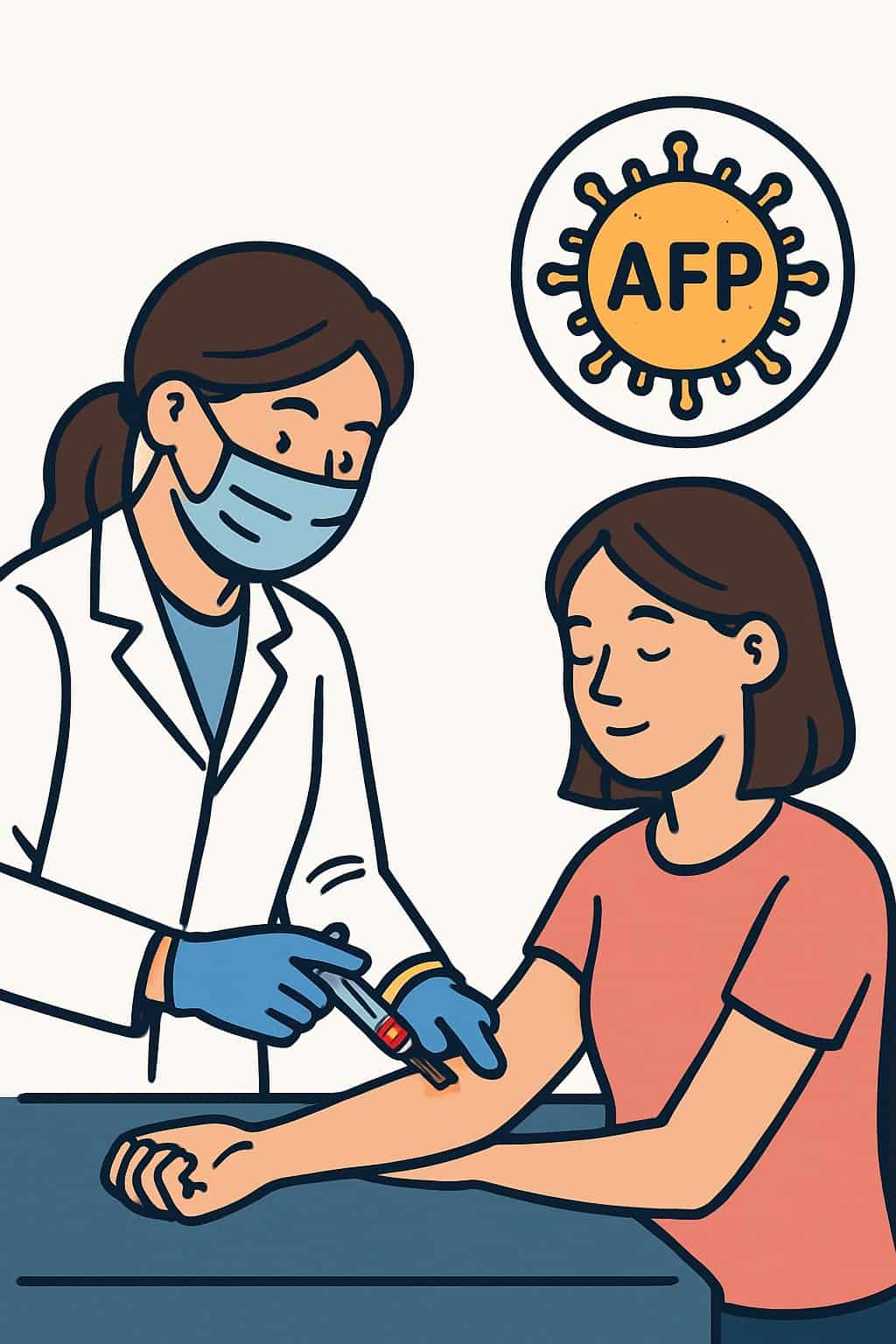
The alpha-fetoprotein (AFP) tumor marker test is a blood test that measures the level of AFP, a protein made in high amounts by a developing fetus.
Overview
The alpha-fetoprotein (AFP) tumor marker test is a blood test that measures the level of AFP, a protein made in high amounts by a developing fetus. In most healthy children and adults who are not pregnant, AFP levels in the blood are low. Clinicians use AFP as a tumor marker, meaning a substance that can be higher with certain cancers. AFP is most often used with imaging tests to help evaluate and monitor liver cancer and some germ cell tumors (such as certain testicular or ovarian cancers). It may also be used to track response to treatment and to watch for recurrence. AFP can be higher in pregnancy and in some noncancer conditions like chronic hepatitis and cirrhosis. Results are interpreted together with your history, exam, and other tests.
Also known as: AFP blood test, AFP tumor marker, Alpha fetoprotein test, AFP serum test
Preparation & Next Steps
Everything you need to know before and after your procedure
Before Care
- Bring the lab order, a photo ID, and your insurance card to the collection site
- Confirm any lab instructions; fasting is usually not required for an AFP test
- Drink water beforehand so your veins are well hydrated unless told otherwise by the lab
- Wear short sleeves or clothing that allows easy access to your arm
- Tell the staff about any bleeding disorders, blood thinner use, or past issues with blood draws
- Inform the staff if you are pregnant, since AFP is normally higher during pregnancy
- Ask how and when results will be released (patient portal, phone, or printout)
- If AFP is being tracked over time, try to use the same lab when possible for consistency
- If testing is tied to treatment cycles, confirm the timing of the draw relative to treatment
After Care
- Keep pressure on the puncture site for several minutes, then leave the bandage on as instructed
- Expect mild soreness or a small bruise; apply a cool pack briefly if needed
- Avoid heavy lifting or strenuous use of the draw arm for several hours
- Watch the site for persistent bleeding, increasing pain, warmth, or redness
- Resume normal eating, drinking, and daily activities unless the lab gave other instructions
- Note the date and time of the test; AFP trends are often compared over multiple tests
- Use the patient portal or report to review results when available
- Understand that results are interpreted with imaging and other tests; a single value rarely gives a complete picture
- Contact your care team if you have ongoing bleeding, large swelling, or signs of infection at the draw site
Clinical Information
Important medical details about this procedure
Indications
- Evaluating a liver mass or abnormal liver imaging
- Monitoring known or treated hepatocellular carcinoma (liver cancer)
- Assessing suspected germ cell tumors (such as certain testicular or ovarian cancers)
- Tracking response to cancer treatment and checking for recurrence
- Part of ongoing monitoring plans for people at higher risk for liver cancer, typically along with imaging
Alternatives
- Liver ultrasound, CT scan, or MRI
- Other biomarkers such as AFP-L3% and des-gamma-carboxy prothrombin (DCP, also called PIVKA-II)
- Beta-hCG and LDH for some germ cell tumors
- Biopsy or cytology when tissue diagnosis is needed
- Observation with repeat testing to assess trends over time
Risks
- Mild pain, bruising, or soreness where blood is drawn
- Dizziness or fainting during or after the blood draw
- Very small risk of infection at the puncture site
- False positives or false negatives; AFP can be affected by noncancer conditions
- Anxiety related to test results or follow-up testing
Contraindications
- Active skin infection or severe rash at the intended draw site
- Significant bleeding tendency without ability to apply adequate pressure after the draw
- Lymphedema or prior mastectomy on the arm selected for venipuncture (use caution or alternate site)
- Ongoing intravenous infusion in the same arm (use a different site)
- Inability to provide consent or remain still for the blood draw
Recovery Timeline
What to expect during your recovery
This is a routine blood test. Most people return to normal activities right away. Minor soreness or bruising at the draw site can occur and usually resolves within a day or two.
Typical Range
Same day
Return to Work
Same day
Recovery Milestones
Resume normal daily activities after leaving the lab
Manage minor tenderness or bruising at the draw site as needed
Review results when released by the lab or portal
Frequently Asked Questions
Common questions and expert answers about this procedure
What is AFP and why is it measured?
What is AFP and why is it measured?
AFP is a protein that is normally high in fetuses and low in most healthy children and adults. Measuring AFP can help evaluate and monitor certain cancers, especially liver cancer and some germ cell tumors.
Do I need to fast for an AFP tumor marker test?
Do I need to fast for an AFP tumor marker test?
Fasting is usually not required. Follow any instructions provided by your lab.
Can conditions other than cancer raise AFP?
Can conditions other than cancer raise AFP?
Yes. Pregnancy, chronic hepatitis, cirrhosis, and recent liver injury can raise AFP. That is why AFP is interpreted with other tests and your medical history.
Can a normal AFP result rule out cancer?
Can a normal AFP result rule out cancer?
No. Some cancers do not raise AFP. A normal result does not rule out cancer, and an elevated result does not by itself confirm cancer.
How is AFP used for liver cancer?
How is AFP used for liver cancer?
AFP is often used with liver imaging to help evaluate a liver mass, monitor known hepatocellular carcinoma, assess response to treatment, and check for recurrence.
How often is AFP testing repeated?
How often is AFP testing repeated?
The frequency varies by condition and care plan. AFP is commonly repeated over time to look at trends rather than a single value.
What is the difference between the AFP tumor marker test and prenatal AFP screening?
What is the difference between the AFP tumor marker test and prenatal AFP screening?
Prenatal AFP is part of maternal blood screening to assess certain fetal conditions. The tumor marker test is used mainly in non-pregnant patients to help evaluate and monitor specific cancers.
References
Medical literature and sources