%20--%3e%3csvg%20version='1.0'%20id='Layer_1'%20xmlns='http://www.w3.org/2000/svg'%20xmlns:xlink='http://www.w3.org/1999/xlink'%20x='0px'%20y='0px'%20viewBox='0%200%20755.52%20814.35'%20style='enable-background:new%200%200%20755.52%20814.35;'%20xml:space='preserve'%3e%3cstyle%20type='text/css'%3e%20.st0{fill:%231ae5ce;stroke:%231ae5ce;stroke-width:7;stroke-miterlimit:10;}%20.st1{fill:%23FFFFFF;stroke:%231ae5ce;stroke-width:7;stroke-miterlimit:10;}%20.st2{fill:%231ae5ce;stroke:%23FFFFFF;stroke-width:7;stroke-miterlimit:10;}%20.st3{fill:%23FFFFFF;stroke:%23FFFFFF;stroke-width:6;stroke-miterlimit:10;}%20%3c/style%3e%3cg%20id='Dark_Logo_00000159431215648494653180000015900878925932721032_'%3e%3cpath%20id='shield_00000152259091539869183100000001926543869452564382_'%20class='st0'%20d='M711.13,173.42%20c-3.37-49.07-38.92-44.9-75.96-52.18c-67.4-13.25-130.47-34.47-192.36-63.92c-22.48-10.7-41.88-25.74-65.05-26.28%20c-23.17,0.54-42.58,15.59-65.05,26.28c-61.89,29.45-124.95,50.68-192.36,63.92c-37.04,7.28-72.59,3.11-75.96,52.18%20c-1.55,22.6,0.34,46.4,1.05,68.92c5.99,190.78,52.91,345.39,206.27,466.46c29.71,23.46,74.51,55.8,108.84,70.75%20c5.99,2.61,11.7,3.73,17.21,3.75c5.51-0.02,11.22-1.14,17.21-3.75c34.33-14.95,79.12-47.3,108.84-70.75%20c153.37-121.07,200.28-275.68,206.27-466.46C710.79,219.82,712.68,196.02,711.13,173.42z'/%3e%3cpath%20id='magnifyingglass_00000073685934697636024790000000342567780940956808_'%20class='st1'%20d='M648.78,624.21l-96.64-104.65%20c34.89-40.63,55.98-93.46,55.98-151.21c0-128.27-103.98-232.24-232.24-232.24S143.63,240.08,143.63,368.35%20s103.98,232.24,232.24,232.24c48.87,0,94.21-15.11,131.62-40.89l97.18,105.24c11.25,12.18,30.24,12.93,42.42,1.69l0,0%20C659.27,655.38,660.03,636.39,648.78,624.21z'/%3e%3ccircle%20id='ellipse_00000129904010550392394720000017056154833629780114_'%20class='st2'%20cx='375.87'%20cy='368.35'%20r='181.21'/%3e%3cpath%20id='dollarsign_00000057140127156649725250000003772530148495155891_'%20class='st3'%20d='M362.91,492.03v-23.91%20c0-2.01-1.58-3.69-3.59-3.77c-18.49-0.78-37.12-5.4-49.4-11.83c-1.75-0.92-2.53-3.01-1.76-4.84l5.87-13.89%20c0.86-2.02,3.23-2.88,5.2-1.89c12.94,6.52,30.45,11.44,49.18,11.44c26.02,0,43.6-12.73,43.6-30.43c0-17.08-14.29-27.63-41.4-36.95%20c-37.37-12.42-60.46-26.7-60.46-53.72c0-24.97,20.29-44.11,52.22-49.51c1.8-0.31,3.11-1.89,3.11-3.72v-24.35%20c0-2.09,1.69-3.78,3.78-3.78h15.16c2.09,0,3.78,1.69,3.78,3.78v22.71c0,2.01,1.58,3.67,3.58,3.77c17.85,0.92,30.88,4.75,40.61,9.1%20c1.92,0.86,2.79,3.09,1.94,5.01l-6.08,13.6c-0.85,1.91-3.09,2.77-4.99,1.91c-8.37-3.8-22.38-8.95-42.75-8.95%20c-28.21,0-38.84,14.28-38.84,26.7c0,16.15,13.56,24.22,45.44,35.4c37.74,13.04,56.79,29.19,56.79,56.82%20c0,23.85-19.05,46.23-54.78,52.3c-1.8,0.31-3.11,1.89-3.11,3.72v25.28c0,2.09-1.69,3.78-3.78,3.78h-15.53%20C364.6,495.81,362.91,494.12,362.91,492.03z'/%3e%3c/g%3e%3c/svg%3e)
Basic Metabolic Panel (BMP) Laboratory Test
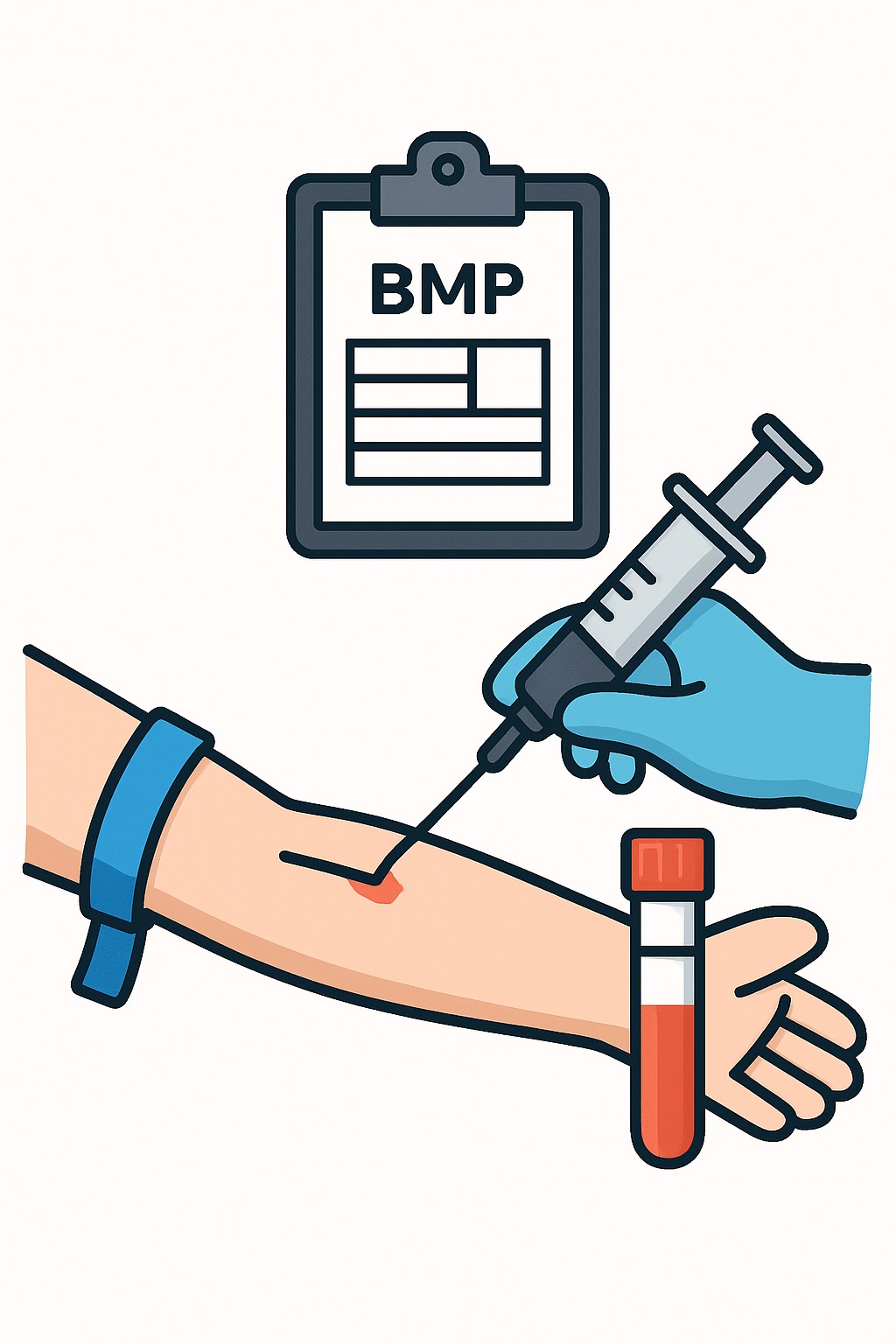
A Basic Metabolic Panel (BMP) is a common blood test that measures key chemicals and minerals in your blood.
Overview
A Basic Metabolic Panel (BMP) is a common blood test that measures key chemicals and minerals in your blood. It usually includes glucose, calcium, electrolytes (sodium, potassium, chloride, and carbon dioxide/bicarbonate), and kidney function markers (blood urea nitrogen and creatinine). Clinicians use a BMP to check fluid balance, kidney function, acid–base status, and blood sugar. It can help evaluate symptoms like weakness, nausea, or confusion, and it is often used to monitor chronic conditions or medicines that affect the kidneys or electrolytes.
Also known as: Chem-7, Basic chem panel, Metabolic panel (basic)
Preparation & Next Steps
Everything you need to know before and after your procedure
Before Care
- Confirm the test order, lab location, and whether an appointment is needed
- Ask if fasting is required; many BMPs do not require fasting, but some labs request 8–12 hours with water allowed
- Drink water so you are well hydrated unless you were told otherwise
- Wear short sleeves or loose clothing for easy access to your arm
- Bring a photo ID, insurance information, and a method of payment if applicable
- Tell staff about bleeding disorders, fainting with blood draws, or if you take blood thinners
- Let the team know about recent IV fluids or dialysis, which can affect results
- Carry an up-to-date list of your medicines and supplements
- Plan your day so you can review results when they post to your patient portal
After Care
- Keep firm pressure on the site for several minutes to reduce bruising
- Leave the bandage on for a few hours and keep the area clean and dry
- Avoid heavy lifting or strenuous use of the puncture arm for the rest of the day
- Drink water as usual unless you were given different instructions
- Watch for persistent bleeding, increasing pain, redness, warmth, or swelling and contact a clinician if these occur
- If you feel lightheaded, sit or lie down until it passes and let the clinic know about the reaction
- Review your results in the patient portal and note the lab reference ranges provided
- Use secure messaging or call the clinic if results are unclear or if additional testing was mentioned
- Track any new symptoms that develop after the test to discuss at follow-up
Clinical Information
Important medical details about this procedure
Indications
- Monitoring kidney function
- Checking electrolytes and acid–base balance
- Evaluating dehydration or fluid status
- Monitoring effects of diuretics or ACE inhibitors
- Assessing blood sugar
- Pre-operative baseline labs
- Evaluating symptoms such as weakness, vomiting, or confusion
Alternatives
- Comprehensive Metabolic Panel (CMP)
- Individual tests ordered separately (electrolytes, creatinine, glucose, calcium)
- Point-of-care electrolyte testing when rapid results are needed
- Arterial blood gas for detailed acid–base evaluation (different test)
Risks
- Minor pain or bruising at the needle site
- Bleeding or a small hematoma
- Lightheadedness or fainting with blood draws
- Very small risk of infection at the puncture site
- Results affected by recent IV fluids, dehydration, or strenuous exercise
Contraindications
- Blood draw from an arm with a dialysis fistula is generally avoided
- Avoiding venipuncture on the side of a prior mastectomy or lymphedema
- Active infection, injury, or severe skin irritation at the draw site
- Severe needle phobia or inability to remain still without support
Recovery Timeline
What to expect during your recovery
A BMP involves a brief blood draw. Most people return to normal activities right away, with any minor soreness or bruising improving over a few days.
Typical Range
Same day
Return to Work
Same day
Recovery Milestones
Resume normal daily activities
Keep bandage on for a few hours and avoid heavy lifting with the puncture arm
Any mild bruising or soreness typically improves
Frequently Asked Questions
Common questions and expert answers about this procedure
What does a BMP measure?
What does a BMP measure?
It typically measures glucose, calcium, sodium, potassium, chloride, carbon dioxide (bicarbonate), blood urea nitrogen (BUN), and creatinine.
Do I need to fast before a BMP?
Do I need to fast before a BMP?
Fasting is not always required, but some labs ask for 8–12 hours without food. Follow the instructions from your clinician or lab; water is usually allowed.
How is the test done?
How is the test done?
A small sample of blood is drawn from a vein in your arm with a needle. The draw usually takes a few minutes.
How long until results are available?
How long until results are available?
Timing varies by lab and setting. Many results are available the same day or within 1–2 business days.
What is the difference between a BMP and a CMP?
What is the difference between a BMP and a CMP?
A CMP includes all BMP items plus additional tests, such as liver enzymes and proteins, to give a broader overview.
Can medicines, food, or exercise affect the results?
Can medicines, food, or exercise affect the results?
Dehydration, recent IV fluids, strenuous exercise, and large or salty meals can affect some values. Certain medicines may also influence results.
Is there any risk to the blood draw?
Is there any risk to the blood draw?
Minor bruising, soreness, or lightheadedness can happen. Infection or significant bleeding is uncommon.
How much blood is taken?
How much blood is taken?
Usually one small tube, a few milliliters.
References
Medical literature and sources