%20--%3e%3csvg%20version='1.0'%20id='Layer_1'%20xmlns='http://www.w3.org/2000/svg'%20xmlns:xlink='http://www.w3.org/1999/xlink'%20x='0px'%20y='0px'%20viewBox='0%200%20755.52%20814.35'%20style='enable-background:new%200%200%20755.52%20814.35;'%20xml:space='preserve'%3e%3cstyle%20type='text/css'%3e%20.st0{fill:%231ae5ce;stroke:%231ae5ce;stroke-width:7;stroke-miterlimit:10;}%20.st1{fill:%23FFFFFF;stroke:%231ae5ce;stroke-width:7;stroke-miterlimit:10;}%20.st2{fill:%231ae5ce;stroke:%23FFFFFF;stroke-width:7;stroke-miterlimit:10;}%20.st3{fill:%23FFFFFF;stroke:%23FFFFFF;stroke-width:6;stroke-miterlimit:10;}%20%3c/style%3e%3cg%20id='Dark_Logo_00000159431215648494653180000015900878925932721032_'%3e%3cpath%20id='shield_00000152259091539869183100000001926543869452564382_'%20class='st0'%20d='M711.13,173.42%20c-3.37-49.07-38.92-44.9-75.96-52.18c-67.4-13.25-130.47-34.47-192.36-63.92c-22.48-10.7-41.88-25.74-65.05-26.28%20c-23.17,0.54-42.58,15.59-65.05,26.28c-61.89,29.45-124.95,50.68-192.36,63.92c-37.04,7.28-72.59,3.11-75.96,52.18%20c-1.55,22.6,0.34,46.4,1.05,68.92c5.99,190.78,52.91,345.39,206.27,466.46c29.71,23.46,74.51,55.8,108.84,70.75%20c5.99,2.61,11.7,3.73,17.21,3.75c5.51-0.02,11.22-1.14,17.21-3.75c34.33-14.95,79.12-47.3,108.84-70.75%20c153.37-121.07,200.28-275.68,206.27-466.46C710.79,219.82,712.68,196.02,711.13,173.42z'/%3e%3cpath%20id='magnifyingglass_00000073685934697636024790000000342567780940956808_'%20class='st1'%20d='M648.78,624.21l-96.64-104.65%20c34.89-40.63,55.98-93.46,55.98-151.21c0-128.27-103.98-232.24-232.24-232.24S143.63,240.08,143.63,368.35%20s103.98,232.24,232.24,232.24c48.87,0,94.21-15.11,131.62-40.89l97.18,105.24c11.25,12.18,30.24,12.93,42.42,1.69l0,0%20C659.27,655.38,660.03,636.39,648.78,624.21z'/%3e%3ccircle%20id='ellipse_00000129904010550392394720000017056154833629780114_'%20class='st2'%20cx='375.87'%20cy='368.35'%20r='181.21'/%3e%3cpath%20id='dollarsign_00000057140127156649725250000003772530148495155891_'%20class='st3'%20d='M362.91,492.03v-23.91%20c0-2.01-1.58-3.69-3.59-3.77c-18.49-0.78-37.12-5.4-49.4-11.83c-1.75-0.92-2.53-3.01-1.76-4.84l5.87-13.89%20c0.86-2.02,3.23-2.88,5.2-1.89c12.94,6.52,30.45,11.44,49.18,11.44c26.02,0,43.6-12.73,43.6-30.43c0-17.08-14.29-27.63-41.4-36.95%20c-37.37-12.42-60.46-26.7-60.46-53.72c0-24.97,20.29-44.11,52.22-49.51c1.8-0.31,3.11-1.89,3.11-3.72v-24.35%20c0-2.09,1.69-3.78,3.78-3.78h15.16c2.09,0,3.78,1.69,3.78,3.78v22.71c0,2.01,1.58,3.67,3.58,3.77c17.85,0.92,30.88,4.75,40.61,9.1%20c1.92,0.86,2.79,3.09,1.94,5.01l-6.08,13.6c-0.85,1.91-3.09,2.77-4.99,1.91c-8.37-3.8-22.38-8.95-42.75-8.95%20c-28.21,0-38.84,14.28-38.84,26.7c0,16.15,13.56,24.22,45.44,35.4c37.74,13.04,56.79,29.19,56.79,56.82%20c0,23.85-19.05,46.23-54.78,52.3c-1.8,0.31-3.11,1.89-3.11,3.72v25.28c0,2.09-1.69,3.78-3.78,3.78h-15.53%20C364.6,495.81,362.91,494.12,362.91,492.03z'/%3e%3c/g%3e%3c/svg%3e)
Blood crossmatch test (for transfusion) Laboratory Test
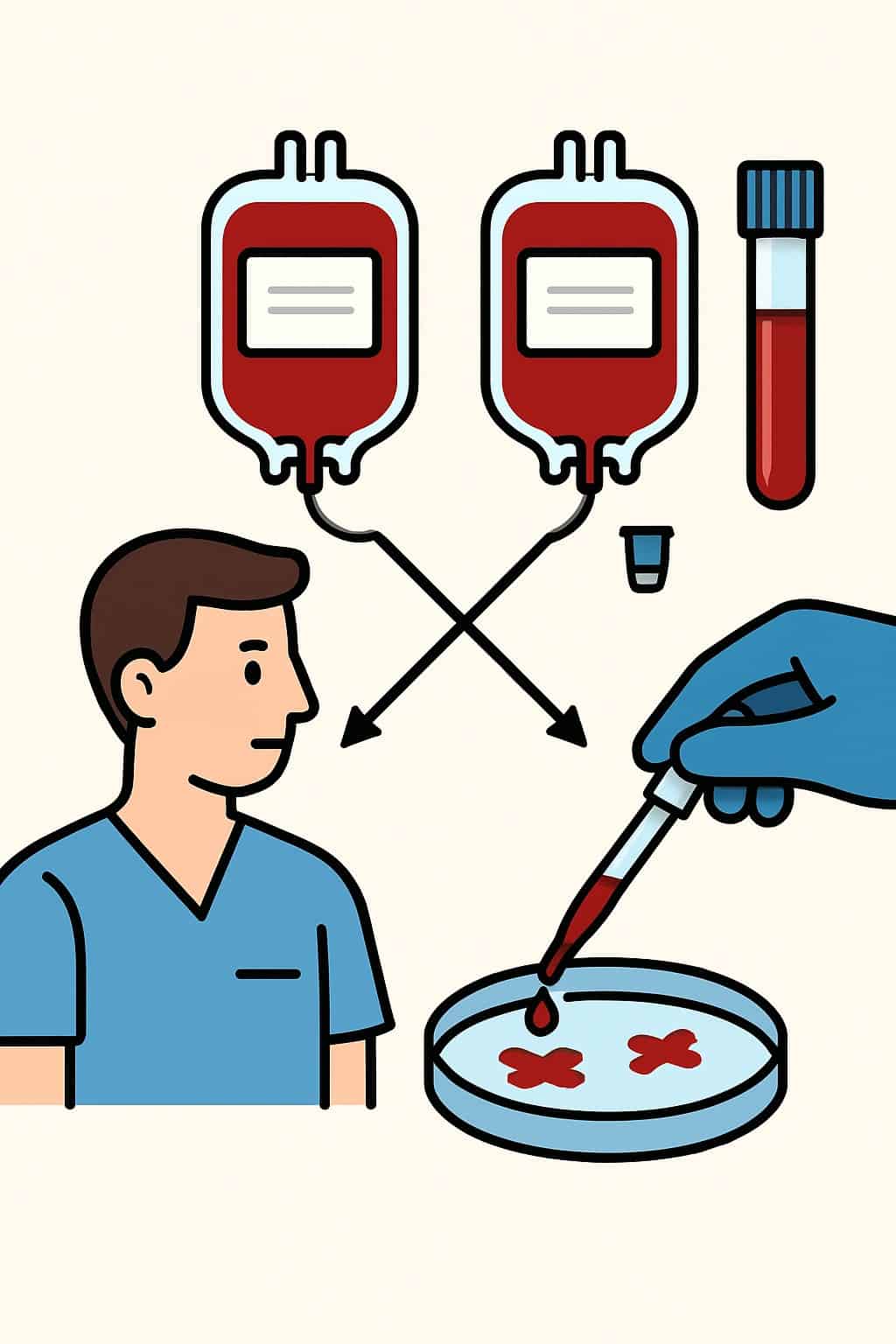
A blood crossmatch is a lab test done before a transfusion to help make sure donor red blood cells are compatible with the recipient.
Overview
A blood crossmatch is a lab test done before a transfusion to help make sure donor red blood cells are compatible with the recipient. A small blood sample is taken and tested along with donor blood or by computer checks to look for reactions. This testing builds on blood typing (ABO and Rh) and an antibody screen. The goal is to lower the chance of a harmful reaction by detecting blood group antibodies, which are proteins your body can make against certain red blood cell features.
Also known as: Crossmatch, Compatibility testing, Type and crossmatch, Pretransfusion testing
Preparation & Next Steps
Everything you need to know before and after your procedure
Before Care
- Bring a photo ID and confirm your full name and date of birth match all labels and any wristband.
- Share your transfusion history, any prior reactions, and any pregnancies; this can affect testing.
- Tell the team if you have been told you have a blood group antibody.
- No fasting is needed; drink water unless you were given different instructions.
- Bring a current list of medicines and allergies.
- If testing is for planned surgery, ask when the sample should be collected; many hospitals use time limits for sample validity in some situations.
- Keep any blood bank wristband on and readable until your care team says it can be removed.
- Plan enough time for the blood draw and any consent or identification steps at the facility.
After Care
- Apply firm pressure to the puncture site for several minutes, then keep the bandage on for a few hours.
- Expect mild soreness or a small bruise that usually fades over 1 to 3 days.
- Avoid heavy lifting or strenuous use of the arm for the rest of the day to limit bruising.
- Ask how and when crossmatch results will be available and whether another sample might be needed later.
- If a transfusion is planned, confirm how long compatible units will be reserved and whether extra time is needed to locate special units.
- Check that your name and date of birth match on any wristband and transfusion paperwork before any blood is given.
- Contact your care team if you notice bleeding that does not stop, increasing pain, swelling, warmth, or pus at the draw site.
- Keep records of any reported antibodies or reactions for future visits.
Clinical Information
Important medical details about this procedure
Indications
- Planned or likely red blood cell transfusion
- Preoperative testing when blood loss is possible
- Significant anemia or active bleeding
- Trauma or medical conditions that often require transfusion (for example, sickle cell disease)
- History of blood group antibodies or prior transfusion reactions
Alternatives
- Type and screen without immediate crossmatch when transfusion is not yet certain
- Electronic crossmatch instead of tube (serologic) crossmatch when criteria are met
- Emergency uncrossmatched blood when life-threatening bleeding prevents full testing
- Strategies to reduce transfusion needs (for example, cell salvage or iron therapy) when appropriate
Risks
- Bruising, soreness, or a small hematoma at the blood draw site
- Lightheadedness or fainting with the blood draw
- Rare infection at the puncture site
- Delays or repeat samples if the tube clots, is mislabeled, or is outdated
- Residual risk of an incompatible transfusion cannot be fully eliminated, though crossmatching reduces it
Contraindications
- No standard contraindications for a routine blood draw
- Inability to confirm identity (name/date of birth) is a safety barrier until resolved
- Very difficult venous access may require an alternate collection approach
Recovery Timeline
What to expect during your recovery
There is no medical recovery period beyond routine care for a blood draw. Most people return to normal activities right away.
Typical Range
Same day
Return to Work
Same day
Recovery Milestones
Resume normal daily activities
Keep bandage on for a few hours and monitor for minor bruising
Expect any small bruise to fade
Frequently Asked Questions
Common questions and expert answers about this procedure
What is a blood crossmatch test?
What is a blood crossmatch test?
It is a lab test done before a transfusion to check that your blood is compatible with donor red blood cells, helping reduce the chance of a reaction.
How is a crossmatch different from a type and screen?
How is a crossmatch different from a type and screen?
Type and screen identifies your ABO and Rh type and looks for antibodies. A crossmatch adds a compatibility check with donor blood or a validated computer match.
Do I need to fast?
Do I need to fast?
No. Crossmatch testing only needs a blood sample from a vein. Drinking water can make the draw easier.
How long does the crossmatch take?
How long does the crossmatch take?
Basic cases may be ready within minutes to a few hours. If antibodies are present, finding compatible units and testing them can take longer.
How long is my sample valid?
How long is my sample valid?
Policies vary. Many hospitals require a sample collected within 3 days of transfusion if you were recently transfused or pregnant within the last 3 months.
Are there different types of crossmatch?
Are there different types of crossmatch?
Yes. Electronic crossmatch uses validated computer checks when criteria are met. Serologic crossmatch mixes your plasma with donor cells, including immediate-spin and antiglobulin phases.
Can I receive blood without a crossmatch in an emergency?
Can I receive blood without a crossmatch in an emergency?
Yes. In life-threatening bleeding, uncrossmatched type O blood may be given while testing continues, then blood is adjusted once results are available.
What if I have a blood group antibody?
What if I have a blood group antibody?
The blood bank will locate units that lack the targeted antigen and perform a serologic crossmatch. This can take extra time but helps improve safety.
References
Medical literature and sources