%20--%3e%3csvg%20version='1.0'%20id='Layer_1'%20xmlns='http://www.w3.org/2000/svg'%20xmlns:xlink='http://www.w3.org/1999/xlink'%20x='0px'%20y='0px'%20viewBox='0%200%20755.52%20814.35'%20style='enable-background:new%200%200%20755.52%20814.35;'%20xml:space='preserve'%3e%3cstyle%20type='text/css'%3e%20.st0{fill:%231ae5ce;stroke:%231ae5ce;stroke-width:7;stroke-miterlimit:10;}%20.st1{fill:%23FFFFFF;stroke:%231ae5ce;stroke-width:7;stroke-miterlimit:10;}%20.st2{fill:%231ae5ce;stroke:%23FFFFFF;stroke-width:7;stroke-miterlimit:10;}%20.st3{fill:%23FFFFFF;stroke:%23FFFFFF;stroke-width:6;stroke-miterlimit:10;}%20%3c/style%3e%3cg%20id='Dark_Logo_00000159431215648494653180000015900878925932721032_'%3e%3cpath%20id='shield_00000152259091539869183100000001926543869452564382_'%20class='st0'%20d='M711.13,173.42%20c-3.37-49.07-38.92-44.9-75.96-52.18c-67.4-13.25-130.47-34.47-192.36-63.92c-22.48-10.7-41.88-25.74-65.05-26.28%20c-23.17,0.54-42.58,15.59-65.05,26.28c-61.89,29.45-124.95,50.68-192.36,63.92c-37.04,7.28-72.59,3.11-75.96,52.18%20c-1.55,22.6,0.34,46.4,1.05,68.92c5.99,190.78,52.91,345.39,206.27,466.46c29.71,23.46,74.51,55.8,108.84,70.75%20c5.99,2.61,11.7,3.73,17.21,3.75c5.51-0.02,11.22-1.14,17.21-3.75c34.33-14.95,79.12-47.3,108.84-70.75%20c153.37-121.07,200.28-275.68,206.27-466.46C710.79,219.82,712.68,196.02,711.13,173.42z'/%3e%3cpath%20id='magnifyingglass_00000073685934697636024790000000342567780940956808_'%20class='st1'%20d='M648.78,624.21l-96.64-104.65%20c34.89-40.63,55.98-93.46,55.98-151.21c0-128.27-103.98-232.24-232.24-232.24S143.63,240.08,143.63,368.35%20s103.98,232.24,232.24,232.24c48.87,0,94.21-15.11,131.62-40.89l97.18,105.24c11.25,12.18,30.24,12.93,42.42,1.69l0,0%20C659.27,655.38,660.03,636.39,648.78,624.21z'/%3e%3ccircle%20id='ellipse_00000129904010550392394720000017056154833629780114_'%20class='st2'%20cx='375.87'%20cy='368.35'%20r='181.21'/%3e%3cpath%20id='dollarsign_00000057140127156649725250000003772530148495155891_'%20class='st3'%20d='M362.91,492.03v-23.91%20c0-2.01-1.58-3.69-3.59-3.77c-18.49-0.78-37.12-5.4-49.4-11.83c-1.75-0.92-2.53-3.01-1.76-4.84l5.87-13.89%20c0.86-2.02,3.23-2.88,5.2-1.89c12.94,6.52,30.45,11.44,49.18,11.44c26.02,0,43.6-12.73,43.6-30.43c0-17.08-14.29-27.63-41.4-36.95%20c-37.37-12.42-60.46-26.7-60.46-53.72c0-24.97,20.29-44.11,52.22-49.51c1.8-0.31,3.11-1.89,3.11-3.72v-24.35%20c0-2.09,1.69-3.78,3.78-3.78h15.16c2.09,0,3.78,1.69,3.78,3.78v22.71c0,2.01,1.58,3.67,3.58,3.77c17.85,0.92,30.88,4.75,40.61,9.1%20c1.92,0.86,2.79,3.09,1.94,5.01l-6.08,13.6c-0.85,1.91-3.09,2.77-4.99,1.91c-8.37-3.8-22.38-8.95-42.75-8.95%20c-28.21,0-38.84,14.28-38.84,26.7c0,16.15,13.56,24.22,45.44,35.4c37.74,13.04,56.79,29.19,56.79,56.82%20c0,23.85-19.05,46.23-54.78,52.3c-1.8,0.31-3.11,1.89-3.11,3.72v25.28c0,2.09-1.69,3.78-3.78,3.78h-15.53%20C364.6,495.81,362.91,494.12,362.91,492.03z'/%3e%3c/g%3e%3c/svg%3e)
BRCA1 gene analysis (breast cancer gene 1) Laboratory Test
BRCA1 gene analysis is a lab test that looks for changes in the BRCA1 gene in your DNA.
Overview
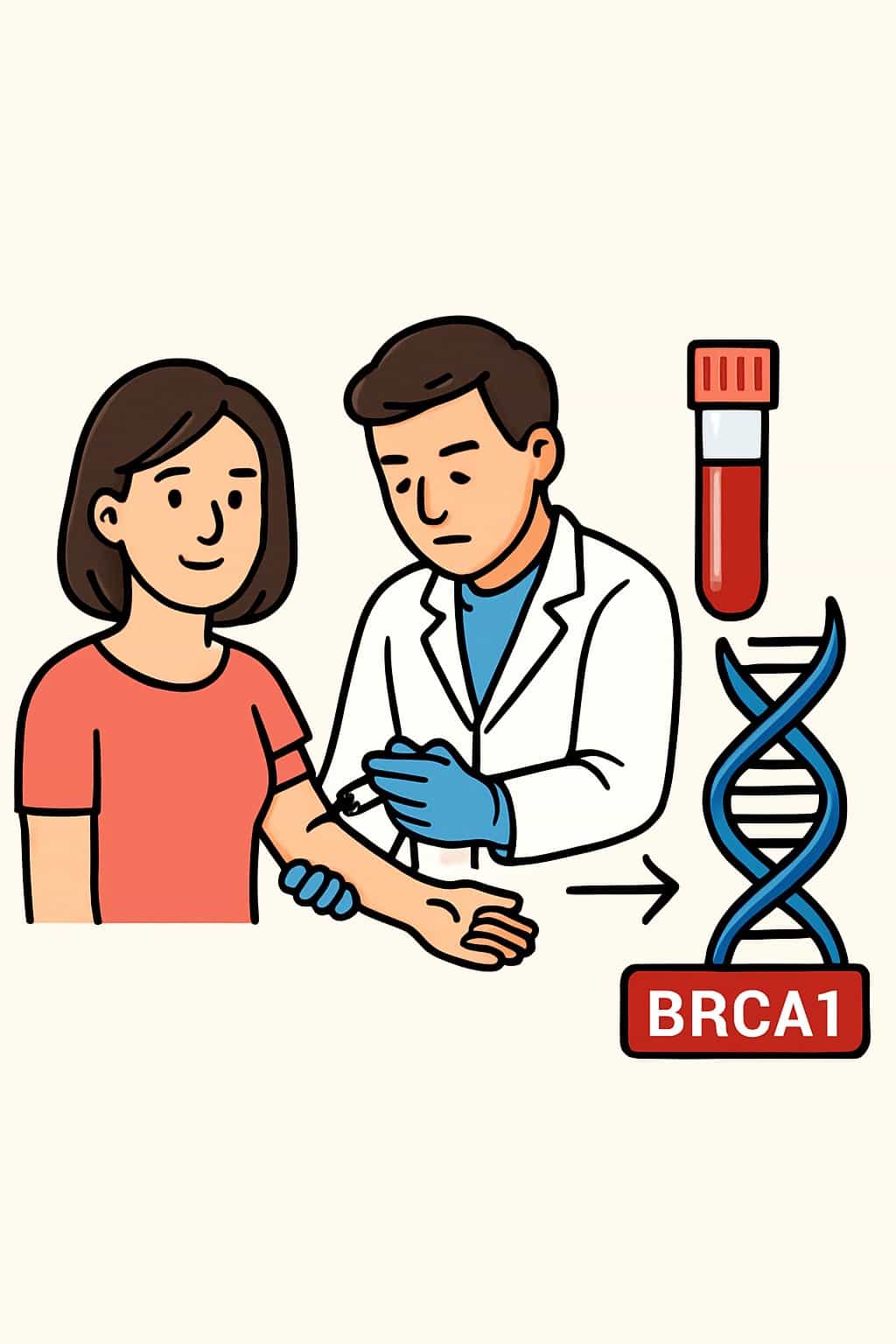
BRCA1 gene analysis is a lab test that looks for changes in the BRCA1 gene in your DNA. These changes, called variants or mutations, can raise the chance of certain cancers, especially breast and ovarian cancer. This test is usually done on a blood or saliva sample and is most useful for people with personal or family histories linked to hereditary cancer. Results can be positive for a harmful variant, negative, or uncertain. Pre-test and post-test genetic counseling is commonly recommended to understand what the results mean for you and your relatives.
Also known as: BRCA1 testing, BRCA1 genetic test, Hereditary breast and ovarian cancer test
Preparation & Next Steps
Everything you need to know before and after your procedure
Before Care
- Confirm if genetic counseling is available before and after testing to discuss benefits and limits
- Gather a detailed family history, including who had cancer, type, and age at diagnosis
- Bring records of any prior genetic tests in the family if available
- Check insurance benefits and any prior authorization requirements for genetic testing
- Clarify the type of test being ordered, such as BRCA1 only or a multigene panel
- Discuss how results will be shared and documented, including access for relatives if desired
- Review privacy protections like GINA and any limits related to life or disability insurance
- Follow the lab’s sample instructions, such as no eating, drinking, or smoking 30 minutes before a saliva sample
- Plan the sample collection method, such as blood draw at a lab or saliva kit at home
- Verify contact information so the clinic or counselor can reach you with results
After Care
- Review the official lab report with a genetic counselor or knowledgeable clinician
- Learn whether the result is positive, negative, or a variant of uncertain significance
- Keep a copy of the report in a secure personal record and patient portal if available
- Ask how the result may affect cancer screening or treatment discussions
- Discuss whether relatives may consider testing and how they can access family-specific information
- Confirm if the lab will notify you about future reclassification of uncertain variants
- Update your family history over time and share major changes with your care team
- Contact the lab or clinic if the report seems incomplete or there are clerical errors
- Check insurance coverage if further testing, such as a broader panel, is considered
- Schedule a follow-up conversation to address questions that arise after reviewing the report
Clinical Information
Important medical details about this procedure
Indications
- Personal history of breast cancer diagnosed at a young age
- Ovarian, fallopian tube, or primary peritoneal cancer at any age
- Triple-negative breast cancer diagnosed under age 60
- Male breast cancer in self or a close relative
- Multiple close relatives with breast or ovarian cancer
- Known BRCA1 or BRCA2 variant in the family
- Ashkenazi Jewish ancestry with breast or ovarian cancer in the family
- Pancreatic or prostate cancer with a family pattern suggesting hereditary risk
Alternatives
- BRCA2 or multigene hereditary cancer panel testing
- Testing an affected family member first to clarify the family variant
- Risk assessment tools and enhanced screening without genetic testing
- Tumor testing to guide treatment, which is different from inherited testing
- Periodic re-evaluation of family history before deciding on testing
Risks
- Emotional distress or anxiety about results
- Variants of uncertain significance that do not give a clear answer
- Potential misinterpretation of results without genetic counseling
- Privacy concerns and limited protections for life, disability, or long-term care insurance
- Incidental findings unrelated to the reason for testing
- Sample or lab errors are rare but possible
Contraindications
- Lack of informed consent or understanding of possible results
- Recent allogeneic stem cell or bone marrow transplant if using a blood sample
- Testing of minors for adult-onset risk when there is no immediate medical impact
- Inadequate sample quality or failure to meet lab collection requirements
Recovery Timeline
What to expect during your recovery
BRCA1 testing is a blood or saliva collection with no medical recovery period. Most people resume normal activities right away.
Typical Range
Same day
Return to Work
Same day
Recovery Milestones
Resume normal daily activities
Monitor the collection site if blood was drawn
Review results and plan a follow-up discussion when available
Frequently Asked Questions
Common questions and expert answers about this procedure
What does BRCA1 gene analysis check for?
What does BRCA1 gene analysis check for?
It looks for inherited DNA changes in the BRCA1 gene that can raise the chance of breast, ovarian, and some other cancers.
How is the test done?
How is the test done?
Most labs use a blood draw or a saliva sample. The DNA is analyzed in a certified laboratory.
Who typically gets BRCA1 testing?
Who typically gets BRCA1 testing?
People with certain personal or family histories of breast, ovarian, pancreatic, or prostate cancer, or with a known family BRCA variant.
What is the difference between germline and tumor testing?
What is the difference between germline and tumor testing?
Germline testing looks for inherited variants present in all cells. Tumor testing looks at changes only in the cancer cells.
What do the results mean?
What do the results mean?
A positive result finds a harmful variant. A negative result finds none. An uncertain result means a change was found but its impact is not known.
How long do results take?
How long do results take?
Turnaround times vary by lab, often a few weeks. The report explains what was tested and how to interpret the findings.
Will this affect my insurance or job?
Will this affect my insurance or job?
A federal law called GINA generally protects against health insurance and employment discrimination. It does not cover life, disability, or long-term care insurance.
Do men ever get BRCA1 testing?
Do men ever get BRCA1 testing?
Yes. Men can carry BRCA1 variants and may have related cancer risks. Testing can also inform relatives.
References
Medical literature and sources