%20--%3e%3csvg%20version='1.0'%20id='Layer_1'%20xmlns='http://www.w3.org/2000/svg'%20xmlns:xlink='http://www.w3.org/1999/xlink'%20x='0px'%20y='0px'%20viewBox='0%200%20755.52%20814.35'%20style='enable-background:new%200%200%20755.52%20814.35;'%20xml:space='preserve'%3e%3cstyle%20type='text/css'%3e%20.st0{fill:%231ae5ce;stroke:%231ae5ce;stroke-width:7;stroke-miterlimit:10;}%20.st1{fill:%23FFFFFF;stroke:%231ae5ce;stroke-width:7;stroke-miterlimit:10;}%20.st2{fill:%231ae5ce;stroke:%23FFFFFF;stroke-width:7;stroke-miterlimit:10;}%20.st3{fill:%23FFFFFF;stroke:%23FFFFFF;stroke-width:6;stroke-miterlimit:10;}%20%3c/style%3e%3cg%20id='Dark_Logo_00000159431215648494653180000015900878925932721032_'%3e%3cpath%20id='shield_00000152259091539869183100000001926543869452564382_'%20class='st0'%20d='M711.13,173.42%20c-3.37-49.07-38.92-44.9-75.96-52.18c-67.4-13.25-130.47-34.47-192.36-63.92c-22.48-10.7-41.88-25.74-65.05-26.28%20c-23.17,0.54-42.58,15.59-65.05,26.28c-61.89,29.45-124.95,50.68-192.36,63.92c-37.04,7.28-72.59,3.11-75.96,52.18%20c-1.55,22.6,0.34,46.4,1.05,68.92c5.99,190.78,52.91,345.39,206.27,466.46c29.71,23.46,74.51,55.8,108.84,70.75%20c5.99,2.61,11.7,3.73,17.21,3.75c5.51-0.02,11.22-1.14,17.21-3.75c34.33-14.95,79.12-47.3,108.84-70.75%20c153.37-121.07,200.28-275.68,206.27-466.46C710.79,219.82,712.68,196.02,711.13,173.42z'/%3e%3cpath%20id='magnifyingglass_00000073685934697636024790000000342567780940956808_'%20class='st1'%20d='M648.78,624.21l-96.64-104.65%20c34.89-40.63,55.98-93.46,55.98-151.21c0-128.27-103.98-232.24-232.24-232.24S143.63,240.08,143.63,368.35%20s103.98,232.24,232.24,232.24c48.87,0,94.21-15.11,131.62-40.89l97.18,105.24c11.25,12.18,30.24,12.93,42.42,1.69l0,0%20C659.27,655.38,660.03,636.39,648.78,624.21z'/%3e%3ccircle%20id='ellipse_00000129904010550392394720000017056154833629780114_'%20class='st2'%20cx='375.87'%20cy='368.35'%20r='181.21'/%3e%3cpath%20id='dollarsign_00000057140127156649725250000003772530148495155891_'%20class='st3'%20d='M362.91,492.03v-23.91%20c0-2.01-1.58-3.69-3.59-3.77c-18.49-0.78-37.12-5.4-49.4-11.83c-1.75-0.92-2.53-3.01-1.76-4.84l5.87-13.89%20c0.86-2.02,3.23-2.88,5.2-1.89c12.94,6.52,30.45,11.44,49.18,11.44c26.02,0,43.6-12.73,43.6-30.43c0-17.08-14.29-27.63-41.4-36.95%20c-37.37-12.42-60.46-26.7-60.46-53.72c0-24.97,20.29-44.11,52.22-49.51c1.8-0.31,3.11-1.89,3.11-3.72v-24.35%20c0-2.09,1.69-3.78,3.78-3.78h15.16c2.09,0,3.78,1.69,3.78,3.78v22.71c0,2.01,1.58,3.67,3.58,3.77c17.85,0.92,30.88,4.75,40.61,9.1%20c1.92,0.86,2.79,3.09,1.94,5.01l-6.08,13.6c-0.85,1.91-3.09,2.77-4.99,1.91c-8.37-3.8-22.38-8.95-42.75-8.95%20c-28.21,0-38.84,14.28-38.84,26.7c0,16.15,13.56,24.22,45.44,35.4c37.74,13.04,56.79,29.19,56.79,56.82%20c0,23.85-19.05,46.23-54.78,52.3c-1.8,0.31-3.11,1.89-3.11,3.72v25.28c0,2.09-1.69,3.78-3.78,3.78h-15.53%20C364.6,495.81,362.91,494.12,362.91,492.03z'/%3e%3c/g%3e%3c/svg%3e)
BRCA2 gene analysis (breast cancer gene 2) Laboratory Test
BRCA2 gene analysis looks for harmful changes in the BRCA2 gene.
Overview
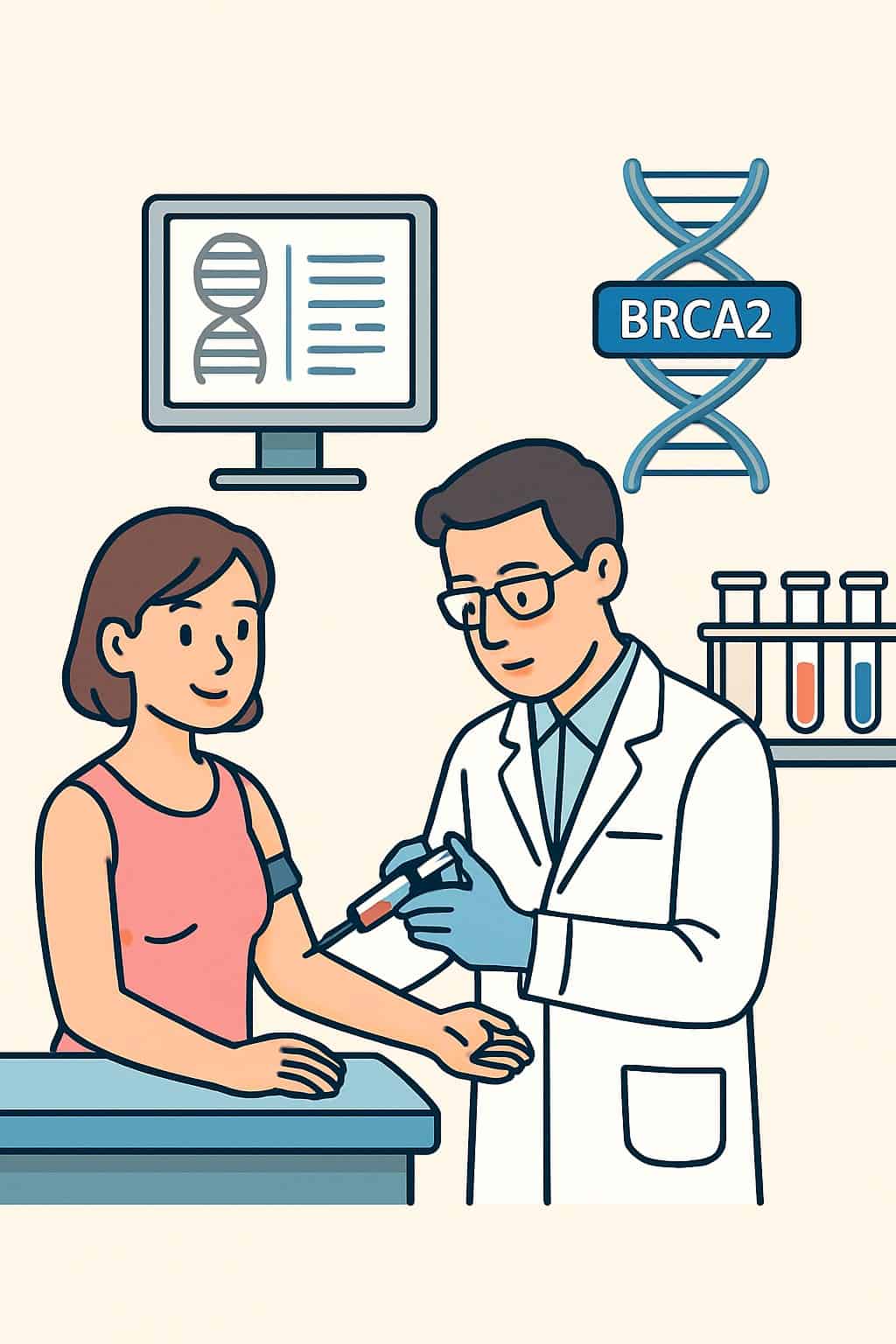
BRCA2 gene analysis looks for harmful changes in the BRCA2 gene. Certain changes can raise the chance of breast, ovarian, prostate, and pancreatic cancers. The test uses a blood or saliva sample that is sent to a certified lab. Results may be positive (a harmful variant found), negative, or uncertain. Genetic counseling is often used to explain what the results may mean for you and your family.
Also known as: BRCA2 testing, BRCA2 genetic test, BRCA2 mutation analysis, Hereditary breast and ovarian cancer testing (BRCA2)
Preparation & Next Steps
Everything you need to know before and after your procedure
Before Care
- Gather your family history of cancer, including types, ages at diagnosis, and which side of the family
- Ask the clinic which sample type is used (blood or saliva) and whether consent forms are required
- Consider meeting with a genetic counselor to review benefits, limits, and possible outcomes
- Bring any prior genetic test reports from you or relatives if available
- Check insurance coverage and whether prior authorization is needed
- Review privacy protections such as the Genetic Information Nondiscrimination Act (GINA) and its limits
- Bring a photo ID and insurance card; confirm the lab location and hours
- No fasting is usually needed for blood or saliva collection unless the lab specifies otherwise
- Decide how you want to receive results and who may be allowed access to them
- Confirm expected turnaround time for results with the clinic or lab
After Care
- Results are not immediate; timing varies by lab and can take days to weeks
- Review the written report with a genetics professional to understand positive, negative, or uncertain findings
- Keep a copy of the lab report in your medical records and personal files
- Ask how results may affect screening or treatment discussions; plans depend on personal and family history
- Consider sharing relevant results with close relatives, since findings can affect their risk discussions
- If the report lists a variant of uncertain significance, clarify that it may not guide medical decisions
- Update your family history in your medical chart based on what you learn
- Contact the ordering clinic if you notice errors in the report or have questions about next steps
- If you used a consumer test, ask whether clinical confirmation is recommended
Clinical Information
Important medical details about this procedure
Indications
- Personal history of breast, ovarian, pancreatic, or prostate cancer, especially at a young age or with certain features
- Family history of these cancers, early diagnoses, or multiple relatives affected
- A known BRCA1 or BRCA2 variant in a blood relative
- Male breast cancer in the individual or family
- Ashkenazi Jewish ancestry with a personal or family history suggestive of hereditary cancer
Alternatives
- Genetic risk assessment using family history tools without testing
- Testing an affected family member first when possible
- Multigene hereditary cancer panel that includes BRCA1/2 and other genes
- Enhanced screening based on clinical risk alone
- No genetic testing at this time with routine care based on history
Risks
- Emotional impact from learning about cancer risk
- Privacy and insurance concerns; GINA protects health insurance and employment but not life, disability, or long-term care policies
- Uncertain results (variant of uncertain significance) that may not change care
- Possible out-of-pocket costs depending on coverage
- Minor risks from a blood draw such as bruising or soreness
Recovery Timeline
What to expect during your recovery
No medical recovery period is expected. Sample collection is brief, and most people return to normal activities right away.
Typical Range
Same day
Return to Work
Same day
Recovery Milestones
Resume normal daily activities after the blood or saliva sample is collected
If a blood draw was used, expect mild soreness or bruising at the site to improve
Review results when available and discuss implications with a genetics professional
Frequently Asked Questions
Common questions and expert answers about this procedure
What does BRCA2 testing look for?
What does BRCA2 testing look for?
It checks DNA for harmful changes in the BRCA2 gene that can raise the risk of certain cancers.
How is the sample collected?
How is the sample collected?
A blood draw or a saliva sample is collected and sent to a certified laboratory for analysis.
Who typically gets BRCA2 testing?
Who typically gets BRCA2 testing?
People with a personal or family history that suggests hereditary breast, ovarian, pancreatic, or prostate cancer, or those with a known family BRCA variant.
What do the results mean?
What do the results mean?
Positive means a harmful variant was found. Negative means none was found. An uncertain result means the lab found a change that is not yet known to affect risk.
How long do results take?
How long do results take?
Timing varies by lab. Results often take days to weeks.
Is a consumer DNA test enough?
Is a consumer DNA test enough?
Some consumer tests look at only a few BRCA variants. Clinical tests usually check the full gene and are used for medical decision-making.
Will health insurance or jobs be affected?
Will health insurance or jobs be affected?
Federal law (GINA) limits genetic discrimination in health insurance and employment, but it does not cover life, disability, or long-term care insurance.
What is the difference between BRCA1 and BRCA2?
What is the difference between BRCA1 and BRCA2?
Both are tumor suppressor genes. Harmful variants in either can raise cancer risk, but the specific risks and patterns can differ.
References
Medical literature and sources