%20--%3e%3csvg%20version='1.0'%20id='Layer_1'%20xmlns='http://www.w3.org/2000/svg'%20xmlns:xlink='http://www.w3.org/1999/xlink'%20x='0px'%20y='0px'%20viewBox='0%200%20755.52%20814.35'%20style='enable-background:new%200%200%20755.52%20814.35;'%20xml:space='preserve'%3e%3cstyle%20type='text/css'%3e%20.st0{fill:%231ae5ce;stroke:%231ae5ce;stroke-width:7;stroke-miterlimit:10;}%20.st1{fill:%23FFFFFF;stroke:%231ae5ce;stroke-width:7;stroke-miterlimit:10;}%20.st2{fill:%231ae5ce;stroke:%23FFFFFF;stroke-width:7;stroke-miterlimit:10;}%20.st3{fill:%23FFFFFF;stroke:%23FFFFFF;stroke-width:6;stroke-miterlimit:10;}%20%3c/style%3e%3cg%20id='Dark_Logo_00000159431215648494653180000015900878925932721032_'%3e%3cpath%20id='shield_00000152259091539869183100000001926543869452564382_'%20class='st0'%20d='M711.13,173.42%20c-3.37-49.07-38.92-44.9-75.96-52.18c-67.4-13.25-130.47-34.47-192.36-63.92c-22.48-10.7-41.88-25.74-65.05-26.28%20c-23.17,0.54-42.58,15.59-65.05,26.28c-61.89,29.45-124.95,50.68-192.36,63.92c-37.04,7.28-72.59,3.11-75.96,52.18%20c-1.55,22.6,0.34,46.4,1.05,68.92c5.99,190.78,52.91,345.39,206.27,466.46c29.71,23.46,74.51,55.8,108.84,70.75%20c5.99,2.61,11.7,3.73,17.21,3.75c5.51-0.02,11.22-1.14,17.21-3.75c34.33-14.95,79.12-47.3,108.84-70.75%20c153.37-121.07,200.28-275.68,206.27-466.46C710.79,219.82,712.68,196.02,711.13,173.42z'/%3e%3cpath%20id='magnifyingglass_00000073685934697636024790000000342567780940956808_'%20class='st1'%20d='M648.78,624.21l-96.64-104.65%20c34.89-40.63,55.98-93.46,55.98-151.21c0-128.27-103.98-232.24-232.24-232.24S143.63,240.08,143.63,368.35%20s103.98,232.24,232.24,232.24c48.87,0,94.21-15.11,131.62-40.89l97.18,105.24c11.25,12.18,30.24,12.93,42.42,1.69l0,0%20C659.27,655.38,660.03,636.39,648.78,624.21z'/%3e%3ccircle%20id='ellipse_00000129904010550392394720000017056154833629780114_'%20class='st2'%20cx='375.87'%20cy='368.35'%20r='181.21'/%3e%3cpath%20id='dollarsign_00000057140127156649725250000003772530148495155891_'%20class='st3'%20d='M362.91,492.03v-23.91%20c0-2.01-1.58-3.69-3.59-3.77c-18.49-0.78-37.12-5.4-49.4-11.83c-1.75-0.92-2.53-3.01-1.76-4.84l5.87-13.89%20c0.86-2.02,3.23-2.88,5.2-1.89c12.94,6.52,30.45,11.44,49.18,11.44c26.02,0,43.6-12.73,43.6-30.43c0-17.08-14.29-27.63-41.4-36.95%20c-37.37-12.42-60.46-26.7-60.46-53.72c0-24.97,20.29-44.11,52.22-49.51c1.8-0.31,3.11-1.89,3.11-3.72v-24.35%20c0-2.09,1.69-3.78,3.78-3.78h15.16c2.09,0,3.78,1.69,3.78,3.78v22.71c0,2.01,1.58,3.67,3.58,3.77c17.85,0.92,30.88,4.75,40.61,9.1%20c1.92,0.86,2.79,3.09,1.94,5.01l-6.08,13.6c-0.85,1.91-3.09,2.77-4.99,1.91c-8.37-3.8-22.38-8.95-42.75-8.95%20c-28.21,0-38.84,14.28-38.84,26.7c0,16.15,13.56,24.22,45.44,35.4c37.74,13.04,56.79,29.19,56.79,56.82%20c0,23.85-19.05,46.23-54.78,52.3c-1.8,0.31-3.11,1.89-3.11,3.72v25.28c0,2.09-1.69,3.78-3.78,3.78h-15.53%20C364.6,495.81,362.91,494.12,362.91,492.03z'/%3e%3c/g%3e%3c/svg%3e)
Chromosomal analysis - 20 cells (cytogenetics) Laboratory Test
Chromosomal analysis (cytogenetics) examines the number and structure of chromosomes in dividing cells.
Overview
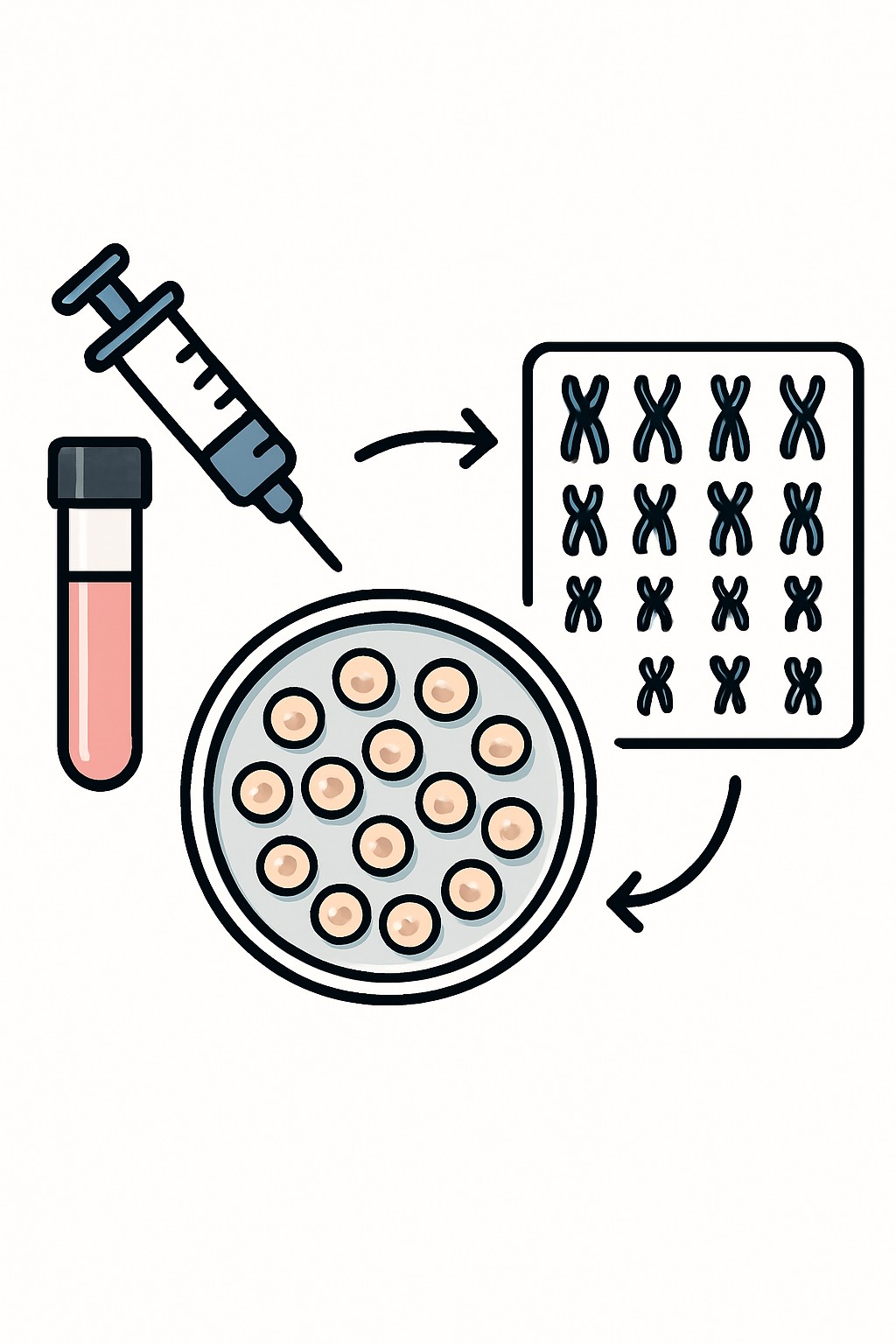
Chromosomal analysis (cytogenetics) examines the number and structure of chromosomes in dividing cells. The lab grows cells, prepares them on slides, stains the chromosomes, and views them under a microscope to look for extra, missing, or rearranged pieces. The phrase "20 cells" means the laboratory aims to analyze 20 dividing cells (metaphases) for a clearer picture of the chromosome pattern. Results are shown as a karyotype, a visual map of the chromosomes.
Also known as: Karyotype, Chromosome analysis, Cytogenetic karyotyping
Preparation & Next Steps
Everything you need to know before and after your procedure
Before Care
- Bring the lab order, photo ID, insurance information, and any consent forms requested by the lab
- Confirm the sample type for your situation (for example, blood, bone marrow, amniotic fluid, chorionic villi, products of conception, or tissue)
- Ask whether you need an appointment for the blood draw or sample drop-off and where to go
- Fasting is generally not required for chromosome analysis; confirm any special instructions with the lab
- Stay well hydrated before a blood draw unless you were told otherwise by the lab
- Carry an up-to-date list of medicines and supplements; note any recent transfusions or transplants
- Gather prior genetic test reports or family history information that may help interpretation
- Ask about expected turnaround time and how you will receive results (portal, phone, or visit)
- Inquire whether genetic counseling is available before or after testing
After Care
- Keep the bandage from the blood draw in place for the time advised by the phlebotomist and avoid heavy lifting with that arm for a short period
- Expect minor soreness or bruising at the draw site; apply gentle pressure if oozing occurs
- Contact the clinic if you have persistent bleeding, increasing redness, swelling, warmth, or fever at the draw site
- Note the lab accession number or receipt so you can track the test if needed
- Watch your patient portal or messages for results and any recommended next steps
- Consider genetic counseling to understand results, limitations, and possible follow-up testing
- Share results with your care team and, when appropriate, family members
- If results are inconclusive due to poor cell growth, the clinician may discuss repeating the test or using a different method
Clinical Information
Important medical details about this procedure
Indications
- Unexplained developmental delay, intellectual disability, or birth differences
- Suspected chromosomal conditions such as Down syndrome or Turner syndrome
- Recurrent miscarriage or infertility evaluation
- Testing products of conception after pregnancy loss
- Diagnosis or monitoring of blood cancers (like leukemia or lymphoma)
- Differences in sex development or unexpected sex chromosome findings
- Family history of a chromosomal rearrangement
Alternatives
- Chromosomal microarray (CMA) to detect copy number changes across the genome
- Fluorescence in situ hybridization (FISH) for targeted regions
- Cell-free DNA screening for common fetal chromosome conditions
- Targeted gene panel, exome, or genome sequencing for gene-level changes
- SNP array to assess copy number and regions of absence of heterozygosity
- qPCR for focused, known changes
Risks
- Bruising, soreness, or bleeding from a blood draw
- Sample collection procedures like amniocentesis or bone marrow aspiration have their own risks
- Cell culture failure or poor growth leading to delayed or inconclusive results
- Low-level mosaicism may be missed when only a limited number of cells are analyzed
- Unexpected or uncertain findings that may require genetic counseling
- Turnaround time can be longer than other tests because cells must grow
Contraindications
- Insufficient viable dividing cells or degraded sample
- Contaminated sample or improper transport conditions
- Recent allogeneic stem cell transplant when testing peripheral blood (may not reflect the person’s original cells)
- Active skin infection at the planned venipuncture site
Recovery Timeline
What to expect during your recovery
There is no medical recovery period from the laboratory test itself. After a blood draw, most people resume normal activities right away; minor soreness or bruising usually improves within a day or two.
Typical Range
Same day
Return to Work
Same day
Recovery Milestones
Resume normal daily activities
Mild soreness or bruising at the draw site improves
Review results and next steps with a clinician or genetic counselor
Frequently Asked Questions
Common questions and expert answers about this procedure
What does "20 cells" mean in chromosomal analysis?
What does "20 cells" mean in chromosomal analysis?
It refers to the lab evaluating 20 dividing cells under a microscope to create and review karyotypes. Looking at multiple cells helps detect abnormalities and reduces the chance of missing mosaic changes.
What can this test detect?
What can this test detect?
It can find changes in chromosome number (like an extra or missing chromosome) and large structural changes such as translocations, inversions, deletions, or duplications.
What can this test not detect well?
What can this test not detect well?
It does not reliably find small gene-level variants. Very small changes and low-level mosaicism may not be seen.
How is this different from chromosomal microarray or FISH?
How is this different from chromosomal microarray or FISH?
Karyotyping shows the whole chromosome structure and can detect balanced rearrangements. Microarray has higher resolution for copy number changes but cannot show balanced rearrangements. FISH targets specific regions and is usually faster for focused questions.
What samples are used?
What samples are used?
Common samples include blood for constitutional testing, bone marrow for blood cancers, and prenatal samples such as amniotic fluid or chorionic villi. Products of conception or tissue may also be tested.
How long do results take?
How long do results take?
Timing varies by sample and laboratory. When cells must be grown in culture, it often takes longer than tests that do not require culture.
Do I need to fast or stop medicines?
Do I need to fast or stop medicines?
Fasting is not usually needed for chromosome analysis. Medicine changes are not common for this test; the ordering clinician or lab provides any specific instructions.
Is genetic counseling part of this process?
Is genetic counseling part of this process?
Many clinics offer counseling to explain what the test can and cannot find, discuss results, and consider whether other tests are appropriate.
References
Medical literature and sources