%20--%3e%3csvg%20version='1.0'%20id='Layer_1'%20xmlns='http://www.w3.org/2000/svg'%20xmlns:xlink='http://www.w3.org/1999/xlink'%20x='0px'%20y='0px'%20viewBox='0%200%20755.52%20814.35'%20style='enable-background:new%200%200%20755.52%20814.35;'%20xml:space='preserve'%3e%3cstyle%20type='text/css'%3e%20.st0{fill:%231ae5ce;stroke:%231ae5ce;stroke-width:7;stroke-miterlimit:10;}%20.st1{fill:%23FFFFFF;stroke:%231ae5ce;stroke-width:7;stroke-miterlimit:10;}%20.st2{fill:%231ae5ce;stroke:%23FFFFFF;stroke-width:7;stroke-miterlimit:10;}%20.st3{fill:%23FFFFFF;stroke:%23FFFFFF;stroke-width:6;stroke-miterlimit:10;}%20%3c/style%3e%3cg%20id='Dark_Logo_00000159431215648494653180000015900878925932721032_'%3e%3cpath%20id='shield_00000152259091539869183100000001926543869452564382_'%20class='st0'%20d='M711.13,173.42%20c-3.37-49.07-38.92-44.9-75.96-52.18c-67.4-13.25-130.47-34.47-192.36-63.92c-22.48-10.7-41.88-25.74-65.05-26.28%20c-23.17,0.54-42.58,15.59-65.05,26.28c-61.89,29.45-124.95,50.68-192.36,63.92c-37.04,7.28-72.59,3.11-75.96,52.18%20c-1.55,22.6,0.34,46.4,1.05,68.92c5.99,190.78,52.91,345.39,206.27,466.46c29.71,23.46,74.51,55.8,108.84,70.75%20c5.99,2.61,11.7,3.73,17.21,3.75c5.51-0.02,11.22-1.14,17.21-3.75c34.33-14.95,79.12-47.3,108.84-70.75%20c153.37-121.07,200.28-275.68,206.27-466.46C710.79,219.82,712.68,196.02,711.13,173.42z'/%3e%3cpath%20id='magnifyingglass_00000073685934697636024790000000342567780940956808_'%20class='st1'%20d='M648.78,624.21l-96.64-104.65%20c34.89-40.63,55.98-93.46,55.98-151.21c0-128.27-103.98-232.24-232.24-232.24S143.63,240.08,143.63,368.35%20s103.98,232.24,232.24,232.24c48.87,0,94.21-15.11,131.62-40.89l97.18,105.24c11.25,12.18,30.24,12.93,42.42,1.69l0,0%20C659.27,655.38,660.03,636.39,648.78,624.21z'/%3e%3ccircle%20id='ellipse_00000129904010550392394720000017056154833629780114_'%20class='st2'%20cx='375.87'%20cy='368.35'%20r='181.21'/%3e%3cpath%20id='dollarsign_00000057140127156649725250000003772530148495155891_'%20class='st3'%20d='M362.91,492.03v-23.91%20c0-2.01-1.58-3.69-3.59-3.77c-18.49-0.78-37.12-5.4-49.4-11.83c-1.75-0.92-2.53-3.01-1.76-4.84l5.87-13.89%20c0.86-2.02,3.23-2.88,5.2-1.89c12.94,6.52,30.45,11.44,49.18,11.44c26.02,0,43.6-12.73,43.6-30.43c0-17.08-14.29-27.63-41.4-36.95%20c-37.37-12.42-60.46-26.7-60.46-53.72c0-24.97,20.29-44.11,52.22-49.51c1.8-0.31,3.11-1.89,3.11-3.72v-24.35%20c0-2.09,1.69-3.78,3.78-3.78h15.16c2.09,0,3.78,1.69,3.78,3.78v22.71c0,2.01,1.58,3.67,3.58,3.77c17.85,0.92,30.88,4.75,40.61,9.1%20c1.92,0.86,2.79,3.09,1.94,5.01l-6.08,13.6c-0.85,1.91-3.09,2.77-4.99,1.91c-8.37-3.8-22.38-8.95-42.75-8.95%20c-28.21,0-38.84,14.28-38.84,26.7c0,16.15,13.56,24.22,45.44,35.4c37.74,13.04,56.79,29.19,56.79,56.82%20c0,23.85-19.05,46.23-54.78,52.3c-1.8,0.31-3.11,1.89-3.11,3.72v25.28c0,2.09-1.69,3.78-3.78,3.78h-15.53%20C364.6,495.81,362.91,494.12,362.91,492.03z'/%3e%3c/g%3e%3c/svg%3e)
Complement C3 level (immune protein test) Laboratory Test
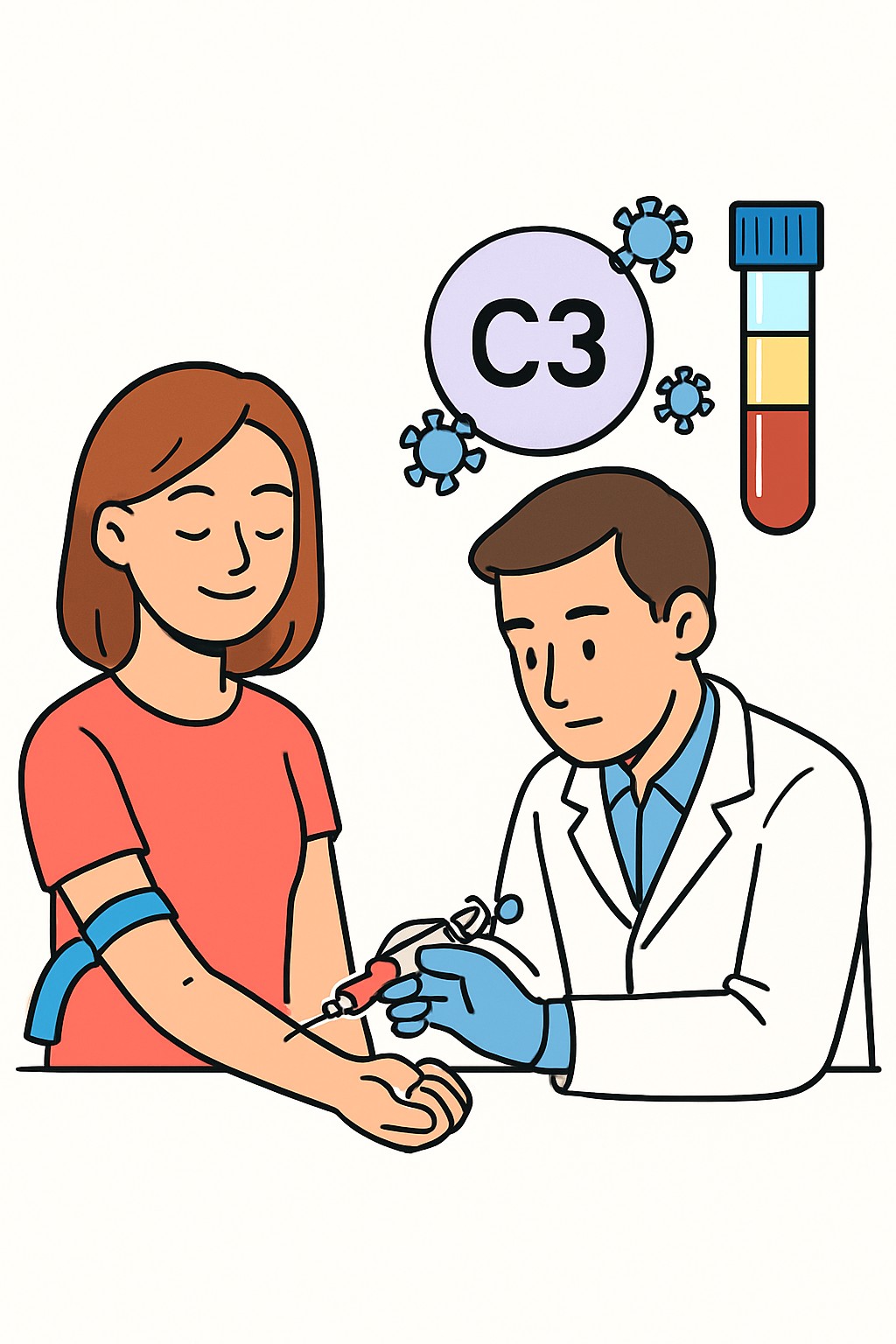
The complement C3 level test is a blood test that measures the amount of complement component 3 (C3), an immune protein that helps fight infections and clear damaged cells.
Overview
The complement C3 level test is a blood test that measures the amount of complement component 3 (C3), an immune protein that helps fight infections and clear damaged cells. C3 is part of the complement system, a group of proteins that work together to trigger inflammation and defend against germs. This test helps evaluate inflammation and immune activity. It is commonly used when autoimmune disease, certain kidney problems, chronic infections, or rare complement deficiencies are being considered. It is often ordered with C4 or with total complement activity tests.
Also known as: C3 complement level, C3 test, Complement component 3, Serum C3
Preparation & Next Steps
Everything you need to know before and after your procedure
Before Care
- Bring a photo ID, insurance card, and the lab order
- Confirm the collection site hours and any special instructions; fasting is usually not required for a C3 test
- Wear short sleeves or clothing that allows easy access to the inner elbow
- Stay well hydrated unless you have been told to limit fluids for another reason
- Carry an up-to-date list of all medicines and supplements
- Tell the phlebotomist if you have fainted or felt dizzy with past blood draws
- Inform staff about bleeding disorders, blood thinner use, or difficult veins
- Plan a few extra minutes after the draw in case you need to sit and recover
After Care
- Keep pressure on the site for several minutes, then keep the bandage on and dry for a few hours
- Expect mild soreness or a small bruise that usually improves within 1 to 2 days
- Avoid heavy lifting or vigorous arm use with the puncture arm for several hours
- Drink fluids and eat as usual unless you were given other instructions for a different test
- Check your patient portal or lab report for results when available
- Note the date and time of the draw if results will be compared over time
- Contact a clinician if you have persistent bleeding, increasing pain, spreading redness, pus, fever, or severe dizziness
Clinical Information
Important medical details about this procedure
Indications
- Workup of autoimmune conditions such as lupus
- Evaluation of some kidney diseases (for example, glomerulonephritis)
- Monitoring disease activity in conditions that affect complement levels
- Assessment for rare inherited complement deficiencies
- Evaluation of certain persistent or severe infections
- Follow-up when total complement activity (CH50) is abnormal
Alternatives
- Complement C4 level
- Total complement activity tests (CH50 or AH50)
- Urinalysis and kidney function tests when kidney involvement is suspected
- Autoimmune panels (for example, ANA) based on clinical question
- Inflammation markers such as ESR or CRP
- Clinical observation and repeat testing over time
Risks
- Bruising or soreness at the blood draw site
- Minor bleeding
- Lightheadedness or fainting during or after the draw
- Very small risk of infection at the puncture site
- Rarely, a larger bruise or lump (hematoma)
Contraindications
- No absolute contraindications for routine venipuncture in most people
- Avoid drawing blood from an arm with severe lymphedema or after certain breast surgeries on that side
- Avoid sites with active skin infection or significant injury
- Use caution with severe bleeding disorders or when on strong blood thinners
- Avoid drawing from an arm with a dialysis fistula unless approved for use
Recovery Timeline
What to expect during your recovery
This is a standard blood draw. Most people return to normal activities right away. Minor soreness or a small bruise can last 1 to 2 days.
Typical Range
Same day
Return to Work
Same day
Recovery Milestones
Resume normal daily activities after leaving the lab
Keep bandage on for a few hours; expect mild arm soreness
Bruising, if present, typically fades
Frequently Asked Questions
Common questions and expert answers about this procedure
What does the C3 test measure?
What does the C3 test measure?
It measures the amount of complement component 3, an immune protein that helps your body respond to infections and inflammation.
Do I need to fast for a C3 test?
Do I need to fast for a C3 test?
Fasting is usually not needed. Follow any instructions provided by the lab.
Why might C3 be low?
Why might C3 be low?
Low levels can be seen with some autoimmune diseases, certain kidney conditions, some infections, and rare inherited complement problems.
Why might C3 be high?
Why might C3 be high?
Higher-than-usual levels may occur with inflammation or some infections. Ranges and significance depend on the lab and clinical context.
How is C3 different from C4 or CH50?
How is C3 different from C4 or CH50?
C3 and C4 measure individual proteins. CH50 and AH50 measure overall complement activity in specific pathways and can show if the system is functioning.
How is the sample collected?
How is the sample collected?
A blood sample is taken from a vein in your arm using a needle. The sample is sent to a lab to measure C3.
How long do results take?
How long do results take?
Results are often available within a few days, depending on the laboratory.
What factors can affect the result?
What factors can affect the result?
Recent infections, active inflammation, some medicines, pregnancy, and sample handling can influence complement levels.
References
Medical literature and sources