%20--%3e%3csvg%20version='1.0'%20id='Layer_1'%20xmlns='http://www.w3.org/2000/svg'%20xmlns:xlink='http://www.w3.org/1999/xlink'%20x='0px'%20y='0px'%20viewBox='0%200%20755.52%20814.35'%20style='enable-background:new%200%200%20755.52%20814.35;'%20xml:space='preserve'%3e%3cstyle%20type='text/css'%3e%20.st0{fill:%231ae5ce;stroke:%231ae5ce;stroke-width:7;stroke-miterlimit:10;}%20.st1{fill:%23FFFFFF;stroke:%231ae5ce;stroke-width:7;stroke-miterlimit:10;}%20.st2{fill:%231ae5ce;stroke:%23FFFFFF;stroke-width:7;stroke-miterlimit:10;}%20.st3{fill:%23FFFFFF;stroke:%23FFFFFF;stroke-width:6;stroke-miterlimit:10;}%20%3c/style%3e%3cg%20id='Dark_Logo_00000159431215648494653180000015900878925932721032_'%3e%3cpath%20id='shield_00000152259091539869183100000001926543869452564382_'%20class='st0'%20d='M711.13,173.42%20c-3.37-49.07-38.92-44.9-75.96-52.18c-67.4-13.25-130.47-34.47-192.36-63.92c-22.48-10.7-41.88-25.74-65.05-26.28%20c-23.17,0.54-42.58,15.59-65.05,26.28c-61.89,29.45-124.95,50.68-192.36,63.92c-37.04,7.28-72.59,3.11-75.96,52.18%20c-1.55,22.6,0.34,46.4,1.05,68.92c5.99,190.78,52.91,345.39,206.27,466.46c29.71,23.46,74.51,55.8,108.84,70.75%20c5.99,2.61,11.7,3.73,17.21,3.75c5.51-0.02,11.22-1.14,17.21-3.75c34.33-14.95,79.12-47.3,108.84-70.75%20c153.37-121.07,200.28-275.68,206.27-466.46C710.79,219.82,712.68,196.02,711.13,173.42z'/%3e%3cpath%20id='magnifyingglass_00000073685934697636024790000000342567780940956808_'%20class='st1'%20d='M648.78,624.21l-96.64-104.65%20c34.89-40.63,55.98-93.46,55.98-151.21c0-128.27-103.98-232.24-232.24-232.24S143.63,240.08,143.63,368.35%20s103.98,232.24,232.24,232.24c48.87,0,94.21-15.11,131.62-40.89l97.18,105.24c11.25,12.18,30.24,12.93,42.42,1.69l0,0%20C659.27,655.38,660.03,636.39,648.78,624.21z'/%3e%3ccircle%20id='ellipse_00000129904010550392394720000017056154833629780114_'%20class='st2'%20cx='375.87'%20cy='368.35'%20r='181.21'/%3e%3cpath%20id='dollarsign_00000057140127156649725250000003772530148495155891_'%20class='st3'%20d='M362.91,492.03v-23.91%20c0-2.01-1.58-3.69-3.59-3.77c-18.49-0.78-37.12-5.4-49.4-11.83c-1.75-0.92-2.53-3.01-1.76-4.84l5.87-13.89%20c0.86-2.02,3.23-2.88,5.2-1.89c12.94,6.52,30.45,11.44,49.18,11.44c26.02,0,43.6-12.73,43.6-30.43c0-17.08-14.29-27.63-41.4-36.95%20c-37.37-12.42-60.46-26.7-60.46-53.72c0-24.97,20.29-44.11,52.22-49.51c1.8-0.31,3.11-1.89,3.11-3.72v-24.35%20c0-2.09,1.69-3.78,3.78-3.78h15.16c2.09,0,3.78,1.69,3.78,3.78v22.71c0,2.01,1.58,3.67,3.58,3.77c17.85,0.92,30.88,4.75,40.61,9.1%20c1.92,0.86,2.79,3.09,1.94,5.01l-6.08,13.6c-0.85,1.91-3.09,2.77-4.99,1.91c-8.37-3.8-22.38-8.95-42.75-8.95%20c-28.21,0-38.84,14.28-38.84,26.7c0,16.15,13.56,24.22,45.44,35.4c37.74,13.04,56.79,29.19,56.79,56.82%20c0,23.85-19.05,46.23-54.78,52.3c-1.8,0.31-3.11,1.89-3.11,3.72v25.28c0,2.09-1.69,3.78-3.78,3.78h-15.53%20C364.6,495.81,362.91,494.12,362.91,492.03z'/%3e%3c/g%3e%3c/svg%3e)
Complete Blood Count (CBC) Laboratory Test
A complete blood count (CBC) is a common blood test that measures red blood cells, white blood cells, hemoglobin, hematocrit, and platelets.
Overview
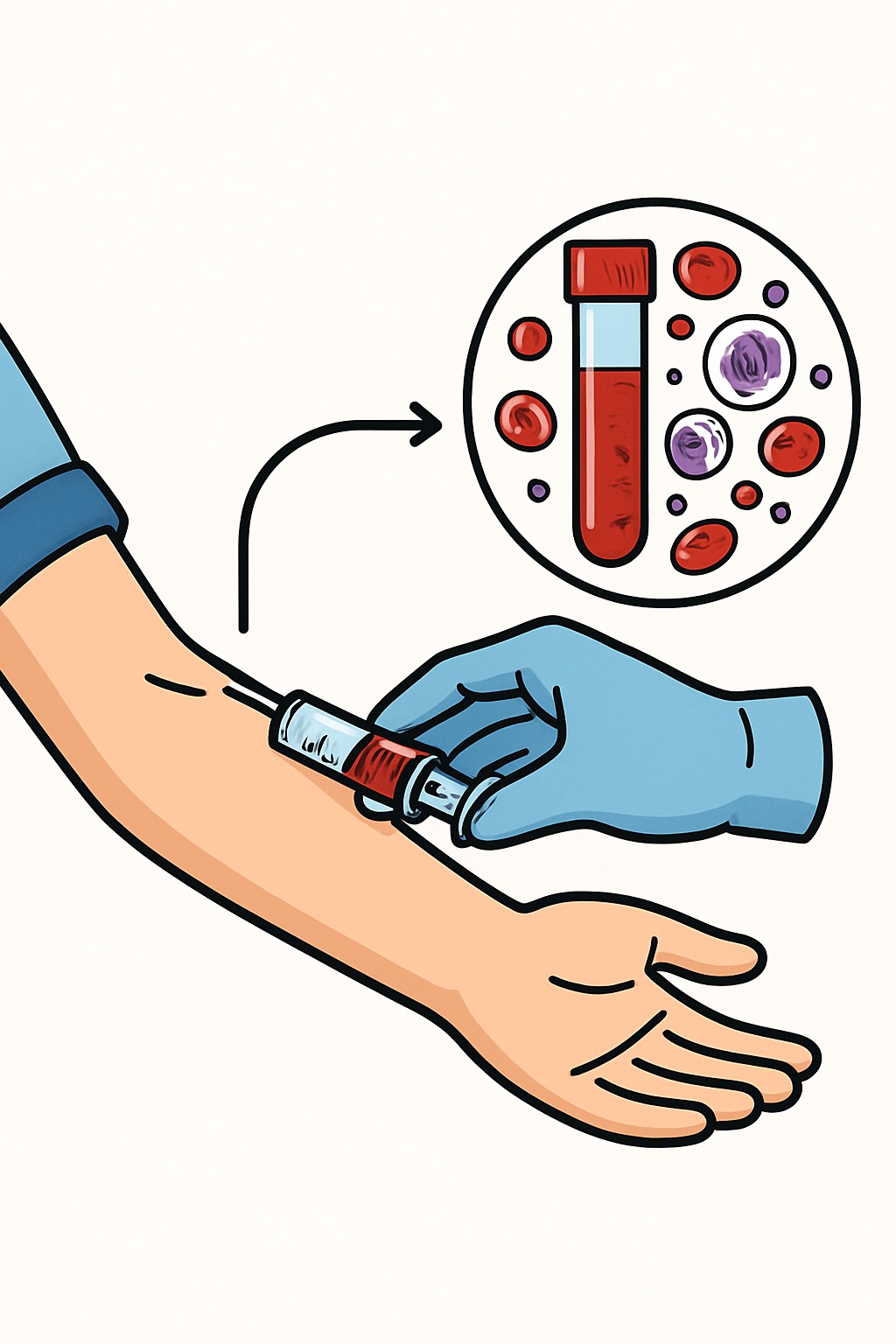
A complete blood count (CBC) is a common blood test that measures red blood cells, white blood cells, hemoglobin, hematocrit, and platelets. It helps check overall health and looks for conditions that affect blood and bone marrow. Clinicians use CBC results to look for anemia, infection, inflammation, bleeding problems, or effects from medicines and treatments. The test uses a small blood sample taken from a vein in your arm and is analyzed by automated machines in a lab.
Also known as: CBC, Full blood count (FBC), Hemogram
Preparation & Next Steps
Everything you need to know before and after your procedure
Before Care
- Bring your lab order, photo ID, and insurance card if applicable
- Confirm the lab location, hours, and whether an appointment is required
- Drink water beforehand unless you were given other instructions for additional tests
- Wear short sleeves or a top with sleeves that roll up easily
- Tell the staff about any past fainting with blood draws
- Inform the staff about allergies to adhesives or latex
- Let the staff know if you are taking blood thinners or have a bleeding disorder
- Ask the lab if any other ordered tests require fasting; a CBC alone usually does not
- Have your preferred pharmacy and contact information available
- Know how you will receive results, such as through a patient portal or a call
After Care
- Keep the bandage on for several hours and keep the site clean and dry
- If there is minor oozing, apply firm pressure with clean gauze until it stops
- Expect mild soreness or small bruising; a cold pack wrapped in cloth can help briefly
- Avoid heavy lifting or strenuous exercise with the arm used for the draw for the rest of the day
- Drink fluids and have a light snack if you feel lightheaded after the draw
- Watch the site for increasing redness, swelling, warmth, drainage, or worsening pain and contact a clinician if these occur
- Review your results when available and read any notes from the ordering clinician
- Schedule any recommended follow-up tests or appointments if instructed
Clinical Information
Important medical details about this procedure
Indications
- Symptoms such as fatigue, weakness, pallor, or shortness of breath
- Fever or signs of infection or inflammation
- Unusual bruising or bleeding
- Monitoring chronic conditions (for example, kidney disease, autoimmune disease)
- Monitoring medicines or treatments that affect blood counts (such as chemotherapy)
- Preoperative assessment or routine health check
- Follow-up of known anemia or blood disorders
Alternatives
- Targeted tests based on the concern (for example, iron studies, ferritin, vitamin B12, folate)
- Reticulocyte count to assess red blood cell production
- Peripheral blood smear review by a laboratory professional
- Point-of-care hemoglobin or hematocrit testing
- Inflammation markers such as C-reactive protein (CRP) or erythrocyte sedimentation rate (ESR)
Risks
- Brief pain or discomfort at the needle site
- Bruising or a small hematoma under the skin
- Minor bleeding from the puncture site
- Lightheadedness or fainting with blood draws
- Rare infection at the puncture site
- Laboratory or sampling issues that may require a repeat test
Contraindications
- Active skin infection or significant injury at the intended draw site
- Lymphedema or prior lymph node removal in the limb (use of that arm is often avoided)
- Arteriovenous fistula or graft in the limb used for dialysis
- Severe bleeding tendency without a plan for bleeding control
Recovery Timeline
What to expect during your recovery
Most people resume normal activities right after a CBC blood draw. Minor soreness or a small bruise may occur and usually fades within a few days.
Typical Range
Same day
Return to Work
Same day
Recovery Milestones
Resume normal daily activities
Keep bandage on and avoid strenuous use of the arm used for the draw
Monitor for bruising or soreness at the site
Review results via portal or as communicated by the clinic
Frequently Asked Questions
Common questions and expert answers about this procedure
What does a CBC measure?
What does a CBC measure?
It reports red and white blood cell counts, hemoglobin, hematocrit, and platelets. Some CBCs also include a white blood cell differential showing the types of white cells.
Do I need to fast for a CBC?
Do I need to fast for a CBC?
Fasting is generally not needed for a CBC. If other tests were ordered at the same time, the lab may give you specific instructions.
How is the test done?
How is the test done?
A healthcare worker places a small needle into a vein in your arm to draw a tube of blood. The sample is analyzed by automated lab instruments.
How long do results take?
How long do results take?
Many labs release CBC results the same day or within 1 to 2 days, depending on the lab and whether additional review is needed.
What is a CBC with differential?
What is a CBC with differential?
It includes a breakdown of white blood cell types, such as neutrophils and lymphocytes, which can help evaluate infections or other conditions.
Are there risks from a CBC?
Are there risks from a CBC?
Risks are low. You may have brief pain, bruising, or lightheadedness. Infection is rare.
Can I exercise before or after the blood draw?
Can I exercise before or after the blood draw?
Light activity is usually fine. Strenuous exercise right before or after the draw can increase bruising at the site.
What might abnormal results mean?
What might abnormal results mean?
Abnormal results can have many causes, such as anemia, infection, inflammation, or bone marrow issues. Further evaluation is often based on the pattern of changes.
References
Medical literature and sources