%20--%3e%3csvg%20version='1.0'%20id='Layer_1'%20xmlns='http://www.w3.org/2000/svg'%20xmlns:xlink='http://www.w3.org/1999/xlink'%20x='0px'%20y='0px'%20viewBox='0%200%20755.52%20814.35'%20style='enable-background:new%200%200%20755.52%20814.35;'%20xml:space='preserve'%3e%3cstyle%20type='text/css'%3e%20.st0{fill:%231ae5ce;stroke:%231ae5ce;stroke-width:7;stroke-miterlimit:10;}%20.st1{fill:%23FFFFFF;stroke:%231ae5ce;stroke-width:7;stroke-miterlimit:10;}%20.st2{fill:%231ae5ce;stroke:%23FFFFFF;stroke-width:7;stroke-miterlimit:10;}%20.st3{fill:%23FFFFFF;stroke:%23FFFFFF;stroke-width:6;stroke-miterlimit:10;}%20%3c/style%3e%3cg%20id='Dark_Logo_00000159431215648494653180000015900878925932721032_'%3e%3cpath%20id='shield_00000152259091539869183100000001926543869452564382_'%20class='st0'%20d='M711.13,173.42%20c-3.37-49.07-38.92-44.9-75.96-52.18c-67.4-13.25-130.47-34.47-192.36-63.92c-22.48-10.7-41.88-25.74-65.05-26.28%20c-23.17,0.54-42.58,15.59-65.05,26.28c-61.89,29.45-124.95,50.68-192.36,63.92c-37.04,7.28-72.59,3.11-75.96,52.18%20c-1.55,22.6,0.34,46.4,1.05,68.92c5.99,190.78,52.91,345.39,206.27,466.46c29.71,23.46,74.51,55.8,108.84,70.75%20c5.99,2.61,11.7,3.73,17.21,3.75c5.51-0.02,11.22-1.14,17.21-3.75c34.33-14.95,79.12-47.3,108.84-70.75%20c153.37-121.07,200.28-275.68,206.27-466.46C710.79,219.82,712.68,196.02,711.13,173.42z'/%3e%3cpath%20id='magnifyingglass_00000073685934697636024790000000342567780940956808_'%20class='st1'%20d='M648.78,624.21l-96.64-104.65%20c34.89-40.63,55.98-93.46,55.98-151.21c0-128.27-103.98-232.24-232.24-232.24S143.63,240.08,143.63,368.35%20s103.98,232.24,232.24,232.24c48.87,0,94.21-15.11,131.62-40.89l97.18,105.24c11.25,12.18,30.24,12.93,42.42,1.69l0,0%20C659.27,655.38,660.03,636.39,648.78,624.21z'/%3e%3ccircle%20id='ellipse_00000129904010550392394720000017056154833629780114_'%20class='st2'%20cx='375.87'%20cy='368.35'%20r='181.21'/%3e%3cpath%20id='dollarsign_00000057140127156649725250000003772530148495155891_'%20class='st3'%20d='M362.91,492.03v-23.91%20c0-2.01-1.58-3.69-3.59-3.77c-18.49-0.78-37.12-5.4-49.4-11.83c-1.75-0.92-2.53-3.01-1.76-4.84l5.87-13.89%20c0.86-2.02,3.23-2.88,5.2-1.89c12.94,6.52,30.45,11.44,49.18,11.44c26.02,0,43.6-12.73,43.6-30.43c0-17.08-14.29-27.63-41.4-36.95%20c-37.37-12.42-60.46-26.7-60.46-53.72c0-24.97,20.29-44.11,52.22-49.51c1.8-0.31,3.11-1.89,3.11-3.72v-24.35%20c0-2.09,1.69-3.78,3.78-3.78h15.16c2.09,0,3.78,1.69,3.78,3.78v22.71c0,2.01,1.58,3.67,3.58,3.77c17.85,0.92,30.88,4.75,40.61,9.1%20c1.92,0.86,2.79,3.09,1.94,5.01l-6.08,13.6c-0.85,1.91-3.09,2.77-4.99,1.91c-8.37-3.8-22.38-8.95-42.75-8.95%20c-28.21,0-38.84,14.28-38.84,26.7c0,16.15,13.56,24.22,45.44,35.4c37.74,13.04,56.79,29.19,56.79,56.82%20c0,23.85-19.05,46.23-54.78,52.3c-1.8,0.31-3.11,1.89-3.11,3.72v25.28c0,2.09-1.69,3.78-3.78,3.78h-15.53%20C364.6,495.81,362.91,494.12,362.91,492.03z'/%3e%3c/g%3e%3c/svg%3e)
Comprehensive Gene Panel (Oncology 50+ genes) Laboratory Test
A comprehensive gene panel for oncology analyzes many cancer-related genes in one test.
Overview
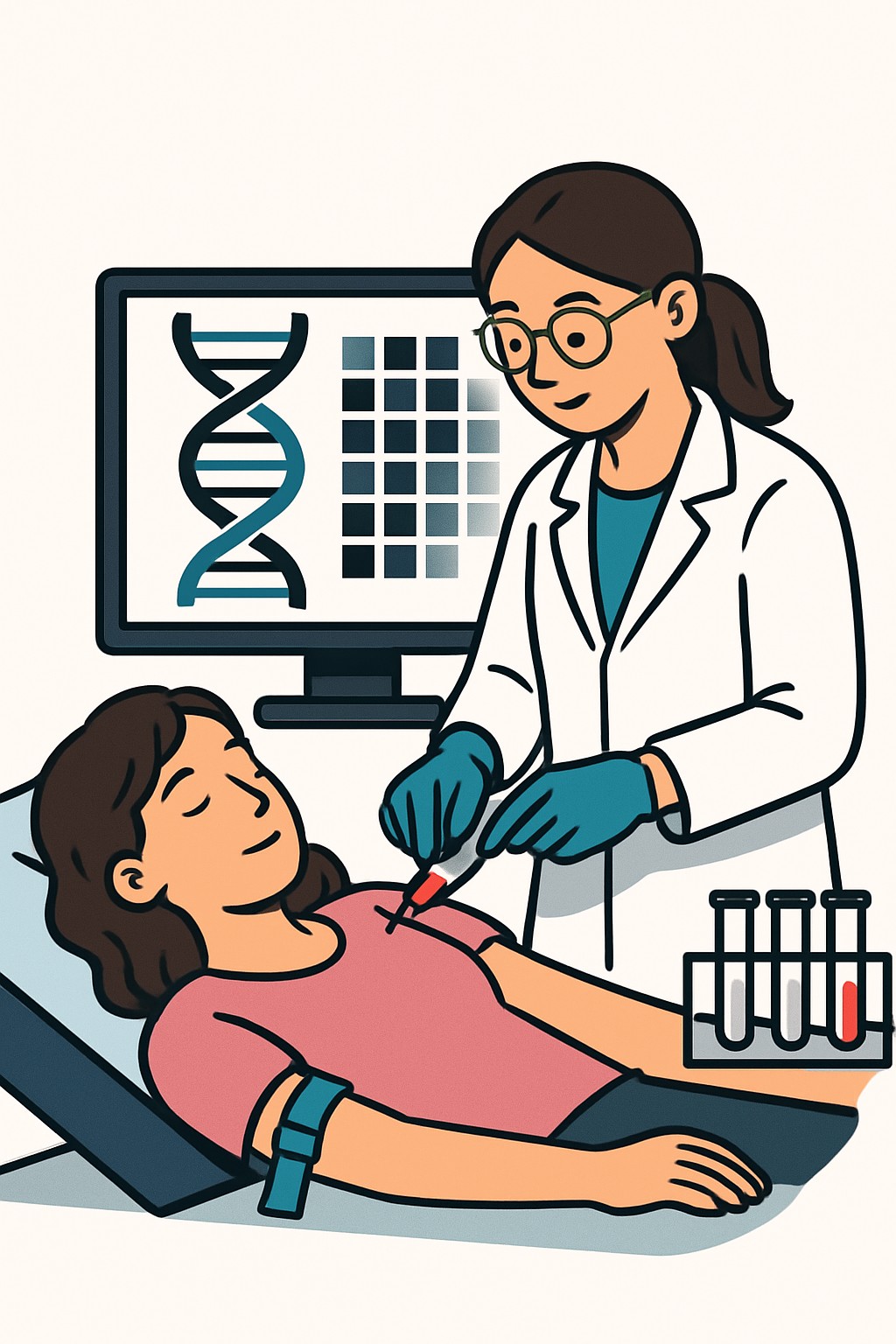
A comprehensive gene panel for oncology analyzes many cancer-related genes in one test. It looks for DNA changes in a tumor sample or in blood to identify biomarkers that may help guide treatment, prognosis, or clinical trial matching. These tests often use next-generation sequencing to scan dozens of genes at the same time. Results may find actionable mutations, show that no known targets were detected, or report uncertain findings.
Also known as: Tumor gene panel, NGS cancer panel, Comprehensive genomic profiling, Somatic mutation panel, Liquid biopsy panel
Preparation & Next Steps
Everything you need to know before and after your procedure
Before Care
- Confirm whether the test analyzes tumor DNA (somatic), inherited DNA (germline), or both
- Ask the care team which sample type will be used (tumor tissue, blood, or saliva) and whether a new biopsy is needed
- Ensure the pathology lab can release blocks or slides if archived tumor tissue will be sent
- Share prior genetic and biomarker results so duplicate testing can be avoided
- Review consent forms, including what types of findings will be reported and data-sharing policies
- Verify insurance requirements and whether prior authorization is needed
- Provide an up-to-date family cancer history if inherited risk might be evaluated
- Confirm expected turnaround time and how results will be delivered (portal, visit, or phone)
- List allergies and past reactions to adhesives or antiseptics used for blood draws
- Arrange transportation if a biopsy or sedation is planned
After Care
- If a blood draw was done, keep the bandage on as instructed and watch for bleeding, swelling, or increasing pain at the site
- If a biopsy was done, follow the facility’s wound care instructions and monitor for redness, warmth, drainage, or fever
- Check the patient portal or agreed method for results and report availability
- Keep a copy of the laboratory report and share it with all members of your care team
- Discuss whether results point to targeted therapies, immunotherapies, or clinical trials
- Ask whether any reported findings could reflect inherited risk and if genetic counseling is appropriate
- Clarify if additional testing (confirmatory tests, RNA fusion testing, or repeat sampling) may be useful
- Confirm how long the lab retains your sample and whether reanalysis may be offered in the future
- Review privacy policies, including if de-identified data may be used for research
- Contact the care team if you notice signs of infection or persistent bleeding at the collection site
Clinical Information
Important medical details about this procedure
Indications
- Identifying biomarkers to guide targeted therapy or immunotherapy
- Advanced, metastatic, or recurrent cancer where broad profiling may inform options
- Cancer with no clear driver mutation after initial tests
- Considering eligibility for biomarker-driven clinical trials
- Refining prognosis or tumor classification when pathology is uncertain
Alternatives
- Single-gene testing based on tumor type
- Small focused panels (hotspot PCR or limited NGS)
- Immunohistochemistry (IHC) for protein markers
- Fluorescence in situ hybridization (FISH) for gene fusions or amplifications
- Whole-exome or whole-genome sequencing when broad discovery is needed
- No molecular testing if not expected to change management
Risks
- Minor discomfort, bruising, or bleeding from a blood draw or biopsy
- Inconclusive results or variants of uncertain significance
- Incidental findings that may suggest inherited risk
- Privacy and data-sharing concerns with genetic information
- Out-of-pocket costs depending on coverage and test scope
- Technical limitations if tumor content is low or DNA is degraded
Contraindications
- Insufficient or poor-quality tumor tissue
- Inability to provide informed consent for genetic testing
- Recent allogeneic bone marrow transplant when using blood for inherited testing (non-blood sample may be needed)
Recovery Timeline
What to expect during your recovery
This testing usually involves a blood draw or uses existing tumor tissue. Most people resume normal activities right away, except when a biopsy is performed.
Typical Range
Same day
Return to Work
Same day
Recovery Milestones
Resume routine daily activities after a standard blood draw
Keep the collection site clean and dry as instructed
Review results and plan next steps with the care team when available
Frequently Asked Questions
Common questions and expert answers about this procedure
What does an oncology 50+ gene panel look for?
What does an oncology 50+ gene panel look for?
It checks many cancer-related genes for mutations, fusions, or other changes that may help guide treatment, prognosis, or clinical trial eligibility.
Is this testing on my tumor or my inherited DNA?
Is this testing on my tumor or my inherited DNA?
Many panels analyze tumor DNA (somatic). Some can also report findings that suggest an inherited risk. The lab report usually states which type was tested.
How is the sample collected?
How is the sample collected?
Testing may use archived tumor tissue from a prior biopsy or surgery, a new biopsy, or a blood sample (liquid biopsy). Some tests use saliva for inherited analysis.
How long do results take?
How long do results take?
Turnaround varies by lab and sample type. The care team or lab can give a typical timeframe for that specific test.
What if the report shows a variant of uncertain significance (VUS)?
What if the report shows a variant of uncertain significance (VUS)?
A VUS is a change with unclear meaning. It should not be used alone to guide treatment. Labs may update classifications as new evidence emerges.
Will results affect my insurance?
Will results affect my insurance?
A federal law called GINA limits health insurance and employment discrimination based on genetic information. It does not cover life, long-term care, or disability insurance.
Are there limits to what the panel can detect?
Are there limits to what the panel can detect?
Yes. Some alterations may be below the detection limit or outside the panel’s coverage. Low tumor content or degraded DNA can also reduce sensitivity.
Could I need repeat testing later?
Could I need repeat testing later?
Sometimes, especially if the tumor evolves or if initial tissue was limited. Repeat testing or broader methods may be considered in certain settings.
References
Medical literature and sources