%20--%3e%3csvg%20version='1.0'%20id='Layer_1'%20xmlns='http://www.w3.org/2000/svg'%20xmlns:xlink='http://www.w3.org/1999/xlink'%20x='0px'%20y='0px'%20viewBox='0%200%20755.52%20814.35'%20style='enable-background:new%200%200%20755.52%20814.35;'%20xml:space='preserve'%3e%3cstyle%20type='text/css'%3e%20.st0{fill:%231ae5ce;stroke:%231ae5ce;stroke-width:7;stroke-miterlimit:10;}%20.st1{fill:%23FFFFFF;stroke:%231ae5ce;stroke-width:7;stroke-miterlimit:10;}%20.st2{fill:%231ae5ce;stroke:%23FFFFFF;stroke-width:7;stroke-miterlimit:10;}%20.st3{fill:%23FFFFFF;stroke:%23FFFFFF;stroke-width:6;stroke-miterlimit:10;}%20%3c/style%3e%3cg%20id='Dark_Logo_00000159431215648494653180000015900878925932721032_'%3e%3cpath%20id='shield_00000152259091539869183100000001926543869452564382_'%20class='st0'%20d='M711.13,173.42%20c-3.37-49.07-38.92-44.9-75.96-52.18c-67.4-13.25-130.47-34.47-192.36-63.92c-22.48-10.7-41.88-25.74-65.05-26.28%20c-23.17,0.54-42.58,15.59-65.05,26.28c-61.89,29.45-124.95,50.68-192.36,63.92c-37.04,7.28-72.59,3.11-75.96,52.18%20c-1.55,22.6,0.34,46.4,1.05,68.92c5.99,190.78,52.91,345.39,206.27,466.46c29.71,23.46,74.51,55.8,108.84,70.75%20c5.99,2.61,11.7,3.73,17.21,3.75c5.51-0.02,11.22-1.14,17.21-3.75c34.33-14.95,79.12-47.3,108.84-70.75%20c153.37-121.07,200.28-275.68,206.27-466.46C710.79,219.82,712.68,196.02,711.13,173.42z'/%3e%3cpath%20id='magnifyingglass_00000073685934697636024790000000342567780940956808_'%20class='st1'%20d='M648.78,624.21l-96.64-104.65%20c34.89-40.63,55.98-93.46,55.98-151.21c0-128.27-103.98-232.24-232.24-232.24S143.63,240.08,143.63,368.35%20s103.98,232.24,232.24,232.24c48.87,0,94.21-15.11,131.62-40.89l97.18,105.24c11.25,12.18,30.24,12.93,42.42,1.69l0,0%20C659.27,655.38,660.03,636.39,648.78,624.21z'/%3e%3ccircle%20id='ellipse_00000129904010550392394720000017056154833629780114_'%20class='st2'%20cx='375.87'%20cy='368.35'%20r='181.21'/%3e%3cpath%20id='dollarsign_00000057140127156649725250000003772530148495155891_'%20class='st3'%20d='M362.91,492.03v-23.91%20c0-2.01-1.58-3.69-3.59-3.77c-18.49-0.78-37.12-5.4-49.4-11.83c-1.75-0.92-2.53-3.01-1.76-4.84l5.87-13.89%20c0.86-2.02,3.23-2.88,5.2-1.89c12.94,6.52,30.45,11.44,49.18,11.44c26.02,0,43.6-12.73,43.6-30.43c0-17.08-14.29-27.63-41.4-36.95%20c-37.37-12.42-60.46-26.7-60.46-53.72c0-24.97,20.29-44.11,52.22-49.51c1.8-0.31,3.11-1.89,3.11-3.72v-24.35%20c0-2.09,1.69-3.78,3.78-3.78h15.16c2.09,0,3.78,1.69,3.78,3.78v22.71c0,2.01,1.58,3.67,3.58,3.77c17.85,0.92,30.88,4.75,40.61,9.1%20c1.92,0.86,2.79,3.09,1.94,5.01l-6.08,13.6c-0.85,1.91-3.09,2.77-4.99,1.91c-8.37-3.8-22.38-8.95-42.75-8.95%20c-28.21,0-38.84,14.28-38.84,26.7c0,16.15,13.56,24.22,45.44,35.4c37.74,13.04,56.79,29.19,56.79,56.82%20c0,23.85-19.05,46.23-54.78,52.3c-1.8,0.31-3.11,1.89-3.11,3.72v25.28c0,2.09-1.69,3.78-3.78,3.78h-15.53%20C364.6,495.81,362.91,494.12,362.91,492.03z'/%3e%3c/g%3e%3c/svg%3e)
Cystic fibrosis genetic screening (DNA panel) Laboratory Test
Cystic fibrosis genetic screening (DNA panel) is a lab test that looks for changes in the CFTR gene that can cause cystic fibrosis.
Overview
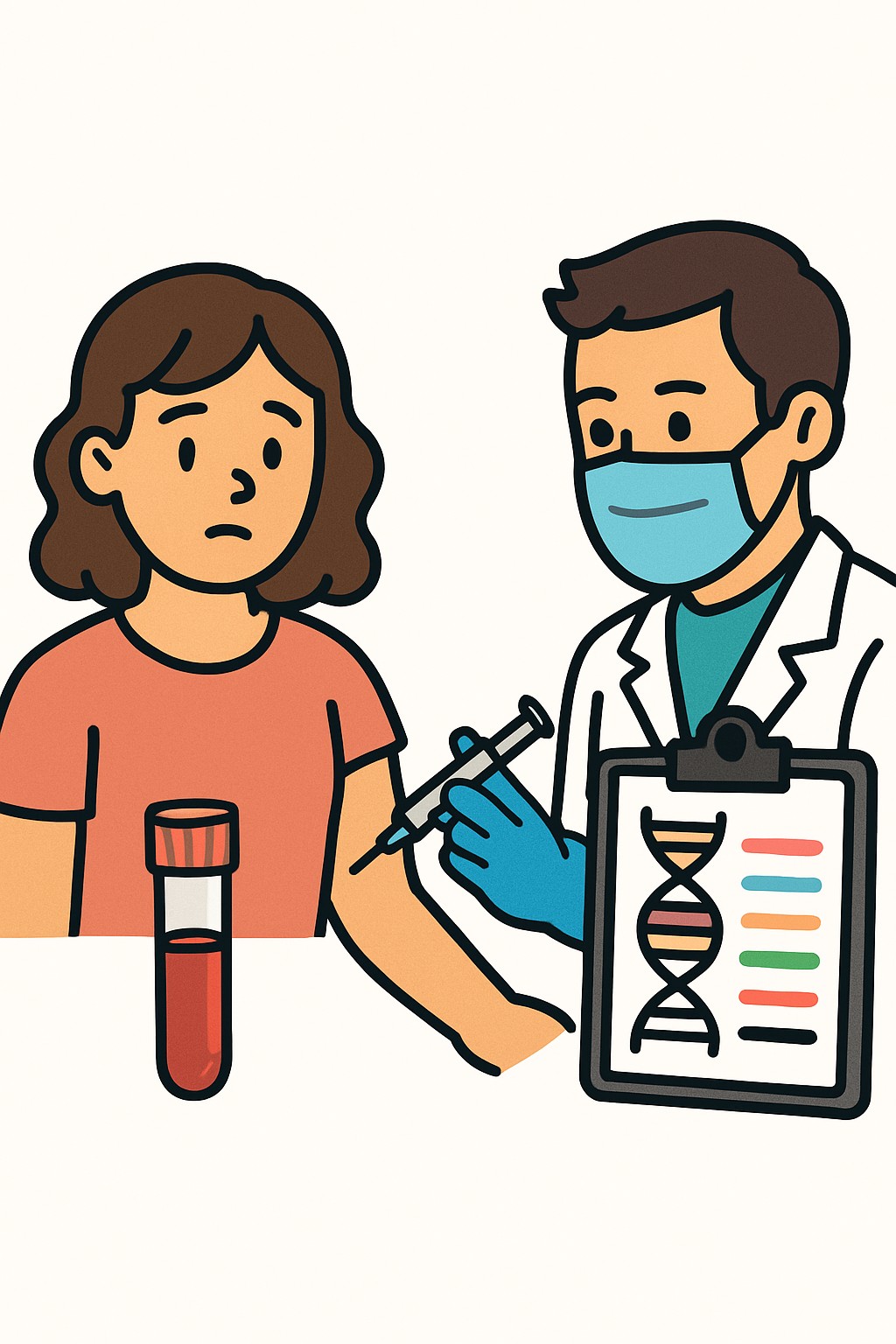
Cystic fibrosis genetic screening (DNA panel) is a lab test that looks for changes in the CFTR gene that can cause cystic fibrosis. It is most often used as a carrier screening test before or during pregnancy to learn if a person carries a CFTR variant (gene change). A sample of blood or saliva is collected. The lab checks a set of common CFTR variants using methods such as targeted genotyping or sequencing. Results usually report whether a CFTR variant was found, not found, or is uncertain. A negative screen lowers the chance of being a carrier but does not rule it out, because no panel finds every possible variant.
Also known as: CF carrier screening, Cystic fibrosis carrier test, CFTR gene panel, CF genetic test
Preparation & Next Steps
Everything you need to know before and after your procedure
Before Care
- Review the test information and consent documents provided by the clinic or lab
- Gather family history of cystic fibrosis and known CFTR variants if available
- Confirm the sample type (blood or saliva) and any collection rules for the kit
- If a family member has a documented CFTR variant, bring a copy of that report
- Ask about typical turnaround time and how and where results will be released
- Check your insurance benefits or ask for an estimate of out-of-pocket costs
- Plan the timing with your partner if they may also be tested
- Verify that your name, date of birth, and contact details match the lab requisition
- Avoid eating, drinking, or smoking just before a saliva sample if the kit instructions require it
- Bring a photo ID and insurance card to the appointment or collection site
After Care
- Expect minor tenderness or bruising at the blood draw site for a day or so
- Keep the collection site clean and dry; watch for increasing redness or swelling
- Look for your results in the patient portal or by the method the lab uses
- Keep a copy of the lab report for your personal records
- Share results with your obstetric, primary care, or genetics team if involved
- If a CFTR variant is reported, partner testing is often offered to clarify reproductive risk
- Ask the lab or clinic whom to contact with questions about uncertain results
- Consider discussing what the results mean for family members who may also be at risk
- Confirm how long the lab stores samples and reports and how your data are protected
- Schedule any recommended follow-up appointments or additional testing if requested by your care team
Clinical Information
Important medical details about this procedure
Indications
- Preconception carrier screening
- Carrier screening during pregnancy
- Family history of cystic fibrosis or known CFTR variant
- Partner has cystic fibrosis or is known to be a carrier
- Follow-up when a fetus or newborn screens positive for possible CFTR-related risk
Alternatives
- Targeted testing for a known familial CFTR variant
- Expanded carrier screening that includes many conditions
- Diagnostic CF testing (sweat chloride test) when CF is suspected clinically
- Prenatal diagnostic testing (CVS or amniocentesis) with CFTR analysis in specific situations
Risks
- Bruising, soreness, or lightheadedness from a blood draw
- Test may miss rare CFTR variants not included on the panel
- Uncertain results that need clarification
- Emotional stress from unexpected findings
- Privacy and insurance concerns related to genetic information
Recovery Timeline
What to expect during your recovery
There is no medical recovery period from the sample collection. Most people return to normal activities right away.
Typical Range
Same day
Return to Work
Same day
Recovery Milestones
Resume normal daily activities after the sample is collected
Expect minor soreness or bruising at the blood draw site, if a blood sample was used
Await lab processing and results release by the clinic or portal
Frequently Asked Questions
Common questions and expert answers about this procedure
What does this test look for?
What does this test look for?
It looks for specific changes in the CFTR gene that are known to cause cystic fibrosis. The exact variants checked depend on the lab panel.
Is this the same as a diagnostic test for cystic fibrosis?
Is this the same as a diagnostic test for cystic fibrosis?
No. This is usually a carrier screen. Diagnosing CF often uses a sweat chloride test and may include detailed CFTR genetic testing when CF is suspected.
How accurate is it?
How accurate is it?
Accuracy is high for the variants included on the panel, but a negative result does not rule out all possible CFTR variants. Detection rates vary by ancestry and panel size.
Do both partners need testing?
Do both partners need testing?
Many clinics screen one partner first. If that person is a carrier, the other partner is often offered testing to better understand the chance of having a child with CF.
How long do results take?
How long do results take?
Timing varies by lab and method. Many panels return results in a few days to a few weeks.
Can a saliva or cheek swab be used?
Can a saliva or cheek swab be used?
Yes. Many labs accept saliva or buccal swabs for DNA. Some clinics prefer a blood sample.
What results might I see?
What results might I see?
Common results include no variant found, carrier of a CFTR variant, two variants suggesting CF, or a variant of uncertain significance that may need clarification.
Is this part of newborn screening?
Is this part of newborn screening?
Newborn screening for CF is separate. It uses blood spots and follow-up tests to see if a baby might have CF.
References
Medical literature and sources