%20--%3e%3csvg%20version='1.0'%20id='Layer_1'%20xmlns='http://www.w3.org/2000/svg'%20xmlns:xlink='http://www.w3.org/1999/xlink'%20x='0px'%20y='0px'%20viewBox='0%200%20755.52%20814.35'%20style='enable-background:new%200%200%20755.52%20814.35;'%20xml:space='preserve'%3e%3cstyle%20type='text/css'%3e%20.st0{fill:%231ae5ce;stroke:%231ae5ce;stroke-width:7;stroke-miterlimit:10;}%20.st1{fill:%23FFFFFF;stroke:%231ae5ce;stroke-width:7;stroke-miterlimit:10;}%20.st2{fill:%231ae5ce;stroke:%23FFFFFF;stroke-width:7;stroke-miterlimit:10;}%20.st3{fill:%23FFFFFF;stroke:%23FFFFFF;stroke-width:6;stroke-miterlimit:10;}%20%3c/style%3e%3cg%20id='Dark_Logo_00000159431215648494653180000015900878925932721032_'%3e%3cpath%20id='shield_00000152259091539869183100000001926543869452564382_'%20class='st0'%20d='M711.13,173.42%20c-3.37-49.07-38.92-44.9-75.96-52.18c-67.4-13.25-130.47-34.47-192.36-63.92c-22.48-10.7-41.88-25.74-65.05-26.28%20c-23.17,0.54-42.58,15.59-65.05,26.28c-61.89,29.45-124.95,50.68-192.36,63.92c-37.04,7.28-72.59,3.11-75.96,52.18%20c-1.55,22.6,0.34,46.4,1.05,68.92c5.99,190.78,52.91,345.39,206.27,466.46c29.71,23.46,74.51,55.8,108.84,70.75%20c5.99,2.61,11.7,3.73,17.21,3.75c5.51-0.02,11.22-1.14,17.21-3.75c34.33-14.95,79.12-47.3,108.84-70.75%20c153.37-121.07,200.28-275.68,206.27-466.46C710.79,219.82,712.68,196.02,711.13,173.42z'/%3e%3cpath%20id='magnifyingglass_00000073685934697636024790000000342567780940956808_'%20class='st1'%20d='M648.78,624.21l-96.64-104.65%20c34.89-40.63,55.98-93.46,55.98-151.21c0-128.27-103.98-232.24-232.24-232.24S143.63,240.08,143.63,368.35%20s103.98,232.24,232.24,232.24c48.87,0,94.21-15.11,131.62-40.89l97.18,105.24c11.25,12.18,30.24,12.93,42.42,1.69l0,0%20C659.27,655.38,660.03,636.39,648.78,624.21z'/%3e%3ccircle%20id='ellipse_00000129904010550392394720000017056154833629780114_'%20class='st2'%20cx='375.87'%20cy='368.35'%20r='181.21'/%3e%3cpath%20id='dollarsign_00000057140127156649725250000003772530148495155891_'%20class='st3'%20d='M362.91,492.03v-23.91%20c0-2.01-1.58-3.69-3.59-3.77c-18.49-0.78-37.12-5.4-49.4-11.83c-1.75-0.92-2.53-3.01-1.76-4.84l5.87-13.89%20c0.86-2.02,3.23-2.88,5.2-1.89c12.94,6.52,30.45,11.44,49.18,11.44c26.02,0,43.6-12.73,43.6-30.43c0-17.08-14.29-27.63-41.4-36.95%20c-37.37-12.42-60.46-26.7-60.46-53.72c0-24.97,20.29-44.11,52.22-49.51c1.8-0.31,3.11-1.89,3.11-3.72v-24.35%20c0-2.09,1.69-3.78,3.78-3.78h15.16c2.09,0,3.78,1.69,3.78,3.78v22.71c0,2.01,1.58,3.67,3.58,3.77c17.85,0.92,30.88,4.75,40.61,9.1%20c1.92,0.86,2.79,3.09,1.94,5.01l-6.08,13.6c-0.85,1.91-3.09,2.77-4.99,1.91c-8.37-3.8-22.38-8.95-42.75-8.95%20c-28.21,0-38.84,14.28-38.84,26.7c0,16.15,13.56,24.22,45.44,35.4c37.74,13.04,56.79,29.19,56.79,56.82%20c0,23.85-19.05,46.23-54.78,52.3c-1.8,0.31-3.11,1.89-3.11,3.72v25.28c0,2.09-1.69,3.78-3.78,3.78h-15.53%20C364.6,495.81,362.91,494.12,362.91,492.03z'/%3e%3c/g%3e%3c/svg%3e)
Cytogenetic study interpretation and report Laboratory Test
A cytogenetic study interpretation and report is the professional review of chromosome-based test results.
Overview
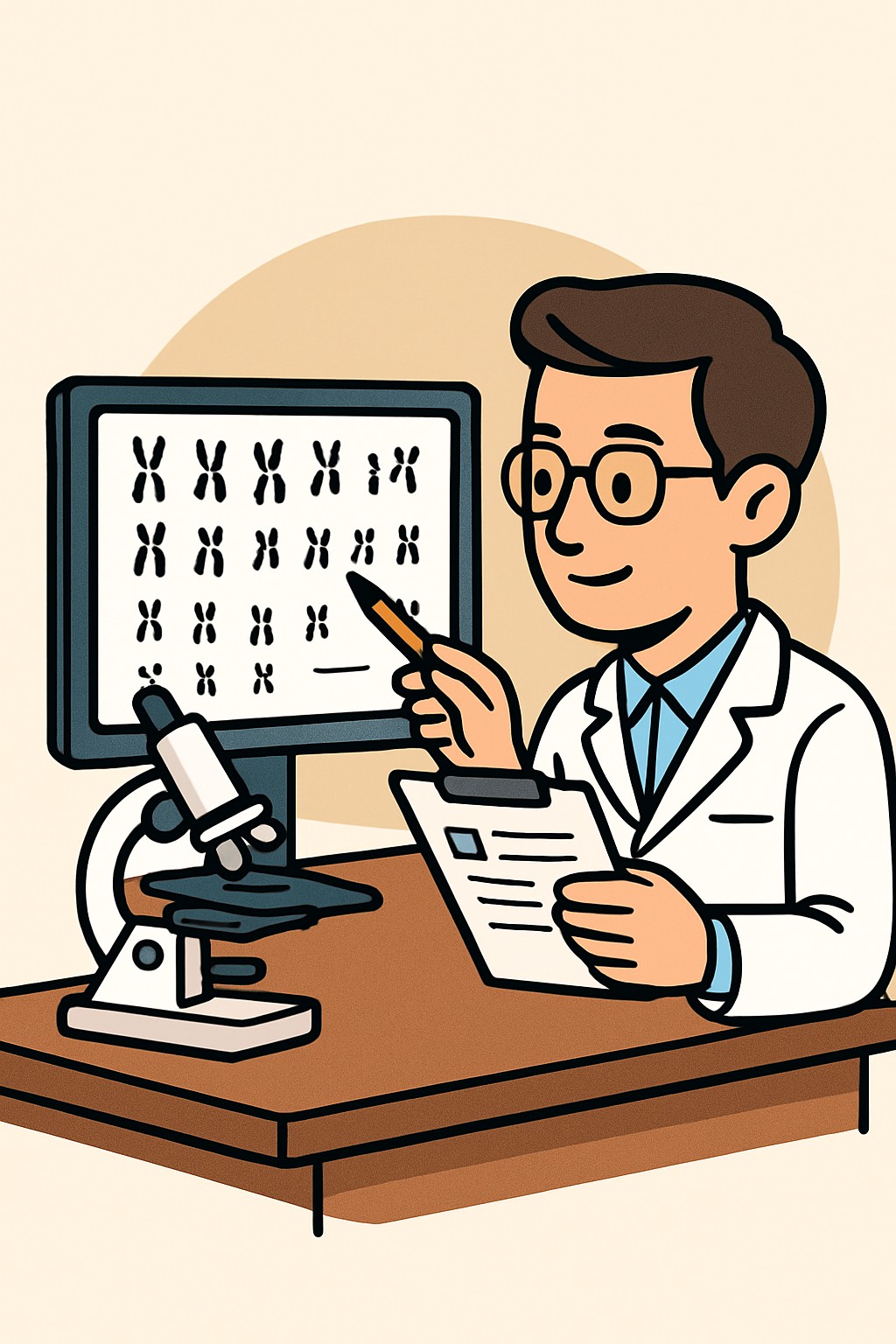
A cytogenetic study interpretation and report is the professional review of chromosome-based test results. A laboratory geneticist or pathologist examines data from tests such as karyotyping, FISH (fluorescence in situ hybridization), or chromosomal microarray and writes a formal report. The report explains what was found, what it may mean for health, how confident the result is, and any test limits. It may include suggestions for follow-up testing or genetic counseling.
Also known as: Cytogenetic analysis report, Karyotype/FISH report, Cytogenomic report
Preparation & Next Steps
Everything you need to know before and after your procedure
Before Care
- Confirm which cytogenetic test was ordered (karyotype, FISH, or microarray) and why it was chosen
- Ensure the lab and clinic have your correct contact information and portal access
- Share key medical and family history that may help interpretation
- Ask about expected turnaround time and how results will be delivered
- Verify insurance coverage and any preauthorization requirements with your plan
- Provide copies of prior genetic or pathology reports for comparison if available
- Clarify preferences for receiving unexpected findings according to lab policy
- Arrange a time to review results with your clinician or a genetic counselor
- If a new sample is needed, follow the collection instructions provided by the clinic
- Keep a personal record of test names, collection dates, and ordering clinician
After Care
- Obtain a copy of the final report and store it in your personal health records
- Schedule time to review the results with your clinician or a genetic counselor
- Discuss whether follow-up testing is recommended for you or relatives
- Ask the clinician to explain any technical terms, limits, or next steps in plain language
- Confirm whether the lab offers reanalysis or updated interpretation in the future
- Share relevant results with other care teams if they affect treatment
- Review how the information will be protected and who can access it
- Contact the ordering clinician with questions about urgent or critical findings noted in the report
- Update your medication list or care plan only if changes are recommended by your care team
- Keep track of any referrals or additional labs linked to the findings
Clinical Information
Important medical details about this procedure
Indications
- Suspected chromosome conditions (for example, Down syndrome or Turner syndrome)
- Developmental delay, intellectual disability, or multiple birth differences
- Prenatal testing after screening results or ultrasound findings
- Recurrent pregnancy loss or infertility workup
- Diagnosis, risk stratification, or treatment monitoring in blood cancers
- Cytogenetic profiling of tumors to guide care
- Family history of a known chromosomal change
Alternatives
- Molecular genetic testing (targeted gene tests, gene panels, exome or genome sequencing)
- Biochemical testing for certain metabolic conditions
- Imaging or clinical observation when appropriate
- Repeat or different tissue sampling if the first sample is not informative
Risks
- Uncertain or inconclusive findings that may not have clear answers
- Unexpected results that may affect family members
- Rare laboratory or interpretation errors
- Privacy and insurance concerns related to genetic information
- Results may not detect all conditions or may miss low-level mosaicism
Contraindications
- Inadequate or contaminated specimen limiting analysis
- Lack of relevant clinical information, which can limit interpretation
- No consent for certain categories of findings according to lab policy
Recovery Timeline
What to expect during your recovery
There is no physical recovery period for an interpretation and report. People usually continue normal activities.
Typical Range
Same day
Return to Work
Same day
Recovery Milestones
Resume normal daily activities
Review the report with a clinician or genetic counselor
Complete any recommended follow-up testing or referrals
Frequently Asked Questions
Common questions and expert answers about this procedure
What is a cytogenetic study interpretation and report?
What is a cytogenetic study interpretation and report?
It is the expert review of chromosome test data and a written summary that explains findings, their meaning, test limits, and suggested next steps.
Which tests are commonly interpreted?
Which tests are commonly interpreted?
Karyotyping, FISH (fluorescence in situ hybridization), and chromosomal microarray are common. The choice depends on the clinical question.
Who interprets the results?
Who interprets the results?
Board-certified laboratory geneticists or pathologists interpret the data and issue the final report.
How long do results take?
How long do results take?
Turnaround time varies by test type, specimen, and lab workflow. Clinics usually provide an estimated time frame.
What can the report show?
What can the report show?
It can show extra or missing chromosome material, structural changes, or specific rearrangements that can aid diagnosis, prognosis, or treatment planning.
What is a variant of uncertain significance?
What is a variant of uncertain significance?
It is a change whose effect on health is not known yet. Over time, new data may allow labs to update the classification.
Will a genetic counselor be involved?
Will a genetic counselor be involved?
Many clinics include genetic counseling to explain results, discuss family implications, and review testing options.
Will my information be private?
Will my information be private?
Genetic information is safeguarded by privacy rules. Ask your clinic and lab how your data are stored, shared, and used.
References
Medical literature and sources