%20--%3e%3csvg%20version='1.0'%20id='Layer_1'%20xmlns='http://www.w3.org/2000/svg'%20xmlns:xlink='http://www.w3.org/1999/xlink'%20x='0px'%20y='0px'%20viewBox='0%200%20755.52%20814.35'%20style='enable-background:new%200%200%20755.52%20814.35;'%20xml:space='preserve'%3e%3cstyle%20type='text/css'%3e%20.st0{fill:%231ae5ce;stroke:%231ae5ce;stroke-width:7;stroke-miterlimit:10;}%20.st1{fill:%23FFFFFF;stroke:%231ae5ce;stroke-width:7;stroke-miterlimit:10;}%20.st2{fill:%231ae5ce;stroke:%23FFFFFF;stroke-width:7;stroke-miterlimit:10;}%20.st3{fill:%23FFFFFF;stroke:%23FFFFFF;stroke-width:6;stroke-miterlimit:10;}%20%3c/style%3e%3cg%20id='Dark_Logo_00000159431215648494653180000015900878925932721032_'%3e%3cpath%20id='shield_00000152259091539869183100000001926543869452564382_'%20class='st0'%20d='M711.13,173.42%20c-3.37-49.07-38.92-44.9-75.96-52.18c-67.4-13.25-130.47-34.47-192.36-63.92c-22.48-10.7-41.88-25.74-65.05-26.28%20c-23.17,0.54-42.58,15.59-65.05,26.28c-61.89,29.45-124.95,50.68-192.36,63.92c-37.04,7.28-72.59,3.11-75.96,52.18%20c-1.55,22.6,0.34,46.4,1.05,68.92c5.99,190.78,52.91,345.39,206.27,466.46c29.71,23.46,74.51,55.8,108.84,70.75%20c5.99,2.61,11.7,3.73,17.21,3.75c5.51-0.02,11.22-1.14,17.21-3.75c34.33-14.95,79.12-47.3,108.84-70.75%20c153.37-121.07,200.28-275.68,206.27-466.46C710.79,219.82,712.68,196.02,711.13,173.42z'/%3e%3cpath%20id='magnifyingglass_00000073685934697636024790000000342567780940956808_'%20class='st1'%20d='M648.78,624.21l-96.64-104.65%20c34.89-40.63,55.98-93.46,55.98-151.21c0-128.27-103.98-232.24-232.24-232.24S143.63,240.08,143.63,368.35%20s103.98,232.24,232.24,232.24c48.87,0,94.21-15.11,131.62-40.89l97.18,105.24c11.25,12.18,30.24,12.93,42.42,1.69l0,0%20C659.27,655.38,660.03,636.39,648.78,624.21z'/%3e%3ccircle%20id='ellipse_00000129904010550392394720000017056154833629780114_'%20class='st2'%20cx='375.87'%20cy='368.35'%20r='181.21'/%3e%3cpath%20id='dollarsign_00000057140127156649725250000003772530148495155891_'%20class='st3'%20d='M362.91,492.03v-23.91%20c0-2.01-1.58-3.69-3.59-3.77c-18.49-0.78-37.12-5.4-49.4-11.83c-1.75-0.92-2.53-3.01-1.76-4.84l5.87-13.89%20c0.86-2.02,3.23-2.88,5.2-1.89c12.94,6.52,30.45,11.44,49.18,11.44c26.02,0,43.6-12.73,43.6-30.43c0-17.08-14.29-27.63-41.4-36.95%20c-37.37-12.42-60.46-26.7-60.46-53.72c0-24.97,20.29-44.11,52.22-49.51c1.8-0.31,3.11-1.89,3.11-3.72v-24.35%20c0-2.09,1.69-3.78,3.78-3.78h15.16c2.09,0,3.78,1.69,3.78,3.78v22.71c0,2.01,1.58,3.67,3.58,3.77c17.85,0.92,30.88,4.75,40.61,9.1%20c1.92,0.86,2.79,3.09,1.94,5.01l-6.08,13.6c-0.85,1.91-3.09,2.77-4.99,1.91c-8.37-3.8-22.38-8.95-42.75-8.95%20c-28.21,0-38.84,14.28-38.84,26.7c0,16.15,13.56,24.22,45.44,35.4c37.74,13.04,56.79,29.19,56.79,56.82%20c0,23.85-19.05,46.23-54.78,52.3c-1.8,0.31-3.11,1.89-3.11,3.72v25.28c0,2.09-1.69,3.78-3.78,3.78h-15.53%20C364.6,495.81,362.91,494.12,362.91,492.03z'/%3e%3c/g%3e%3c/svg%3e)
Fecal occult blood test (immunochemical) Laboratory Test
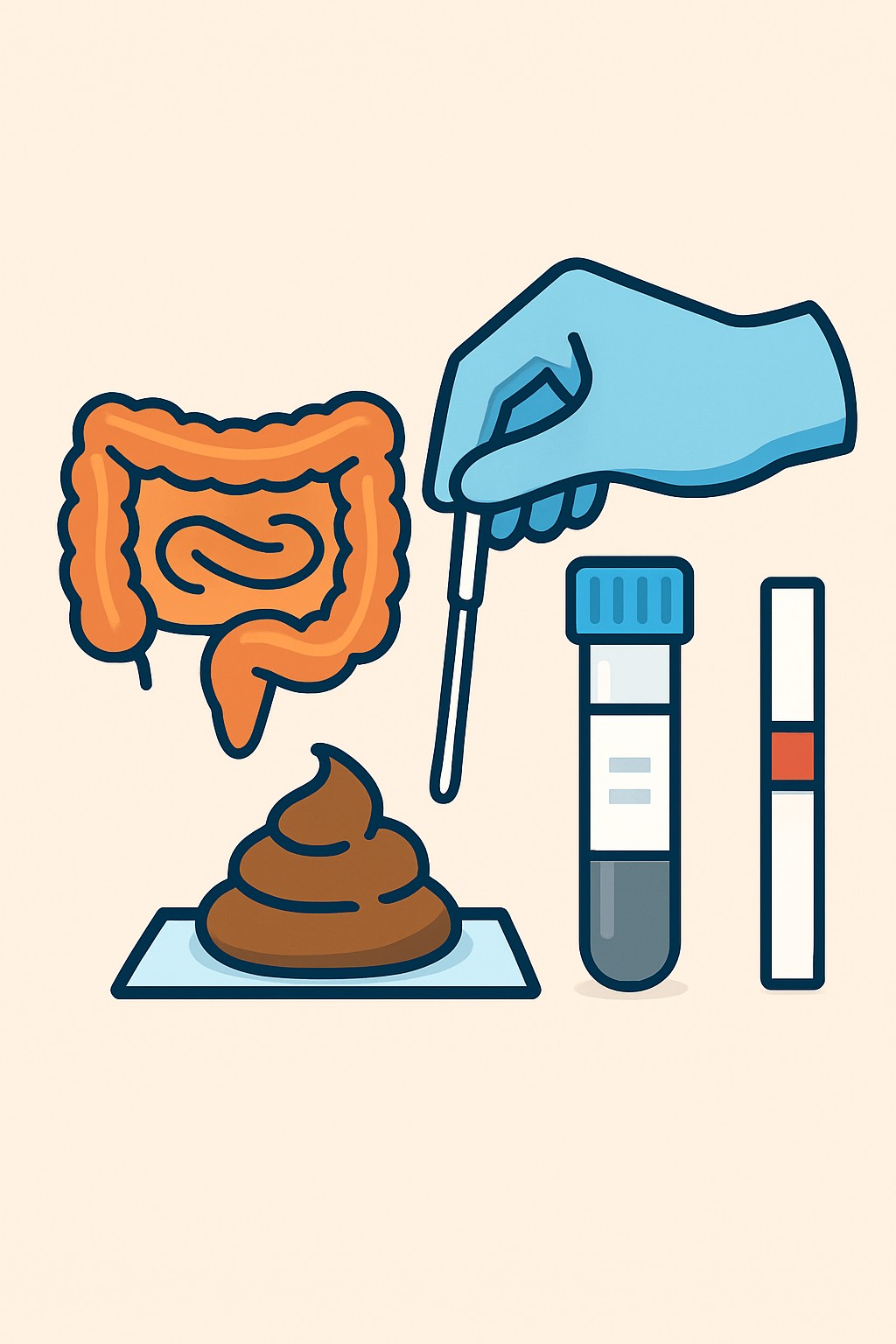
A fecal occult blood test (immunochemical), often called a FIT, is a stool test that looks for tiny amounts of hidden blood.
Overview
A fecal occult blood test (immunochemical), often called a FIT, is a stool test that looks for tiny amounts of hidden blood. It uses antibodies that bind to human hemoglobin, a protein in red blood cells. This test is commonly used for colorectal cancer screening. It does not diagnose cancer. A positive result means blood was detected and more testing, often a colonoscopy, is typically used to look for the source.
Also known as: FIT, iFOBT, Fecal immunochemical test, Immunochemical fecal occult blood test
Preparation & Next Steps
Everything you need to know before and after your procedure
Before Care
- Read the kit instructions fully and check the expiration date before starting
- No diet or medication changes are usually needed for FIT, unlike some older stool tests
- Plan ahead for how to return or mail the kit and confirm the address and hours if dropping off
- Avoid collecting a sample during menstrual bleeding, active hemorrhoid bleeding, or urinary bleeding
- Use the collection materials provided to keep stool free of urine and toilet water
- Label the sample as instructed with the date and any other required details
- Store and handle the sample as directed; keep away from heat and direct sunlight
- Wash hands before and after collection; use gloves if provided
- Confirm how you will receive results (patient portal, phone call, or mail)
After Care
- Seal and return or mail the kit promptly according to the instructions
- Note the date and time you mailed or dropped off the sample to track timing
- Check your portal or messages for results and any next steps
- Understand that a positive result means blood was detected and evaluation with colonoscopy is commonly used to find the source
- A negative result does not rule out colorectal cancer; many screening programs repeat FIT at regular intervals
- If results are invalid or inconclusive, a repeat sample may be needed
- Contact your clinician if you notice new or heavy rectal bleeding, black stools, or ongoing abdominal pain
Clinical Information
Important medical details about this procedure
Indications
- Screening for colorectal cancer and large polyps in average-risk adults
- A stool-based option when colonoscopy is not chosen for primary screening
- Programmatic screening to be repeated at regular intervals
Alternatives
- Guaiac-based fecal occult blood test (gFOBT)
- Stool DNA test with FIT (sDNA-FIT)
- Colonoscopy
- Flexible sigmoidoscopy
- CT colonography
Risks
- False positive result leading to additional testing such as colonoscopy
- False negative result that misses blood from time to time
- Sample mix-up or handling errors causing invalid or delayed results
- Anxiety while waiting for results
- Improper storage or mailing delays that may affect the sample
Contraindications
- Not intended as a stand-alone diagnostic test for symptoms like ongoing rectal bleeding or iron-deficiency anemia
- Collection during active menstrual bleeding or significant hemorrhoid bleeding
- High-risk conditions where colonoscopy-based surveillance is commonly used (such as certain hereditary syndromes or prior colorectal cancer)
Recovery Timeline
What to expect during your recovery
FIT is an at-home stool test and does not require recovery time. Most people continue normal activities right away.
Typical Range
Same day
Return to Work
Same day
Recovery Milestones
Collect the stool sample at home and resume normal activities
Return or mail the kit as instructed
Review results when available and confirm next steps if needed
Frequently Asked Questions
Common questions and expert answers about this procedure
What does the immunochemical fecal occult blood test detect?
What does the immunochemical fecal occult blood test detect?
It detects small amounts of human blood in stool using antibodies to hemoglobin. It is designed to find bleeding from the lower digestive tract.
How is FIT different from the guaiac fecal occult blood test (gFOBT)?
How is FIT different from the guaiac fecal occult blood test (gFOBT)?
FIT uses antibodies to human hemoglobin and generally does not require diet or medication restrictions. gFOBT uses a chemical reaction and can be affected by certain foods and medicines.
How often is FIT used for screening?
How often is FIT used for screening?
Many screening programs use FIT every year for average-risk adults starting at age 45, based on recommendations from national guideline groups.
Do I need to change my diet or stop medicines before FIT?
Do I need to change my diet or stop medicines before FIT?
No special diet or medication changes are typically needed for FIT, unlike some older stool tests.
What happens if my FIT is positive?
What happens if my FIT is positive?
A positive result means blood was found in the stool. Colonoscopy is commonly used to look for the cause, such as a polyp or other source of bleeding.
Can FIT detect bleeding from the stomach or upper intestines?
Can FIT detect bleeding from the stomach or upper intestines?
FIT is more specific for lower intestinal bleeding. Hemoglobin from upper intestinal bleeding may break down before it reaches the stool, so FIT may not detect it.
When should I avoid collecting the sample?
When should I avoid collecting the sample?
Avoid collecting during menstrual bleeding, active hemorrhoid bleeding, or if urine contaminated the sample. Wait until bleeding has stopped and follow the kit instructions.
References
Medical literature and sources