%20--%3e%3csvg%20version='1.0'%20id='Layer_1'%20xmlns='http://www.w3.org/2000/svg'%20xmlns:xlink='http://www.w3.org/1999/xlink'%20x='0px'%20y='0px'%20viewBox='0%200%20755.52%20814.35'%20style='enable-background:new%200%200%20755.52%20814.35;'%20xml:space='preserve'%3e%3cstyle%20type='text/css'%3e%20.st0{fill:%231ae5ce;stroke:%231ae5ce;stroke-width:7;stroke-miterlimit:10;}%20.st1{fill:%23FFFFFF;stroke:%231ae5ce;stroke-width:7;stroke-miterlimit:10;}%20.st2{fill:%231ae5ce;stroke:%23FFFFFF;stroke-width:7;stroke-miterlimit:10;}%20.st3{fill:%23FFFFFF;stroke:%23FFFFFF;stroke-width:6;stroke-miterlimit:10;}%20%3c/style%3e%3cg%20id='Dark_Logo_00000159431215648494653180000015900878925932721032_'%3e%3cpath%20id='shield_00000152259091539869183100000001926543869452564382_'%20class='st0'%20d='M711.13,173.42%20c-3.37-49.07-38.92-44.9-75.96-52.18c-67.4-13.25-130.47-34.47-192.36-63.92c-22.48-10.7-41.88-25.74-65.05-26.28%20c-23.17,0.54-42.58,15.59-65.05,26.28c-61.89,29.45-124.95,50.68-192.36,63.92c-37.04,7.28-72.59,3.11-75.96,52.18%20c-1.55,22.6,0.34,46.4,1.05,68.92c5.99,190.78,52.91,345.39,206.27,466.46c29.71,23.46,74.51,55.8,108.84,70.75%20c5.99,2.61,11.7,3.73,17.21,3.75c5.51-0.02,11.22-1.14,17.21-3.75c34.33-14.95,79.12-47.3,108.84-70.75%20c153.37-121.07,200.28-275.68,206.27-466.46C710.79,219.82,712.68,196.02,711.13,173.42z'/%3e%3cpath%20id='magnifyingglass_00000073685934697636024790000000342567780940956808_'%20class='st1'%20d='M648.78,624.21l-96.64-104.65%20c34.89-40.63,55.98-93.46,55.98-151.21c0-128.27-103.98-232.24-232.24-232.24S143.63,240.08,143.63,368.35%20s103.98,232.24,232.24,232.24c48.87,0,94.21-15.11,131.62-40.89l97.18,105.24c11.25,12.18,30.24,12.93,42.42,1.69l0,0%20C659.27,655.38,660.03,636.39,648.78,624.21z'/%3e%3ccircle%20id='ellipse_00000129904010550392394720000017056154833629780114_'%20class='st2'%20cx='375.87'%20cy='368.35'%20r='181.21'/%3e%3cpath%20id='dollarsign_00000057140127156649725250000003772530148495155891_'%20class='st3'%20d='M362.91,492.03v-23.91%20c0-2.01-1.58-3.69-3.59-3.77c-18.49-0.78-37.12-5.4-49.4-11.83c-1.75-0.92-2.53-3.01-1.76-4.84l5.87-13.89%20c0.86-2.02,3.23-2.88,5.2-1.89c12.94,6.52,30.45,11.44,49.18,11.44c26.02,0,43.6-12.73,43.6-30.43c0-17.08-14.29-27.63-41.4-36.95%20c-37.37-12.42-60.46-26.7-60.46-53.72c0-24.97,20.29-44.11,52.22-49.51c1.8-0.31,3.11-1.89,3.11-3.72v-24.35%20c0-2.09,1.69-3.78,3.78-3.78h15.16c2.09,0,3.78,1.69,3.78,3.78v22.71c0,2.01,1.58,3.67,3.58,3.77c17.85,0.92,30.88,4.75,40.61,9.1%20c1.92,0.86,2.79,3.09,1.94,5.01l-6.08,13.6c-0.85,1.91-3.09,2.77-4.99,1.91c-8.37-3.8-22.38-8.95-42.75-8.95%20c-28.21,0-38.84,14.28-38.84,26.7c0,16.15,13.56,24.22,45.44,35.4c37.74,13.04,56.79,29.19,56.79,56.82%20c0,23.85-19.05,46.23-54.78,52.3c-1.8,0.31-3.11,1.89-3.11,3.72v25.28c0,2.09-1.69,3.78-3.78,3.78h-15.53%20C364.6,495.81,362.91,494.12,362.91,492.03z'/%3e%3c/g%3e%3c/svg%3e)
Flow cytometry immunophenotyping (cell analysis) Laboratory Test
Flow cytometry immunophenotyping is a laboratory test that measures proteins on the surface or inside cells to identify what types of cells are present.
Overview
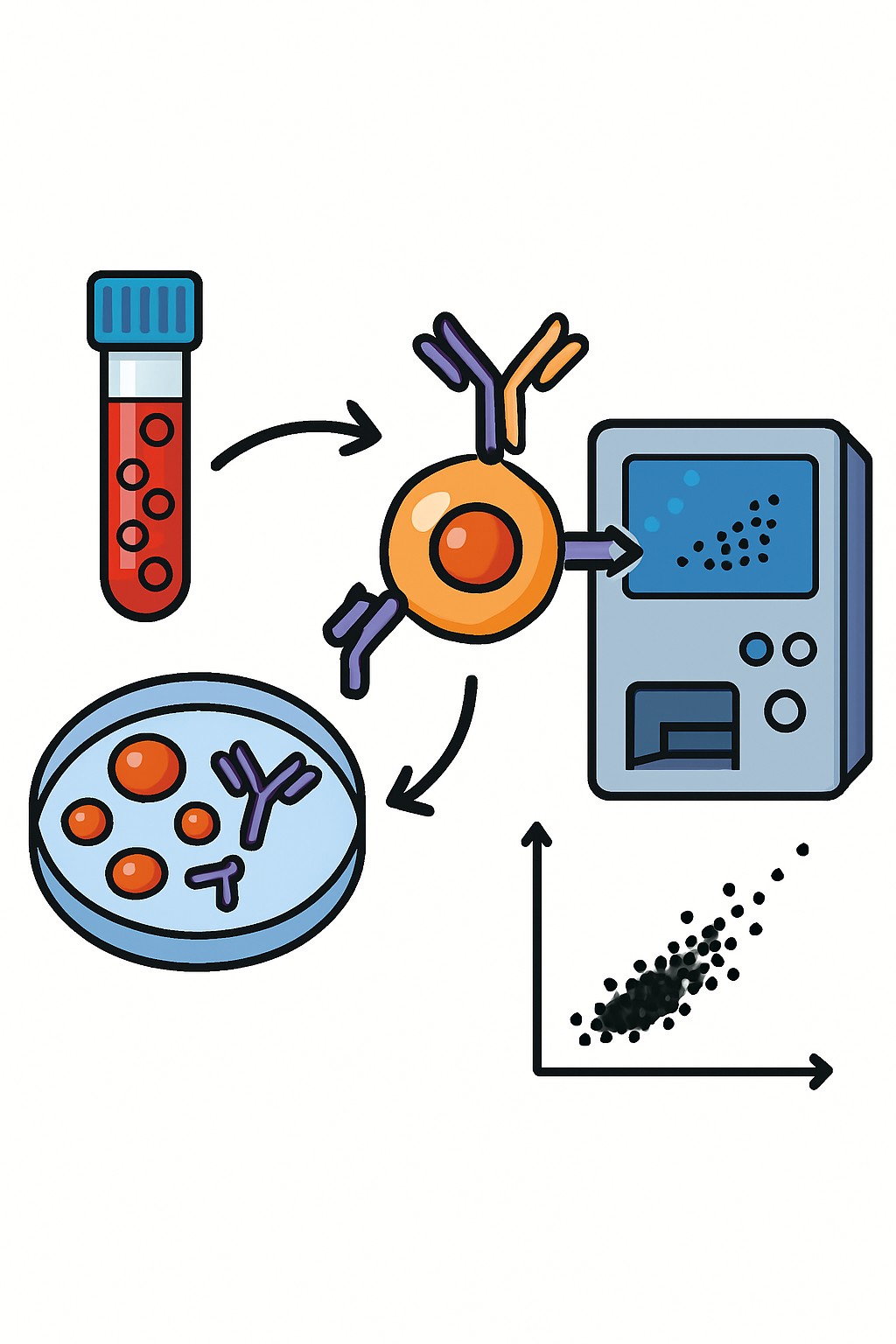
Flow cytometry immunophenotyping is a laboratory test that measures proteins on the surface or inside cells to identify what types of cells are present. A machine shines lasers on cells in a fluid stream and reads signals from attached antibodies that light up specific cell markers. This test helps classify blood and immune cells, detect abnormal cell populations, and track changes over time. It is commonly used in evaluating blood cancers, immune system problems, and certain blood disorders.
Also known as: Flow cytometry, Immunophenotyping, Flow cytometric analysis, Leukemia/lymphoma flow panel
Preparation & Next Steps
Everything you need to know before and after your procedure
Before Care
- Verify test orders, ID, and where the specimen will be collected
- Most flow cytometry tests do not require fasting; follow any clinic instructions if given
- Bring a current list of medicines and supplements for the lab to record
- Ask the ordering clinic if any time-of-day or transport requirements apply to the sample
- Wear short sleeves or loose clothing for an easier blood draw
- Plan extra time if a biopsy or bone marrow sample may also be collected
- Arrange a ride if sedatives or anesthesia are planned for a biopsy
- Tell staff about allergies to tape, latex, or antiseptics
- Hydrate with water unless you were told not to for another test
After Care
- Keep the bandage on the draw site as instructed and keep the area clean and dry
- Apply gentle pressure if minor oozing occurs at the puncture site
- Expect mild soreness or bruising; it usually fades over several days
- If a biopsy was done, follow the site care instructions provided by the clinic
- Avoid heavy lifting with the affected arm for the rest of the day if sore
- Drink fluids and have a snack if you felt lightheaded during the draw
- Watch for increasing redness, warmth, swelling, pus, or fever and contact the clinic if these occur
- Check your portal or with the ordering clinic for when results are expected
- Keep a copy of the lab report for your records and future comparisons
Clinical Information
Important medical details about this procedure
Indications
- Evaluate suspected leukemia or lymphoma
- Classify blood cancers by cell type and markers
- Monitor treatment response or minimal residual disease
- Assess immune function, such as CD4 counts in HIV
- Investigate unexplained high or low white blood cell counts
- Evaluate suspected paroxysmal nocturnal hemoglobinuria (PNH)
- Monitor immune recovery after transplant or therapy
Alternatives
- Microscopic review of blood smear or tissue
- Immunohistochemistry on biopsy tissue
- Cytogenetics or karyotyping
- Fluorescence in situ hybridization (FISH)
- PCR or next-generation sequencing for gene changes
- Serology or antibody titer tests
- Manual differential blood counts
Risks
- Bruising, soreness, or bleeding at the blood draw site
- Infection at a biopsy site if tissue or bone marrow is collected
- Lightheadedness or fainting with blood draws
- Allergic reaction to antiseptics or adhesives is rare
- False positives or false negatives if sample quality is poor or markers overlap
Contraindications
- Active skin infection at the planned draw or biopsy site
- Uncontrolled bleeding disorder or very low platelets for invasive sampling
- Known severe allergy to local anesthetics or antiseptics used for biopsy
Recovery Timeline
What to expect during your recovery
Most people resume normal activities right after a blood draw. If a tissue or bone marrow sample is taken, the area may be sore for 1 to 3 days.
Typical Range
0–3 days
Return to Work
0–1 days
Recovery Milestones
Resume light daily activities
Keep bandage in place and site clean after blood draw
Biopsy site soreness typically improves
Bruising at the draw site gradually fades
Frequently Asked Questions
Common questions and expert answers about this procedure
What is flow cytometry immunophenotyping?
What is flow cytometry immunophenotyping?
It is a lab method that uses lasers and antibody tags to identify cell types based on their markers, helping map normal and abnormal cell populations.
What samples are used for this test?
What samples are used for this test?
Common samples are blood, bone marrow, and tissue or lymph node fluid. The ordering clinician chooses the sample based on the question being asked.
Do I need to fast or stop medicines?
Do I need to fast or stop medicines?
Most flow cytometry tests do not need fasting. Medicine changes are not routine for this test; follow any instructions from the ordering clinic.
How long do results take?
How long do results take?
Timing varies by lab and panel complexity. Many reports are available within a few days, while specialized panels can take longer.
What do CD markers mean?
What do CD markers mean?
CD markers are proteins on cells. Their pattern helps identify cell types, such as T cells or B cells, and can show if cells are abnormal.
Can this test diagnose cancer by itself?
Can this test diagnose cancer by itself?
Flow results are interpreted with other information, such as a biopsy, imaging, or genetic tests. Diagnosis usually relies on the full picture.
Are there risks from the test?
Are there risks from the test?
Risks come from collecting the sample. Blood draws can cause bruising or lightheadedness. Biopsies can cause soreness, bleeding, or infection.
References
Medical literature and sources