%20--%3e%3csvg%20version='1.0'%20id='Layer_1'%20xmlns='http://www.w3.org/2000/svg'%20xmlns:xlink='http://www.w3.org/1999/xlink'%20x='0px'%20y='0px'%20viewBox='0%200%20755.52%20814.35'%20style='enable-background:new%200%200%20755.52%20814.35;'%20xml:space='preserve'%3e%3cstyle%20type='text/css'%3e%20.st0{fill:%231ae5ce;stroke:%231ae5ce;stroke-width:7;stroke-miterlimit:10;}%20.st1{fill:%23FFFFFF;stroke:%231ae5ce;stroke-width:7;stroke-miterlimit:10;}%20.st2{fill:%231ae5ce;stroke:%23FFFFFF;stroke-width:7;stroke-miterlimit:10;}%20.st3{fill:%23FFFFFF;stroke:%23FFFFFF;stroke-width:6;stroke-miterlimit:10;}%20%3c/style%3e%3cg%20id='Dark_Logo_00000159431215648494653180000015900878925932721032_'%3e%3cpath%20id='shield_00000152259091539869183100000001926543869452564382_'%20class='st0'%20d='M711.13,173.42%20c-3.37-49.07-38.92-44.9-75.96-52.18c-67.4-13.25-130.47-34.47-192.36-63.92c-22.48-10.7-41.88-25.74-65.05-26.28%20c-23.17,0.54-42.58,15.59-65.05,26.28c-61.89,29.45-124.95,50.68-192.36,63.92c-37.04,7.28-72.59,3.11-75.96,52.18%20c-1.55,22.6,0.34,46.4,1.05,68.92c5.99,190.78,52.91,345.39,206.27,466.46c29.71,23.46,74.51,55.8,108.84,70.75%20c5.99,2.61,11.7,3.73,17.21,3.75c5.51-0.02,11.22-1.14,17.21-3.75c34.33-14.95,79.12-47.3,108.84-70.75%20c153.37-121.07,200.28-275.68,206.27-466.46C710.79,219.82,712.68,196.02,711.13,173.42z'/%3e%3cpath%20id='magnifyingglass_00000073685934697636024790000000342567780940956808_'%20class='st1'%20d='M648.78,624.21l-96.64-104.65%20c34.89-40.63,55.98-93.46,55.98-151.21c0-128.27-103.98-232.24-232.24-232.24S143.63,240.08,143.63,368.35%20s103.98,232.24,232.24,232.24c48.87,0,94.21-15.11,131.62-40.89l97.18,105.24c11.25,12.18,30.24,12.93,42.42,1.69l0,0%20C659.27,655.38,660.03,636.39,648.78,624.21z'/%3e%3ccircle%20id='ellipse_00000129904010550392394720000017056154833629780114_'%20class='st2'%20cx='375.87'%20cy='368.35'%20r='181.21'/%3e%3cpath%20id='dollarsign_00000057140127156649725250000003772530148495155891_'%20class='st3'%20d='M362.91,492.03v-23.91%20c0-2.01-1.58-3.69-3.59-3.77c-18.49-0.78-37.12-5.4-49.4-11.83c-1.75-0.92-2.53-3.01-1.76-4.84l5.87-13.89%20c0.86-2.02,3.23-2.88,5.2-1.89c12.94,6.52,30.45,11.44,49.18,11.44c26.02,0,43.6-12.73,43.6-30.43c0-17.08-14.29-27.63-41.4-36.95%20c-37.37-12.42-60.46-26.7-60.46-53.72c0-24.97,20.29-44.11,52.22-49.51c1.8-0.31,3.11-1.89,3.11-3.72v-24.35%20c0-2.09,1.69-3.78,3.78-3.78h15.16c2.09,0,3.78,1.69,3.78,3.78v22.71c0,2.01,1.58,3.67,3.58,3.77c17.85,0.92,30.88,4.75,40.61,9.1%20c1.92,0.86,2.79,3.09,1.94,5.01l-6.08,13.6c-0.85,1.91-3.09,2.77-4.99,1.91c-8.37-3.8-22.38-8.95-42.75-8.95%20c-28.21,0-38.84,14.28-38.84,26.7c0,16.15,13.56,24.22,45.44,35.4c37.74,13.04,56.79,29.19,56.79,56.82%20c0,23.85-19.05,46.23-54.78,52.3c-1.8,0.31-3.11,1.89-3.11,3.72v25.28c0,2.09-1.69,3.78-3.78,3.78h-15.53%20C364.6,495.81,362.91,494.12,362.91,492.03z'/%3e%3c/g%3e%3c/svg%3e)
Genetic Testing Panel (BRCA1/2 analysis) Laboratory Test
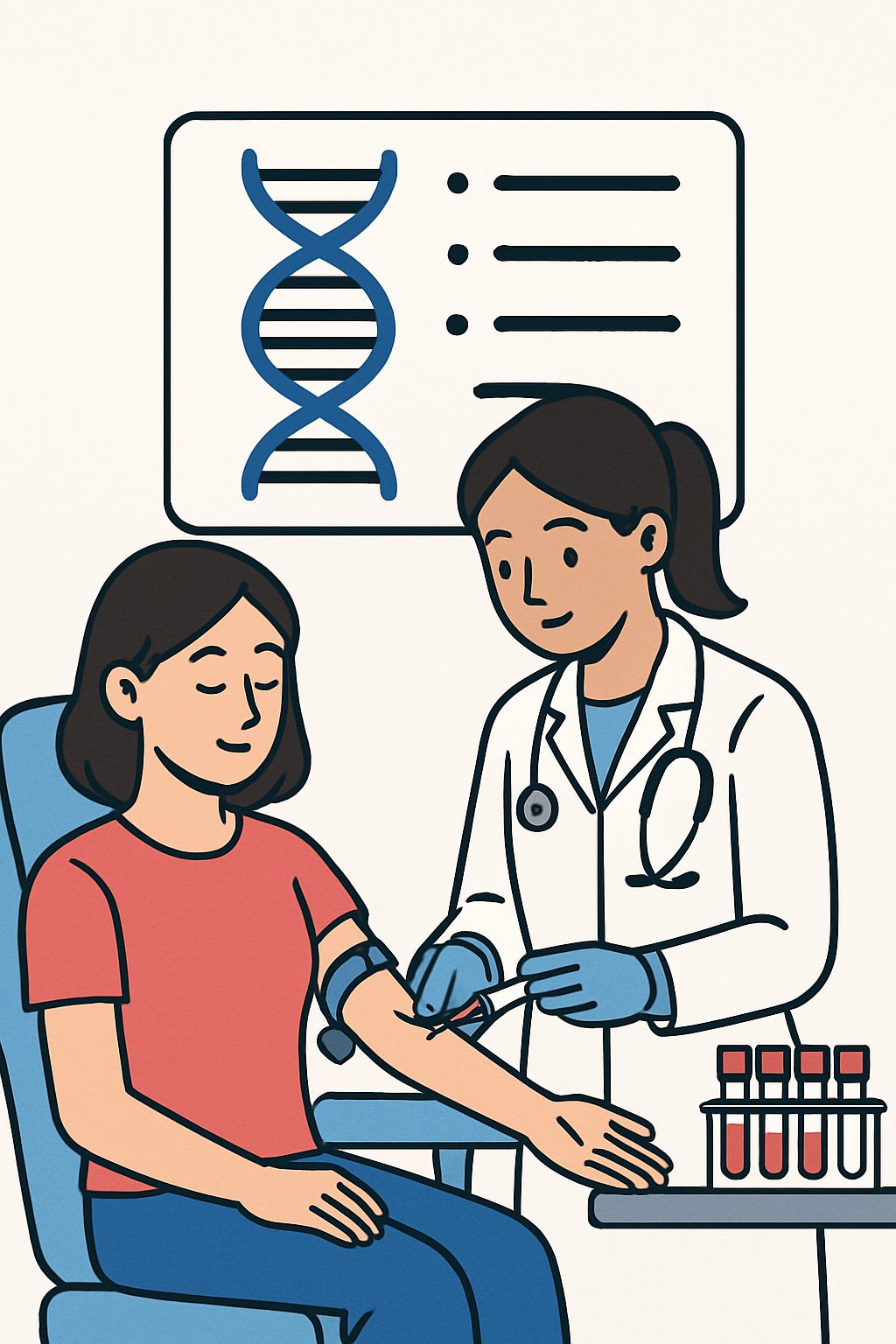
A BRCA1/2 genetic testing panel analyzes the BRCA1 and BRCA2 genes using a blood or saliva sample.
Overview
A BRCA1/2 genetic testing panel analyzes the BRCA1 and BRCA2 genes using a blood or saliva sample. It looks for inherited changes, called variants, that are linked to higher risks for certain cancers. This test does not diagnose cancer. It estimates inherited risk and may inform screening or risk‑reduction choices. Some panels include only BRCA1/2, while others include additional hereditary cancer genes.
Also known as: BRCA test, BRCA1 and BRCA2 genetic testing, Hereditary breast and ovarian cancer testing, BRCA panel
Preparation & Next Steps
Everything you need to know before and after your procedure
Before Care
- Review consent materials so you understand benefits, limits, and privacy terms
- Gather family history details (who had cancer, type, age at diagnosis, and side of the family)
- Confirm which genes are included; some panels analyze only BRCA1/2 while others add more genes
- Ask how the sample will be collected (blood draw or saliva) and where collection will occur
- Follow kit instructions for sample collection, labeling, and shipping if using a mail‑in kit
- Verify how and when results will be delivered (patient portal, phone call, or written report)
- Check whether your insurance requires prior authorization and what costs might apply
- Bring a government ID and insurance information if providing a sample in person
- Plan time for pre‑test education; genetic counseling may be offered by the clinic or lab
- Clarify the lab’s policies on data storage, sharing, and research opt‑in or opt‑out
After Care
- Keep a copy of the full lab report, including any variant details
- Results may be positive, negative, or a variant of uncertain significance; ask for an explanation of your report
- Share the report with clinicians involved in your care so it is in your medical record
- Some findings can have implications for relatives; labs or counselors often provide family communication resources
- If the lab reports an insufficient sample or failed test, arrange a recollection per the lab’s instructions
- Review the lab’s privacy settings and any options to limit data sharing
- Monitor billing statements and contact the lab or insurer with questions about charges
- Schedule time to review results; a follow‑up discussion may be offered by the clinic or lab
- Contact a clinician if you experience distress, confusion, or new questions after receiving results
Clinical Information
Important medical details about this procedure
Indications
- Personal history of breast cancer, especially at a young age
- Triple‑negative breast cancer diagnosed before age 60
- Ovarian, fallopian tube, or primary peritoneal cancer at any age
- Male breast cancer
- Pancreatic or metastatic prostate cancer
- Multiple close relatives with breast, ovarian, pancreatic, or prostate cancer
- Known BRCA1/2 variant in the family
- Ashkenazi Jewish ancestry with personal or family history of related cancers
Alternatives
- Targeted testing for a known family variant
- Broader hereditary cancer panel that includes additional genes
- Testing an affected relative first to clarify the familial variant
- Managing cancer risk based on personal and family history without genetic testing
- Tumor genomic testing (for treatment planning) when relevant; this is different from germline testing
Risks
- Emotional distress or anxiety related to results
- Privacy and data‑sharing concerns
- Potential effects on life, disability, or long‑term care insurance coverage
- Uncertain results such as a variant of uncertain significance (VUS)
- Out‑of‑pocket costs depending on coverage and financial assistance
- Possible need for repeat sampling if the first sample is inadequate
Contraindications
- Inability to provide informed consent
- Unclear test scope or lack of pre‑test information
- Unresolved privacy or data‑use concerns
- Insufficient or compromised sample that cannot be tested
Recovery Timeline
What to expect during your recovery
There is no physical recovery period for providing a saliva sample or blood draw for BRCA1/2 testing. Most people return to normal activities right away.
Typical Range
Same day
Return to Work
Same day
Recovery Milestones
Resume normal daily activities
Confirm the lab has received the sample and that contact details for results are correct
Review the report when available and plan any recommended follow‑up discussions
Frequently Asked Questions
Common questions and expert answers about this procedure
What does BRCA1/2 testing look for?
What does BRCA1/2 testing look for?
It looks for inherited changes in the BRCA1 and BRCA2 genes that are linked to higher risks for certain cancers.
How is the sample collected?
How is the sample collected?
Most labs use either a blood draw or a saliva sample. Both provide DNA for analysis.
Will this test tell me if I have cancer now?
Will this test tell me if I have cancer now?
No. It estimates inherited risk. It does not detect or rule out an existing cancer.
What do positive, negative, and VUS results mean?
What do positive, negative, and VUS results mean?
Positive means a harmful variant was found; negative means none was found; VUS means a change was found but its impact on risk is unknown.
Who typically considers BRCA1/2 testing?
Who typically considers BRCA1/2 testing?
People with certain personal or family histories of breast, ovarian, pancreatic, or prostate cancer, or families with a known BRCA variant.
How long do results take?
How long do results take?
Turnaround times vary by lab. Many results are available within days to weeks.
Is my genetic information protected?
Is my genetic information protected?
Federal law (GINA) generally bars genetic discrimination in health insurance and employment, but it does not cover life, disability, or long‑term care insurance.
What is the difference between BRCA‑only testing and a larger panel?
What is the difference between BRCA‑only testing and a larger panel?
BRCA‑only testing focuses on BRCA1/2. Larger panels analyze additional genes that can also affect cancer risk.
References
Medical literature and sources