%20--%3e%3csvg%20version='1.0'%20id='Layer_1'%20xmlns='http://www.w3.org/2000/svg'%20xmlns:xlink='http://www.w3.org/1999/xlink'%20x='0px'%20y='0px'%20viewBox='0%200%20755.52%20814.35'%20style='enable-background:new%200%200%20755.52%20814.35;'%20xml:space='preserve'%3e%3cstyle%20type='text/css'%3e%20.st0{fill:%231ae5ce;stroke:%231ae5ce;stroke-width:7;stroke-miterlimit:10;}%20.st1{fill:%23FFFFFF;stroke:%231ae5ce;stroke-width:7;stroke-miterlimit:10;}%20.st2{fill:%231ae5ce;stroke:%23FFFFFF;stroke-width:7;stroke-miterlimit:10;}%20.st3{fill:%23FFFFFF;stroke:%23FFFFFF;stroke-width:6;stroke-miterlimit:10;}%20%3c/style%3e%3cg%20id='Dark_Logo_00000159431215648494653180000015900878925932721032_'%3e%3cpath%20id='shield_00000152259091539869183100000001926543869452564382_'%20class='st0'%20d='M711.13,173.42%20c-3.37-49.07-38.92-44.9-75.96-52.18c-67.4-13.25-130.47-34.47-192.36-63.92c-22.48-10.7-41.88-25.74-65.05-26.28%20c-23.17,0.54-42.58,15.59-65.05,26.28c-61.89,29.45-124.95,50.68-192.36,63.92c-37.04,7.28-72.59,3.11-75.96,52.18%20c-1.55,22.6,0.34,46.4,1.05,68.92c5.99,190.78,52.91,345.39,206.27,466.46c29.71,23.46,74.51,55.8,108.84,70.75%20c5.99,2.61,11.7,3.73,17.21,3.75c5.51-0.02,11.22-1.14,17.21-3.75c34.33-14.95,79.12-47.3,108.84-70.75%20c153.37-121.07,200.28-275.68,206.27-466.46C710.79,219.82,712.68,196.02,711.13,173.42z'/%3e%3cpath%20id='magnifyingglass_00000073685934697636024790000000342567780940956808_'%20class='st1'%20d='M648.78,624.21l-96.64-104.65%20c34.89-40.63,55.98-93.46,55.98-151.21c0-128.27-103.98-232.24-232.24-232.24S143.63,240.08,143.63,368.35%20s103.98,232.24,232.24,232.24c48.87,0,94.21-15.11,131.62-40.89l97.18,105.24c11.25,12.18,30.24,12.93,42.42,1.69l0,0%20C659.27,655.38,660.03,636.39,648.78,624.21z'/%3e%3ccircle%20id='ellipse_00000129904010550392394720000017056154833629780114_'%20class='st2'%20cx='375.87'%20cy='368.35'%20r='181.21'/%3e%3cpath%20id='dollarsign_00000057140127156649725250000003772530148495155891_'%20class='st3'%20d='M362.91,492.03v-23.91%20c0-2.01-1.58-3.69-3.59-3.77c-18.49-0.78-37.12-5.4-49.4-11.83c-1.75-0.92-2.53-3.01-1.76-4.84l5.87-13.89%20c0.86-2.02,3.23-2.88,5.2-1.89c12.94,6.52,30.45,11.44,49.18,11.44c26.02,0,43.6-12.73,43.6-30.43c0-17.08-14.29-27.63-41.4-36.95%20c-37.37-12.42-60.46-26.7-60.46-53.72c0-24.97,20.29-44.11,52.22-49.51c1.8-0.31,3.11-1.89,3.11-3.72v-24.35%20c0-2.09,1.69-3.78,3.78-3.78h15.16c2.09,0,3.78,1.69,3.78,3.78v22.71c0,2.01,1.58,3.67,3.58,3.77c17.85,0.92,30.88,4.75,40.61,9.1%20c1.92,0.86,2.79,3.09,1.94,5.01l-6.08,13.6c-0.85,1.91-3.09,2.77-4.99,1.91c-8.37-3.8-22.38-8.95-42.75-8.95%20c-28.21,0-38.84,14.28-38.84,26.7c0,16.15,13.56,24.22,45.44,35.4c37.74,13.04,56.79,29.19,56.79,56.82%20c0,23.85-19.05,46.23-54.78,52.3c-1.8,0.31-3.11,1.89-3.11,3.72v25.28c0,2.09-1.69,3.78-3.78,3.78h-15.53%20C364.6,495.81,362.91,494.12,362.91,492.03z'/%3e%3c/g%3e%3c/svg%3e)
Glucose tolerance test (3-hour GTT) Laboratory Test
A 3-hour glucose tolerance test is a lab test that measures how your body handles sugar over time.
Overview
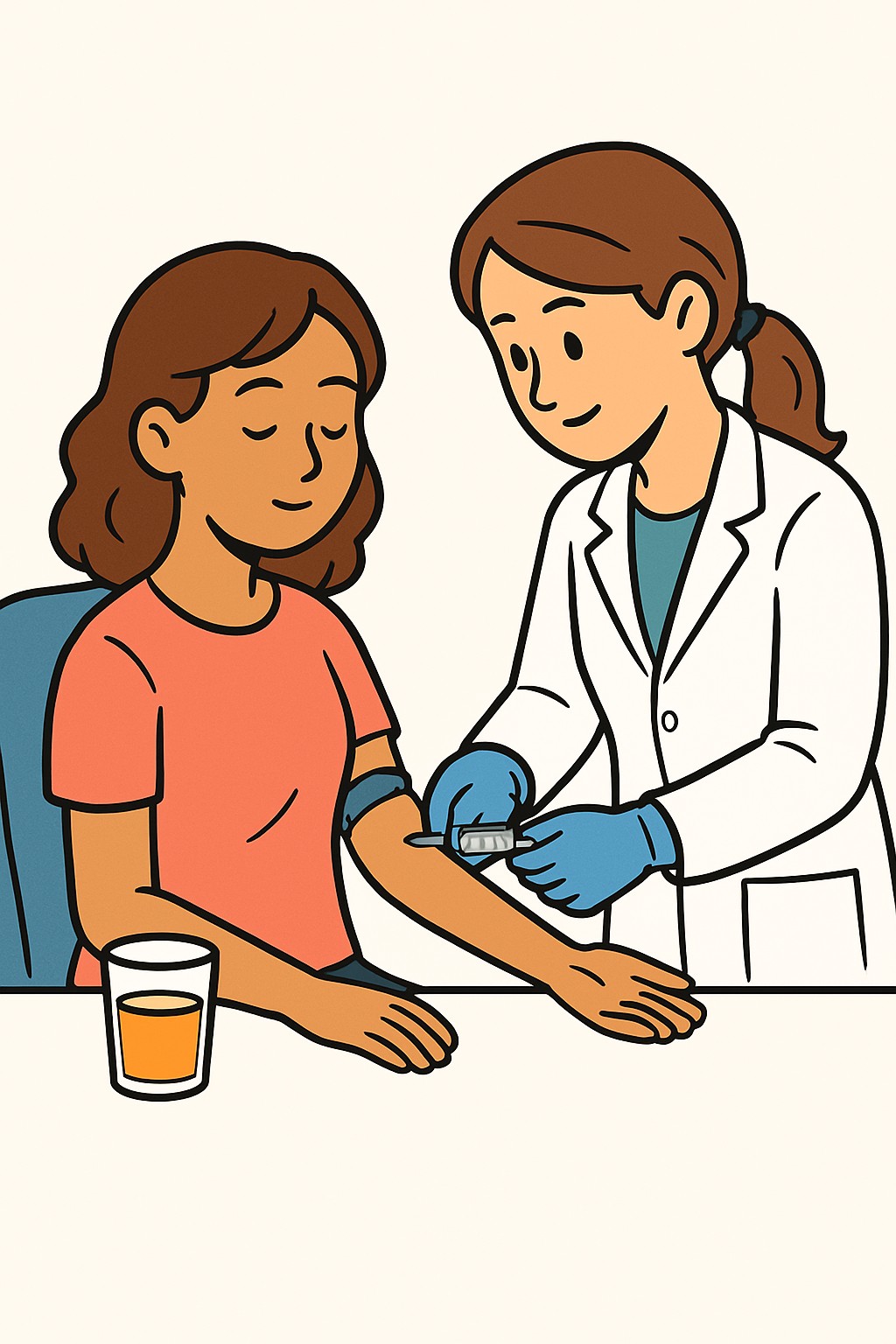
A 3-hour glucose tolerance test is a lab test that measures how your body handles sugar over time. After a fasting blood draw, you drink a measured sweet liquid and have several blood samples taken over three hours to track changes in your blood glucose. This test is most often used during pregnancy to diagnose gestational diabetes after an abnormal 1-hour screening test. It may also be used when a clinician needs more detailed information about glucose handling.
Also known as: 3-hour oral glucose tolerance test, 3-hour OGTT, Oral glucose tolerance test (3-hour)
Preparation & Next Steps
Everything you need to know before and after your procedure
Before Care
- Fast for 8–14 hours before the test; you can usually drink plain water
- Schedule a morning appointment if possible to make fasting easier
- Ask the lab or your clinician about medicines or supplements that may affect results; do not change dosing unless instructed by them
- Avoid strenuous exercise for 8–12 hours before and during the test
- Do not smoke, vape, or use nicotine during the fasting period and test
- Plan to stay at the lab for about 3–4 hours and avoid leaving between blood draws
- Bring a photo ID, your lab order, and a list of current medicines
- Wear clothing that allows easy access to your arms for multiple blood draws
- Tell the staff if you are feeling ill or have had recent vomiting so they can advise about timing
- Bring a snack for after the final blood draw
After Care
- Eat a regular meal or snack after the final blood draw to help you feel better
- Drink water to rehydrate after fasting and testing
- Keep the bandage on the draw site for 30–60 minutes; watch for bleeding or bruising
- If you feel lightheaded, sit or rest until you feel steady
- Note if you vomited during the test; results may be invalid and the test might need to be repeated
- Check your patient portal or ask about when results will be available
- Store a copy of your results for your records
- Resume normal daily activities as you feel able the same day
- Contact the lab or your clinician if you have severe dizziness, fainting, or signs of infection at the draw site (worsening redness, warmth, swelling, pus)
Clinical Information
Important medical details about this procedure
Indications
- Confirming gestational diabetes after an abnormal 1-hour glucose screen
- Screening for gestational diabetes between 24 and 28 weeks of pregnancy
- Further evaluation when other glucose tests are borderline or unclear
Alternatives
- 1-hour glucose challenge test (screening)
- 2-hour 75 g oral glucose tolerance test (one-step approach)
- Fasting plasma glucose test
- A1C blood test
- Home blood glucose checks as part of diagnostic evaluation
Risks
- Nausea, vomiting, or stomach discomfort from the glucose drink
- Lightheadedness, headache, or fainting
- Bruising, soreness, or bleeding at the blood draw site
- Temporary changes in energy or mood from changing glucose levels
Contraindications
- Active vomiting or inability to keep the glucose drink down
- Acute illness or infection that could affect results
- Inability to fast as required before the test
- Recent vigorous exercise or smoking that cannot be paused for testing
Recovery Timeline
What to expect during your recovery
Most people return to normal activities the same day. Any tiredness, nausea, or lightheadedness from fasting or the drink usually fades within hours.
Typical Range
Same day
Return to Work
Same day
Recovery Milestones
Remain at the lab and avoid strenuous activity during the test period
Have a snack and hydrate after the final blood draw
Minor arm soreness or bruising may occur and usually improves
Frequently Asked Questions
Common questions and expert answers about this procedure
What is the 3-hour glucose tolerance test?
What is the 3-hour glucose tolerance test?
It is a series of blood tests done after fasting and drinking a measured sweet liquid to see how your blood sugar changes over three hours.
Why would I need this test?
Why would I need this test?
It is commonly used to diagnose gestational diabetes after an abnormal 1-hour screening test in pregnancy.
How is the test performed?
How is the test performed?
After a fasting blood draw, you drink a glucose solution (often 100 grams). Blood is then drawn at set times, typically at 1, 2, and 3 hours.
How long does it take?
How long does it take?
Plan for about 3–4 hours to allow for check-in, the fasting sample, the drink, and the timed blood draws.
Do I need to fast?
Do I need to fast?
Yes. Most labs require 8–14 hours of fasting before the test. Plain water is usually allowed.
Can I drink water during the test?
Can I drink water during the test?
Most labs allow plain water. Avoid coffee, tea, juice, and flavored or sugary drinks.
What if I feel sick or vomit after the drink?
What if I feel sick or vomit after the drink?
Tell the staff. The test may be stopped and repeated later because vomiting can make results unreliable.
How is this different from the 1-hour test?
How is this different from the 1-hour test?
The 1-hour test is a screening without fasting and uses one blood sample. The 3-hour test requires fasting and multiple timed blood draws to diagnose gestational diabetes.
When will results be ready?
When will results be ready?
Timing varies by lab, often the same day or within a few business days. Check your portal or printed instructions.
References
Medical literature and sources