%20--%3e%3csvg%20version='1.0'%20id='Layer_1'%20xmlns='http://www.w3.org/2000/svg'%20xmlns:xlink='http://www.w3.org/1999/xlink'%20x='0px'%20y='0px'%20viewBox='0%200%20755.52%20814.35'%20style='enable-background:new%200%200%20755.52%20814.35;'%20xml:space='preserve'%3e%3cstyle%20type='text/css'%3e%20.st0{fill:%231ae5ce;stroke:%231ae5ce;stroke-width:7;stroke-miterlimit:10;}%20.st1{fill:%23FFFFFF;stroke:%231ae5ce;stroke-width:7;stroke-miterlimit:10;}%20.st2{fill:%231ae5ce;stroke:%23FFFFFF;stroke-width:7;stroke-miterlimit:10;}%20.st3{fill:%23FFFFFF;stroke:%23FFFFFF;stroke-width:6;stroke-miterlimit:10;}%20%3c/style%3e%3cg%20id='Dark_Logo_00000159431215648494653180000015900878925932721032_'%3e%3cpath%20id='shield_00000152259091539869183100000001926543869452564382_'%20class='st0'%20d='M711.13,173.42%20c-3.37-49.07-38.92-44.9-75.96-52.18c-67.4-13.25-130.47-34.47-192.36-63.92c-22.48-10.7-41.88-25.74-65.05-26.28%20c-23.17,0.54-42.58,15.59-65.05,26.28c-61.89,29.45-124.95,50.68-192.36,63.92c-37.04,7.28-72.59,3.11-75.96,52.18%20c-1.55,22.6,0.34,46.4,1.05,68.92c5.99,190.78,52.91,345.39,206.27,466.46c29.71,23.46,74.51,55.8,108.84,70.75%20c5.99,2.61,11.7,3.73,17.21,3.75c5.51-0.02,11.22-1.14,17.21-3.75c34.33-14.95,79.12-47.3,108.84-70.75%20c153.37-121.07,200.28-275.68,206.27-466.46C710.79,219.82,712.68,196.02,711.13,173.42z'/%3e%3cpath%20id='magnifyingglass_00000073685934697636024790000000342567780940956808_'%20class='st1'%20d='M648.78,624.21l-96.64-104.65%20c34.89-40.63,55.98-93.46,55.98-151.21c0-128.27-103.98-232.24-232.24-232.24S143.63,240.08,143.63,368.35%20s103.98,232.24,232.24,232.24c48.87,0,94.21-15.11,131.62-40.89l97.18,105.24c11.25,12.18,30.24,12.93,42.42,1.69l0,0%20C659.27,655.38,660.03,636.39,648.78,624.21z'/%3e%3ccircle%20id='ellipse_00000129904010550392394720000017056154833629780114_'%20class='st2'%20cx='375.87'%20cy='368.35'%20r='181.21'/%3e%3cpath%20id='dollarsign_00000057140127156649725250000003772530148495155891_'%20class='st3'%20d='M362.91,492.03v-23.91%20c0-2.01-1.58-3.69-3.59-3.77c-18.49-0.78-37.12-5.4-49.4-11.83c-1.75-0.92-2.53-3.01-1.76-4.84l5.87-13.89%20c0.86-2.02,3.23-2.88,5.2-1.89c12.94,6.52,30.45,11.44,49.18,11.44c26.02,0,43.6-12.73,43.6-30.43c0-17.08-14.29-27.63-41.4-36.95%20c-37.37-12.42-60.46-26.7-60.46-53.72c0-24.97,20.29-44.11,52.22-49.51c1.8-0.31,3.11-1.89,3.11-3.72v-24.35%20c0-2.09,1.69-3.78,3.78-3.78h15.16c2.09,0,3.78,1.69,3.78,3.78v22.71c0,2.01,1.58,3.67,3.58,3.77c17.85,0.92,30.88,4.75,40.61,9.1%20c1.92,0.86,2.79,3.09,1.94,5.01l-6.08,13.6c-0.85,1.91-3.09,2.77-4.99,1.91c-8.37-3.8-22.38-8.95-42.75-8.95%20c-28.21,0-38.84,14.28-38.84,26.7c0,16.15,13.56,24.22,45.44,35.4c37.74,13.04,56.79,29.19,56.79,56.82%20c0,23.85-19.05,46.23-54.78,52.3c-1.8,0.31-3.11,1.89-3.11,3.72v25.28c0,2.09-1.69,3.78-3.78,3.78h-15.53%20C364.6,495.81,362.91,494.12,362.91,492.03z'/%3e%3c/g%3e%3c/svg%3e)
Hemoglobin A1c (Diabetes) Laboratory Test
Hemoglobin A1c is a blood test that shows the average level of sugar attached to your red blood cells over the past 2 to 3 months.
Overview
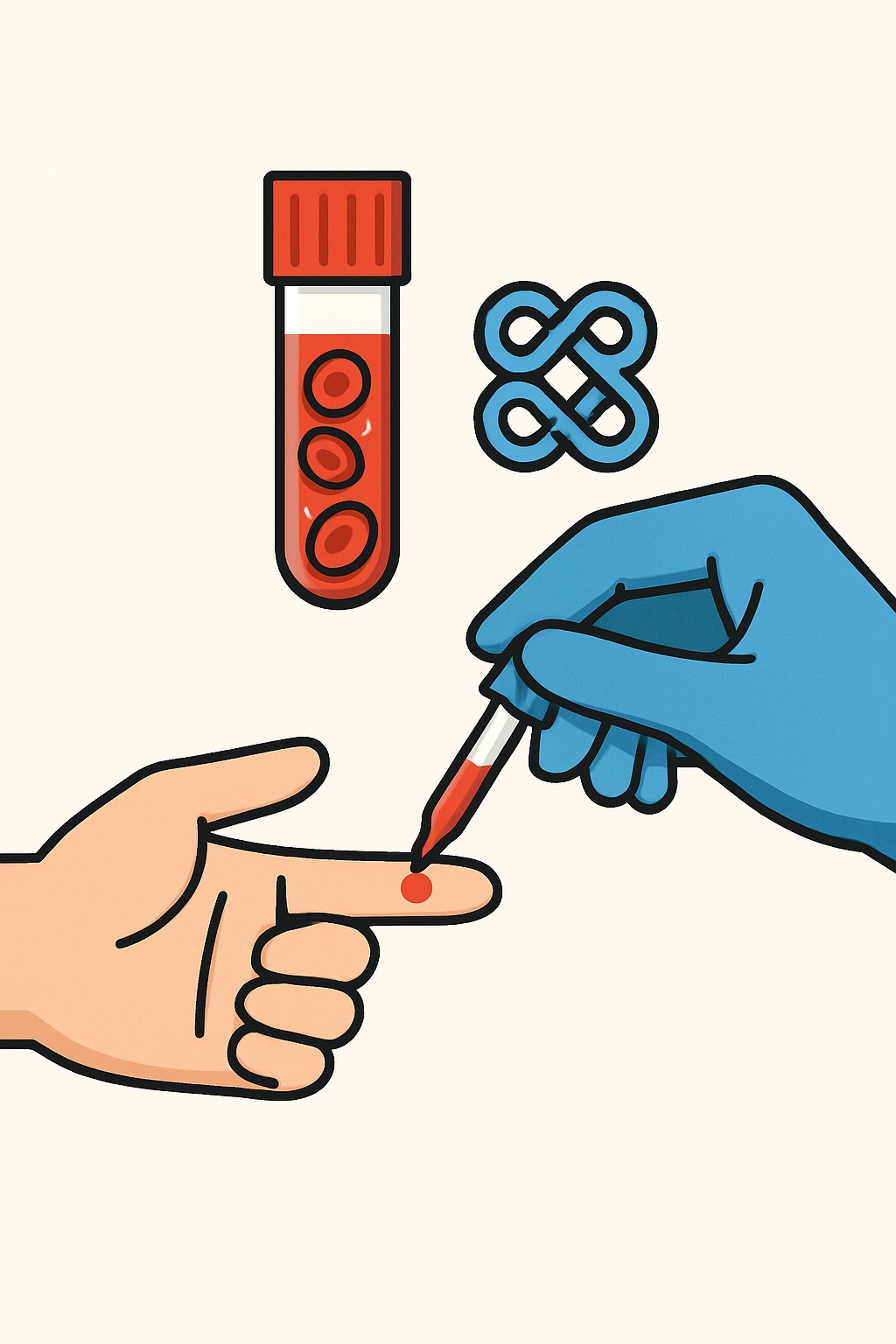
Hemoglobin A1c is a blood test that shows the average level of sugar attached to your red blood cells over the past 2 to 3 months. Results are reported as a percent, which reflects how much hemoglobin has sugar attached. Clinicians use A1c to help screen for, diagnose, and monitor diabetes and prediabetes. Many labs do not require fasting for this test. Certain conditions can affect accuracy, so results are interpreted together with your history, symptoms, and other tests.
Also known as: A1C, HbA1c, Glycohemoglobin, Hemoglobin A1c test
Preparation & Next Steps
Everything you need to know before and after your procedure
Before Care
- No fasting is typically needed for an A1c test; confirm any lab instructions when you schedule
- Bring a photo ID and the lab order or electronic confirmation
- Drink water beforehand so veins are easier to access unless you were told otherwise
- Wear sleeves that roll up easily for a quick blood draw
- Have a current list of medicines and supplements
- Tell the staff if you have felt faint during past blood draws or have a bleeding disorder
- Let the lab know if you have a known hemoglobin variant or had a recent transfusion
- Plan a few minutes after the draw to apply pressure and ensure bleeding has stopped
- Confirm how and when results will be shared, such as through a patient portal
After Care
- Keep the bandage on for a few hours and check the site for bleeding
- Apply gentle pressure if minor bleeding occurs and replace the bandage if needed
- Avoid heavy lifting with the affected arm for the rest of the day if the site is sore
- Drink fluids and have a snack if you feel lightheaded
- Watch for increasing redness, warmth, swelling, or drainage at the site and contact a clinician if these appear
- Review the posted results and any notes from the ordering clinician
- Track your A1c values over time to see overall trends
- Ask how factors like anemia, kidney disease, or recent transfusion could affect interpretation
- Schedule future testing based on the care plan made with your clinician
Clinical Information
Important medical details about this procedure
Indications
- Screening for diabetes or prediabetes in people at risk
- Diagnosis of diabetes or prediabetes
- Ongoing monitoring of blood sugar control in type 1 or type 2 diabetes
- Evaluating response to treatment changes
- Assessing risk of diabetes complications
Alternatives
- Fasting plasma glucose test
- Oral glucose tolerance test (OGTT)
- Random plasma glucose test
- Self-monitoring of blood glucose with a meter
- Continuous glucose monitor (CGM) metrics such as GMI
- Fructosamine or glycated albumin when A1c may be unreliable
Risks
- Bruising, soreness, or bleeding at the needle site
- Lightheadedness or fainting during or after the blood draw
- Rare infection at the puncture site
- Potentially misleading results with some conditions (for example, anemia, recent blood loss or transfusion, kidney disease, pregnancy, or certain hemoglobin variants)
Contraindications
- Recent blood transfusion or major blood loss (may make results unreliable)
- Known hemoglobin variants or hemoglobinopathies if the lab method is not validated for them
- Conditions that change red blood cell lifespan (for example, severe anemia or kidney failure) which can alter A1c
- Pregnancy, especially for diagnosing gestational diabetes, where other tests are preferred
Recovery Timeline
What to expect during your recovery
There is no medical recovery period after a standard blood draw for A1c. Most people return to normal activities right away.
Typical Range
Same day
Return to Work
Same day
Recovery Milestones
Resume normal daily activities
Remove bandage once the site is dry
Check your portal or messages for results
Frequently Asked Questions
Common questions and expert answers about this procedure
What does the A1c test measure?
What does the A1c test measure?
It measures the percent of hemoglobin with sugar attached, reflecting your average blood sugar over about 2 to 3 months.
Do I need to fast for an A1c test?
Do I need to fast for an A1c test?
Fasting is usually not required. Many labs can draw this test at any time of day.
How is the test done?
How is the test done?
A small blood sample is taken from a vein in your arm. Some clinics use a fingerstick device. The draw typically takes a few minutes.
How long until I get results?
How long until I get results?
Point-of-care devices can give results in minutes. Standard lab tests are often ready the same day or in 1 to 3 days.
What do A1c numbers mean?
What do A1c numbers mean?
In general, an A1c below 5.7% is considered normal, 5.7% to 6.4% suggests prediabetes, and 6.5% or higher on a repeatable test indicates diabetes. Labs may vary slightly.
How often is A1c checked?
How often is A1c checked?
It is often checked about every 3 months when treatment is changing or goals are not met, and about every 6 months when stable.
Can anything make an A1c result inaccurate?
Can anything make an A1c result inaccurate?
Yes. Anemia, recent blood loss or transfusion, kidney disease, pregnancy, and some hemoglobin variants can affect results. Using standardized lab methods helps reduce errors.
Is a fingerstick A1c accurate for diagnosis?
Is a fingerstick A1c accurate for diagnosis?
Fingerstick point-of-care A1c can help with monitoring. For diagnosis, guidelines recommend a laboratory method aligned with national standards.
References
Medical literature and sources