%20--%3e%3csvg%20version='1.0'%20id='Layer_1'%20xmlns='http://www.w3.org/2000/svg'%20xmlns:xlink='http://www.w3.org/1999/xlink'%20x='0px'%20y='0px'%20viewBox='0%200%20755.52%20814.35'%20style='enable-background:new%200%200%20755.52%20814.35;'%20xml:space='preserve'%3e%3cstyle%20type='text/css'%3e%20.st0{fill:%231ae5ce;stroke:%231ae5ce;stroke-width:7;stroke-miterlimit:10;}%20.st1{fill:%23FFFFFF;stroke:%231ae5ce;stroke-width:7;stroke-miterlimit:10;}%20.st2{fill:%231ae5ce;stroke:%23FFFFFF;stroke-width:7;stroke-miterlimit:10;}%20.st3{fill:%23FFFFFF;stroke:%23FFFFFF;stroke-width:6;stroke-miterlimit:10;}%20%3c/style%3e%3cg%20id='Dark_Logo_00000159431215648494653180000015900878925932721032_'%3e%3cpath%20id='shield_00000152259091539869183100000001926543869452564382_'%20class='st0'%20d='M711.13,173.42%20c-3.37-49.07-38.92-44.9-75.96-52.18c-67.4-13.25-130.47-34.47-192.36-63.92c-22.48-10.7-41.88-25.74-65.05-26.28%20c-23.17,0.54-42.58,15.59-65.05,26.28c-61.89,29.45-124.95,50.68-192.36,63.92c-37.04,7.28-72.59,3.11-75.96,52.18%20c-1.55,22.6,0.34,46.4,1.05,68.92c5.99,190.78,52.91,345.39,206.27,466.46c29.71,23.46,74.51,55.8,108.84,70.75%20c5.99,2.61,11.7,3.73,17.21,3.75c5.51-0.02,11.22-1.14,17.21-3.75c34.33-14.95,79.12-47.3,108.84-70.75%20c153.37-121.07,200.28-275.68,206.27-466.46C710.79,219.82,712.68,196.02,711.13,173.42z'/%3e%3cpath%20id='magnifyingglass_00000073685934697636024790000000342567780940956808_'%20class='st1'%20d='M648.78,624.21l-96.64-104.65%20c34.89-40.63,55.98-93.46,55.98-151.21c0-128.27-103.98-232.24-232.24-232.24S143.63,240.08,143.63,368.35%20s103.98,232.24,232.24,232.24c48.87,0,94.21-15.11,131.62-40.89l97.18,105.24c11.25,12.18,30.24,12.93,42.42,1.69l0,0%20C659.27,655.38,660.03,636.39,648.78,624.21z'/%3e%3ccircle%20id='ellipse_00000129904010550392394720000017056154833629780114_'%20class='st2'%20cx='375.87'%20cy='368.35'%20r='181.21'/%3e%3cpath%20id='dollarsign_00000057140127156649725250000003772530148495155891_'%20class='st3'%20d='M362.91,492.03v-23.91%20c0-2.01-1.58-3.69-3.59-3.77c-18.49-0.78-37.12-5.4-49.4-11.83c-1.75-0.92-2.53-3.01-1.76-4.84l5.87-13.89%20c0.86-2.02,3.23-2.88,5.2-1.89c12.94,6.52,30.45,11.44,49.18,11.44c26.02,0,43.6-12.73,43.6-30.43c0-17.08-14.29-27.63-41.4-36.95%20c-37.37-12.42-60.46-26.7-60.46-53.72c0-24.97,20.29-44.11,52.22-49.51c1.8-0.31,3.11-1.89,3.11-3.72v-24.35%20c0-2.09,1.69-3.78,3.78-3.78h15.16c2.09,0,3.78,1.69,3.78,3.78v22.71c0,2.01,1.58,3.67,3.58,3.77c17.85,0.92,30.88,4.75,40.61,9.1%20c1.92,0.86,2.79,3.09,1.94,5.01l-6.08,13.6c-0.85,1.91-3.09,2.77-4.99,1.91c-8.37-3.8-22.38-8.95-42.75-8.95%20c-28.21,0-38.84,14.28-38.84,26.7c0,16.15,13.56,24.22,45.44,35.4c37.74,13.04,56.79,29.19,56.79,56.82%20c0,23.85-19.05,46.23-54.78,52.3c-1.8,0.31-3.11,1.89-3.11,3.72v25.28c0,2.09-1.69,3.78-3.78,3.78h-15.53%20C364.6,495.81,362.91,494.12,362.91,492.03z'/%3e%3c/g%3e%3c/svg%3e)
Hepatitis B core antibody test (HBcAb) Laboratory Test
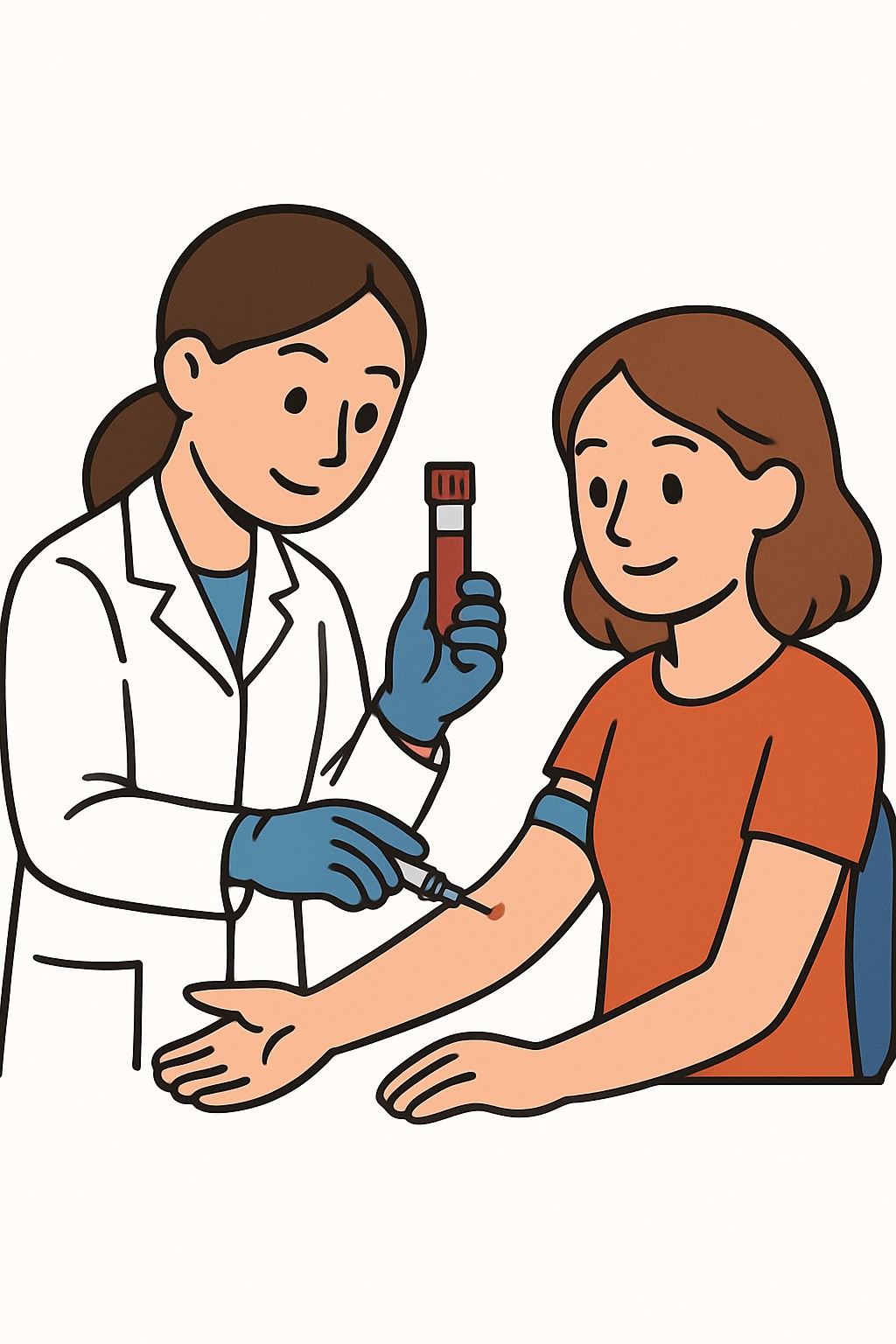
The hepatitis B core antibody test (HBcAb) is a blood test that looks for antibodies your immune system makes after exposure to the core protein of the hepatitis B virus (HBV).
Overview
The hepatitis B core antibody test (HBcAb) is a blood test that looks for antibodies your immune system makes after exposure to the core protein of the hepatitis B virus (HBV). Total anti-HBc usually stays positive for life after a natural infection. This test is often ordered with hepatitis B surface antigen (HBsAg) and hepatitis B surface antibody (anti-HBs) to help tell if someone has a current infection, a past infection, or immunity from vaccination. Vaccination does not produce anti-HBc.
Also known as: Anti-HBc, HBcAb test, Hepatitis B core total antibody, Total anti-HBc, HBcAb (total) test
Preparation & Next Steps
Everything you need to know before and after your procedure
Before Care
- Bring a photo ID, insurance card, and the lab order or electronic code
- Confirm if other ordered tests require fasting; HBcAb itself does not require fasting
- Drink water beforehand to make veins easier to access unless told otherwise
- Wear sleeves that roll up easily for a blood draw from the arm
- Have a list of medicines and supplements, including blood thinners
- Know any prior hepatitis B diagnoses, vaccinations, or test results if available
- Ask where results will appear (patient portal or clinician call) and typical timing
- Plan extra time if multiple tubes or additional tests are being drawn
After Care
- Keep pressure on the puncture site for several minutes to reduce bruising
- Leave the bandage on for a few hours and keep the area clean and dry
- Expect mild soreness or a small bruise that fades over a few days
- Avoid heavy lifting with the drawn arm for the rest of the day if sore
- Drink fluids and eat as usual unless other tests require different steps
- Review results in your portal and note any additional tests that were ordered
- Contact the lab or clinic if the site keeps bleeding, becomes very swollen, or shows spreading redness
- Ask the ordering clinician about next steps if results are unclear or isolated (for example, anti-HBc positive alone)
Clinical Information
Important medical details about this procedure
Indications
- Part of one-time adult hepatitis B screening with HBsAg and anti-HBs
- Assessing possible exposure or symptoms of hepatitis
- Clarifying results when HBsAg or anti-HBs are borderline or unexpected
- Checking status before starting immunosuppressive therapy
- Follow-up of abnormal liver enzymes (ALT, AST)
- Evaluating unclear hepatitis B history or records
Alternatives
- Hepatitis B surface antigen (HBsAg) test
- Hepatitis B surface antibody (anti-HBs) test
- Hepatitis B core IgM antibody (anti-HBc IgM) test
- Hepatitis B virus DNA (PCR) test
- Comprehensive hepatitis B panel
- Liver function tests (ALT, AST, bilirubin)
Risks
- Mild pain, bruising, or bleeding at the blood draw site
- Lightheadedness or fainting during or after the draw
- Very small risk of infection at the puncture site
- Results can be hard to interpret without other hepatitis B tests
- Possible false-positive or isolated anti-HBc result requiring more testing
Contraindications
- No absolute contraindications for a routine venipuncture
- Uncontrolled bleeding disorders without appropriate precautions
- Recent blood transfusion or immune globulin may affect interpretation
Recovery Timeline
What to expect during your recovery
A standard blood draw has no medical recovery period. Most people resume normal activities right away.
Typical Range
Same day
Return to Work
Same day
Recovery Milestones
Resume normal daily activities
Keep the bandage on and monitor for minor bruising
Avoid heavy lifting with the drawn arm if sore
Review results and any recommended follow-up testing
Frequently Asked Questions
Common questions and expert answers about this procedure
What does a positive total anti-HBc result mean?
What does a positive total anti-HBc result mean?
It usually means you have had a hepatitis B infection at some point. It can be present with current or past infection and needs other tests (HBsAg, anti-HBs, sometimes HBV DNA) to interpret.
Does the hepatitis B vaccine make anti-HBc positive?
Does the hepatitis B vaccine make anti-HBc positive?
No. Vaccination produces anti-HBs, not anti-HBc. Anti-HBc generally indicates past or current infection.
What is the difference between total anti-HBc and anti-HBc IgM?
What is the difference between total anti-HBc and anti-HBc IgM?
Total anti-HBc stays positive after a natural infection, often for life. Anti-HBc IgM appears with recent infection and helps identify an acute infection.
Do I need to fast for the HBcAb test?
Do I need to fast for the HBcAb test?
No fasting is needed for HBcAb itself. If other labs are ordered at the same time, follow their instructions.
How soon after exposure can anti-HBc be detected?
How soon after exposure can anti-HBc be detected?
Anti-HBc typically appears around the time acute symptoms would start. Early after exposure, results may be negative and need repeat or additional tests.
Can someone have only anti-HBc positive and other tests negative?
Can someone have only anti-HBc positive and other tests negative?
Yes. An isolated anti-HBc result can reflect a past resolved infection, a false-positive, or rarely low-level (occult) infection. Further testing is often used to clarify.
Is this test part of routine hepatitis B screening?
Is this test part of routine hepatitis B screening?
Yes. CDC recommends one-time adult screening with HBsAg, anti-HBs, and total anti-HBc, with additional testing as indicated.
Can recent transfusions or immune globulin affect results?
Can recent transfusions or immune globulin affect results?
They can affect interpretation. Tell the clinician or lab about recent transfusions or injections of immune globulin.
References
Medical literature and sources