%20--%3e%3csvg%20version='1.0'%20id='Layer_1'%20xmlns='http://www.w3.org/2000/svg'%20xmlns:xlink='http://www.w3.org/1999/xlink'%20x='0px'%20y='0px'%20viewBox='0%200%20755.52%20814.35'%20style='enable-background:new%200%200%20755.52%20814.35;'%20xml:space='preserve'%3e%3cstyle%20type='text/css'%3e%20.st0{fill:%231ae5ce;stroke:%231ae5ce;stroke-width:7;stroke-miterlimit:10;}%20.st1{fill:%23FFFFFF;stroke:%231ae5ce;stroke-width:7;stroke-miterlimit:10;}%20.st2{fill:%231ae5ce;stroke:%23FFFFFF;stroke-width:7;stroke-miterlimit:10;}%20.st3{fill:%23FFFFFF;stroke:%23FFFFFF;stroke-width:6;stroke-miterlimit:10;}%20%3c/style%3e%3cg%20id='Dark_Logo_00000159431215648494653180000015900878925932721032_'%3e%3cpath%20id='shield_00000152259091539869183100000001926543869452564382_'%20class='st0'%20d='M711.13,173.42%20c-3.37-49.07-38.92-44.9-75.96-52.18c-67.4-13.25-130.47-34.47-192.36-63.92c-22.48-10.7-41.88-25.74-65.05-26.28%20c-23.17,0.54-42.58,15.59-65.05,26.28c-61.89,29.45-124.95,50.68-192.36,63.92c-37.04,7.28-72.59,3.11-75.96,52.18%20c-1.55,22.6,0.34,46.4,1.05,68.92c5.99,190.78,52.91,345.39,206.27,466.46c29.71,23.46,74.51,55.8,108.84,70.75%20c5.99,2.61,11.7,3.73,17.21,3.75c5.51-0.02,11.22-1.14,17.21-3.75c34.33-14.95,79.12-47.3,108.84-70.75%20c153.37-121.07,200.28-275.68,206.27-466.46C710.79,219.82,712.68,196.02,711.13,173.42z'/%3e%3cpath%20id='magnifyingglass_00000073685934697636024790000000342567780940956808_'%20class='st1'%20d='M648.78,624.21l-96.64-104.65%20c34.89-40.63,55.98-93.46,55.98-151.21c0-128.27-103.98-232.24-232.24-232.24S143.63,240.08,143.63,368.35%20s103.98,232.24,232.24,232.24c48.87,0,94.21-15.11,131.62-40.89l97.18,105.24c11.25,12.18,30.24,12.93,42.42,1.69l0,0%20C659.27,655.38,660.03,636.39,648.78,624.21z'/%3e%3ccircle%20id='ellipse_00000129904010550392394720000017056154833629780114_'%20class='st2'%20cx='375.87'%20cy='368.35'%20r='181.21'/%3e%3cpath%20id='dollarsign_00000057140127156649725250000003772530148495155891_'%20class='st3'%20d='M362.91,492.03v-23.91%20c0-2.01-1.58-3.69-3.59-3.77c-18.49-0.78-37.12-5.4-49.4-11.83c-1.75-0.92-2.53-3.01-1.76-4.84l5.87-13.89%20c0.86-2.02,3.23-2.88,5.2-1.89c12.94,6.52,30.45,11.44,49.18,11.44c26.02,0,43.6-12.73,43.6-30.43c0-17.08-14.29-27.63-41.4-36.95%20c-37.37-12.42-60.46-26.7-60.46-53.72c0-24.97,20.29-44.11,52.22-49.51c1.8-0.31,3.11-1.89,3.11-3.72v-24.35%20c0-2.09,1.69-3.78,3.78-3.78h15.16c2.09,0,3.78,1.69,3.78,3.78v22.71c0,2.01,1.58,3.67,3.58,3.77c17.85,0.92,30.88,4.75,40.61,9.1%20c1.92,0.86,2.79,3.09,1.94,5.01l-6.08,13.6c-0.85,1.91-3.09,2.77-4.99,1.91c-8.37-3.8-22.38-8.95-42.75-8.95%20c-28.21,0-38.84,14.28-38.84,26.7c0,16.15,13.56,24.22,45.44,35.4c37.74,13.04,56.79,29.19,56.79,56.82%20c0,23.85-19.05,46.23-54.78,52.3c-1.8,0.31-3.11,1.89-3.11,3.72v25.28c0,2.09-1.69,3.78-3.78,3.78h-15.53%20C364.6,495.81,362.91,494.12,362.91,492.03z'/%3e%3c/g%3e%3c/svg%3e)
Hepatitis C antibody test (anti-HCV) Laboratory Test
A hepatitis C antibody test looks for antibodies that your immune system makes after exposure to the hepatitis C virus (HCV).
Overview
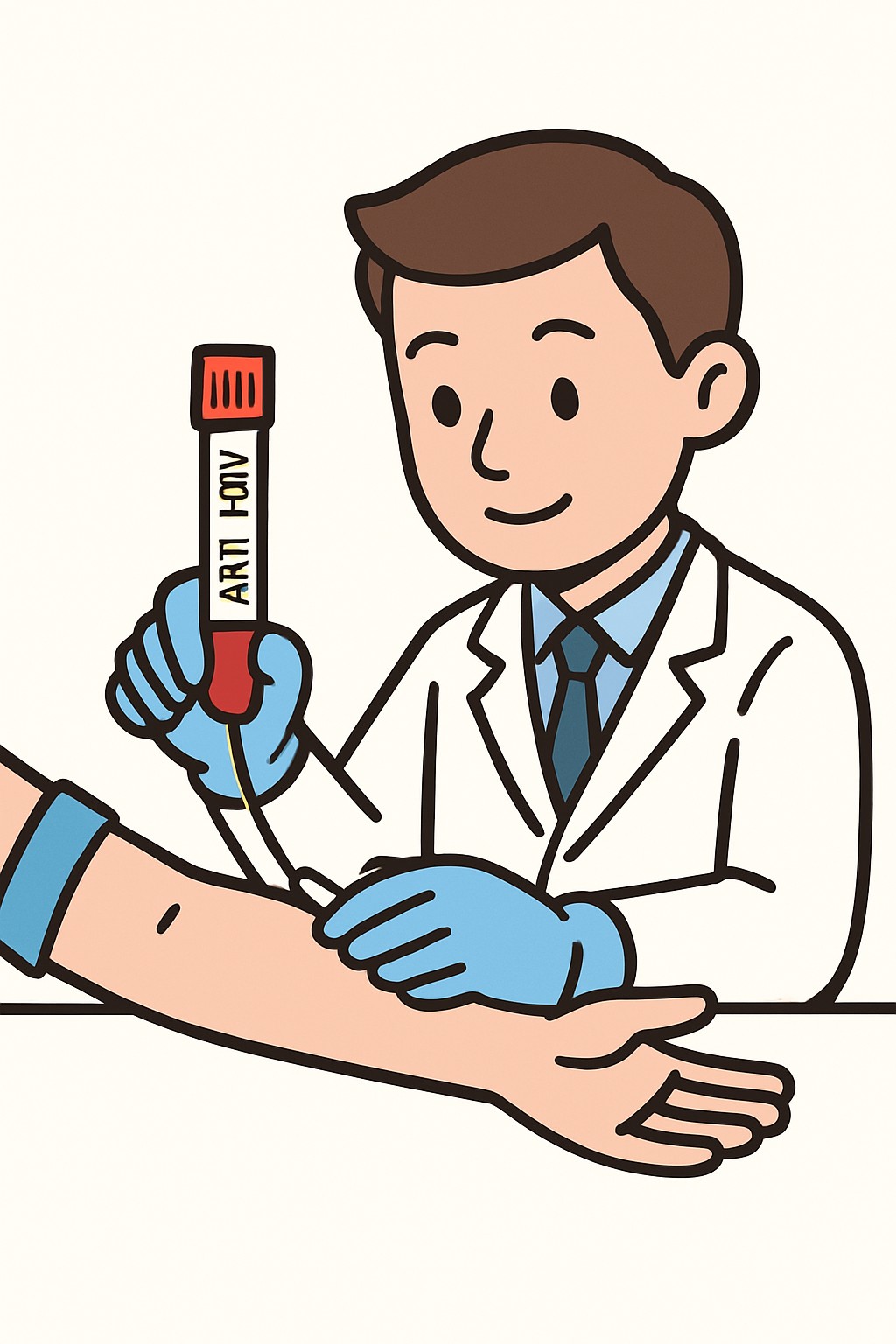
A hepatitis C antibody test looks for antibodies that your immune system makes after exposure to the hepatitis C virus (HCV). It is usually done on a blood sample taken from a vein or by a rapid fingerstick test. Results are reported as nonreactive (negative) or reactive (positive). A reactive antibody test does not by itself show a current infection. Most labs follow up a reactive antibody result with an HCV RNA test to check for active virus.
Also known as: HCV antibody test, Anti-HCV, Hepatitis C screening test, HCV Ab
Preparation & Next Steps
Everything you need to know before and after your procedure
Before Care
- No fasting is usually needed; confirm any lab instructions when you schedule
- Bring a photo ID, insurance details, and the lab order if you were given one
- Hydrate with water so veins are easier to access unless you were told otherwise
- Wear a short-sleeved or loose shirt for an easier blood draw
- Know the date of any recent possible exposure since early testing can be negative
- Ask whether the lab uses reflex testing to HCV RNA after a reactive antibody
- Confirm how and when results will be delivered (portal, phone, or email)
- Check insurance coverage or potential costs with the lab or plan
- Share any bleeding disorders, anticoagulant use, or fainting history with staff
After Care
- Keep pressure on the puncture site for several minutes and leave the bandage on for at least 15 to 30 minutes
- Expect mild tenderness or bruising; apply a cool pack briefly if needed
- Limit heavy lifting with the affected arm for a few hours after the draw
- Review your report; results are usually listed as nonreactive or reactive
- Reactive antibody results are commonly followed by an HCV RNA test to check for current infection
- If recent exposure occurred, results may be negative early; many protocols repeat testing after the window period
- Keep a copy of results for your records and share them with your care team if asked
- Contact a clinician if you have persistent bleeding, increasing swelling, severe pain, or signs of infection at the draw site
Clinical Information
Important medical details about this procedure
Indications
- One-time screening for most adults
- Screening during each pregnancy
- Past or current injection drug use
- Transfusion or organ transplant before 1992 or clotting factor before 1987
- Long-term hemodialysis
- HIV infection
- Abnormal liver tests (such as elevated ALT)
- Known exposure to HCV (for example, needlestick)
Alternatives
- HCV RNA nucleic acid test (NAT) to detect current infection
- HCV core antigen test when NAT is not available
- Reflex algorithm: antibody test with automatic RNA testing if reactive
- Repeat antibody testing after the window period if recent exposure
Risks
- Bruising, soreness, or lightheadedness from a blood draw
- False negative if tested during the early window period or with weakened immunity
- False positive in low-risk settings, requiring confirmation
- Anxiety or stress while waiting for results
- Privacy and confidentiality concerns about test results
Contraindications
- No widely recognized absolute contraindications to routine venipuncture; people with bleeding disorders may need special precautions
Recovery Timeline
What to expect during your recovery
This is a simple blood test. Most people resume normal activities right away.
Typical Range
Same day
Return to Work
Same day
Recovery Milestones
Resume normal daily activities
Keep bandage on for 15–30 minutes after the blood draw
Avoid heavy lifting with the puncture arm for several hours
Frequently Asked Questions
Common questions and expert answers about this procedure
What does the hepatitis C antibody test show?
What does the hepatitis C antibody test show?
It shows whether your body has made antibodies to HCV, meaning past exposure. It does not confirm a current infection.
If my antibody test is positive, do I have hepatitis C now?
If my antibody test is positive, do I have hepatitis C now?
Not necessarily. A reactive antibody result is usually followed by an HCV RNA test to see if the virus is present now.
Do I need to fast for this test?
Do I need to fast for this test?
Fasting is not typically needed for an HCV antibody test. Follow any instructions from the lab.
How soon after exposure will the test turn positive?
How soon after exposure will the test turn positive?
Antibodies usually appear 8 to 11 weeks after exposure. Testing earlier can be negative even if infection occurred.
Can I have a negative antibody test but still have hepatitis C?
Can I have a negative antibody test but still have hepatitis C?
Yes, early after exposure or with weakened immunity the antibody may be negative. Nucleic acid testing can detect current infection earlier.
Will antibodies go away after successful treatment?
Will antibodies go away after successful treatment?
Antibodies often remain positive for life even after the virus is cleared. RNA testing is used to check cure or active infection.
Is there a vaccine that can affect the result?
Is there a vaccine that can affect the result?
There is no vaccine for hepatitis C, so vaccination does not cause a positive antibody test.
Who is recommended to get screened?
Who is recommended to get screened?
Many guidelines recommend one-time screening for all adults, screening during each pregnancy, and periodic testing for people with risk factors.
References
Medical literature and sources