%20--%3e%3csvg%20version='1.0'%20id='Layer_1'%20xmlns='http://www.w3.org/2000/svg'%20xmlns:xlink='http://www.w3.org/1999/xlink'%20x='0px'%20y='0px'%20viewBox='0%200%20755.52%20814.35'%20style='enable-background:new%200%200%20755.52%20814.35;'%20xml:space='preserve'%3e%3cstyle%20type='text/css'%3e%20.st0{fill:%231ae5ce;stroke:%231ae5ce;stroke-width:7;stroke-miterlimit:10;}%20.st1{fill:%23FFFFFF;stroke:%231ae5ce;stroke-width:7;stroke-miterlimit:10;}%20.st2{fill:%231ae5ce;stroke:%23FFFFFF;stroke-width:7;stroke-miterlimit:10;}%20.st3{fill:%23FFFFFF;stroke:%23FFFFFF;stroke-width:6;stroke-miterlimit:10;}%20%3c/style%3e%3cg%20id='Dark_Logo_00000159431215648494653180000015900878925932721032_'%3e%3cpath%20id='shield_00000152259091539869183100000001926543869452564382_'%20class='st0'%20d='M711.13,173.42%20c-3.37-49.07-38.92-44.9-75.96-52.18c-67.4-13.25-130.47-34.47-192.36-63.92c-22.48-10.7-41.88-25.74-65.05-26.28%20c-23.17,0.54-42.58,15.59-65.05,26.28c-61.89,29.45-124.95,50.68-192.36,63.92c-37.04,7.28-72.59,3.11-75.96,52.18%20c-1.55,22.6,0.34,46.4,1.05,68.92c5.99,190.78,52.91,345.39,206.27,466.46c29.71,23.46,74.51,55.8,108.84,70.75%20c5.99,2.61,11.7,3.73,17.21,3.75c5.51-0.02,11.22-1.14,17.21-3.75c34.33-14.95,79.12-47.3,108.84-70.75%20c153.37-121.07,200.28-275.68,206.27-466.46C710.79,219.82,712.68,196.02,711.13,173.42z'/%3e%3cpath%20id='magnifyingglass_00000073685934697636024790000000342567780940956808_'%20class='st1'%20d='M648.78,624.21l-96.64-104.65%20c34.89-40.63,55.98-93.46,55.98-151.21c0-128.27-103.98-232.24-232.24-232.24S143.63,240.08,143.63,368.35%20s103.98,232.24,232.24,232.24c48.87,0,94.21-15.11,131.62-40.89l97.18,105.24c11.25,12.18,30.24,12.93,42.42,1.69l0,0%20C659.27,655.38,660.03,636.39,648.78,624.21z'/%3e%3ccircle%20id='ellipse_00000129904010550392394720000017056154833629780114_'%20class='st2'%20cx='375.87'%20cy='368.35'%20r='181.21'/%3e%3cpath%20id='dollarsign_00000057140127156649725250000003772530148495155891_'%20class='st3'%20d='M362.91,492.03v-23.91%20c0-2.01-1.58-3.69-3.59-3.77c-18.49-0.78-37.12-5.4-49.4-11.83c-1.75-0.92-2.53-3.01-1.76-4.84l5.87-13.89%20c0.86-2.02,3.23-2.88,5.2-1.89c12.94,6.52,30.45,11.44,49.18,11.44c26.02,0,43.6-12.73,43.6-30.43c0-17.08-14.29-27.63-41.4-36.95%20c-37.37-12.42-60.46-26.7-60.46-53.72c0-24.97,20.29-44.11,52.22-49.51c1.8-0.31,3.11-1.89,3.11-3.72v-24.35%20c0-2.09,1.69-3.78,3.78-3.78h15.16c2.09,0,3.78,1.69,3.78,3.78v22.71c0,2.01,1.58,3.67,3.58,3.77c17.85,0.92,30.88,4.75,40.61,9.1%20c1.92,0.86,2.79,3.09,1.94,5.01l-6.08,13.6c-0.85,1.91-3.09,2.77-4.99,1.91c-8.37-3.8-22.38-8.95-42.75-8.95%20c-28.21,0-38.84,14.28-38.84,26.7c0,16.15,13.56,24.22,45.44,35.4c37.74,13.04,56.79,29.19,56.79,56.82%20c0,23.85-19.05,46.23-54.78,52.3c-1.8,0.31-3.11,1.89-3.11,3.72v25.28c0,2.09-1.69,3.78-3.78,3.78h-15.53%20C364.6,495.81,362.91,494.12,362.91,492.03z'/%3e%3c/g%3e%3c/svg%3e)
HPV DNA test (high-risk types) Laboratory Test
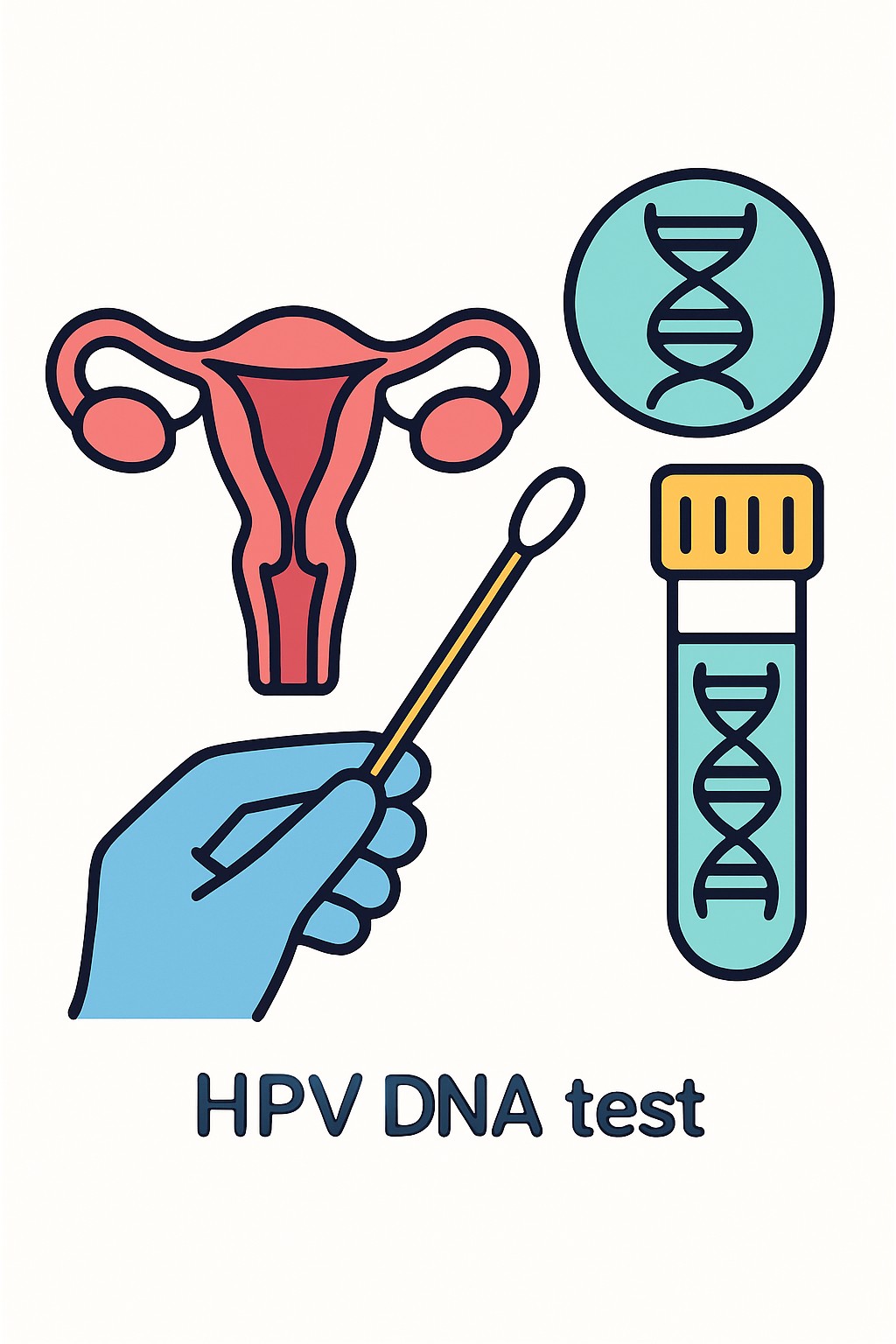
An HPV DNA test (high-risk types) looks for genetic material from human papillomavirus types that are linked to cervical cancer, most often HPV 16 and 18 and other high-risk types.
Overview
An HPV DNA test (high-risk types) looks for genetic material from human papillomavirus types that are linked to cervical cancer, most often HPV 16 and 18 and other high-risk types. The sample is usually collected from the cervix during a pelvic exam using a soft brush. Some FDA-cleared tests also allow a self-collected vaginal swab in a health care setting. This test is used for cervical cancer screening, often by itself (primary HPV screening) or with a Pap test (co-testing), and to follow up certain abnormal Pap results. Finding high-risk HPV helps identify who may need closer follow-up such as repeat testing or a colposcopy.
Also known as: High-risk HPV test, HPV screening test, HR-HPV DNA test
Preparation & Next Steps
Everything you need to know before and after your procedure
Before Care
- Confirm with the clinic which test will be done (HPV alone, Pap, or both) and how results will be shared
- Avoid vaginal medicines, spermicides, douching, or intercourse for 24 to 48 hours before the test if possible
- Try to schedule when you are not having heavy menstrual bleeding
- Bring a list of your prior Pap or HPV results and dates if available
- Bring a photo ID, insurance card, and a payment method if a copay or deductible may apply
- Ask whether a self-collected vaginal sample is offered in the clinic and whether it fits your situation
- Wear clothing that is easy to remove from the waist down for a pelvic exam
- Update allergies and current medicines, including blood thinners and vaginal products
- Plan a few extra minutes in case additional counseling or documentation is needed
- Verify that your contact information and preferred pharmacy are current in the clinic records
After Care
- Mild cramping or light spotting can occur; using a pad is usually enough
- Resume normal daily activities as you feel comfortable
- Review your results when available and keep a copy for your records
- If results are positive for high-risk HPV, the clinic may arrange repeat testing, genotyping, or colposcopy
- If results are negative, future screening intervals typically follow guideline-based schedules
- Confirm how and when you will receive results (portal, phone, mail) and who to contact with questions
- Report heavy bleeding, fever, or severe pelvic pain to your clinician
- Avoid vaginal douching or new products for 24 hours if the area feels irritated
- Note any new symptoms and share them at follow-up
- Check your insurance explanation of benefits and ask the clinic about any unexpected charges
Clinical Information
Important medical details about this procedure
Indications
- Routine cervical cancer screening based on age and guidelines
- Primary HPV screening or co-testing with a Pap test
- Triage of ASC-US (atypical squamous cells of undetermined significance) Pap results
- Follow-up after abnormal screening or after treatment of cervical precancer
- Screening in people with increased risk as guided by prior results and history
Alternatives
- Pap test (cervical cytology) alone
- Co-testing (Pap test plus HPV test) at guideline-based intervals
- Repeat cytology at a short interval when appropriate
- Colposcopy with biopsy for diagnostic evaluation if indicated
- Clinician-collected versus self-collected vaginal sample in a clinic, when available
Risks
- False positive or false negative results
- Anxiety related to positive results
- Mild discomfort or light spotting from sample collection
- Very low risk of infection or irritation at the sampling site
- Potential out-of-pocket costs depending on coverage and setting
- Privacy or confidentiality concerns about test results
Contraindications
- No cervix after a total hysterectomy for benign reasons when screening is not recommended
- Heavy menstrual bleeding that may interfere with sample quality
- Inability to tolerate a pelvic exam; a supervised self-collected sample may be an option where available
- Recent cervical or vaginal procedures causing active bleeding
Recovery Timeline
What to expect during your recovery
There is no medical recovery period for an HPV DNA test. Most people return to normal activities immediately after the sample is collected.
Typical Range
Same day
Return to Work
Same day
Recovery Milestones
Resume normal activities
Manage mild spotting with a pad if present
Review results via portal or phone and note follow-up plan if needed
Frequently Asked Questions
Common questions and expert answers about this procedure
What does the HPV DNA test look for?
What does the HPV DNA test look for?
It detects the genetic material of high-risk HPV types linked to cervical cancer, including HPV 16 and 18 and other oncogenic types.
How is the sample collected?
How is the sample collected?
A soft brush is used to collect cells from the cervix during a pelvic exam. Some FDA-cleared tests allow a self-collected vaginal swab in a clinic setting.
Does this replace the Pap test?
Does this replace the Pap test?
It can be used alone for primary screening or combined with a Pap test. The approach depends on age, history, and clinic protocol.
What do positive and negative results mean?
What do positive and negative results mean?
A positive result means high-risk HPV was found and may lead to closer follow-up. A negative result means it was not found and routine screening intervals may apply.
Can I get the test during my period?
Can I get the test during my period?
Light bleeding may be acceptable, but heavy bleeding can affect sample quality. Clinics often prefer scheduling when bleeding is lighter.
Is the test safe during pregnancy?
Is the test safe during pregnancy?
Sampling is generally considered low risk in pregnancy, though some clinics may time testing with routine prenatal care.
How long do results take?
How long do results take?
Labs often report results within a few days to about a week, depending on the clinic and laboratory.
Will insurance cover it?
Will insurance cover it?
Coverage varies by plan, age, and setting. Many plans cover recommended cervical cancer screening tests; check your benefits.
References
Medical literature and sources