%20--%3e%3csvg%20version='1.0'%20id='Layer_1'%20xmlns='http://www.w3.org/2000/svg'%20xmlns:xlink='http://www.w3.org/1999/xlink'%20x='0px'%20y='0px'%20viewBox='0%200%20755.52%20814.35'%20style='enable-background:new%200%200%20755.52%20814.35;'%20xml:space='preserve'%3e%3cstyle%20type='text/css'%3e%20.st0{fill:%231ae5ce;stroke:%231ae5ce;stroke-width:7;stroke-miterlimit:10;}%20.st1{fill:%23FFFFFF;stroke:%231ae5ce;stroke-width:7;stroke-miterlimit:10;}%20.st2{fill:%231ae5ce;stroke:%23FFFFFF;stroke-width:7;stroke-miterlimit:10;}%20.st3{fill:%23FFFFFF;stroke:%23FFFFFF;stroke-width:6;stroke-miterlimit:10;}%20%3c/style%3e%3cg%20id='Dark_Logo_00000159431215648494653180000015900878925932721032_'%3e%3cpath%20id='shield_00000152259091539869183100000001926543869452564382_'%20class='st0'%20d='M711.13,173.42%20c-3.37-49.07-38.92-44.9-75.96-52.18c-67.4-13.25-130.47-34.47-192.36-63.92c-22.48-10.7-41.88-25.74-65.05-26.28%20c-23.17,0.54-42.58,15.59-65.05,26.28c-61.89,29.45-124.95,50.68-192.36,63.92c-37.04,7.28-72.59,3.11-75.96,52.18%20c-1.55,22.6,0.34,46.4,1.05,68.92c5.99,190.78,52.91,345.39,206.27,466.46c29.71,23.46,74.51,55.8,108.84,70.75%20c5.99,2.61,11.7,3.73,17.21,3.75c5.51-0.02,11.22-1.14,17.21-3.75c34.33-14.95,79.12-47.3,108.84-70.75%20c153.37-121.07,200.28-275.68,206.27-466.46C710.79,219.82,712.68,196.02,711.13,173.42z'/%3e%3cpath%20id='magnifyingglass_00000073685934697636024790000000342567780940956808_'%20class='st1'%20d='M648.78,624.21l-96.64-104.65%20c34.89-40.63,55.98-93.46,55.98-151.21c0-128.27-103.98-232.24-232.24-232.24S143.63,240.08,143.63,368.35%20s103.98,232.24,232.24,232.24c48.87,0,94.21-15.11,131.62-40.89l97.18,105.24c11.25,12.18,30.24,12.93,42.42,1.69l0,0%20C659.27,655.38,660.03,636.39,648.78,624.21z'/%3e%3ccircle%20id='ellipse_00000129904010550392394720000017056154833629780114_'%20class='st2'%20cx='375.87'%20cy='368.35'%20r='181.21'/%3e%3cpath%20id='dollarsign_00000057140127156649725250000003772530148495155891_'%20class='st3'%20d='M362.91,492.03v-23.91%20c0-2.01-1.58-3.69-3.59-3.77c-18.49-0.78-37.12-5.4-49.4-11.83c-1.75-0.92-2.53-3.01-1.76-4.84l5.87-13.89%20c0.86-2.02,3.23-2.88,5.2-1.89c12.94,6.52,30.45,11.44,49.18,11.44c26.02,0,43.6-12.73,43.6-30.43c0-17.08-14.29-27.63-41.4-36.95%20c-37.37-12.42-60.46-26.7-60.46-53.72c0-24.97,20.29-44.11,52.22-49.51c1.8-0.31,3.11-1.89,3.11-3.72v-24.35%20c0-2.09,1.69-3.78,3.78-3.78h15.16c2.09,0,3.78,1.69,3.78,3.78v22.71c0,2.01,1.58,3.67,3.58,3.77c17.85,0.92,30.88,4.75,40.61,9.1%20c1.92,0.86,2.79,3.09,1.94,5.01l-6.08,13.6c-0.85,1.91-3.09,2.77-4.99,1.91c-8.37-3.8-22.38-8.95-42.75-8.95%20c-28.21,0-38.84,14.28-38.84,26.7c0,16.15,13.56,24.22,45.44,35.4c37.74,13.04,56.79,29.19,56.79,56.82%20c0,23.85-19.05,46.23-54.78,52.3c-1.8,0.31-3.11,1.89-3.11,3.72v25.28c0,2.09-1.69,3.78-3.78,3.78h-15.53%20C364.6,495.81,362.91,494.12,362.91,492.03z'/%3e%3c/g%3e%3c/svg%3e)
In situ hybridization (e.g. tumor HER2 test) Laboratory Test
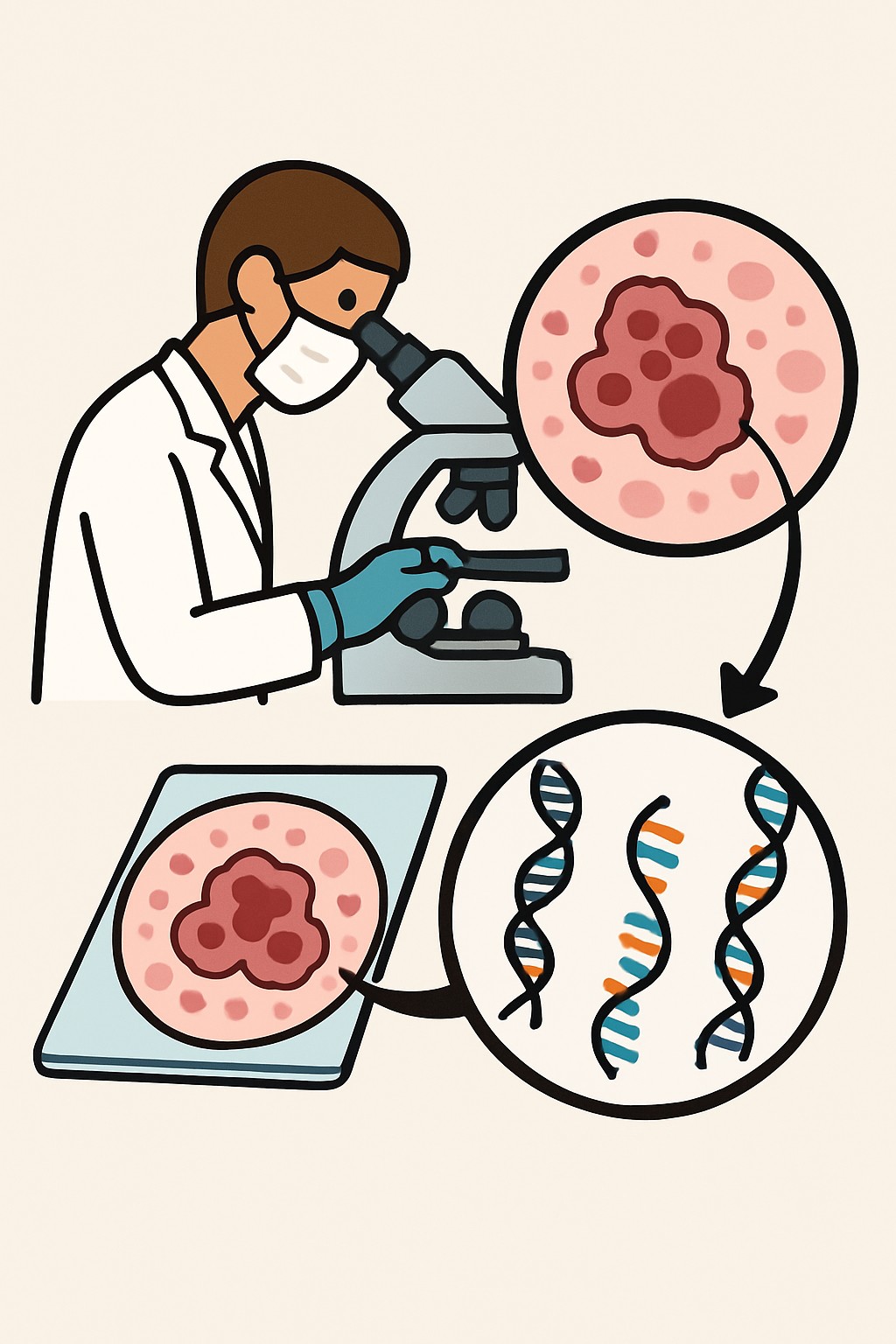
In situ hybridization (ISH) is a laboratory method that uses short, labeled strands of DNA or RNA called probes to find specific genetic material in cells or tissue on a microscope slide.
Overview
In situ hybridization (ISH) is a laboratory method that uses short, labeled strands of DNA or RNA called probes to find specific genetic material in cells or tissue on a microscope slide. The probe binds to its matching sequence in the sample and produces a signal that can be seen under a microscope. In cancer care, ISH is often used to check if a tumor has extra copies (amplification) of a gene such as HER2. Knowing a tumor’s HER2 status helps guide treatment choices. ISH can also detect certain viruses or other targets in tissue.
Also known as: ISH, FISH, CISH, SISH, HER2 amplification test
Preparation & Next Steps
Everything you need to know before and after your procedure
Before Care
- Confirm how the sample will be obtained (existing tissue block, blood smear, or a new biopsy) and the location handling the test
- Make sure your clinic and pathology lab have up-to-date contact information for delivering results
- Verify insurance benefits and any prior authorization requirements for biomarker testing
- If a biopsy is planned, review the facility’s instructions for eating, drinking, and medicines
- Arrange transportation if sedation or anesthesia may be used for sample collection
- Have a current list of medicines, supplements, allergies, and bleeding disorders available
- Tell the care team about anticoagulants or antiplatelet medicines before any biopsy
- Bring photo ID and any requested consent or release-of-information forms for specimen handling
After Care
- If a biopsy was done, keep the site clean and dry as instructed and protect the bandage
- Watch the biopsy area for increasing pain, redness, swelling, drainage, fever, or heavy bleeding and contact a clinician with concerns
- Avoid strenuous activity that could strain the biopsy site until the area is healed
- Know when and how results will be shared; many labs report within several days depending on the test and workflow
- Review the pathology report and note the stated method (e.g., FISH, CISH) and result interpretation
- Track any follow-up appointments to discuss results and next steps
- Keep copies of reports in your personal health records for future reference
- Ask whom to contact for questions about result interpretation or if additional testing is suggested
Clinical Information
Important medical details about this procedure
Indications
- Determining HER2 status in breast or gastric cancers for treatment planning
- Confirming equivocal or borderline immunohistochemistry (IHC) results
- Detecting gene amplifications, deletions, or rearrangements in tumors
- Identifying viral RNA or DNA in tissue (for example, EBV or HPV in certain tumors)
- Clarifying tumor classification when morphology and other tests are inconclusive
- Research or clinical trial eligibility that requires biomarker confirmation
Alternatives
- Immunohistochemistry (IHC) for protein expression (e.g., HER2 IHC)
- Polymerase chain reaction (PCR) based assays
- Next-generation sequencing (NGS) panels
- Chromogenic or silver in situ hybridization viewed by light microscope
- Repeat testing on another tumor block or a new specimen when feasible
Risks
- No direct physical risk from the lab test itself
- Risks related to sample collection if a biopsy is performed, such as bleeding, bruising, infection, or pain
- Possibility of inconclusive results that require retesting
- False negative or false positive results due to technical or sample factors
- Delay in results if the specimen is inadequate or needs additional processing
- Privacy and data security risks related to handling of medical information
Contraindications
- Insufficient tumor cells or poor-quality specimen
- Specimens damaged by harsh decalcification or fixation that degrades nucleic acids
- Heavy necrosis or crush artifact that limits interpretation
- Incompatibility between the chosen probe/test kit and the specimen type
Recovery Timeline
What to expect during your recovery
There is no physical recovery period from the laboratory test itself. If a biopsy was used to collect the sample, mild site soreness or bruising is common for a short time.
Typical Range
Same day
Return to Work
Same day
Recovery Milestones
Resume normal daily activities
Expect minor tenderness or bruising if a biopsy was performed
Review and discuss results once the pathology report is available
Frequently Asked Questions
Common questions and expert answers about this procedure
What is in situ hybridization?
What is in situ hybridization?
It is a lab method that uses labeled DNA or RNA probes to bind to specific genetic sequences in cells or tissue on a slide so they can be seen under a microscope.
What is the difference between FISH, CISH, and SISH?
What is the difference between FISH, CISH, and SISH?
FISH uses fluorescent signals viewed with special microscopes. CISH and SISH use colored or silver signals visible with standard light microscopes. All are forms of ISH.
Why is ISH used for HER2 testing?
Why is ISH used for HER2 testing?
ISH can show whether the HER2 gene is amplified in tumor cells, which helps classify the cancer and inform treatment options.
What sample is used for the test?
What sample is used for the test?
Most often a piece of tumor tissue preserved on a slide or in a paraffin block. In some settings, cells from body fluids or smears may be used.
How long do results take?
How long do results take?
Timing varies by lab, workload, and test platform. Results are often available within several days once the lab receives a suitable specimen.
Can ISH results differ from immunohistochemistry (IHC)?
Can ISH results differ from immunohistochemistry (IHC)?
Yes. IHC measures protein on the cell surface, while ISH measures gene copies. When results do not match, labs may perform additional review or testing.
Will I need another biopsy?
Will I need another biopsy?
If the original sample is too small, degraded, or not representative, the team may request more tissue or use another tumor block if available.
Does insurance cover HER2 or other ISH tests?
Does insurance cover HER2 or other ISH tests?
Coverage varies by plan and indication. Many plans cover biomarker tests used to guide treatment. Prior authorization may be required.