%20--%3e%3csvg%20version='1.0'%20id='Layer_1'%20xmlns='http://www.w3.org/2000/svg'%20xmlns:xlink='http://www.w3.org/1999/xlink'%20x='0px'%20y='0px'%20viewBox='0%200%20755.52%20814.35'%20style='enable-background:new%200%200%20755.52%20814.35;'%20xml:space='preserve'%3e%3cstyle%20type='text/css'%3e%20.st0{fill:%231ae5ce;stroke:%231ae5ce;stroke-width:7;stroke-miterlimit:10;}%20.st1{fill:%23FFFFFF;stroke:%231ae5ce;stroke-width:7;stroke-miterlimit:10;}%20.st2{fill:%231ae5ce;stroke:%23FFFFFF;stroke-width:7;stroke-miterlimit:10;}%20.st3{fill:%23FFFFFF;stroke:%23FFFFFF;stroke-width:6;stroke-miterlimit:10;}%20%3c/style%3e%3cg%20id='Dark_Logo_00000159431215648494653180000015900878925932721032_'%3e%3cpath%20id='shield_00000152259091539869183100000001926543869452564382_'%20class='st0'%20d='M711.13,173.42%20c-3.37-49.07-38.92-44.9-75.96-52.18c-67.4-13.25-130.47-34.47-192.36-63.92c-22.48-10.7-41.88-25.74-65.05-26.28%20c-23.17,0.54-42.58,15.59-65.05,26.28c-61.89,29.45-124.95,50.68-192.36,63.92c-37.04,7.28-72.59,3.11-75.96,52.18%20c-1.55,22.6,0.34,46.4,1.05,68.92c5.99,190.78,52.91,345.39,206.27,466.46c29.71,23.46,74.51,55.8,108.84,70.75%20c5.99,2.61,11.7,3.73,17.21,3.75c5.51-0.02,11.22-1.14,17.21-3.75c34.33-14.95,79.12-47.3,108.84-70.75%20c153.37-121.07,200.28-275.68,206.27-466.46C710.79,219.82,712.68,196.02,711.13,173.42z'/%3e%3cpath%20id='magnifyingglass_00000073685934697636024790000000342567780940956808_'%20class='st1'%20d='M648.78,624.21l-96.64-104.65%20c34.89-40.63,55.98-93.46,55.98-151.21c0-128.27-103.98-232.24-232.24-232.24S143.63,240.08,143.63,368.35%20s103.98,232.24,232.24,232.24c48.87,0,94.21-15.11,131.62-40.89l97.18,105.24c11.25,12.18,30.24,12.93,42.42,1.69l0,0%20C659.27,655.38,660.03,636.39,648.78,624.21z'/%3e%3ccircle%20id='ellipse_00000129904010550392394720000017056154833629780114_'%20class='st2'%20cx='375.87'%20cy='368.35'%20r='181.21'/%3e%3cpath%20id='dollarsign_00000057140127156649725250000003772530148495155891_'%20class='st3'%20d='M362.91,492.03v-23.91%20c0-2.01-1.58-3.69-3.59-3.77c-18.49-0.78-37.12-5.4-49.4-11.83c-1.75-0.92-2.53-3.01-1.76-4.84l5.87-13.89%20c0.86-2.02,3.23-2.88,5.2-1.89c12.94,6.52,30.45,11.44,49.18,11.44c26.02,0,43.6-12.73,43.6-30.43c0-17.08-14.29-27.63-41.4-36.95%20c-37.37-12.42-60.46-26.7-60.46-53.72c0-24.97,20.29-44.11,52.22-49.51c1.8-0.31,3.11-1.89,3.11-3.72v-24.35%20c0-2.09,1.69-3.78,3.78-3.78h15.16c2.09,0,3.78,1.69,3.78,3.78v22.71c0,2.01,1.58,3.67,3.58,3.77c17.85,0.92,30.88,4.75,40.61,9.1%20c1.92,0.86,2.79,3.09,1.94,5.01l-6.08,13.6c-0.85,1.91-3.09,2.77-4.99,1.91c-8.37-3.8-22.38-8.95-42.75-8.95%20c-28.21,0-38.84,14.28-38.84,26.7c0,16.15,13.56,24.22,45.44,35.4c37.74,13.04,56.79,29.19,56.79,56.82%20c0,23.85-19.05,46.23-54.78,52.3c-1.8,0.31-3.11,1.89-3.11,3.72v25.28c0,2.09-1.69,3.78-3.78,3.78h-15.53%20C364.6,495.81,362.91,494.12,362.91,492.03z'/%3e%3c/g%3e%3c/svg%3e)
Level 1 Pathology Consultation (microscopic consult) Laboratory Test
A Level 1 pathology consultation (microscopic consult) is a review of prepared tissue slides by a pathologist to provide an independent opinion or confirm a prior diagnosis.
Overview
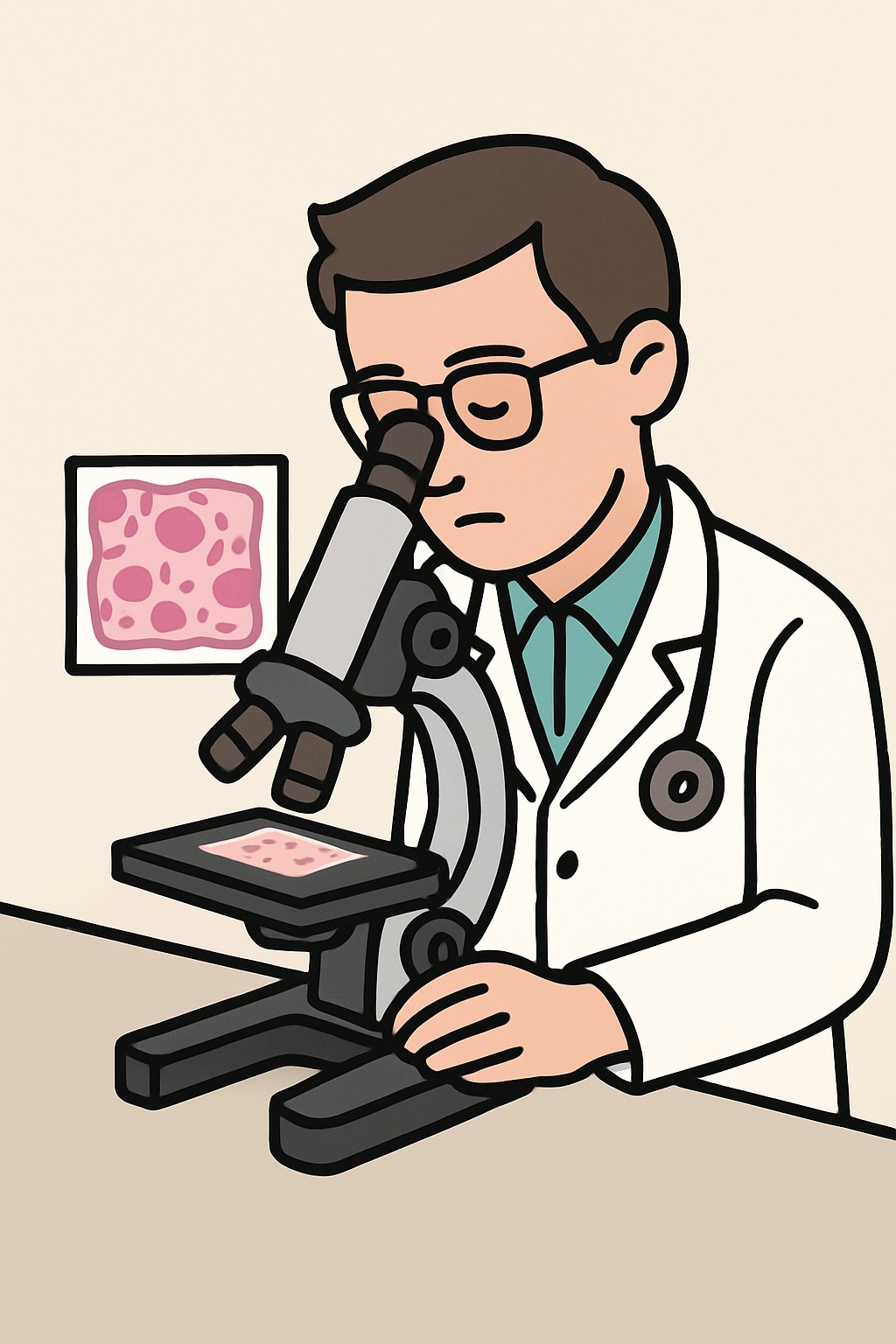
A Level 1 pathology consultation (microscopic consult) is a review of prepared tissue slides by a pathologist to provide an independent opinion or confirm a prior diagnosis. The pathologist studies the slides under a microscope and reviews the available report and clinical history. Level 1 generally indicates a lower-complexity consult that relies on slides prepared elsewhere, with limited or no additional testing. It does not involve a new biopsy or a clinic visit. The result is a written report sent to the ordering clinician.
Also known as: Pathology second opinion, Surgical pathology consult, Microscopic slide review, External slide review
Preparation & Next Steps
Everything you need to know before and after your procedure
Before Care
- Confirm which clinician or facility is requesting the consultation and where the report will be sent
- Sign any required release forms so the original lab can send slides and the prior report
- Provide relevant clinical history, prior procedures, medicines, and the date and site of biopsy
- Verify whether original slides, tissue blocks, or digital images are needed and who handles shipping
- Ask the clinic or lab about expected turnaround times and how you will receive results
- Check insurance benefits for second-opinion pathology and whether prior authorization is required
- Clarify any handling or courier fees for slide retrieval, shipping, or return
- Ensure your contact information and preferred pharmacy are up to date in the clinic portal
- Keep copies of prior pathology reports and imaging summaries to share if requested
After Care
- Review the consultation report when available and note the key diagnosis and comments
- Discuss with your clinician how the findings may affect the treatment plan
- Ask whether additional stains, molecular tests, or a repeat biopsy are recommended
- Confirm that slides and tissue blocks are returned to the original facility when the review is complete
- Keep a copy of the final report in your personal medical records
- Track timelines and contact the clinic if results are delayed beyond the estimate
- Verify any related charges on your statements and contact billing if something looks incorrect
- Request a plain-language explanation of medical terms in the report if needed
- Coordinate follow-up appointments or tumor board review if suggested by your care team
Clinical Information
Important medical details about this procedure
Indications
- Second opinion to confirm a diagnosis before treatment
- Review of outside pathology slides after transfer of care
- Clarification when results or interpretations differ
- Assessment of rare or complex findings
- Tumor board or multidisciplinary review support
- Quality assurance or verification required by a facility
Alternatives
- Proceed with the original pathology report only
- Request a more comprehensive pathology consultation
- Digital telepathology review
- Repeat biopsy or specimen collection if material is insufficient
- Molecular or special stain testing when relevant
- Case discussion at a multidisciplinary tumor board
Risks
- Possible delay if slides or records are incomplete or shipping is slow
- Diagnosis may differ from the original report
- Additional tests may be suggested, which can add time and cost
- Potential out-of-pocket charges depending on coverage
- Small risk of slide damage or loss during transport
- Privacy risks if materials or records are handled improperly
Contraindications
- No available slides or tissue blocks to review
- Slides are too damaged or of inadequate quality for interpretation
- Legal or institutional restrictions that prevent release of materials
- Urgent clinical situations where a second opinion would cause harmful delay
Recovery Timeline
What to expect during your recovery
There is no physical recovery for a microscopic pathology consultation. People typically continue normal activities while waiting for the report.
Typical Range
Same day
Return to Work
Same day
Recovery Milestones
Resume normal daily activities
Review results and discuss next steps with your clinician
Arrange any additional tests or appointments if recommended
Frequently Asked Questions
Common questions and expert answers about this procedure
What does Level 1 mean in a pathology consultation?
What does Level 1 mean in a pathology consultation?
It usually refers to a lower-complexity microscopic review based on existing slides and records, with limited or no additional testing.
Will a new biopsy be done for this consult?
Will a new biopsy be done for this consult?
No. The pathologist reviews slides and materials already prepared elsewhere. A new biopsy is only considered if the material is insufficient or not representative.
How long do results usually take?
How long do results usually take?
Timing varies by case complexity, shipping, and lab workload. Many reports are available in several days to a couple of weeks.
Who gets the report from the consultation?
Who gets the report from the consultation?
The written report is typically sent to the ordering clinician or facility, and it may also appear in your patient portal.
Can this be done with digital slides?
Can this be done with digital slides?
Sometimes. Labs may scan slides for digital review, depending on technology, policies, and image quality.
Could the diagnosis change after the consult?
Could the diagnosis change after the consult?
Yes. A second opinion may confirm, refine, or revise the original diagnosis, which can influence treatment planning.
What if the pathologist needs more tests?
What if the pathologist needs more tests?
They may suggest special stains or molecular studies. These tests may require permission and can add time and cost.
Are my slides returned after review?
Are my slides returned after review?
Slides and blocks are usually returned to the originating lab after the consultation, following lab policy.
References
Medical literature and sources