%20--%3e%3csvg%20version='1.0'%20id='Layer_1'%20xmlns='http://www.w3.org/2000/svg'%20xmlns:xlink='http://www.w3.org/1999/xlink'%20x='0px'%20y='0px'%20viewBox='0%200%20755.52%20814.35'%20style='enable-background:new%200%200%20755.52%20814.35;'%20xml:space='preserve'%3e%3cstyle%20type='text/css'%3e%20.st0{fill:%231ae5ce;stroke:%231ae5ce;stroke-width:7;stroke-miterlimit:10;}%20.st1{fill:%23FFFFFF;stroke:%231ae5ce;stroke-width:7;stroke-miterlimit:10;}%20.st2{fill:%231ae5ce;stroke:%23FFFFFF;stroke-width:7;stroke-miterlimit:10;}%20.st3{fill:%23FFFFFF;stroke:%23FFFFFF;stroke-width:6;stroke-miterlimit:10;}%20%3c/style%3e%3cg%20id='Dark_Logo_00000159431215648494653180000015900878925932721032_'%3e%3cpath%20id='shield_00000152259091539869183100000001926543869452564382_'%20class='st0'%20d='M711.13,173.42%20c-3.37-49.07-38.92-44.9-75.96-52.18c-67.4-13.25-130.47-34.47-192.36-63.92c-22.48-10.7-41.88-25.74-65.05-26.28%20c-23.17,0.54-42.58,15.59-65.05,26.28c-61.89,29.45-124.95,50.68-192.36,63.92c-37.04,7.28-72.59,3.11-75.96,52.18%20c-1.55,22.6,0.34,46.4,1.05,68.92c5.99,190.78,52.91,345.39,206.27,466.46c29.71,23.46,74.51,55.8,108.84,70.75%20c5.99,2.61,11.7,3.73,17.21,3.75c5.51-0.02,11.22-1.14,17.21-3.75c34.33-14.95,79.12-47.3,108.84-70.75%20c153.37-121.07,200.28-275.68,206.27-466.46C710.79,219.82,712.68,196.02,711.13,173.42z'/%3e%3cpath%20id='magnifyingglass_00000073685934697636024790000000342567780940956808_'%20class='st1'%20d='M648.78,624.21l-96.64-104.65%20c34.89-40.63,55.98-93.46,55.98-151.21c0-128.27-103.98-232.24-232.24-232.24S143.63,240.08,143.63,368.35%20s103.98,232.24,232.24,232.24c48.87,0,94.21-15.11,131.62-40.89l97.18,105.24c11.25,12.18,30.24,12.93,42.42,1.69l0,0%20C659.27,655.38,660.03,636.39,648.78,624.21z'/%3e%3ccircle%20id='ellipse_00000129904010550392394720000017056154833629780114_'%20class='st2'%20cx='375.87'%20cy='368.35'%20r='181.21'/%3e%3cpath%20id='dollarsign_00000057140127156649725250000003772530148495155891_'%20class='st3'%20d='M362.91,492.03v-23.91%20c0-2.01-1.58-3.69-3.59-3.77c-18.49-0.78-37.12-5.4-49.4-11.83c-1.75-0.92-2.53-3.01-1.76-4.84l5.87-13.89%20c0.86-2.02,3.23-2.88,5.2-1.89c12.94,6.52,30.45,11.44,49.18,11.44c26.02,0,43.6-12.73,43.6-30.43c0-17.08-14.29-27.63-41.4-36.95%20c-37.37-12.42-60.46-26.7-60.46-53.72c0-24.97,20.29-44.11,52.22-49.51c1.8-0.31,3.11-1.89,3.11-3.72v-24.35%20c0-2.09,1.69-3.78,3.78-3.78h15.16c2.09,0,3.78,1.69,3.78,3.78v22.71c0,2.01,1.58,3.67,3.58,3.77c17.85,0.92,30.88,4.75,40.61,9.1%20c1.92,0.86,2.79,3.09,1.94,5.01l-6.08,13.6c-0.85,1.91-3.09,2.77-4.99,1.91c-8.37-3.8-22.38-8.95-42.75-8.95%20c-28.21,0-38.84,14.28-38.84,26.7c0,16.15,13.56,24.22,45.44,35.4c37.74,13.04,56.79,29.19,56.79,56.82%20c0,23.85-19.05,46.23-54.78,52.3c-1.8,0.31-3.11,1.89-3.11,3.72v25.28c0,2.09-1.69,3.78-3.78,3.78h-15.53%20C364.6,495.81,362.91,494.12,362.91,492.03z'/%3e%3c/g%3e%3c/svg%3e)
Lyme disease antibody test Laboratory Test
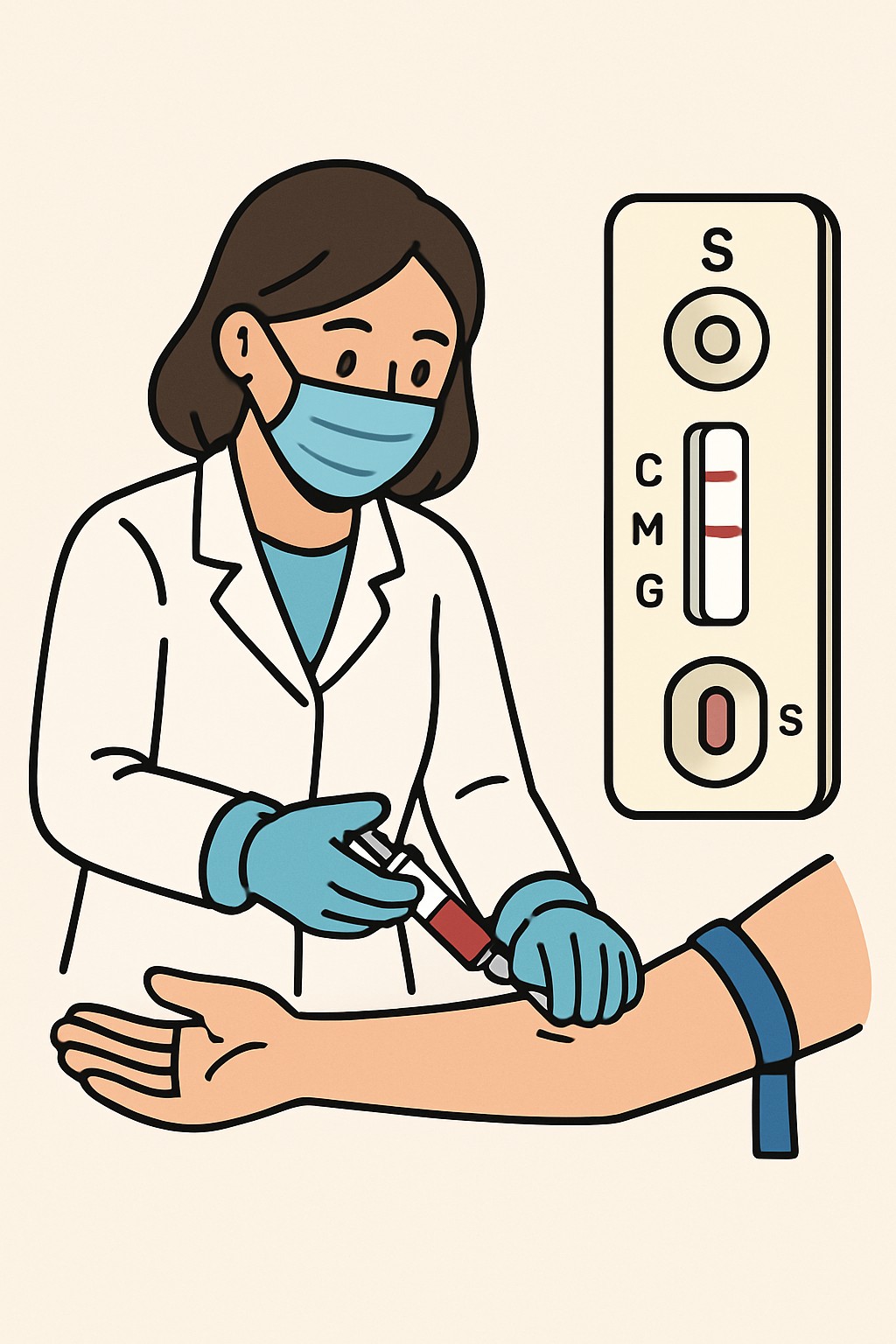
A Lyme disease antibody test is a blood test that looks for your body’s immune response to Borrelia burgdorferi, the bacteria that cause Lyme disease.
Overview
A Lyme disease antibody test is a blood test that looks for your body’s immune response to Borrelia burgdorferi, the bacteria that cause Lyme disease. Most labs use a two-step process: an initial antibody screen, followed by a second test if the first is positive or borderline. Results are interpreted together. This test helps support a diagnosis when someone has symptoms after possible exposure to blacklegged ticks. Antibodies often take time to develop, so very early infections can test negative even if Lyme disease is present.
Also known as: Lyme serology, Lyme titer, Lyme disease blood test, Lyme antibody screen
Preparation & Next Steps
Everything you need to know before and after your procedure
Before Care
- Bring the dates and locations of possible tick exposure and a brief symptom timeline
- Carry a current list of medicines and supplements and note any allergies
- Confirm how and where the lab will share results (patient portal, phone, or mail)
- Ask the ordering clinician or lab about timing, since antibodies often take 1–3 weeks to appear
- Fasting is usually not required for this blood test; verify if your lab has any special instructions
- Wear clothing that allows easy access to the inside of your elbow for the blood draw
- Hydrate with water unless instructed otherwise by the lab
- Tell the phlebotomist if you have a history of fainting during blood draws or a bleeding disorder
- Bring identification and insurance information and plan time for check-in
- If you previously had Lyme disease or a Lyme vaccine in the past, bring any dates or records you have
After Care
- Leave the bandage in place for several hours and keep the area clean and dry
- Mild soreness or a small bruise at the draw site is common and usually fades in a few days
- If bleeding occurs at the site, apply firm pressure with clean gauze
- Drink fluids and resume normal activities as you feel comfortable
- Review how results will be delivered and when to expect them, often within a few days
- Understand that many labs use a two-step method; a second test may be automatically performed if the first is positive or borderline
- If testing was done very soon after exposure and symptoms continue, a repeat test at a later date may be considered
- Contact a clinician if you develop an expanding rash, new neurologic symptoms, chest pain, or worsening joint swelling
- Keep copies of your results for your records
- Ask how results will be interpreted in context of your symptoms and exposure history
Clinical Information
Important medical details about this procedure
Indications
- Compatible symptoms after possible tick exposure (fever, fatigue, headache, neck stiffness, joint pain)
- Evaluation of later symptoms such as intermittent or persistent joint swelling (Lyme arthritis)
- Neurologic symptoms with exposure risk when clinical evaluation suggests Lyme disease
- Supporting diagnosis when the classic expanding rash is absent or uncertain
- Follow-up testing when an earlier test was negative but symptoms persist
Alternatives
- Clinical diagnosis of the classic expanding erythema migrans rash without testing
- Repeat antibody testing after time has passed if initial test was early
- PCR testing on joint (synovial) fluid in select cases of suspected Lyme arthritis
- Evaluation and testing for other conditions with similar symptoms
Risks
- False negative early in infection before antibodies develop
- False positive from cross-reacting antibodies or past infection
- Mild pain, bruising, or lightheadedness from the blood draw
- Anxiety while waiting for results
- Additional testing may be needed to clarify results
- Privacy and data security considerations for lab results
Recovery Timeline
What to expect during your recovery
Most people resume normal activities right after the blood draw. Minor soreness or bruising at the draw site can last up to a day.
Typical Range
0–1 days
Return to Work
Same day
Recovery Milestones
Resume normal daily activities
Expect mild arm soreness or small bruise at the draw site
Review results when available and note any recommended follow-up
If advised by your clinician, repeat testing may occur in this window for early infections
Frequently Asked Questions
Common questions and expert answers about this procedure
What does a Lyme disease antibody test measure?
What does a Lyme disease antibody test measure?
It detects antibodies your immune system makes against Borrelia bacteria. These antibodies help show if your body has responded to the infection.
Do I need to fast for this test?
Do I need to fast for this test?
Fasting is usually not required for Lyme antibody testing. Check with your lab for any special instructions.
How soon after a tick bite will the test be accurate?
How soon after a tick bite will the test be accurate?
Antibodies often appear 1–3 weeks after infection. Testing very early can be negative even if you are infected, so timing matters.
What is two-step testing for Lyme disease?
What is two-step testing for Lyme disease?
Labs first run an antibody screening test. If it is positive or borderline, a second test is performed. Results from both steps are combined to report a final result.
Can the test stay positive after treatment?
Can the test stay positive after treatment?
Yes. Antibodies can remain for months or years, so tests are not used to show cure or guide when to stop treatment.
What can cause a false positive result?
What can cause a false positive result?
Other infections or conditions can produce cross-reacting antibodies, and past Lyme infection can also lead to a positive result.
How long do results take?
How long do results take?
Many labs report results within a few days, but timing varies by lab and whether a second test is needed.
References
Medical literature and sources