%20--%3e%3csvg%20version='1.0'%20id='Layer_1'%20xmlns='http://www.w3.org/2000/svg'%20xmlns:xlink='http://www.w3.org/1999/xlink'%20x='0px'%20y='0px'%20viewBox='0%200%20755.52%20814.35'%20style='enable-background:new%200%200%20755.52%20814.35;'%20xml:space='preserve'%3e%3cstyle%20type='text/css'%3e%20.st0{fill:%231ae5ce;stroke:%231ae5ce;stroke-width:7;stroke-miterlimit:10;}%20.st1{fill:%23FFFFFF;stroke:%231ae5ce;stroke-width:7;stroke-miterlimit:10;}%20.st2{fill:%231ae5ce;stroke:%23FFFFFF;stroke-width:7;stroke-miterlimit:10;}%20.st3{fill:%23FFFFFF;stroke:%23FFFFFF;stroke-width:6;stroke-miterlimit:10;}%20%3c/style%3e%3cg%20id='Dark_Logo_00000159431215648494653180000015900878925932721032_'%3e%3cpath%20id='shield_00000152259091539869183100000001926543869452564382_'%20class='st0'%20d='M711.13,173.42%20c-3.37-49.07-38.92-44.9-75.96-52.18c-67.4-13.25-130.47-34.47-192.36-63.92c-22.48-10.7-41.88-25.74-65.05-26.28%20c-23.17,0.54-42.58,15.59-65.05,26.28c-61.89,29.45-124.95,50.68-192.36,63.92c-37.04,7.28-72.59,3.11-75.96,52.18%20c-1.55,22.6,0.34,46.4,1.05,68.92c5.99,190.78,52.91,345.39,206.27,466.46c29.71,23.46,74.51,55.8,108.84,70.75%20c5.99,2.61,11.7,3.73,17.21,3.75c5.51-0.02,11.22-1.14,17.21-3.75c34.33-14.95,79.12-47.3,108.84-70.75%20c153.37-121.07,200.28-275.68,206.27-466.46C710.79,219.82,712.68,196.02,711.13,173.42z'/%3e%3cpath%20id='magnifyingglass_00000073685934697636024790000000342567780940956808_'%20class='st1'%20d='M648.78,624.21l-96.64-104.65%20c34.89-40.63,55.98-93.46,55.98-151.21c0-128.27-103.98-232.24-232.24-232.24S143.63,240.08,143.63,368.35%20s103.98,232.24,232.24,232.24c48.87,0,94.21-15.11,131.62-40.89l97.18,105.24c11.25,12.18,30.24,12.93,42.42,1.69l0,0%20C659.27,655.38,660.03,636.39,648.78,624.21z'/%3e%3ccircle%20id='ellipse_00000129904010550392394720000017056154833629780114_'%20class='st2'%20cx='375.87'%20cy='368.35'%20r='181.21'/%3e%3cpath%20id='dollarsign_00000057140127156649725250000003772530148495155891_'%20class='st3'%20d='M362.91,492.03v-23.91%20c0-2.01-1.58-3.69-3.59-3.77c-18.49-0.78-37.12-5.4-49.4-11.83c-1.75-0.92-2.53-3.01-1.76-4.84l5.87-13.89%20c0.86-2.02,3.23-2.88,5.2-1.89c12.94,6.52,30.45,11.44,49.18,11.44c26.02,0,43.6-12.73,43.6-30.43c0-17.08-14.29-27.63-41.4-36.95%20c-37.37-12.42-60.46-26.7-60.46-53.72c0-24.97,20.29-44.11,52.22-49.51c1.8-0.31,3.11-1.89,3.11-3.72v-24.35%20c0-2.09,1.69-3.78,3.78-3.78h15.16c2.09,0,3.78,1.69,3.78,3.78v22.71c0,2.01,1.58,3.67,3.58,3.77c17.85,0.92,30.88,4.75,40.61,9.1%20c1.92,0.86,2.79,3.09,1.94,5.01l-6.08,13.6c-0.85,1.91-3.09,2.77-4.99,1.91c-8.37-3.8-22.38-8.95-42.75-8.95%20c-28.21,0-38.84,14.28-38.84,26.7c0,16.15,13.56,24.22,45.44,35.4c37.74,13.04,56.79,29.19,56.79,56.82%20c0,23.85-19.05,46.23-54.78,52.3c-1.8,0.31-3.11,1.89-3.11,3.72v25.28c0,2.09-1.69,3.78-3.78,3.78h-15.53%20C364.6,495.81,362.91,494.12,362.91,492.03z'/%3e%3c/g%3e%3c/svg%3e)
Myoglobin blood level (muscle injury test) Laboratory Test
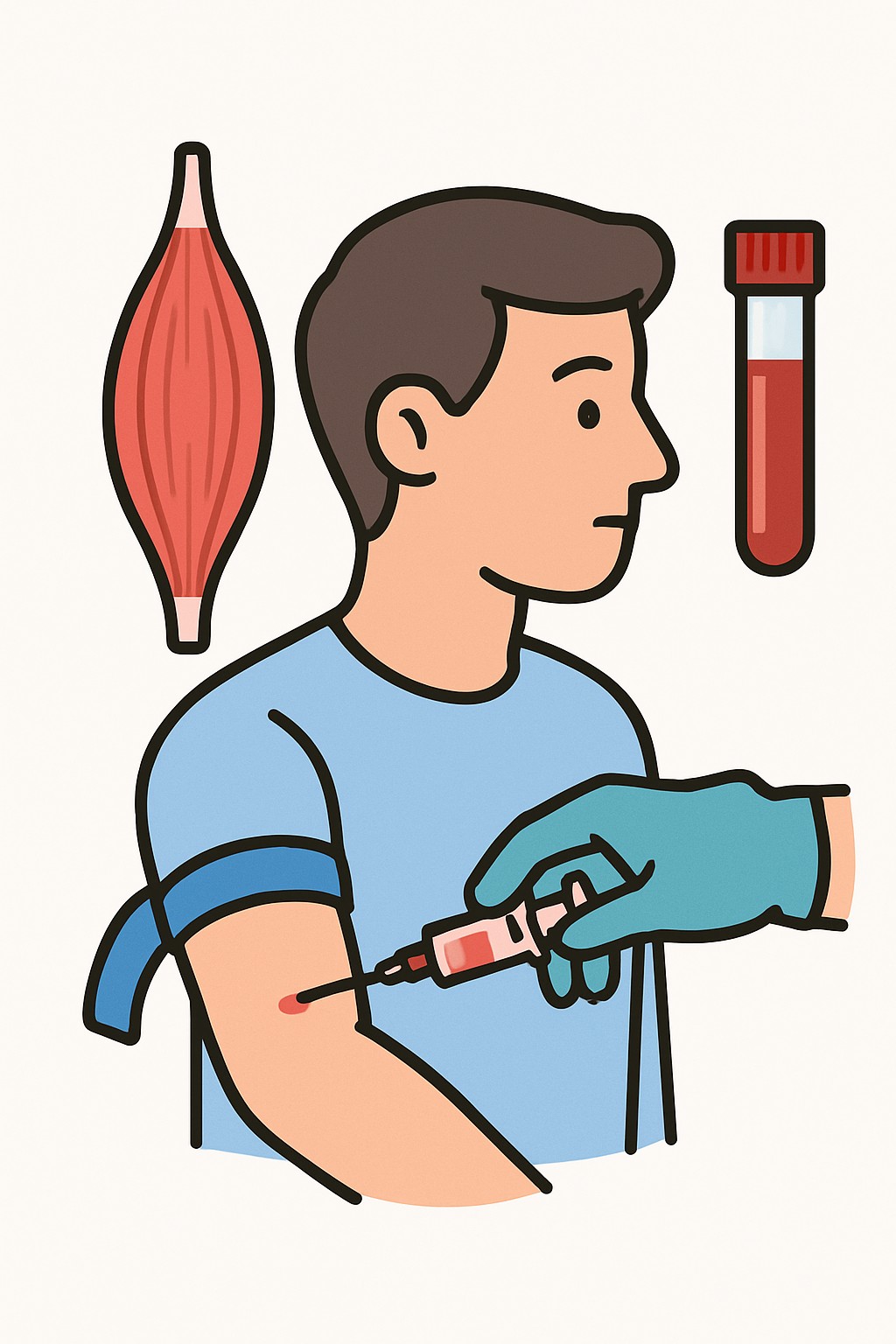
A myoglobin blood test measures the amount of myoglobin, a protein found in heart and skeletal muscle, in your blood.
Overview
A myoglobin blood test measures the amount of myoglobin, a protein found in heart and skeletal muscle, in your blood. Myoglobin is released into the bloodstream when muscle tissue is damaged. Clinicians may order this test to check for recent muscle injury, to help evaluate dark urine that may be due to myoglobin, or as part of a panel when chest pain or other symptoms raise concern for heart or muscle damage.
Also known as: Myoglobin test, Serum myoglobin, Plasma myoglobin
Preparation & Next Steps
Everything you need to know before and after your procedure
Before Care
- No fasting is usually needed; confirm any special instructions from the lab
- Avoid strenuous exercise before the test because it can raise myoglobin levels
- Tell the staff about all medicines and supplements you take, including blood thinners
- Share the timing of symptom onset, injuries, or heavy activity, which can affect results
- Bring a photo ID, insurance card, and any lab order or confirmation number
- Stay well hydrated unless you were told otherwise
- Wear sleeves that roll up easily for a blood draw
- If prior results exist, have the dates handy for comparison
After Care
- Keep pressure on the site for several minutes to reduce bruising
- Leave the bandage on for a few hours and keep the area clean and dry
- Avoid heavy lifting with the arm used for the blood draw for the rest of the day
- Drink fluids as usual unless you were told otherwise
- Watch for ongoing bleeding, increasing pain, warmth, or swelling at the site and contact a clinician if these occur
- Review your results when available and note the collection time, since myoglobin changes quickly
- Share any recent intense exercise or injuries with your clinician when discussing results
- Arrange follow-up testing if it was part of the plan
Clinical Information
Important medical details about this procedure
Indications
- Recent muscle injury or crush injury
- Symptoms of rhabdomyolysis (muscle breakdown), such as muscle pain or dark urine
- Evaluation of chest pain early after symptom onset
- Monitoring the course of muscle damage over time
- Suspected heat illness or exertional injury
- Assessing muscle injury after seizures, falls, or prolonged immobility
Alternatives
- High-sensitivity cardiac troponin test for heart muscle injury
- Creatine kinase (CK) test for muscle damage
- Urine myoglobin test for myoglobin in urine
- Electrocardiogram (ECG) and clinical assessment for chest pain
- Imaging such as ultrasound or MRI for focal muscle injury
- Repeat blood tests over time to track changes
Risks
- Brief pain or bruising at the needle site
- Bleeding or hematoma at the draw site
- Lightheadedness or fainting with blood draws
- Very small risk of infection at the puncture site
Contraindications
- Venipuncture in an arm with lymphedema or after lymph node removal
- Active skin infection at the draw site
- Uncontrolled bleeding disorders or use of certain blood thinners may require special precautions
Recovery Timeline
What to expect during your recovery
There is no medical recovery period from a standard blood draw. Most people resume normal activities right away.
Typical Range
Same day
Return to Work
Same day
Recovery Milestones
Resume normal daily activities
Keep bandage on for several hours and avoid heavy lifting with the draw arm
Review results and any follow-up instructions
Frequently Asked Questions
Common questions and expert answers about this procedure
What does the myoglobin test measure?
What does the myoglobin test measure?
It measures the amount of myoglobin, a muscle protein, in your blood. Levels can rise quickly after muscle injury.
Is this the main test for a heart attack?
Is this the main test for a heart attack?
No. High-sensitivity troponin is the preferred test for heart muscle injury. Myoglobin may rise earlier but is less specific.
Do I need to fast?
Do I need to fast?
Fasting is not usually required. Your lab will tell you if there are special instructions.
Can exercise affect my results?
Can exercise affect my results?
Yes. Intense or recent exercise can raise myoglobin levels even without an injury.
How is the test done?
How is the test done?
A blood sample is taken from a vein in your arm and sent to a lab for analysis.
How quickly do myoglobin levels change?
How quickly do myoglobin levels change?
They can rise within hours after muscle injury and may return toward baseline within a day or so.
What if I have kidney disease?
What if I have kidney disease?
Reduced kidney function can cause myoglobin to stay elevated longer because the kidneys help clear it from the blood.
What other tests might be ordered?
What other tests might be ordered?
Depending on the situation, tests may include troponin, CK, basic metabolic panel, urinalysis, or an ECG.
References
Medical literature and sources