%20--%3e%3csvg%20version='1.0'%20id='Layer_1'%20xmlns='http://www.w3.org/2000/svg'%20xmlns:xlink='http://www.w3.org/1999/xlink'%20x='0px'%20y='0px'%20viewBox='0%200%20755.52%20814.35'%20style='enable-background:new%200%200%20755.52%20814.35;'%20xml:space='preserve'%3e%3cstyle%20type='text/css'%3e%20.st0{fill:%231ae5ce;stroke:%231ae5ce;stroke-width:7;stroke-miterlimit:10;}%20.st1{fill:%23FFFFFF;stroke:%231ae5ce;stroke-width:7;stroke-miterlimit:10;}%20.st2{fill:%231ae5ce;stroke:%23FFFFFF;stroke-width:7;stroke-miterlimit:10;}%20.st3{fill:%23FFFFFF;stroke:%23FFFFFF;stroke-width:6;stroke-miterlimit:10;}%20%3c/style%3e%3cg%20id='Dark_Logo_00000159431215648494653180000015900878925932721032_'%3e%3cpath%20id='shield_00000152259091539869183100000001926543869452564382_'%20class='st0'%20d='M711.13,173.42%20c-3.37-49.07-38.92-44.9-75.96-52.18c-67.4-13.25-130.47-34.47-192.36-63.92c-22.48-10.7-41.88-25.74-65.05-26.28%20c-23.17,0.54-42.58,15.59-65.05,26.28c-61.89,29.45-124.95,50.68-192.36,63.92c-37.04,7.28-72.59,3.11-75.96,52.18%20c-1.55,22.6,0.34,46.4,1.05,68.92c5.99,190.78,52.91,345.39,206.27,466.46c29.71,23.46,74.51,55.8,108.84,70.75%20c5.99,2.61,11.7,3.73,17.21,3.75c5.51-0.02,11.22-1.14,17.21-3.75c34.33-14.95,79.12-47.3,108.84-70.75%20c153.37-121.07,200.28-275.68,206.27-466.46C710.79,219.82,712.68,196.02,711.13,173.42z'/%3e%3cpath%20id='magnifyingglass_00000073685934697636024790000000342567780940956808_'%20class='st1'%20d='M648.78,624.21l-96.64-104.65%20c34.89-40.63,55.98-93.46,55.98-151.21c0-128.27-103.98-232.24-232.24-232.24S143.63,240.08,143.63,368.35%20s103.98,232.24,232.24,232.24c48.87,0,94.21-15.11,131.62-40.89l97.18,105.24c11.25,12.18,30.24,12.93,42.42,1.69l0,0%20C659.27,655.38,660.03,636.39,648.78,624.21z'/%3e%3ccircle%20id='ellipse_00000129904010550392394720000017056154833629780114_'%20class='st2'%20cx='375.87'%20cy='368.35'%20r='181.21'/%3e%3cpath%20id='dollarsign_00000057140127156649725250000003772530148495155891_'%20class='st3'%20d='M362.91,492.03v-23.91%20c0-2.01-1.58-3.69-3.59-3.77c-18.49-0.78-37.12-5.4-49.4-11.83c-1.75-0.92-2.53-3.01-1.76-4.84l5.87-13.89%20c0.86-2.02,3.23-2.88,5.2-1.89c12.94,6.52,30.45,11.44,49.18,11.44c26.02,0,43.6-12.73,43.6-30.43c0-17.08-14.29-27.63-41.4-36.95%20c-37.37-12.42-60.46-26.7-60.46-53.72c0-24.97,20.29-44.11,52.22-49.51c1.8-0.31,3.11-1.89,3.11-3.72v-24.35%20c0-2.09,1.69-3.78,3.78-3.78h15.16c2.09,0,3.78,1.69,3.78,3.78v22.71c0,2.01,1.58,3.67,3.58,3.77c17.85,0.92,30.88,4.75,40.61,9.1%20c1.92,0.86,2.79,3.09,1.94,5.01l-6.08,13.6c-0.85,1.91-3.09,2.77-4.99,1.91c-8.37-3.8-22.38-8.95-42.75-8.95%20c-28.21,0-38.84,14.28-38.84,26.7c0,16.15,13.56,24.22,45.44,35.4c37.74,13.04,56.79,29.19,56.79,56.82%20c0,23.85-19.05,46.23-54.78,52.3c-1.8,0.31-3.11,1.89-3.11,3.72v25.28c0,2.09-1.69,3.78-3.78,3.78h-15.53%20C364.6,495.81,362.91,494.12,362.91,492.03z'/%3e%3c/g%3e%3c/svg%3e)
Rapid Strep Test Laboratory Test
A rapid strep test is a quick throat swab that looks for group A Streptococcus, the bacteria that most often causes strep throat.
Overview
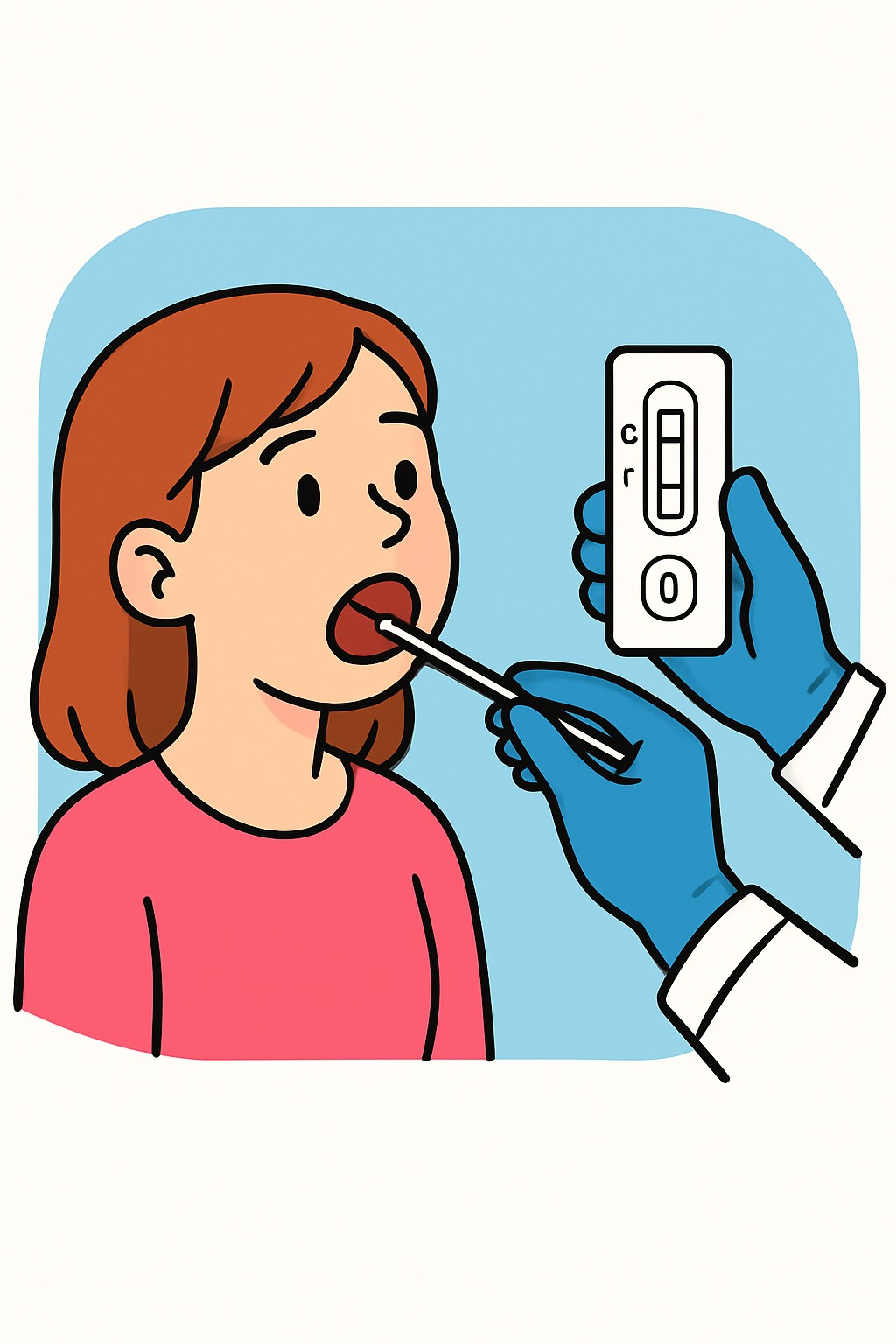
A rapid strep test is a quick throat swab that looks for group A Streptococcus, the bacteria that most often causes strep throat. A clinician rubs a soft swab over the tonsils and back of the throat to collect a sample and runs the test in the clinic. Results are usually available within minutes. The test helps tell if a sore throat may be caused by bacteria rather than a virus. In children and teens, a negative rapid test is often checked with a backup throat culture to confirm.
Also known as: RADT, Rapid antigen strep test, Rapid GAS test, Point-of-care strep test
Preparation & Next Steps
Everything you need to know before and after your procedure
Before Care
- Bring a photo ID, insurance card, and a form of payment if required by the clinic
- Know when symptoms started, any fevers, and any exposure to strep throat
- Have a current list of medicines and note any recent antibiotic use
- Tell staff about allergies, including to adhesives or antiseptics
- Remove gum, food, or lozenges from your mouth before the swab
- Let the clinician know about bleeding disorders or low platelet counts
- If bringing a child, plan how you will help them sit still during the swab
- Ask the clinic if they prefer that you avoid eating, drinking, smoking, or throat sprays for 15–30 minutes before the swab
- Use the patient portal or forms to pre-complete contact and pharmacy details
After Care
- Results may be ready during the visit; ask how culture or NAAT results will be shared if a backup test is sent
- Follow the care plan provided by your clinician and any printed or portal instructions
- If antibiotics are prescribed, take them exactly as directed by your clinician
- Use over-the-counter pain and fever medicines only as labeled or as advised by your clinician
- Practice hand hygiene and avoid sharing drinks or utensils while sick
- If a throat culture was sent, expect an update in about 24–48 hours
- Contact the clinic if symptoms worsen, swallowing becomes hard, high fever persists, a new rash appears, or you are not improving as expected
- Keep track of symptoms and any side effects to discuss at follow-up
Clinical Information
Important medical details about this procedure
Indications
- Sore throat with fever or swollen tonsils
- Red or pus-covered tonsils
- Tender or swollen neck lymph nodes
- Exposure to someone with confirmed strep throat
- Fine, sandpaper-like rash that may suggest scarlet fever
Alternatives
- Throat culture to confirm or rule out group A strep
- Nucleic acid amplification test (NAAT), sometimes called PCR
- Clinical scoring with testing when indicated
- Observation when symptoms strongly suggest a viral illness
Risks
- Brief gagging or coughing during the swab
- Minor throat irritation or rare small spots of bleeding
- False negative or false positive results
- Potential unnecessary antibiotics if results are misinterpreted
Contraindications
- Recent significant mouth or throat injury or surgery that makes swabbing unsafe
- Inability to open the mouth or control gag reflex enough for safe swabbing
- Active bleeding in the mouth or throat
Recovery Timeline
What to expect during your recovery
There is no medical recovery period from the swab itself. Most people resume normal activities immediately after the test.
Typical Range
Same day
Return to Work
Same day
Recovery Milestones
Resume normal daily activities
Receive rapid test result during the visit in most clinics
Await throat culture or NAAT results if a backup test was sent
Review any care plan updates based on final results
Frequently Asked Questions
Common questions and expert answers about this procedure
What does a rapid strep test check for?
What does a rapid strep test check for?
It looks for proteins from group A Streptococcus in a throat swab sample to help diagnose strep throat.
How long do results take?
How long do results take?
Rapid results are typically ready in minutes. If a throat culture is sent, results usually take about 24–48 hours.
How accurate is the rapid strep test?
How accurate is the rapid strep test?
It is specific but not perfect. In children and teens, a negative rapid test is often checked with a throat culture to avoid missing an infection.
Will I need a throat culture too?
Will I need a throat culture too?
Many clinics send a culture for children and teens after a negative rapid test. Adults may not always need a backup culture.
Does the swab hurt?
Does the swab hurt?
It can feel uncomfortable and may trigger a brief gag, but it is quick and usually lasts only a few seconds.
Can I eat or drink before the test?
Can I eat or drink before the test?
Many clinics have no strict rules, but some prefer you avoid food, drinks, or throat sprays shortly before the swab. Ask your clinic for their preference.
Does a positive rapid test always mean antibiotics?
Does a positive rapid test always mean antibiotics?
Clinicians interpret the result along with your symptoms and exam. Antibiotics are used for confirmed group A strep, but the care plan depends on the full picture.
Does the rapid test find other strep types?
Does the rapid test find other strep types?
Standard rapid tests detect group A strep. A throat culture or some NAATs can identify other groups if needed.
References
Medical literature and sources