%20--%3e%3csvg%20version='1.0'%20id='Layer_1'%20xmlns='http://www.w3.org/2000/svg'%20xmlns:xlink='http://www.w3.org/1999/xlink'%20x='0px'%20y='0px'%20viewBox='0%200%20755.52%20814.35'%20style='enable-background:new%200%200%20755.52%20814.35;'%20xml:space='preserve'%3e%3cstyle%20type='text/css'%3e%20.st0{fill:%231ae5ce;stroke:%231ae5ce;stroke-width:7;stroke-miterlimit:10;}%20.st1{fill:%23FFFFFF;stroke:%231ae5ce;stroke-width:7;stroke-miterlimit:10;}%20.st2{fill:%231ae5ce;stroke:%23FFFFFF;stroke-width:7;stroke-miterlimit:10;}%20.st3{fill:%23FFFFFF;stroke:%23FFFFFF;stroke-width:6;stroke-miterlimit:10;}%20%3c/style%3e%3cg%20id='Dark_Logo_00000159431215648494653180000015900878925932721032_'%3e%3cpath%20id='shield_00000152259091539869183100000001926543869452564382_'%20class='st0'%20d='M711.13,173.42%20c-3.37-49.07-38.92-44.9-75.96-52.18c-67.4-13.25-130.47-34.47-192.36-63.92c-22.48-10.7-41.88-25.74-65.05-26.28%20c-23.17,0.54-42.58,15.59-65.05,26.28c-61.89,29.45-124.95,50.68-192.36,63.92c-37.04,7.28-72.59,3.11-75.96,52.18%20c-1.55,22.6,0.34,46.4,1.05,68.92c5.99,190.78,52.91,345.39,206.27,466.46c29.71,23.46,74.51,55.8,108.84,70.75%20c5.99,2.61,11.7,3.73,17.21,3.75c5.51-0.02,11.22-1.14,17.21-3.75c34.33-14.95,79.12-47.3,108.84-70.75%20c153.37-121.07,200.28-275.68,206.27-466.46C710.79,219.82,712.68,196.02,711.13,173.42z'/%3e%3cpath%20id='magnifyingglass_00000073685934697636024790000000342567780940956808_'%20class='st1'%20d='M648.78,624.21l-96.64-104.65%20c34.89-40.63,55.98-93.46,55.98-151.21c0-128.27-103.98-232.24-232.24-232.24S143.63,240.08,143.63,368.35%20s103.98,232.24,232.24,232.24c48.87,0,94.21-15.11,131.62-40.89l97.18,105.24c11.25,12.18,30.24,12.93,42.42,1.69l0,0%20C659.27,655.38,660.03,636.39,648.78,624.21z'/%3e%3ccircle%20id='ellipse_00000129904010550392394720000017056154833629780114_'%20class='st2'%20cx='375.87'%20cy='368.35'%20r='181.21'/%3e%3cpath%20id='dollarsign_00000057140127156649725250000003772530148495155891_'%20class='st3'%20d='M362.91,492.03v-23.91%20c0-2.01-1.58-3.69-3.59-3.77c-18.49-0.78-37.12-5.4-49.4-11.83c-1.75-0.92-2.53-3.01-1.76-4.84l5.87-13.89%20c0.86-2.02,3.23-2.88,5.2-1.89c12.94,6.52,30.45,11.44,49.18,11.44c26.02,0,43.6-12.73,43.6-30.43c0-17.08-14.29-27.63-41.4-36.95%20c-37.37-12.42-60.46-26.7-60.46-53.72c0-24.97,20.29-44.11,52.22-49.51c1.8-0.31,3.11-1.89,3.11-3.72v-24.35%20c0-2.09,1.69-3.78,3.78-3.78h15.16c2.09,0,3.78,1.69,3.78,3.78v22.71c0,2.01,1.58,3.67,3.58,3.77c17.85,0.92,30.88,4.75,40.61,9.1%20c1.92,0.86,2.79,3.09,1.94,5.01l-6.08,13.6c-0.85,1.91-3.09,2.77-4.99,1.91c-8.37-3.8-22.38-8.95-42.75-8.95%20c-28.21,0-38.84,14.28-38.84,26.7c0,16.15,13.56,24.22,45.44,35.4c37.74,13.04,56.79,29.19,56.79,56.82%20c0,23.85-19.05,46.23-54.78,52.3c-1.8,0.31-3.11,1.89-3.11,3.72v25.28c0,2.09-1.69,3.78-3.78,3.78h-15.53%20C364.6,495.81,362.91,494.12,362.91,492.03z'/%3e%3c/g%3e%3c/svg%3e)
Rapid streptococcal antigen test Laboratory Test
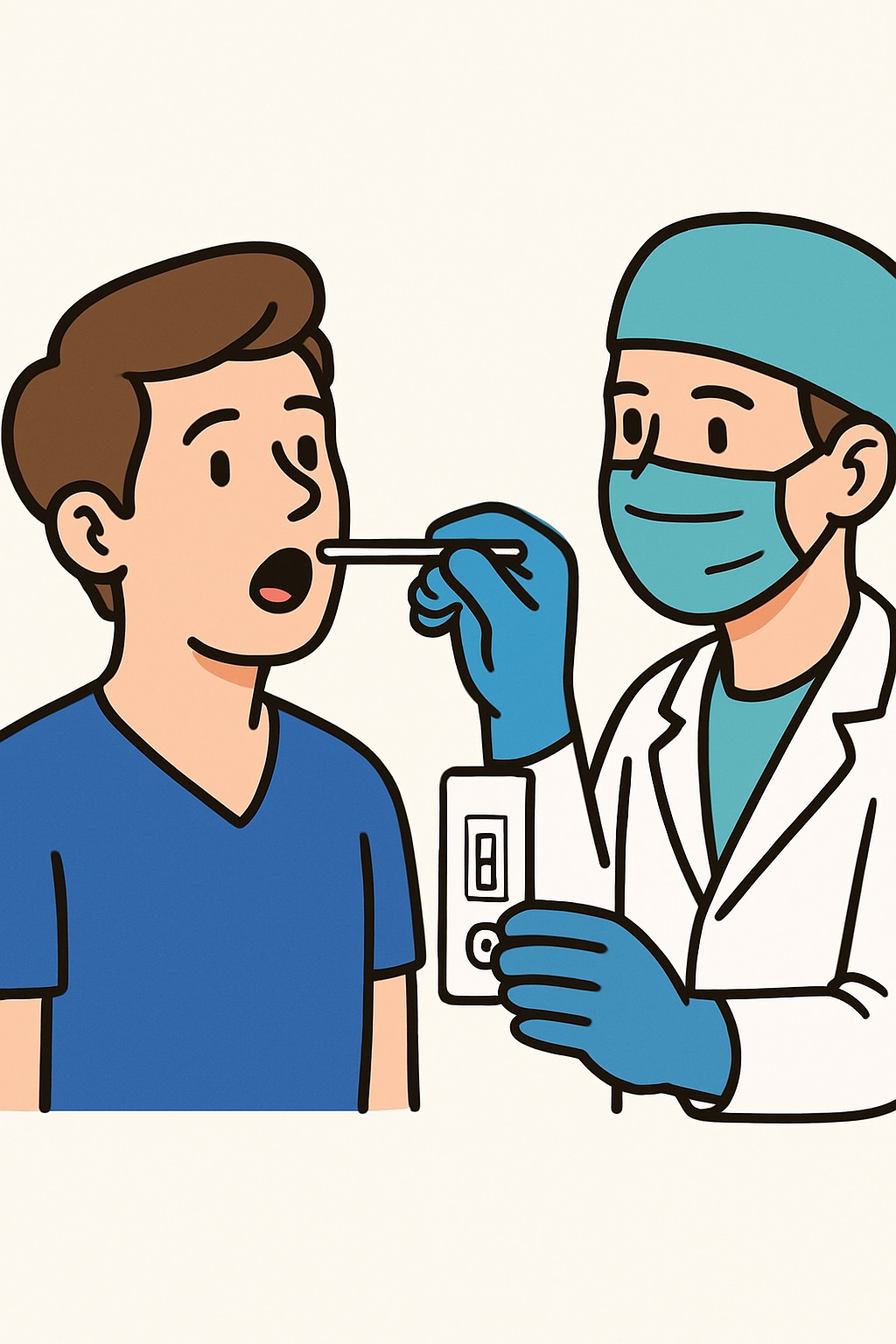
A rapid streptococcal antigen test checks a throat swab for proteins (antigens) from group A Streptococcus, the bacteria that can cause strep throat.
Overview
A rapid streptococcal antigen test checks a throat swab for proteins (antigens) from group A Streptococcus, the bacteria that can cause strep throat. The swab is rubbed over the tonsils and back of the throat and then tested. Results are usually ready in minutes during the same visit. Clinicians use the result, along with your symptoms and exam, to help decide on next steps.
Also known as: Rapid strep test, RADT, Point-of-care strep test
Preparation & Next Steps
Everything you need to know before and after your procedure
Before Care
- Most clinics do not require special preparation; follow any instructions you receive
- Bring a photo ID, insurance card, and a payment method if a copay applies
- Bring a list of all medicines and supplements, including any recent antibiotics
- Be ready to share when symptoms started and any known strep exposure
- Remove gum or lozenges before the swab and be prepared to open your mouth wide
- Tell staff if you have a strong gag reflex, jaw or neck mobility limits, or bleeding problems
- Plan to stay a short time after the swab in case results are run on site
- Ask the clinic if you should avoid food, drinks, or throat sprays right before the swab
After Care
- Ask how and when results will be provided; many clinics give rapid results in minutes
- If the rapid test is negative in a child or teen, confirm whether a throat culture will be sent and when those results will be ready
- Follow the care plan provided by your clinician, including any instructions for symptom relief or activity
- If medicines are prescribed, use them as directed by your clinician
- Track symptoms and any side effects in a simple log for follow-up
- Practice hand hygiene and avoid sharing utensils or drinks while you are sick
- Contact the clinic if symptoms worsen or new concerning symptoms appear, such as trouble breathing, drooling, severe neck stiffness, or a spreading rash
- Ask the clinic for guidance on returning to school or work if strep is confirmed
Clinical Information
Important medical details about this procedure
Indications
- Sore throat with fever and tender neck lymph nodes
- Swollen or red tonsils, sometimes with white patches
- Known exposure to someone with strep throat
- School or group setting outbreaks
- To help guide antibiotic decisions when strep throat is suspected
Alternatives
- Throat culture (lab test that can confirm group A strep)
- Nucleic acid amplification test (NAAT), such as PCR for strep
- Clinical assessment without testing when clear viral features are present (per guidelines)
Risks
- Brief discomfort, gagging, or coughing during the throat swab
- Minor throat irritation or rare small spot of bleeding
- False negative result if bacteria are few or the swab misses the area
- False positive in carriers who have strep bacteria without illness
- May need a follow-up throat culture in some age groups after a negative result
- Out-of-pocket cost depending on insurance coverage
Contraindications
- Severe breathing trouble requiring emergency care
- Recent throat surgery or significant throat injury where swabbing is unsafe
- Uncontrolled bleeding risk in the throat area
Recovery Timeline
What to expect during your recovery
There is no medical recovery period for the throat swab itself. Most people resume normal activities right away.
Typical Range
Same day
Return to Work
Same day
Recovery Milestones
Resume normal daily activities after the swab
Review rapid result and any follow-up plan
If a culture or NAAT was sent, watch for final results
Frequently Asked Questions
Common questions and expert answers about this procedure
What does a rapid strep test look for?
What does a rapid strep test look for?
It detects antigens from group A Streptococcus on a throat swab to help identify strep throat.
How long do results take?
How long do results take?
Many rapid tests return results during the same visit, often in about 10 to 20 minutes.
Do I need to do anything to prepare?
Do I need to do anything to prepare?
Usually no special preparation is needed. Ask your clinic if they prefer you avoid food, drinks, or throat sprays right before the swab.
How accurate is the rapid strep test?
How accurate is the rapid strep test?
Specificity is high, so positives are usually reliable. Sensitivity is lower than culture or NAAT, so some infections can be missed, especially with a poor swab.
If my rapid test is negative, am I done?
If my rapid test is negative, am I done?
Adults often do not need more testing. In children and teens, guidelines commonly recommend a follow-up throat culture after a negative rapid test.
How is this different from a throat culture or PCR?
How is this different from a throat culture or PCR?
A rapid test gives results quickly. A throat culture and NAAT (PCR) are lab tests that are more sensitive and can confirm infection but take longer.
Can I test positive even if a virus is causing my sore throat?
Can I test positive even if a virus is causing my sore throat?
Yes. Some people carry group A strep without illness. A positive test in a carrier may not explain symptoms if a virus is present.
Will insurance cover the test?
Will insurance cover the test?
Coverage varies by plan and setting. Check your benefits or ask the clinic about expected charges.
References
Medical literature and sources