%20--%3e%3csvg%20version='1.0'%20id='Layer_1'%20xmlns='http://www.w3.org/2000/svg'%20xmlns:xlink='http://www.w3.org/1999/xlink'%20x='0px'%20y='0px'%20viewBox='0%200%20755.52%20814.35'%20style='enable-background:new%200%200%20755.52%20814.35;'%20xml:space='preserve'%3e%3cstyle%20type='text/css'%3e%20.st0{fill:%231ae5ce;stroke:%231ae5ce;stroke-width:7;stroke-miterlimit:10;}%20.st1{fill:%23FFFFFF;stroke:%231ae5ce;stroke-width:7;stroke-miterlimit:10;}%20.st2{fill:%231ae5ce;stroke:%23FFFFFF;stroke-width:7;stroke-miterlimit:10;}%20.st3{fill:%23FFFFFF;stroke:%23FFFFFF;stroke-width:6;stroke-miterlimit:10;}%20%3c/style%3e%3cg%20id='Dark_Logo_00000159431215648494653180000015900878925932721032_'%3e%3cpath%20id='shield_00000152259091539869183100000001926543869452564382_'%20class='st0'%20d='M711.13,173.42%20c-3.37-49.07-38.92-44.9-75.96-52.18c-67.4-13.25-130.47-34.47-192.36-63.92c-22.48-10.7-41.88-25.74-65.05-26.28%20c-23.17,0.54-42.58,15.59-65.05,26.28c-61.89,29.45-124.95,50.68-192.36,63.92c-37.04,7.28-72.59,3.11-75.96,52.18%20c-1.55,22.6,0.34,46.4,1.05,68.92c5.99,190.78,52.91,345.39,206.27,466.46c29.71,23.46,74.51,55.8,108.84,70.75%20c5.99,2.61,11.7,3.73,17.21,3.75c5.51-0.02,11.22-1.14,17.21-3.75c34.33-14.95,79.12-47.3,108.84-70.75%20c153.37-121.07,200.28-275.68,206.27-466.46C710.79,219.82,712.68,196.02,711.13,173.42z'/%3e%3cpath%20id='magnifyingglass_00000073685934697636024790000000342567780940956808_'%20class='st1'%20d='M648.78,624.21l-96.64-104.65%20c34.89-40.63,55.98-93.46,55.98-151.21c0-128.27-103.98-232.24-232.24-232.24S143.63,240.08,143.63,368.35%20s103.98,232.24,232.24,232.24c48.87,0,94.21-15.11,131.62-40.89l97.18,105.24c11.25,12.18,30.24,12.93,42.42,1.69l0,0%20C659.27,655.38,660.03,636.39,648.78,624.21z'/%3e%3ccircle%20id='ellipse_00000129904010550392394720000017056154833629780114_'%20class='st2'%20cx='375.87'%20cy='368.35'%20r='181.21'/%3e%3cpath%20id='dollarsign_00000057140127156649725250000003772530148495155891_'%20class='st3'%20d='M362.91,492.03v-23.91%20c0-2.01-1.58-3.69-3.59-3.77c-18.49-0.78-37.12-5.4-49.4-11.83c-1.75-0.92-2.53-3.01-1.76-4.84l5.87-13.89%20c0.86-2.02,3.23-2.88,5.2-1.89c12.94,6.52,30.45,11.44,49.18,11.44c26.02,0,43.6-12.73,43.6-30.43c0-17.08-14.29-27.63-41.4-36.95%20c-37.37-12.42-60.46-26.7-60.46-53.72c0-24.97,20.29-44.11,52.22-49.51c1.8-0.31,3.11-1.89,3.11-3.72v-24.35%20c0-2.09,1.69-3.78,3.78-3.78h15.16c2.09,0,3.78,1.69,3.78,3.78v22.71c0,2.01,1.58,3.67,3.58,3.77c17.85,0.92,30.88,4.75,40.61,9.1%20c1.92,0.86,2.79,3.09,1.94,5.01l-6.08,13.6c-0.85,1.91-3.09,2.77-4.99,1.91c-8.37-3.8-22.38-8.95-42.75-8.95%20c-28.21,0-38.84,14.28-38.84,26.7c0,16.15,13.56,24.22,45.44,35.4c37.74,13.04,56.79,29.19,56.79,56.82%20c0,23.85-19.05,46.23-54.78,52.3c-1.8,0.31-3.11,1.89-3.11,3.72v25.28c0,2.09-1.69,3.78-3.78,3.78h-15.53%20C364.6,495.81,362.91,494.12,362.91,492.03z'/%3e%3c/g%3e%3c/svg%3e)
RBC antibody screen (pre-transfusion test) Laboratory Test
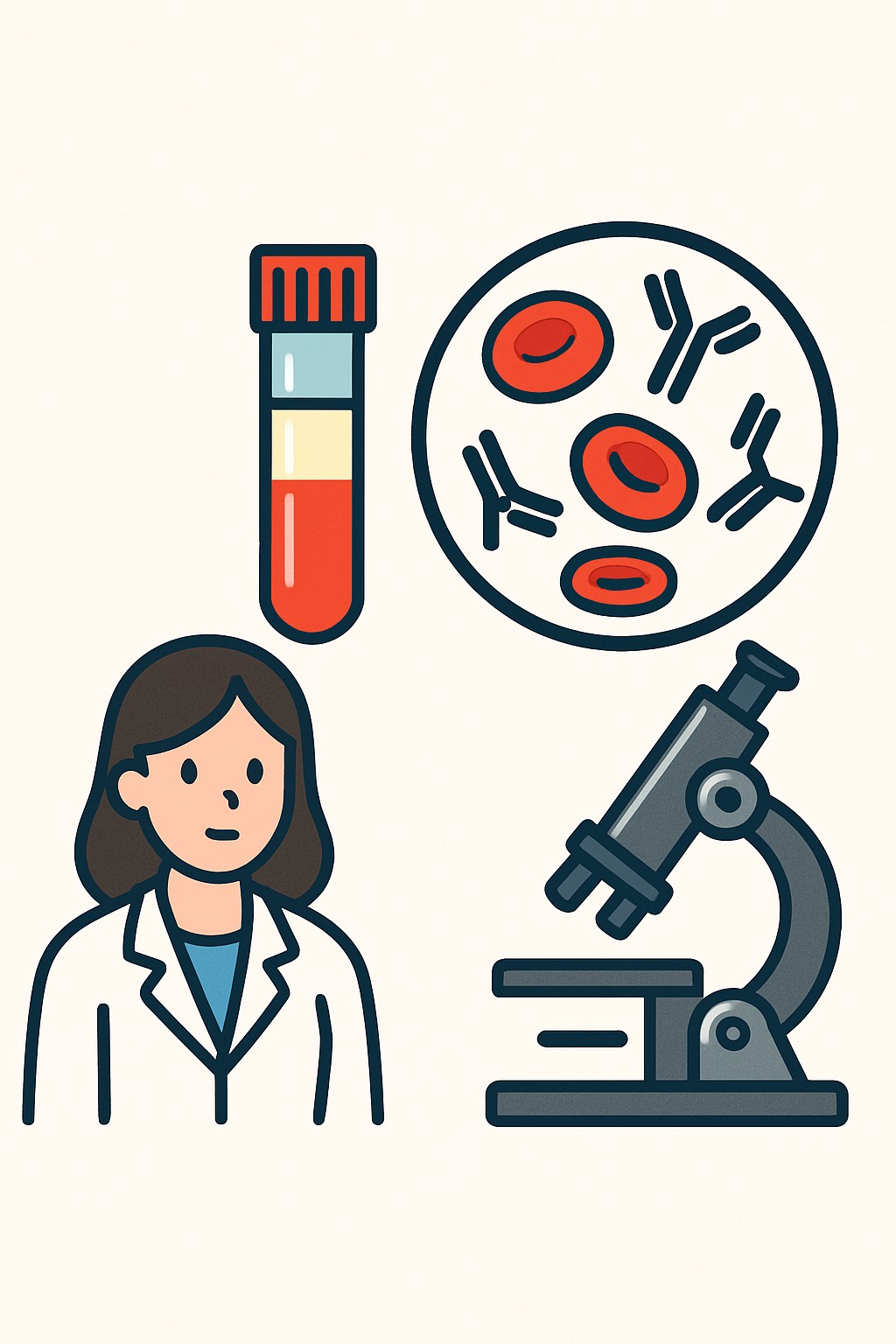
An RBC antibody screen is a blood test that looks for antibodies in your plasma that could react with donor red blood cells.
Overview
An RBC antibody screen is a blood test that looks for antibodies in your plasma that could react with donor red blood cells. It is a standard part of pre-transfusion testing often done together with ABO/Rh blood typing, sometimes called a type and screen. Finding these antibodies helps the blood bank choose compatible units and lowers the chance of a transfusion reaction. If antibodies are found, extra testing is done to identify them and locate matching blood.
Also known as: Antibody screen, Type and screen, Indirect antiglobulin test, Pretransfusion antibody screen
Preparation & Next Steps
Everything you need to know before and after your procedure
Before Care
- Bring a photo ID and confirm your full name and date of birth match your medical record
- Share any history of transfusion reactions, recent transfusions, and pregnancies
- Carry a current medication and allergy list, including over-the-counter products
- If you have a blood bank or antibody card, bring it to your appointment
- Ask how long the sample will be considered valid for the planned procedure at your facility
- Stay hydrated unless you were given different instructions
- Wear a short-sleeve or loose-sleeve shirt to allow easy access to your arm
- Plan time for the blood draw and possible extra tubes if more testing is needed
- Verify where and how you will receive your results
After Care
- Keep pressure on the puncture site and leave the bandage on for several hours
- Limit heavy lifting with the drawn arm for the rest of the day to reduce bruising
- Drink fluids and have a small snack if you feel lightheaded
- Watch for persistent bleeding, increasing pain, large swelling, or signs of infection at the site and contact a clinician if these occur
- Review your results when posted and note any identified antibodies
- If antibodies are found, confirm with the care team how compatibility testing may affect timing of transfusion or surgery
- Ensure the sample date meets your hospital’s validity window if your procedure is scheduled soon
- Keep any blood bank or antibody identification card with you for future care
Clinical Information
Important medical details about this procedure
Indications
- Testing before a planned or possible blood transfusion
- Preoperative evaluation when transfusion may be needed
- Prenatal care to check for antibodies that could affect a fetus or newborn
- History of prior transfusions
- History of transfusion reaction
- Conditions with frequent transfusions, such as sickle cell disease or thalassemia
Alternatives
- Emergency release uncrossmatched blood when waiting for testing would risk harm
- Use of recent, valid type and screen results if allowed by facility policy
Risks
- Bruising, soreness, or bleeding at the blood draw site
- Lightheadedness or fainting during or after the blood draw
- Rare infection at the puncture site
- Sample or labeling errors that may require a repeat draw
- Possible delays in getting blood if antibodies are present and compatible units must be located
Contraindications
- No specific test contraindications; standard precautions for blood draws apply
- Relative concerns include difficult venous access or bleeding disorders
Recovery Timeline
What to expect during your recovery
This is a routine blood draw. Most people resume normal activities right away. Minor soreness or bruising at the site can occur and usually fades within a few days.
Typical Range
Same day
Return to Work
Same day
Recovery Milestones
Resume normal daily activities
Remove bandage once the site is dry and not bleeding
Expect mild soreness or bruising to improve
Review results and confirm next steps if antibodies are reported
Frequently Asked Questions
Common questions and expert answers about this procedure
What is an RBC antibody screen?
What is an RBC antibody screen?
It is a lab test on your blood plasma that looks for antibodies that could react with donor red blood cells. It helps choose compatible blood and reduce transfusion reactions.
Why is this test done before a transfusion?
Why is this test done before a transfusion?
The screen finds antibodies you may have formed from past transfusions or pregnancies. If antibodies are present, the blood bank selects donor units that lack those matching antigens.
Do I need to fast for this test?
Do I need to fast for this test?
No. Fasting is not typically required for an antibody screen.
How is this different from blood typing and crossmatch?
How is this different from blood typing and crossmatch?
Typing determines your ABO and Rh. The antibody screen looks for unexpected antibodies. A crossmatch tests your sample against specific donor units to confirm compatibility.
What happens if my antibody screen is positive?
What happens if my antibody screen is positive?
The lab performs additional tests to identify the antibody and locates antigen-negative donor blood. This can take extra time.
How long are results valid?
How long are results valid?
Policies vary. Many hospitals use a 3-day validity window if you were recently transfused or pregnant. Your facility’s rules apply.
Will recent transfusion or pregnancy affect the test?
Will recent transfusion or pregnancy affect the test?
Yes. Both can stimulate antibody formation and may shorten how long a sample is considered valid before transfusion.
How much blood is drawn and how long does it take?
How much blood is drawn and how long does it take?
Usually one or more small tubes, about a few teaspoons (5–10 mL). The draw is brief. Result timing depends on the lab and whether extra testing is needed.
References
Medical literature and sources