%20--%3e%3csvg%20version='1.0'%20id='Layer_1'%20xmlns='http://www.w3.org/2000/svg'%20xmlns:xlink='http://www.w3.org/1999/xlink'%20x='0px'%20y='0px'%20viewBox='0%200%20755.52%20814.35'%20style='enable-background:new%200%200%20755.52%20814.35;'%20xml:space='preserve'%3e%3cstyle%20type='text/css'%3e%20.st0{fill:%231ae5ce;stroke:%231ae5ce;stroke-width:7;stroke-miterlimit:10;}%20.st1{fill:%23FFFFFF;stroke:%231ae5ce;stroke-width:7;stroke-miterlimit:10;}%20.st2{fill:%231ae5ce;stroke:%23FFFFFF;stroke-width:7;stroke-miterlimit:10;}%20.st3{fill:%23FFFFFF;stroke:%23FFFFFF;stroke-width:6;stroke-miterlimit:10;}%20%3c/style%3e%3cg%20id='Dark_Logo_00000159431215648494653180000015900878925932721032_'%3e%3cpath%20id='shield_00000152259091539869183100000001926543869452564382_'%20class='st0'%20d='M711.13,173.42%20c-3.37-49.07-38.92-44.9-75.96-52.18c-67.4-13.25-130.47-34.47-192.36-63.92c-22.48-10.7-41.88-25.74-65.05-26.28%20c-23.17,0.54-42.58,15.59-65.05,26.28c-61.89,29.45-124.95,50.68-192.36,63.92c-37.04,7.28-72.59,3.11-75.96,52.18%20c-1.55,22.6,0.34,46.4,1.05,68.92c5.99,190.78,52.91,345.39,206.27,466.46c29.71,23.46,74.51,55.8,108.84,70.75%20c5.99,2.61,11.7,3.73,17.21,3.75c5.51-0.02,11.22-1.14,17.21-3.75c34.33-14.95,79.12-47.3,108.84-70.75%20c153.37-121.07,200.28-275.68,206.27-466.46C710.79,219.82,712.68,196.02,711.13,173.42z'/%3e%3cpath%20id='magnifyingglass_00000073685934697636024790000000342567780940956808_'%20class='st1'%20d='M648.78,624.21l-96.64-104.65%20c34.89-40.63,55.98-93.46,55.98-151.21c0-128.27-103.98-232.24-232.24-232.24S143.63,240.08,143.63,368.35%20s103.98,232.24,232.24,232.24c48.87,0,94.21-15.11,131.62-40.89l97.18,105.24c11.25,12.18,30.24,12.93,42.42,1.69l0,0%20C659.27,655.38,660.03,636.39,648.78,624.21z'/%3e%3ccircle%20id='ellipse_00000129904010550392394720000017056154833629780114_'%20class='st2'%20cx='375.87'%20cy='368.35'%20r='181.21'/%3e%3cpath%20id='dollarsign_00000057140127156649725250000003772530148495155891_'%20class='st3'%20d='M362.91,492.03v-23.91%20c0-2.01-1.58-3.69-3.59-3.77c-18.49-0.78-37.12-5.4-49.4-11.83c-1.75-0.92-2.53-3.01-1.76-4.84l5.87-13.89%20c0.86-2.02,3.23-2.88,5.2-1.89c12.94,6.52,30.45,11.44,49.18,11.44c26.02,0,43.6-12.73,43.6-30.43c0-17.08-14.29-27.63-41.4-36.95%20c-37.37-12.42-60.46-26.7-60.46-53.72c0-24.97,20.29-44.11,52.22-49.51c1.8-0.31,3.11-1.89,3.11-3.72v-24.35%20c0-2.09,1.69-3.78,3.78-3.78h15.16c2.09,0,3.78,1.69,3.78,3.78v22.71c0,2.01,1.58,3.67,3.58,3.77c17.85,0.92,30.88,4.75,40.61,9.1%20c1.92,0.86,2.79,3.09,1.94,5.01l-6.08,13.6c-0.85,1.91-3.09,2.77-4.99,1.91c-8.37-3.8-22.38-8.95-42.75-8.95%20c-28.21,0-38.84,14.28-38.84,26.7c0,16.15,13.56,24.22,45.44,35.4c37.74,13.04,56.79,29.19,56.79,56.82%20c0,23.85-19.05,46.23-54.78,52.3c-1.8,0.31-3.11,1.89-3.11,3.72v25.28c0,2.09-1.69,3.78-3.78,3.78h-15.53%20C364.6,495.81,362.91,494.12,362.91,492.03z'/%3e%3c/g%3e%3c/svg%3e)
Tacrolimus level (immunosuppressant drug) Laboratory Test
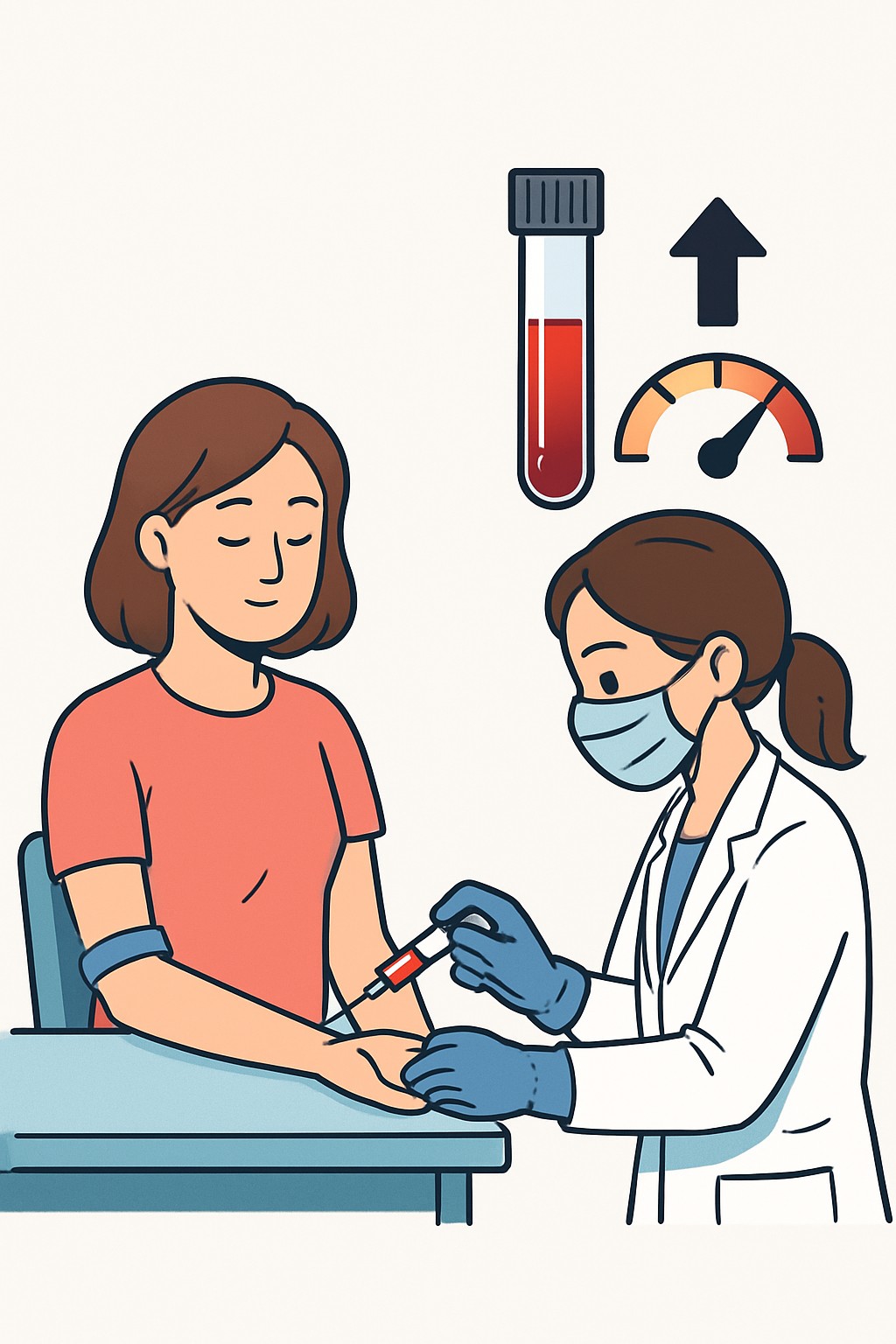
A tacrolimus level test measures how much tacrolimus is in your blood.
Overview
A tacrolimus level test measures how much tacrolimus is in your blood. Tacrolimus is a medicine that lowers the immune system to help prevent organ rejection after a transplant and to treat some autoimmune conditions. This test helps check that the amount of medicine in your body stays within a target range. Levels that are too low may not control the immune system well, and levels that are too high may cause side effects.
Also known as: FK506 level, Prograf level, Tac level, Tacrolimus trough
Preparation & Next Steps
Everything you need to know before and after your procedure
Before Care
- Plan timing: a trough sample is usually collected right before the next tacrolimus dose; many centers use about 12 hours after the last dose for twice-daily forms and about 24 hours for once-daily forms
- Write down the exact time you last took tacrolimus and the brand or formulation you use (immediate-release or extended-release)
- Bring a current list of all medicines and supplements; some antibiotics, antifungals, seizure medicines, HIV medicines, and herbal products like St. John's wort can change tacrolimus levels
- Be aware that grapefruit or grapefruit juice can raise tacrolimus levels; the lab may ask about recent intake
- Drink water and eat as you normally do unless your clinician or lab has given different instructions
- Carry your photo ID, insurance card, and the lab order or electronic confirmation
- If you recently missed, delayed, or vomited a dose, note this and the times involved
- Arrange a ride or plan extra time if you tend to feel faint with blood draws
- Follow any transplant center or lab-specific instructions about dose timing on the day of the test
After Care
- Apply gentle pressure and keep the bandage on the draw site for about 30 to 60 minutes to reduce bruising
- Resume normal daily activities as you feel able
- Record the sample time and your most recent tacrolimus dose time for your personal records
- Check your patient portal or ask how you will receive results; methods (immunoassay vs LC-MS/MS) and reporting units can differ by lab
- Tell your care team about new medicines or supplements since they may interact with tacrolimus
- Report new or worsening symptoms that could be related to tacrolimus levels, such as tremor, headache, nausea, confusion, or changes in urine amount
- Repeat level testing is often done after dose changes or when starting or stopping interacting medicines
- Watch the puncture site for redness, swelling, or pain that gets worse and contact a clinician if you notice this
Clinical Information
Important medical details about this procedure
Indications
- Routine monitoring after organ transplant (kidney, liver, heart, lung, and others)
- Checking a level after a dose change
- New symptoms that may suggest low or high levels (for example, tremor, headache, nausea, changes in urine)
- Starting or stopping medicines known to interact with tacrolimus
- Assessing adherence if doses were missed or delayed
Alternatives
- Clinical monitoring without a drug level (watching symptoms and labs such as kidney function)
- Pharmacogenetic testing (such as CYP3A5) to help inform dosing strategy
- Measuring a different immunosuppressant level if using another drug (for example, cyclosporine or sirolimus)
- Area-under-the-curve or limited-sampling strategies in specialized settings
Risks
- Bruising, tenderness, or bleeding at the blood draw site
- Lightheadedness or fainting with blood draws
- Very small risk of infection at the puncture site
- Misleading result if the sample timing does not match dosing
- Interactions with other medicines or grapefruit products that change the level
Contraindications
- Uncontrolled bleeding problems without special precautions
- Severe difficulty with venous access
- Recent procedures or medical devices in an arm where blood draw is restricted
Recovery Timeline
What to expect during your recovery
This is a standard blood test with no medical recovery time. Most people continue normal activities right away.
Typical Range
Same day
Return to Work
Same day
Recovery Milestones
Resume normal activities
Mild soreness or bruising at the draw site may occur
Review results when posted and note any follow-up plan
Frequently Asked Questions
Common questions and expert answers about this procedure
What is a tacrolimus level test?
What is a tacrolimus level test?
It is a blood test that measures the amount of tacrolimus in your body to help keep it within a target range.
Why does timing matter for this test?
Why does timing matter for this test?
The level is usually checked as a trough, right before the next dose, so results can be compared over time and used to adjust dosing.
Do I need to fast?
Do I need to fast?
Fasting is not usually required, but follow any instructions from your care team or lab.
What can affect my tacrolimus level?
What can affect my tacrolimus level?
Other medicines, herbal products, grapefruit, liver function, diarrhea, and missed or late doses can change the level.
How is the sample collected?
How is the sample collected?
A small tube of blood is taken from a vein in your arm. The lab measures the concentration, usually reported in ng/mL.
How long do results take?
How long do results take?
Turnaround time varies by lab and method. Many labs report results the same day or within 1–2 business days.
What are the target ranges?
What are the target ranges?
Targets depend on the type of transplant, time since surgery, your other medicines, and the lab method. Your care team sets your range.
Does the timing differ for extended-release tacrolimus?
Does the timing differ for extended-release tacrolimus?
Yes. Many centers collect the trough about 24 hours after the last once-daily dose and about 12 hours after twice-daily doses.
References
Medical literature and sources