%20--%3e%3csvg%20version='1.0'%20id='Layer_1'%20xmlns='http://www.w3.org/2000/svg'%20xmlns:xlink='http://www.w3.org/1999/xlink'%20x='0px'%20y='0px'%20viewBox='0%200%20755.52%20814.35'%20style='enable-background:new%200%200%20755.52%20814.35;'%20xml:space='preserve'%3e%3cstyle%20type='text/css'%3e%20.st0{fill:%231ae5ce;stroke:%231ae5ce;stroke-width:7;stroke-miterlimit:10;}%20.st1{fill:%23FFFFFF;stroke:%231ae5ce;stroke-width:7;stroke-miterlimit:10;}%20.st2{fill:%231ae5ce;stroke:%23FFFFFF;stroke-width:7;stroke-miterlimit:10;}%20.st3{fill:%23FFFFFF;stroke:%23FFFFFF;stroke-width:6;stroke-miterlimit:10;}%20%3c/style%3e%3cg%20id='Dark_Logo_00000159431215648494653180000015900878925932721032_'%3e%3cpath%20id='shield_00000152259091539869183100000001926543869452564382_'%20class='st0'%20d='M711.13,173.42%20c-3.37-49.07-38.92-44.9-75.96-52.18c-67.4-13.25-130.47-34.47-192.36-63.92c-22.48-10.7-41.88-25.74-65.05-26.28%20c-23.17,0.54-42.58,15.59-65.05,26.28c-61.89,29.45-124.95,50.68-192.36,63.92c-37.04,7.28-72.59,3.11-75.96,52.18%20c-1.55,22.6,0.34,46.4,1.05,68.92c5.99,190.78,52.91,345.39,206.27,466.46c29.71,23.46,74.51,55.8,108.84,70.75%20c5.99,2.61,11.7,3.73,17.21,3.75c5.51-0.02,11.22-1.14,17.21-3.75c34.33-14.95,79.12-47.3,108.84-70.75%20c153.37-121.07,200.28-275.68,206.27-466.46C710.79,219.82,712.68,196.02,711.13,173.42z'/%3e%3cpath%20id='magnifyingglass_00000073685934697636024790000000342567780940956808_'%20class='st1'%20d='M648.78,624.21l-96.64-104.65%20c34.89-40.63,55.98-93.46,55.98-151.21c0-128.27-103.98-232.24-232.24-232.24S143.63,240.08,143.63,368.35%20s103.98,232.24,232.24,232.24c48.87,0,94.21-15.11,131.62-40.89l97.18,105.24c11.25,12.18,30.24,12.93,42.42,1.69l0,0%20C659.27,655.38,660.03,636.39,648.78,624.21z'/%3e%3ccircle%20id='ellipse_00000129904010550392394720000017056154833629780114_'%20class='st2'%20cx='375.87'%20cy='368.35'%20r='181.21'/%3e%3cpath%20id='dollarsign_00000057140127156649725250000003772530148495155891_'%20class='st3'%20d='M362.91,492.03v-23.91%20c0-2.01-1.58-3.69-3.59-3.77c-18.49-0.78-37.12-5.4-49.4-11.83c-1.75-0.92-2.53-3.01-1.76-4.84l5.87-13.89%20c0.86-2.02,3.23-2.88,5.2-1.89c12.94,6.52,30.45,11.44,49.18,11.44c26.02,0,43.6-12.73,43.6-30.43c0-17.08-14.29-27.63-41.4-36.95%20c-37.37-12.42-60.46-26.7-60.46-53.72c0-24.97,20.29-44.11,52.22-49.51c1.8-0.31,3.11-1.89,3.11-3.72v-24.35%20c0-2.09,1.69-3.78,3.78-3.78h15.16c2.09,0,3.78,1.69,3.78,3.78v22.71c0,2.01,1.58,3.67,3.58,3.77c17.85,0.92,30.88,4.75,40.61,9.1%20c1.92,0.86,2.79,3.09,1.94,5.01l-6.08,13.6c-0.85,1.91-3.09,2.77-4.99,1.91c-8.37-3.8-22.38-8.95-42.75-8.95%20c-28.21,0-38.84,14.28-38.84,26.7c0,16.15,13.56,24.22,45.44,35.4c37.74,13.04,56.79,29.19,56.79,56.82%20c0,23.85-19.05,46.23-54.78,52.3c-1.8,0.31-3.11,1.89-3.11,3.72v25.28c0,2.09-1.69,3.78-3.78,3.78h-15.53%20C364.6,495.81,362.91,494.12,362.91,492.03z'/%3e%3c/g%3e%3c/svg%3e)
TB blood test (interferon-gamma release assay) Laboratory Test
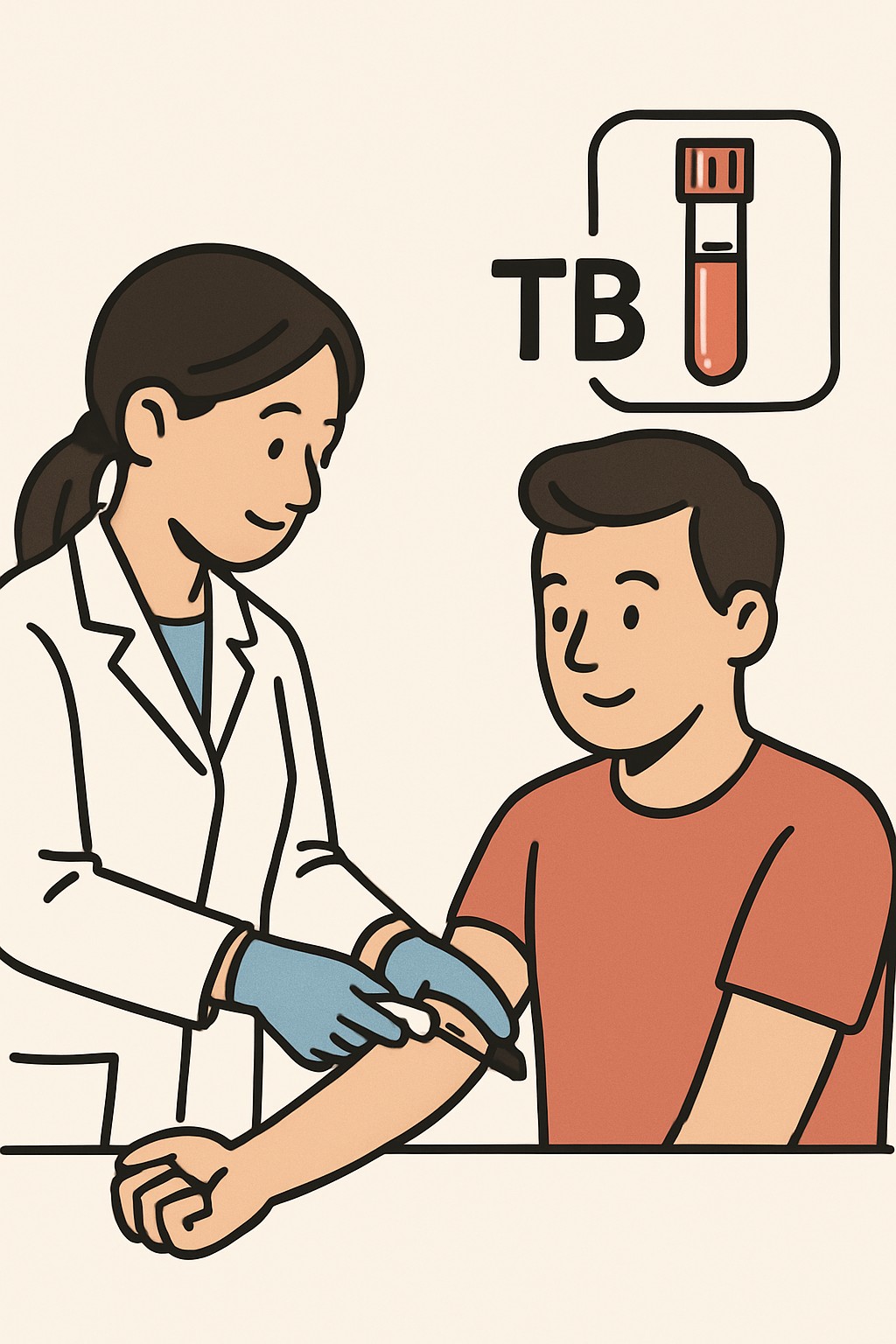
A TB blood test, also called an interferon-gamma release assay (IGRA), checks a blood sample to see how your immune cells react to proteins from the bacteria that cause tuberculosis.
Overview
A TB blood test, also called an interferon-gamma release assay (IGRA), checks a blood sample to see how your immune cells react to proteins from the bacteria that cause tuberculosis. The result is reported as positive, negative, or indeterminate. It is used to detect TB infection, which can be latent (no symptoms) or part of an evaluation for possible active TB disease. IGRAs do not cross-react with the BCG vaccine and usually require only one visit for the blood draw.
Also known as: IGRA, QuantiFERON-TB Gold, T-SPOT.TB, TB IGRA blood test
Preparation & Next Steps
Everything you need to know before and after your procedure
Before Care
- Bring a photo ID, your lab order or requisition, and insurance information if applicable
- Confirm the lab location, hours, and whether an appointment is needed
- Drink water and eat a light meal unless another ordered test requires fasting
- Wear short sleeves or clothing that allows easy access to your arm
- Tell the staff if you have a bleeding disorder, take blood thinners, or have fainted with blood draws
- Inform the staff if you recently received a live-virus vaccine (such as MMR or varicella) because timing can affect TB test results
- Have a list of prior TB tests, BCG vaccination history, and TB risk factors or exposures
- Arrive on time so the sample can be collected and processed promptly
After Care
- Keep light pressure on the bandage for 10 to 30 minutes to reduce bruising
- Expect mild soreness or a small bruise at the draw site; a cool compress can help
- If the arm is sore, avoid heavy lifting with that arm for the rest of the day
- Check your portal or with the lab for when results will be ready; many labs report within a few business days
- If results are positive or indeterminate, additional evaluation such as a chest X-ray or sputum tests is commonly ordered
- If you have symptoms such as a cough lasting 3 weeks, chest pain, fever, night sweats, or weight loss, contact a clinician
- Seek help if bleeding does not stop, you develop significant swelling, severe pain, or you feel faint
- Keep copies of your results for employment, school, or future screenings
Clinical Information
Important medical details about this procedure
Indications
- Screening for latent TB infection after exposure or based on risk factors
- Pre-employment or school health screening where TB testing is required
- Testing people who received BCG vaccine
- Baseline and periodic testing for healthcare and congregate setting workers
- Evaluation as part of workup for symptoms that could be TB
- Assessment before starting immunosuppressive therapy
Alternatives
- Tuberculin skin test (TST, Mantoux)
- Two-step TST for baseline screening in some settings
- Chest X-ray after a positive TB test or when symptoms are present
- Sputum smear, culture, and nucleic acid amplification tests when active TB is suspected
Risks
- Bruising, soreness, or bleeding at the blood draw site
- Lightheadedness or fainting during or after the blood draw
- Indeterminate or borderline results that may require repeat testing
- False negative results early after exposure or in some immune conditions
- False positive results are uncommon but can occur
- Possible out-of-pocket costs depending on coverage and setting
Contraindications
- Inability to safely draw blood due to severe bleeding risk or poor venous access
- Very young age (under 5 years) where the skin test is often preferred in guidelines
- Recent live-virus vaccination without appropriate timing relative to the test
Recovery Timeline
What to expect during your recovery
There is no medical recovery period after a routine blood draw for an IGRA. Most people resume normal activities right away.
Typical Range
Same day
Return to Work
Same day
Recovery Milestones
Resume normal daily activities
Keep bandage on for several hours and avoid heavy lifting with the draw arm if sore
Review and document results for work or school requirements
Frequently Asked Questions
Common questions and expert answers about this procedure
What is an IGRA TB blood test?
What is an IGRA TB blood test?
It is a lab test that measures interferon-gamma released by your immune cells when exposed to TB-specific proteins, indicating TB infection or not.
How is it different from the TB skin test?
How is it different from the TB skin test?
IGRA needs one visit and is not affected by BCG vaccination. The skin test requires a return visit to read the result and can be affected by BCG.
Who typically gets an IGRA instead of a skin test?
Who typically gets an IGRA instead of a skin test?
People who received BCG vaccine, those unlikely to return for skin test reading, and many adults in workplace or school screening programs.
Can the IGRA diagnose active TB disease?
Can the IGRA diagnose active TB disease?
No. A positive IGRA shows TB infection. Diagnosing active disease needs more evaluation, often including chest imaging and sputum tests.
How soon after exposure will the test turn positive?
How soon after exposure will the test turn positive?
It can take 2 to 8 weeks after infection for a test to become positive. Testing too early may be negative and sometimes is repeated later.
Do vaccines affect IGRA results?
Do vaccines affect IGRA results?
Live-virus vaccines like MMR or varicella can affect results. Testing is often done the same day as the vaccine or several weeks later.
Does BCG vaccination cause a positive IGRA?
Does BCG vaccination cause a positive IGRA?
No. BCG vaccination can cause a positive skin test but does not cause a positive IGRA.
What do indeterminate results mean?
What do indeterminate results mean?
The lab could not clearly tell if the result was positive or negative. A repeat test or another method may be used.
References
Medical literature and sources