%20--%3e%3csvg%20version='1.0'%20id='Layer_1'%20xmlns='http://www.w3.org/2000/svg'%20xmlns:xlink='http://www.w3.org/1999/xlink'%20x='0px'%20y='0px'%20viewBox='0%200%20755.52%20814.35'%20style='enable-background:new%200%200%20755.52%20814.35;'%20xml:space='preserve'%3e%3cstyle%20type='text/css'%3e%20.st0{fill:%231ae5ce;stroke:%231ae5ce;stroke-width:7;stroke-miterlimit:10;}%20.st1{fill:%23FFFFFF;stroke:%231ae5ce;stroke-width:7;stroke-miterlimit:10;}%20.st2{fill:%231ae5ce;stroke:%23FFFFFF;stroke-width:7;stroke-miterlimit:10;}%20.st3{fill:%23FFFFFF;stroke:%23FFFFFF;stroke-width:6;stroke-miterlimit:10;}%20%3c/style%3e%3cg%20id='Dark_Logo_00000159431215648494653180000015900878925932721032_'%3e%3cpath%20id='shield_00000152259091539869183100000001926543869452564382_'%20class='st0'%20d='M711.13,173.42%20c-3.37-49.07-38.92-44.9-75.96-52.18c-67.4-13.25-130.47-34.47-192.36-63.92c-22.48-10.7-41.88-25.74-65.05-26.28%20c-23.17,0.54-42.58,15.59-65.05,26.28c-61.89,29.45-124.95,50.68-192.36,63.92c-37.04,7.28-72.59,3.11-75.96,52.18%20c-1.55,22.6,0.34,46.4,1.05,68.92c5.99,190.78,52.91,345.39,206.27,466.46c29.71,23.46,74.51,55.8,108.84,70.75%20c5.99,2.61,11.7,3.73,17.21,3.75c5.51-0.02,11.22-1.14,17.21-3.75c34.33-14.95,79.12-47.3,108.84-70.75%20c153.37-121.07,200.28-275.68,206.27-466.46C710.79,219.82,712.68,196.02,711.13,173.42z'/%3e%3cpath%20id='magnifyingglass_00000073685934697636024790000000342567780940956808_'%20class='st1'%20d='M648.78,624.21l-96.64-104.65%20c34.89-40.63,55.98-93.46,55.98-151.21c0-128.27-103.98-232.24-232.24-232.24S143.63,240.08,143.63,368.35%20s103.98,232.24,232.24,232.24c48.87,0,94.21-15.11,131.62-40.89l97.18,105.24c11.25,12.18,30.24,12.93,42.42,1.69l0,0%20C659.27,655.38,660.03,636.39,648.78,624.21z'/%3e%3ccircle%20id='ellipse_00000129904010550392394720000017056154833629780114_'%20class='st2'%20cx='375.87'%20cy='368.35'%20r='181.21'/%3e%3cpath%20id='dollarsign_00000057140127156649725250000003772530148495155891_'%20class='st3'%20d='M362.91,492.03v-23.91%20c0-2.01-1.58-3.69-3.59-3.77c-18.49-0.78-37.12-5.4-49.4-11.83c-1.75-0.92-2.53-3.01-1.76-4.84l5.87-13.89%20c0.86-2.02,3.23-2.88,5.2-1.89c12.94,6.52,30.45,11.44,49.18,11.44c26.02,0,43.6-12.73,43.6-30.43c0-17.08-14.29-27.63-41.4-36.95%20c-37.37-12.42-60.46-26.7-60.46-53.72c0-24.97,20.29-44.11,52.22-49.51c1.8-0.31,3.11-1.89,3.11-3.72v-24.35%20c0-2.09,1.69-3.78,3.78-3.78h15.16c2.09,0,3.78,1.69,3.78,3.78v22.71c0,2.01,1.58,3.67,3.58,3.77c17.85,0.92,30.88,4.75,40.61,9.1%20c1.92,0.86,2.79,3.09,1.94,5.01l-6.08,13.6c-0.85,1.91-3.09,2.77-4.99,1.91c-8.37-3.8-22.38-8.95-42.75-8.95%20c-28.21,0-38.84,14.28-38.84,26.7c0,16.15,13.56,24.22,45.44,35.4c37.74,13.04,56.79,29.19,56.79,56.82%20c0,23.85-19.05,46.23-54.78,52.3c-1.8,0.31-3.11,1.89-3.11,3.72v25.28c0,2.09-1.69,3.78-3.78,3.78h-15.53%20C364.6,495.81,362.91,494.12,362.91,492.03z'/%3e%3c/g%3e%3c/svg%3e)
Vitamin D-binding protein assay Laboratory Test
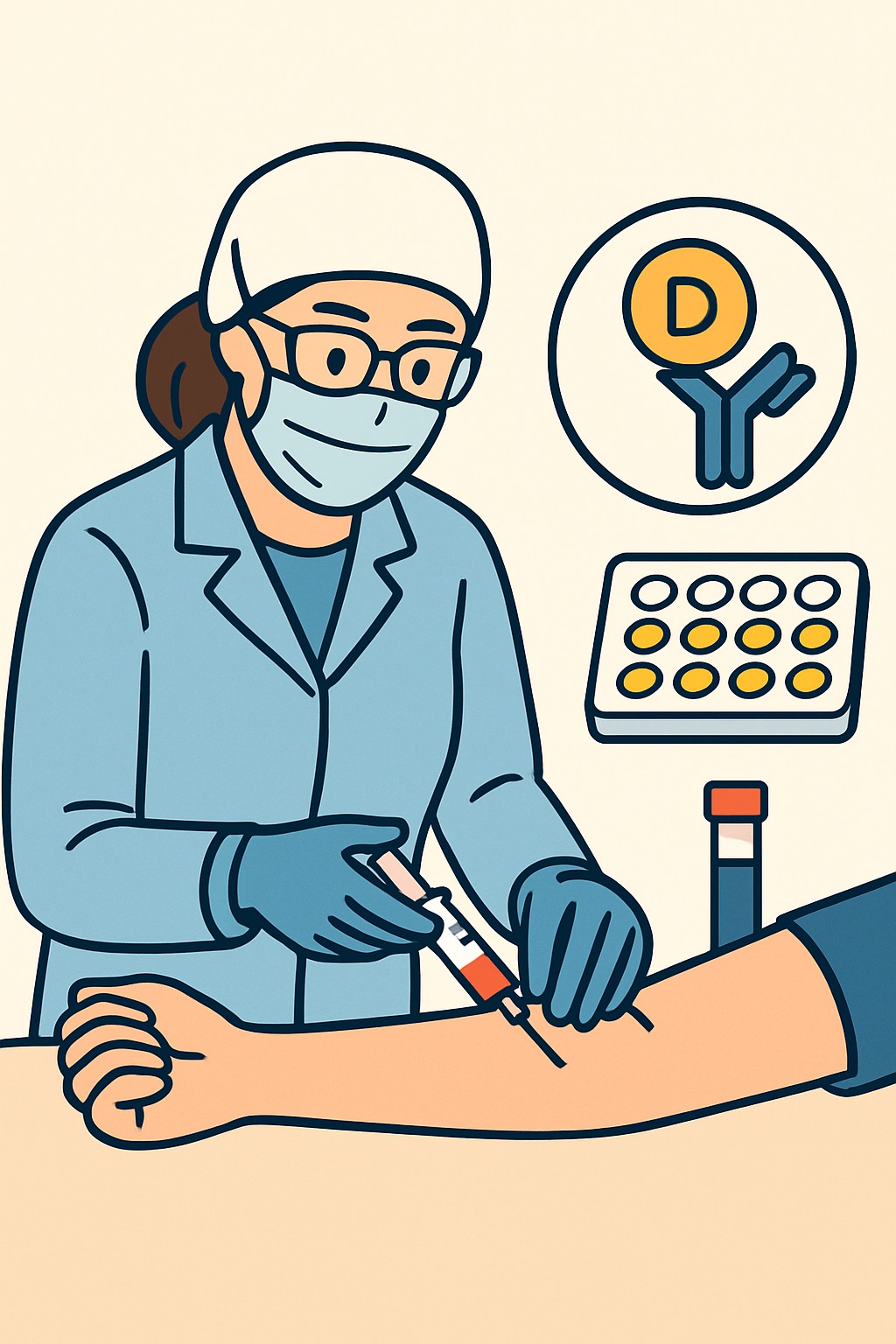
A vitamin D-binding protein assay is a blood test that measures the amount of vitamin D-binding protein (DBP), a protein made in the liver that carries vitamin D in the bloodstream.
Overview
A vitamin D-binding protein assay is a blood test that measures the amount of vitamin D-binding protein (DBP), a protein made in the liver that carries vitamin D in the bloodstream. DBP is also called GC globulin. This test may be used with other labs, such as total 25-hydroxyvitamin D and albumin, to help estimate free or bioavailable vitamin D. It is not a routine test and is more often used in research or for specific clinical questions where binding proteins may affect vitamin D results.
Also known as: DBP test, GC globulin test, Vitamin D binding protein
Preparation & Next Steps
Everything you need to know before and after your procedure
Before Care
- Fasting is usually not required for this stand-alone test unless other labs are ordered at the same time.
- Stay well hydrated; drinking water can make the blood draw easier.
- Wear short sleeves or loose clothing to allow access to your arm.
- Bring a current list of medicines and supplements, including vitamin D and calcium.
- Tell the lab if you recently took high-dose biotin (vitamin B7), which can interfere with some immunoassays.
- Confirm where and how results will be shared, such as through a patient portal.
- Verify test availability and any special handling requirements at your chosen lab.
- Bring a photo ID, insurance card, and a payment method if a copay or fee applies.
After Care
- Keep pressure on the site for several minutes after the draw to reduce bruising.
- Leave the bandage on for 30 to 60 minutes, then remove it and keep the area clean and dry.
- Avoid heavy lifting or strenuous use of the draw arm for a few hours.
- Drink fluids and have a light snack if you feel lightheaded.
- Watch for increasing pain, swelling, warmth, or persistent bleeding at the site and contact a clinician if noted.
- Review results in your portal when available and note any comments on how they were measured.
- Understand that pregnancy, liver or kidney conditions, and genetic differences can affect DBP levels and result interpretation.
- Keep records of related tests such as total 25-hydroxyvitamin D, albumin, calcium, and parathyroid hormone for context.
Clinical Information
Important medical details about this procedure
Indications
- Clarifying vitamin D status when total 25-hydroxyvitamin D results are hard to interpret
- Situations that change binding proteins, such as pregnancy, liver disease, or kidney conditions
- Evaluating free or bioavailable vitamin D in research settings
- Suspected genetic variants of the GC gene that can alter DBP levels
- Critical illness or significant inflammation, which can affect DBP concentrations
Alternatives
- Standard 25-hydroxyvitamin D blood test
- Direct free 25-hydroxyvitamin D assay (limited availability)
- Calculated free or bioavailable vitamin D using total 25-hydroxyvitamin D and albumin
- Clinical monitoring without additional vitamin D protein testing
Risks
- Bruising or soreness at the needle site
- Minor bleeding
- Lightheadedness or fainting during or after the blood draw
- Very small risk of infection at the puncture site
Contraindications
- Active skin infection or significant injury at the planned draw site
- History of severe reactions to blood draws without available support
- Recent lymph node removal or vascular access devices in the limb that limit safe venipuncture
- Severe bleeding disorders may require special precautions
Recovery Timeline
What to expect during your recovery
A blood draw for this test does not usually require recovery time. Most people return to normal activities right away.
Typical Range
Same day
Return to Work
Same day
Recovery Milestones
Resume routine daily activities
Remove bandage after 30–60 minutes
Avoid heavy lifting with the draw arm for several hours
Frequently Asked Questions
Common questions and expert answers about this procedure
What does the vitamin D-binding protein assay measure?
What does the vitamin D-binding protein assay measure?
It measures the amount of vitamin D-binding protein (DBP) in your blood, a protein that transports vitamin D and influences how much is free or bioavailable.
Why would someone get this test instead of a standard vitamin D test?
Why would someone get this test instead of a standard vitamin D test?
It is used when binding proteins may affect vitamin D results or when estimating free or bioavailable vitamin D is important. It is not a routine test.
Do I need to fast?
Do I need to fast?
Fasting is usually not needed for this test unless it is done with other labs that require fasting.
How is the sample collected?
How is the sample collected?
A healthcare worker draws blood from a vein in your arm. The sample is sent to a laboratory for analysis.
Can supplements affect the result?
Can supplements affect the result?
Vitamin D supplements change vitamin D levels, while DBP levels are more affected by genetics, pregnancy, liver function, kidney disease, and inflammation.
How long do results take?
How long do results take?
Turnaround time varies by laboratory and shipping. Many send-out tests take several days.
What other tests are often done with this assay?
What other tests are often done with this assay?
Common related tests include total 25-hydroxyvitamin D, albumin, calcium, and parathyroid hormone. Some labs also offer free 25-hydroxyvitamin D.
Is this test covered by insurance?
Is this test covered by insurance?
Coverage varies and may be limited because the test is not routine. Check your plan and the laboratory’s billing policies.
References
Medical literature and sources