%20--%3e%3csvg%20version='1.0'%20id='Layer_1'%20xmlns='http://www.w3.org/2000/svg'%20xmlns:xlink='http://www.w3.org/1999/xlink'%20x='0px'%20y='0px'%20viewBox='0%200%20755.52%20814.35'%20style='enable-background:new%200%200%20755.52%20814.35;'%20xml:space='preserve'%3e%3cstyle%20type='text/css'%3e%20.st0{fill:%231ae5ce;stroke:%231ae5ce;stroke-width:7;stroke-miterlimit:10;}%20.st1{fill:%23FFFFFF;stroke:%231ae5ce;stroke-width:7;stroke-miterlimit:10;}%20.st2{fill:%231ae5ce;stroke:%23FFFFFF;stroke-width:7;stroke-miterlimit:10;}%20.st3{fill:%23FFFFFF;stroke:%23FFFFFF;stroke-width:6;stroke-miterlimit:10;}%20%3c/style%3e%3cg%20id='Dark_Logo_00000159431215648494653180000015900878925932721032_'%3e%3cpath%20id='shield_00000152259091539869183100000001926543869452564382_'%20class='st0'%20d='M711.13,173.42%20c-3.37-49.07-38.92-44.9-75.96-52.18c-67.4-13.25-130.47-34.47-192.36-63.92c-22.48-10.7-41.88-25.74-65.05-26.28%20c-23.17,0.54-42.58,15.59-65.05,26.28c-61.89,29.45-124.95,50.68-192.36,63.92c-37.04,7.28-72.59,3.11-75.96,52.18%20c-1.55,22.6,0.34,46.4,1.05,68.92c5.99,190.78,52.91,345.39,206.27,466.46c29.71,23.46,74.51,55.8,108.84,70.75%20c5.99,2.61,11.7,3.73,17.21,3.75c5.51-0.02,11.22-1.14,17.21-3.75c34.33-14.95,79.12-47.3,108.84-70.75%20c153.37-121.07,200.28-275.68,206.27-466.46C710.79,219.82,712.68,196.02,711.13,173.42z'/%3e%3cpath%20id='magnifyingglass_00000073685934697636024790000000342567780940956808_'%20class='st1'%20d='M648.78,624.21l-96.64-104.65%20c34.89-40.63,55.98-93.46,55.98-151.21c0-128.27-103.98-232.24-232.24-232.24S143.63,240.08,143.63,368.35%20s103.98,232.24,232.24,232.24c48.87,0,94.21-15.11,131.62-40.89l97.18,105.24c11.25,12.18,30.24,12.93,42.42,1.69l0,0%20C659.27,655.38,660.03,636.39,648.78,624.21z'/%3e%3ccircle%20id='ellipse_00000129904010550392394720000017056154833629780114_'%20class='st2'%20cx='375.87'%20cy='368.35'%20r='181.21'/%3e%3cpath%20id='dollarsign_00000057140127156649725250000003772530148495155891_'%20class='st3'%20d='M362.91,492.03v-23.91%20c0-2.01-1.58-3.69-3.59-3.77c-18.49-0.78-37.12-5.4-49.4-11.83c-1.75-0.92-2.53-3.01-1.76-4.84l5.87-13.89%20c0.86-2.02,3.23-2.88,5.2-1.89c12.94,6.52,30.45,11.44,49.18,11.44c26.02,0,43.6-12.73,43.6-30.43c0-17.08-14.29-27.63-41.4-36.95%20c-37.37-12.42-60.46-26.7-60.46-53.72c0-24.97,20.29-44.11,52.22-49.51c1.8-0.31,3.11-1.89,3.11-3.72v-24.35%20c0-2.09,1.69-3.78,3.78-3.78h15.16c2.09,0,3.78,1.69,3.78,3.78v22.71c0,2.01,1.58,3.67,3.58,3.77c17.85,0.92,30.88,4.75,40.61,9.1%20c1.92,0.86,2.79,3.09,1.94,5.01l-6.08,13.6c-0.85,1.91-3.09,2.77-4.99,1.91c-8.37-3.8-22.38-8.95-42.75-8.95%20c-28.21,0-38.84,14.28-38.84,26.7c0,16.15,13.56,24.22,45.44,35.4c37.74,13.04,56.79,29.19,56.79,56.82%20c0,23.85-19.05,46.23-54.78,52.3c-1.8,0.31-3.11,1.89-3.11,3.72v25.28c0,2.09-1.69,3.78-3.78,3.78h-15.53%20C364.6,495.81,362.91,494.12,362.91,492.03z'/%3e%3c/g%3e%3c/svg%3e)
Creatine kinase (CK) muscle enzyme test Laboratory
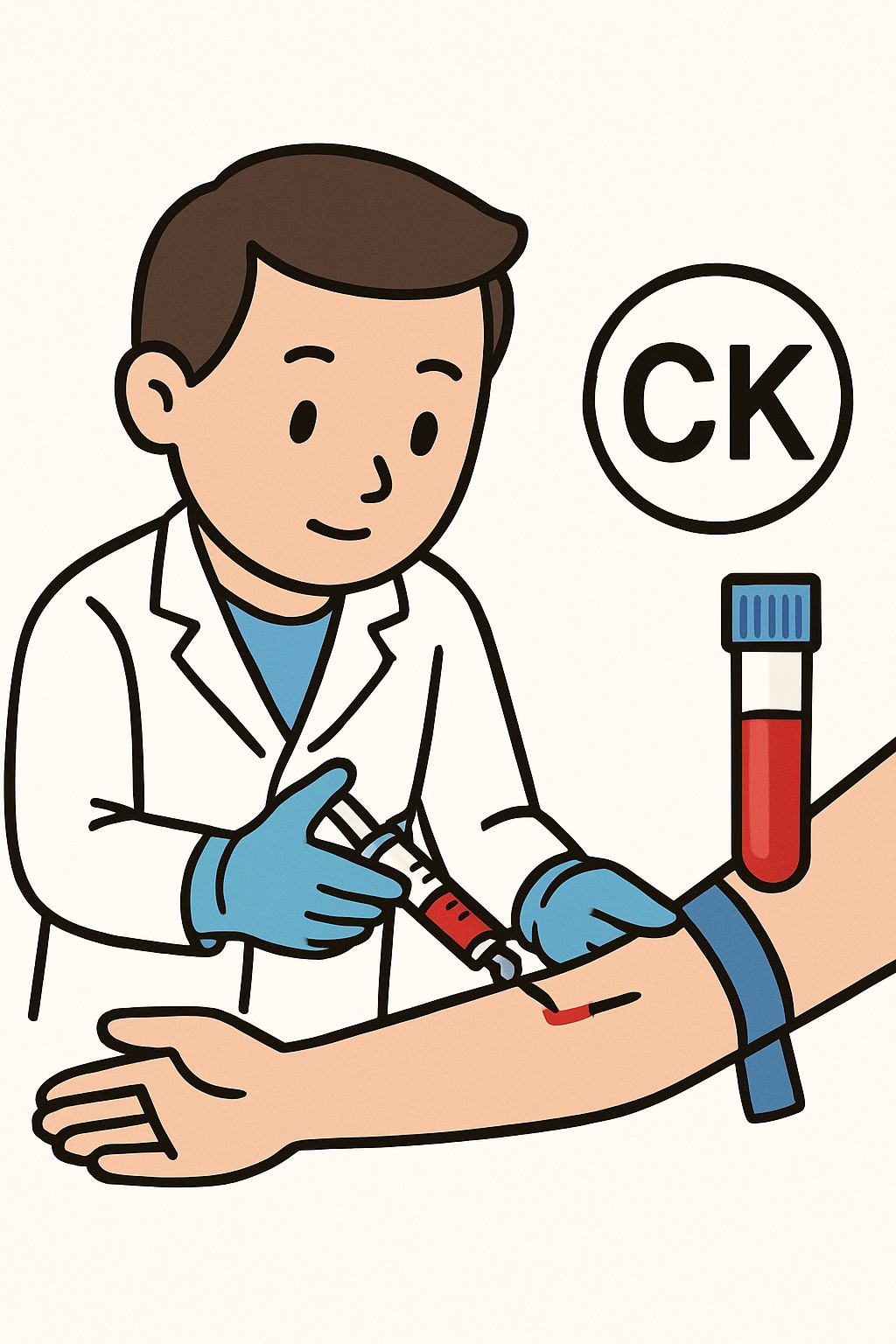
The creatine kinase (CK) muscle enzyme test is a blood test that measures the amount of CK, an enzyme found mostly in skeletal muscle and heart muscle.
Overview
The creatine kinase (CK) muscle enzyme test is a blood test that measures the amount of CK, an enzyme found mostly in skeletal muscle and heart muscle. When muscle cells are injured or break down, CK can leak into the bloodstream and raise the level. Clinicians use CK testing to help evaluate muscle pain, weakness, or possible muscle injury from illness, heat, crush injury, or certain medicines. Specialized CK tests may separate isoenzymes, but for heart injury, troponin tests are now usually preferred.
Also known as: CK blood test, CPK test, Creatine phosphokinase test, Serum CK test
Preparation & Next Steps
Everything you need to know before and after your procedure
Before Care
- Fasting is usually not required; follow any specific lab instructions if given
- Avoid strenuous exercise for 24–48 hours before the test if instructed, as heavy activity can raise CK
- Bring a current list of medicines and supplements; note recent injections or new medicines like statins
- Drink water beforehand unless you have fluid restrictions
- Wear a short-sleeved shirt to make the blood draw easier
- Tell the lab staff about any bleeding disorders, anticoagulants, or past fainting with blood draws
- Bring a photo ID, insurance card, and a payment method if needed
- Plan extra time for check-in and sample collection
- Arrange a ride if you tend to feel faint after blood draws
After Care
- Keep the bandage on for 30–60 minutes and keep the site clean and dry
- If bleeding restarts, apply firm pressure with clean gauze for several minutes
- Avoid heavy lifting with the drawn arm for a few hours
- Drink fluids as allowed to stay hydrated
- Mild bruising or soreness can happen and usually improves over a few days
- Review results in your patient portal or as instructed; many labs report within 1–3 days
- Ask how exercise, injections, or medicines might affect the timing of any repeat CK tests
- Contact the clinic if you notice increasing redness, warmth, swelling, pus, or worsening pain at the puncture site
- Write down any new muscle symptoms to discuss at follow-up
Clinical Information
Important medical details about this procedure
Indications
- Unexplained muscle pain, weakness, or cramps
- Dark urine or concern for muscle breakdown (rhabdomyolysis)
- Heat illness, crush injury, or after seizures
- Muscle symptoms while taking medicines such as statins
- Monitoring known muscle diseases (myositis, muscular dystrophy)
- Evaluating possible heart or skeletal muscle injury alongside other tests
Alternatives
- Observation and repeat physical exam
- Blood tests such as aldolase, AST/ALT, LDH, or serum/urine myoglobin
- High-sensitivity troponin for heart muscle injury
- Electrocardiogram (ECG) and echocardiogram for heart evaluation
- Electromyography (EMG) or nerve conduction studies for neuromuscular problems
- Muscle MRI or, in select cases, muscle biopsy
- Genetic testing for suspected inherited myopathies
Risks
- Soreness, bruising, or bleeding at the blood draw site
- Lightheadedness or fainting with blood draws
- Very small risk of infection at the puncture site
- Recent hard exercise, intramuscular shots, or some medicines can raise CK and affect results
Contraindications
- Severe bleeding disorders or very low platelets increase bleeding risk
- Use of blood thinners may increase bleeding from the draw site
- Skin infection or significant injury at the intended draw site
- Recent strenuous exercise or intramuscular injection may affect timing for the most accurate baseline
Recovery Timeline
What to expect during your recovery
There is no medical recovery period for a routine blood draw. Most people return to normal activities right away.
Typical Range
Same day
Return to Work
Same day
Recovery Milestones
Resume normal daily activities
Keep bandage on and watch for minor bruising at the draw site
Avoid heavy lifting with the drawn arm for several hours
Review test results and plan any follow-up testing if ordered
Frequently Asked Questions
Common questions and expert answers about this procedure
What does the CK test measure?
What does the CK test measure?
It measures creatine kinase, an enzyme released into the blood when muscle cells are injured or break down.
Do I need to fast before a CK test?
Do I need to fast before a CK test?
Usually no. Some labs may give specific instructions, so follow any directions provided.
What can raise CK levels besides disease?
What can raise CK levels besides disease?
Hard exercise, intramuscular shots, recent alcohol use, some medicines like statins, seizures, and heat illness can raise CK.
How is the test done?
How is the test done?
A sample of blood is taken from a vein in the arm with a small needle. The draw usually takes a few minutes.
How long do results take?
How long do results take?
Many labs report the CK result the same day or within 1–3 days, depending on the setting.
Can this test diagnose a heart attack?
Can this test diagnose a heart attack?
CK-MB was used in the past, but troponin tests are now preferred to detect heart muscle injury.
Can I exercise before the test?
Can I exercise before the test?
Strenuous exercise can raise CK for a day or more. Some clinicians ask people to avoid heavy workouts shortly before testing.
What if my CK is normal but I still have symptoms?
What if my CK is normal but I still have symptoms?
CK is one piece of information. Clinicians often consider symptoms, exam, timing, and other tests to understand muscle or heart problems.
References
Medical literature and sources