%20--%3e%3csvg%20version='1.0'%20id='Layer_1'%20xmlns='http://www.w3.org/2000/svg'%20xmlns:xlink='http://www.w3.org/1999/xlink'%20x='0px'%20y='0px'%20viewBox='0%200%20755.52%20814.35'%20style='enable-background:new%200%200%20755.52%20814.35;'%20xml:space='preserve'%3e%3cstyle%20type='text/css'%3e%20.st0{fill:%231ae5ce;stroke:%231ae5ce;stroke-width:7;stroke-miterlimit:10;}%20.st1{fill:%23FFFFFF;stroke:%231ae5ce;stroke-width:7;stroke-miterlimit:10;}%20.st2{fill:%231ae5ce;stroke:%23FFFFFF;stroke-width:7;stroke-miterlimit:10;}%20.st3{fill:%23FFFFFF;stroke:%23FFFFFF;stroke-width:6;stroke-miterlimit:10;}%20%3c/style%3e%3cg%20id='Dark_Logo_00000159431215648494653180000015900878925932721032_'%3e%3cpath%20id='shield_00000152259091539869183100000001926543869452564382_'%20class='st0'%20d='M711.13,173.42%20c-3.37-49.07-38.92-44.9-75.96-52.18c-67.4-13.25-130.47-34.47-192.36-63.92c-22.48-10.7-41.88-25.74-65.05-26.28%20c-23.17,0.54-42.58,15.59-65.05,26.28c-61.89,29.45-124.95,50.68-192.36,63.92c-37.04,7.28-72.59,3.11-75.96,52.18%20c-1.55,22.6,0.34,46.4,1.05,68.92c5.99,190.78,52.91,345.39,206.27,466.46c29.71,23.46,74.51,55.8,108.84,70.75%20c5.99,2.61,11.7,3.73,17.21,3.75c5.51-0.02,11.22-1.14,17.21-3.75c34.33-14.95,79.12-47.3,108.84-70.75%20c153.37-121.07,200.28-275.68,206.27-466.46C710.79,219.82,712.68,196.02,711.13,173.42z'/%3e%3cpath%20id='magnifyingglass_00000073685934697636024790000000342567780940956808_'%20class='st1'%20d='M648.78,624.21l-96.64-104.65%20c34.89-40.63,55.98-93.46,55.98-151.21c0-128.27-103.98-232.24-232.24-232.24S143.63,240.08,143.63,368.35%20s103.98,232.24,232.24,232.24c48.87,0,94.21-15.11,131.62-40.89l97.18,105.24c11.25,12.18,30.24,12.93,42.42,1.69l0,0%20C659.27,655.38,660.03,636.39,648.78,624.21z'/%3e%3ccircle%20id='ellipse_00000129904010550392394720000017056154833629780114_'%20class='st2'%20cx='375.87'%20cy='368.35'%20r='181.21'/%3e%3cpath%20id='dollarsign_00000057140127156649725250000003772530148495155891_'%20class='st3'%20d='M362.91,492.03v-23.91%20c0-2.01-1.58-3.69-3.59-3.77c-18.49-0.78-37.12-5.4-49.4-11.83c-1.75-0.92-2.53-3.01-1.76-4.84l5.87-13.89%20c0.86-2.02,3.23-2.88,5.2-1.89c12.94,6.52,30.45,11.44,49.18,11.44c26.02,0,43.6-12.73,43.6-30.43c0-17.08-14.29-27.63-41.4-36.95%20c-37.37-12.42-60.46-26.7-60.46-53.72c0-24.97,20.29-44.11,52.22-49.51c1.8-0.31,3.11-1.89,3.11-3.72v-24.35%20c0-2.09,1.69-3.78,3.78-3.78h15.16c2.09,0,3.78,1.69,3.78,3.78v22.71c0,2.01,1.58,3.67,3.58,3.77c17.85,0.92,30.88,4.75,40.61,9.1%20c1.92,0.86,2.79,3.09,1.94,5.01l-6.08,13.6c-0.85,1.91-3.09,2.77-4.99,1.91c-8.37-3.8-22.38-8.95-42.75-8.95%20c-28.21,0-38.84,14.28-38.84,26.7c0,16.15,13.56,24.22,45.44,35.4c37.74,13.04,56.79,29.19,56.79,56.82%20c0,23.85-19.05,46.23-54.78,52.3c-1.8,0.31-3.11,1.89-3.11,3.72v25.28c0,2.09-1.69,3.78-3.78,3.78h-15.53%20C364.6,495.81,362.91,494.12,362.91,492.03z'/%3e%3c/g%3e%3c/svg%3e)
HIV Screening (Antigen/Antibody Test) Laboratory
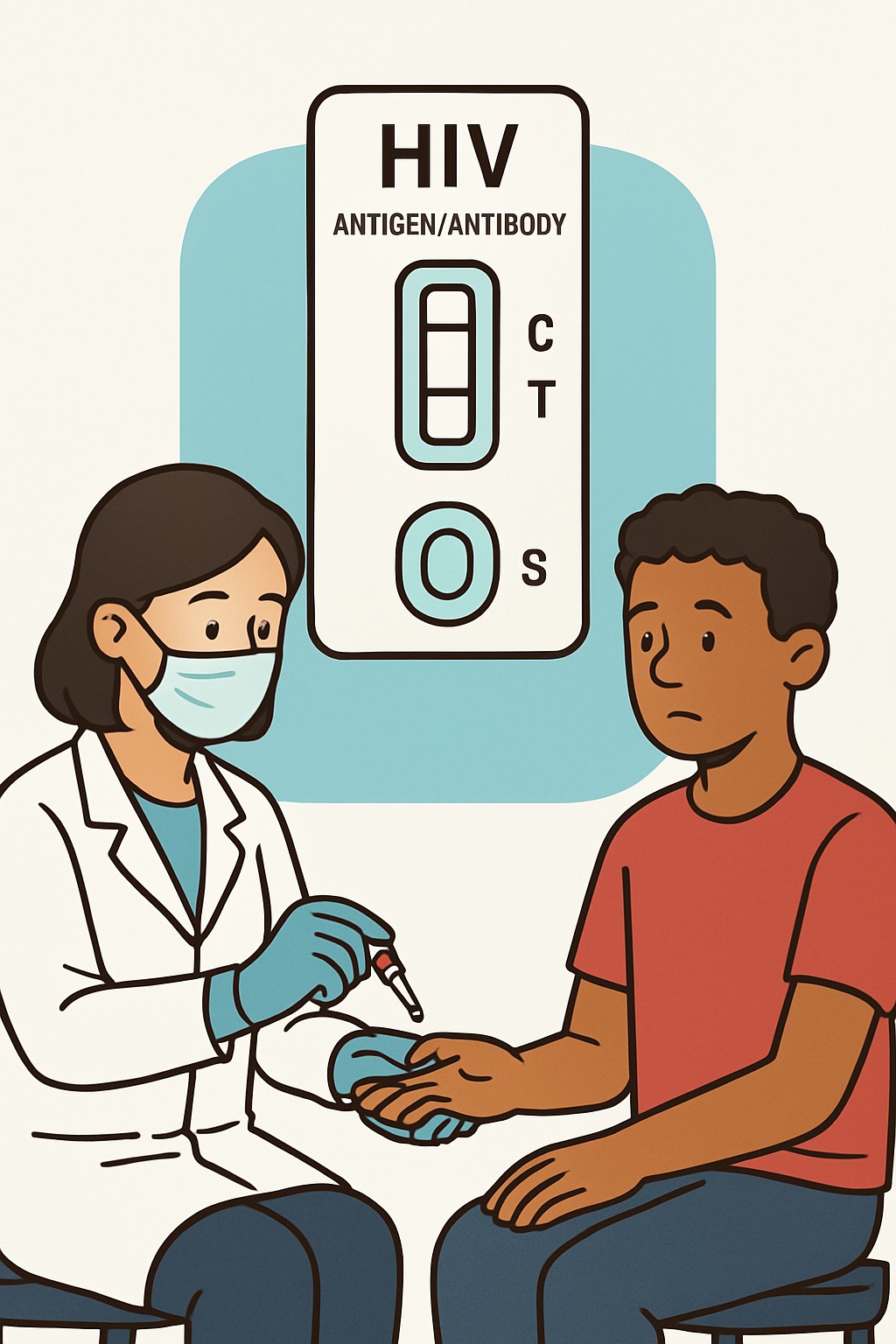
An HIV antigen/antibody screening test looks for HIV-1/2 antibodies and the p24 antigen in a blood sample.
Overview
An HIV antigen/antibody screening test looks for HIV-1/2 antibodies and the p24 antigen in a blood sample. Lab-based versions are often called 4th generation tests. They can find infection earlier than antibody-only tests because the p24 antigen appears before antibodies. This test is used for routine screening and after possible exposure. A reactive (preliminary positive) screen is followed by additional tests to confirm the result and determine HIV type.
Also known as: HIV 4th generation test, HIV Ag/Ab test, HIV combo test
Preparation & Next Steps
Everything you need to know before and after your procedure
Before Care
- No fasting is needed for this test; eat and drink normally unless told otherwise by the clinic
- Bring a photo ID, insurance details if you plan to use coverage, and a payment method
- Know the approximate date of any recent exposure to help interpret the window period
- Tell the staff if you recently started or are taking PEP or PrEP, as this can affect testing strategy
- Ask how and when you will receive results (portal, phone, text, or pickup)
- Drink water and wear sleeves that roll up easily for a blood draw
- If you prefer a rapid or fingerstick option, ask whether it is available at the site
- Confirm the clinic’s privacy practices and what information is reported to public health
- Plan your schedule in case confirmatory testing is needed after a reactive screen
- Let the clinic know if the exposure was within the past days to weeks, since different tests may be used
After Care
- Keep the bandage on for several hours and watch for minor bruising at the draw site
- Know when to expect results; rapid tests may be same day, while lab tests often take 1–3 business days
- Understand that a reactive screen is not a diagnosis; confirmatory tests are used to verify the result
- If your screen is negative but the exposure was recent, repeat testing may be needed after the window period
- Continue safer practices such as using condoms and not sharing needles
- If you are on PEP or PrEP, follow your existing plan and discuss testing intervals with your care team
- Ask the clinic about confidential partner services if you receive a confirmed positive result
- If you feel lightheaded, have bleeding that does not stop, or develop worsening pain at the site, contact the clinic
- Store a copy of your results for your records or future healthcare visits
Clinical Information
Important medical details about this procedure
Indications
- Routine HIV screening for adolescents and adults per national guidelines
- Starting a new sexual relationship or changing partners
- After potential sexual or needle exposure to HIV
- Evaluation during pregnancy
- After a diagnosis of another sexually transmitted infection
- Before starting or while using PrEP
- After occupational exposure or needlestick
- After sexual assault when testing is part of care
Alternatives
- Rapid antibody or antigen/antibody fingerstick test
- HIV nucleic acid test (NAT or RNA test)
- Antibody-only tests (blood or oral fluid)
- FDA-authorized HIV self-test or home sample collection kit
Risks
- Brief pain, bruising, or bleeding from the blood draw
- Lightheadedness or fainting during or after blood collection
- False-negative results during the window period
- False-positive screening result requiring confirmatory testing
- Emotional stress while waiting for results
- Privacy concerns and mandatory public health reporting for positive results
Contraindications
- No known absolute contraindications
- Very recent exposure may require a different test type or timing
Recovery Timeline
What to expect during your recovery
There is no medical recovery period for an HIV screening blood test. Most people resume normal activities immediately after the blood draw.
Typical Range
Same day
Return to Work
Same day
Recovery Milestones
Resume normal daily activities after the blood draw
Keep bandage on and monitor for minor bruising or soreness
Review results via portal or as instructed by the clinic for lab-based tests
If the screen is reactive, confirmatory testing is typically arranged
If exposure was recent, repeat testing may occur during the window period depending on test type
Frequently Asked Questions
Common questions and expert answers about this procedure
What is an HIV antigen/antibody test?
What is an HIV antigen/antibody test?
It is a blood test that looks for both HIV antibodies and the p24 antigen. This helps detect infection earlier than antibody-only tests.
How soon after exposure is the test reliable?
How soon after exposure is the test reliable?
Lab-based antigen/antibody tests can usually detect HIV 18–45 days after exposure. Rapid fingerstick versions may take 18–90 days. A nucleic acid test can detect infection earlier.
Do I need to fast before the test?
Do I need to fast before the test?
No. Fasting is not required for HIV screening.
How is the sample collected?
How is the sample collected?
Most lab tests use blood drawn from a vein. Some rapid tests use a fingerstick blood drop. Oral fluid antibody tests are also available in some settings.
How long will results take?
How long will results take?
Rapid tests can give results the same day. Lab-based tests often return results in 1–3 business days, depending on the lab.
What does a reactive result mean?
What does a reactive result mean?
Reactive means the screen found signs of HIV. It is not a final diagnosis. Follow-up tests are used to confirm and identify the virus type.
Will my results be confidential?
Will my results be confidential?
Results are protected by privacy laws. Positive results are reported to health departments for public health purposes. Partner services are available and confidential.
Can PrEP or PEP affect testing?
Can PrEP or PEP affect testing?
HIV medicines can affect the timing of detectable markers. Clinics may use specific test types or schedules when PrEP or PEP is involved.
References
Medical literature and sources