%20--%3e%3csvg%20version='1.0'%20id='Layer_1'%20xmlns='http://www.w3.org/2000/svg'%20xmlns:xlink='http://www.w3.org/1999/xlink'%20x='0px'%20y='0px'%20viewBox='0%200%20755.52%20814.35'%20style='enable-background:new%200%200%20755.52%20814.35;'%20xml:space='preserve'%3e%3cstyle%20type='text/css'%3e%20.st0{fill:%231ae5ce;stroke:%231ae5ce;stroke-width:7;stroke-miterlimit:10;}%20.st1{fill:%23FFFFFF;stroke:%231ae5ce;stroke-width:7;stroke-miterlimit:10;}%20.st2{fill:%231ae5ce;stroke:%23FFFFFF;stroke-width:7;stroke-miterlimit:10;}%20.st3{fill:%23FFFFFF;stroke:%23FFFFFF;stroke-width:6;stroke-miterlimit:10;}%20%3c/style%3e%3cg%20id='Dark_Logo_00000159431215648494653180000015900878925932721032_'%3e%3cpath%20id='shield_00000152259091539869183100000001926543869452564382_'%20class='st0'%20d='M711.13,173.42%20c-3.37-49.07-38.92-44.9-75.96-52.18c-67.4-13.25-130.47-34.47-192.36-63.92c-22.48-10.7-41.88-25.74-65.05-26.28%20c-23.17,0.54-42.58,15.59-65.05,26.28c-61.89,29.45-124.95,50.68-192.36,63.92c-37.04,7.28-72.59,3.11-75.96,52.18%20c-1.55,22.6,0.34,46.4,1.05,68.92c5.99,190.78,52.91,345.39,206.27,466.46c29.71,23.46,74.51,55.8,108.84,70.75%20c5.99,2.61,11.7,3.73,17.21,3.75c5.51-0.02,11.22-1.14,17.21-3.75c34.33-14.95,79.12-47.3,108.84-70.75%20c153.37-121.07,200.28-275.68,206.27-466.46C710.79,219.82,712.68,196.02,711.13,173.42z'/%3e%3cpath%20id='magnifyingglass_00000073685934697636024790000000342567780940956808_'%20class='st1'%20d='M648.78,624.21l-96.64-104.65%20c34.89-40.63,55.98-93.46,55.98-151.21c0-128.27-103.98-232.24-232.24-232.24S143.63,240.08,143.63,368.35%20s103.98,232.24,232.24,232.24c48.87,0,94.21-15.11,131.62-40.89l97.18,105.24c11.25,12.18,30.24,12.93,42.42,1.69l0,0%20C659.27,655.38,660.03,636.39,648.78,624.21z'/%3e%3ccircle%20id='ellipse_00000129904010550392394720000017056154833629780114_'%20class='st2'%20cx='375.87'%20cy='368.35'%20r='181.21'/%3e%3cpath%20id='dollarsign_00000057140127156649725250000003772530148495155891_'%20class='st3'%20d='M362.91,492.03v-23.91%20c0-2.01-1.58-3.69-3.59-3.77c-18.49-0.78-37.12-5.4-49.4-11.83c-1.75-0.92-2.53-3.01-1.76-4.84l5.87-13.89%20c0.86-2.02,3.23-2.88,5.2-1.89c12.94,6.52,30.45,11.44,49.18,11.44c26.02,0,43.6-12.73,43.6-30.43c0-17.08-14.29-27.63-41.4-36.95%20c-37.37-12.42-60.46-26.7-60.46-53.72c0-24.97,20.29-44.11,52.22-49.51c1.8-0.31,3.11-1.89,3.11-3.72v-24.35%20c0-2.09,1.69-3.78,3.78-3.78h15.16c2.09,0,3.78,1.69,3.78,3.78v22.71c0,2.01,1.58,3.67,3.58,3.77c17.85,0.92,30.88,4.75,40.61,9.1%20c1.92,0.86,2.79,3.09,1.94,5.01l-6.08,13.6c-0.85,1.91-3.09,2.77-4.99,1.91c-8.37-3.8-22.38-8.95-42.75-8.95%20c-28.21,0-38.84,14.28-38.84,26.7c0,16.15,13.56,24.22,45.44,35.4c37.74,13.04,56.79,29.19,56.79,56.82%20c0,23.85-19.05,46.23-54.78,52.3c-1.8,0.31-3.11,1.89-3.11,3.72v25.28c0,2.09-1.69,3.78-3.78,3.78h-15.53%20C364.6,495.81,362.91,494.12,362.91,492.03z'/%3e%3c/g%3e%3c/svg%3e)
Protein electrophoresis (serum) Laboratory
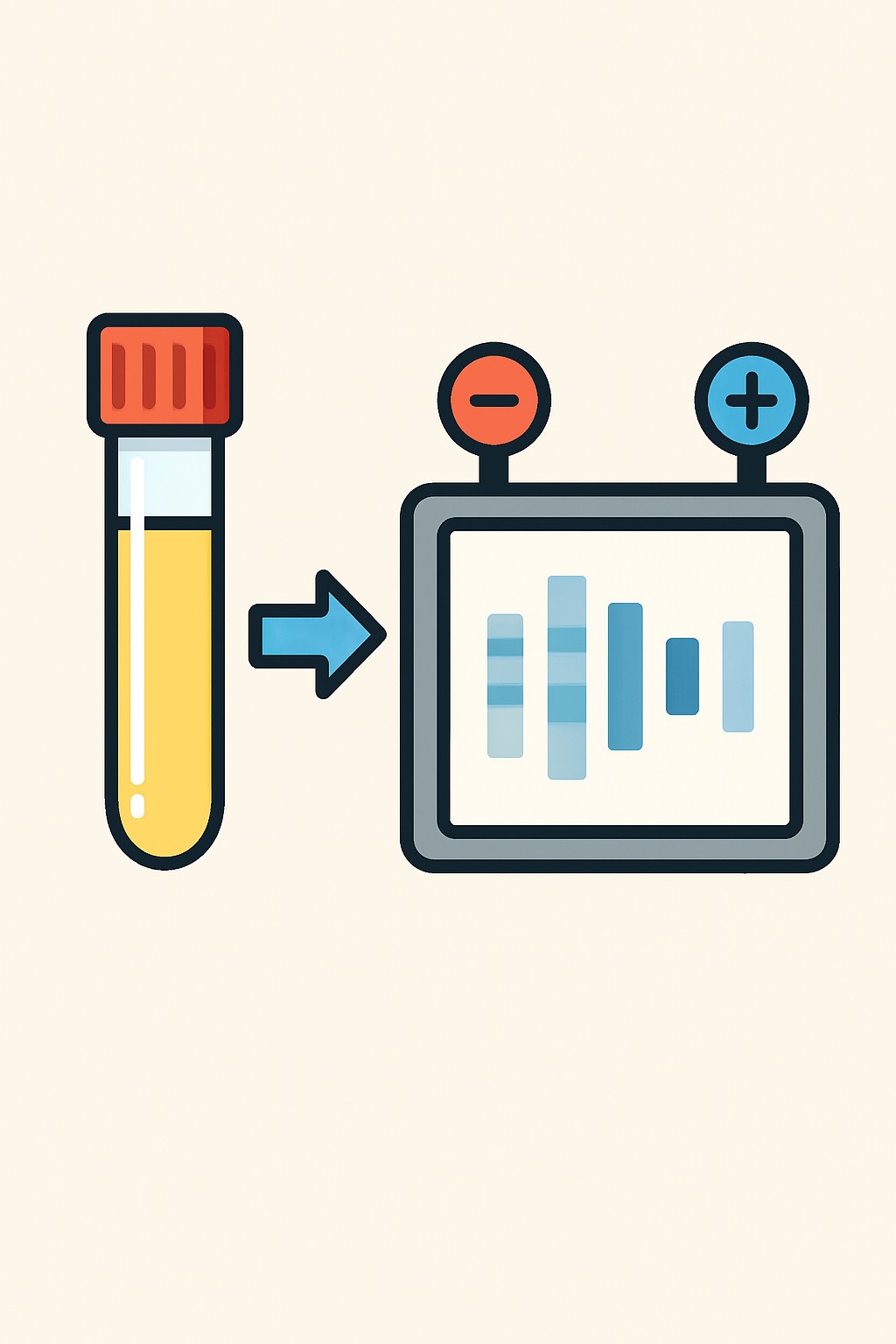
Serum protein electrophoresis is a blood test that separates the proteins in your serum into groups, such as albumin and globulins (alpha-1, alpha-2, beta, and gamma).
Overview
Serum protein electrophoresis is a blood test that separates the proteins in your serum into groups, such as albumin and globulins (alpha-1, alpha-2, beta, and gamma). The pattern helps identify increases or decreases in certain proteins. Clinicians use this test to look for abnormal proteins, check for a monoclonal protein (M-protein), and assess conditions that affect the immune system, bone marrow, liver, kidneys, or nutrition.
Also known as: Serum protein electrophoresis, SPEP, Blood protein electrophoresis
Preparation & Next Steps
Everything you need to know before and after your procedure
Before Care
- No fasting is usually required; follow any instructions from the lab or clinic
- Bring a photo ID, insurance card, and any lab order or requisition
- Stay well hydrated to make the blood draw easier unless told otherwise
- Wear sleeves that roll up easily for access to your arm
- Tell staff about bleeding disorders, easy bruising, or if you take blood thinners
- Inform the lab if you recently had a blood transfusion or IV infusions
- List current medicines and supplements, including over-the-counter items
- Plan for about 15–30 minutes at the lab, including check-in and recovery
- Ask how and when you will receive results (portal, phone, or follow-up visit
After Care
- Keep pressure on the bandage for the time advised to reduce bruising
- Keep the site clean and dry for several hours and replace the bandage if needed
- Avoid heavy lifting or strenuous use of the drawn arm for the rest of the day
- Drink fluids and eat as usual unless you were told otherwise for other tests
- Expect mild soreness or a small bruise that improves over a few days
- Contact the lab or clinic if the bandage soaks with blood or bleeding does not stop
- Notify the clinic if you notice increasing redness, warmth, swelling, or pus at the site
- Review your results when available and note if follow-up tests (like immunofixation) are recommended
- Use your patient portal or clinic number to ask questions about the report
Clinical Information
Important medical details about this procedure
Indications
- Unexplained high total protein or low albumin on prior labs
- Evaluation for multiple myeloma or related plasma cell disorders
- Monitoring known monoclonal gammopathy (such as MGUS)
- Unexplained anemia, bone pain, kidney problems, or high calcium
- Frequent infections or suspected immune deficiency
- Chronic inflammation or autoimmune conditions
- Liver or kidney disease evaluation
- Peripheral neuropathy of unclear cause
Alternatives
- Quantitative immunoglobulins (IgG, IgA, IgM)
- Serum immunofixation or immunotyping to identify monoclonal proteins
- Serum free light chains assay
- Urine protein electrophoresis (UPEP) with or without immunofixation
- Total protein and albumin with A/G ratio
- Targeted imaging or biopsy when indicated by overall evaluation
Risks
- Bruising, soreness, or bleeding at the blood draw site
- Lightheadedness or fainting during or after the draw
- Very small risk of infection at the puncture site
- Results can be affected by recent transfusion, dehydration, or acute illness
- Abnormal patterns often require additional testing to clarify the cause
Contraindications
- No absolute contraindications to a routine venipuncture
- Avoid using an arm with lymphedema, a dialysis fistula, or recent mastectomy when alternatives are available
- Uncontrolled bleeding tendency increases risk with blood draws
- Recent blood transfusion may complicate interpretation
Recovery Timeline
What to expect during your recovery
There is no medical recovery period beyond normal blood draw care. Most people resume usual activities right away.
Typical Range
Same day
Return to Work
Same day
Recovery Milestones
Resume normal daily activities
Keep puncture site clean and dry; limit heavy use of that arm
Expect any mild bruising to fade
Frequently Asked Questions
Common questions and expert answers about this procedure
What does serum protein electrophoresis measure?
What does serum protein electrophoresis measure?
It separates blood proteins into groups (albumin and globulins) to look for abnormal amounts or a monoclonal protein pattern.
Do I need to fast for this test?
Do I need to fast for this test?
Fasting is not usually needed for SPEP. Follow any instructions given by the lab.
How is the test done?
How is the test done?
A small sample of blood is drawn from a vein in your arm and analyzed to separate proteins by their charge and size.
How long do results take?
How long do results take?
Timing varies by lab and workflow. Many labs report results within a few business days.
What is the difference between SPEP and immunofixation?
What is the difference between SPEP and immunofixation?
SPEP shows the overall pattern of protein groups. Immunofixation helps identify the specific type of monoclonal protein if one is seen.
Why would I also need urine protein electrophoresis or free light chains?
Why would I also need urine protein electrophoresis or free light chains?
These tests can detect light chains or small amounts of monoclonal protein that may not be clear on SPEP alone.
Can anything affect the results?
Can anything affect the results?
Recent transfusion, dehydration, pregnancy, or active inflammation can change the pattern and may complicate interpretation.
Does this test screen for multiple myeloma?
Does this test screen for multiple myeloma?
SPEP is part of the evaluation when myeloma is suspected, but it is not a general screening test for people without symptoms.
References
Medical literature and sources