%20--%3e%3csvg%20version='1.0'%20id='Layer_1'%20xmlns='http://www.w3.org/2000/svg'%20xmlns:xlink='http://www.w3.org/1999/xlink'%20x='0px'%20y='0px'%20viewBox='0%200%20755.52%20814.35'%20style='enable-background:new%200%200%20755.52%20814.35;'%20xml:space='preserve'%3e%3cstyle%20type='text/css'%3e%20.st0{fill:%231ae5ce;stroke:%231ae5ce;stroke-width:7;stroke-miterlimit:10;}%20.st1{fill:%23FFFFFF;stroke:%231ae5ce;stroke-width:7;stroke-miterlimit:10;}%20.st2{fill:%231ae5ce;stroke:%23FFFFFF;stroke-width:7;stroke-miterlimit:10;}%20.st3{fill:%23FFFFFF;stroke:%23FFFFFF;stroke-width:6;stroke-miterlimit:10;}%20%3c/style%3e%3cg%20id='Dark_Logo_00000159431215648494653180000015900878925932721032_'%3e%3cpath%20id='shield_00000152259091539869183100000001926543869452564382_'%20class='st0'%20d='M711.13,173.42%20c-3.37-49.07-38.92-44.9-75.96-52.18c-67.4-13.25-130.47-34.47-192.36-63.92c-22.48-10.7-41.88-25.74-65.05-26.28%20c-23.17,0.54-42.58,15.59-65.05,26.28c-61.89,29.45-124.95,50.68-192.36,63.92c-37.04,7.28-72.59,3.11-75.96,52.18%20c-1.55,22.6,0.34,46.4,1.05,68.92c5.99,190.78,52.91,345.39,206.27,466.46c29.71,23.46,74.51,55.8,108.84,70.75%20c5.99,2.61,11.7,3.73,17.21,3.75c5.51-0.02,11.22-1.14,17.21-3.75c34.33-14.95,79.12-47.3,108.84-70.75%20c153.37-121.07,200.28-275.68,206.27-466.46C710.79,219.82,712.68,196.02,711.13,173.42z'/%3e%3cpath%20id='magnifyingglass_00000073685934697636024790000000342567780940956808_'%20class='st1'%20d='M648.78,624.21l-96.64-104.65%20c34.89-40.63,55.98-93.46,55.98-151.21c0-128.27-103.98-232.24-232.24-232.24S143.63,240.08,143.63,368.35%20s103.98,232.24,232.24,232.24c48.87,0,94.21-15.11,131.62-40.89l97.18,105.24c11.25,12.18,30.24,12.93,42.42,1.69l0,0%20C659.27,655.38,660.03,636.39,648.78,624.21z'/%3e%3ccircle%20id='ellipse_00000129904010550392394720000017056154833629780114_'%20class='st2'%20cx='375.87'%20cy='368.35'%20r='181.21'/%3e%3cpath%20id='dollarsign_00000057140127156649725250000003772530148495155891_'%20class='st3'%20d='M362.91,492.03v-23.91%20c0-2.01-1.58-3.69-3.59-3.77c-18.49-0.78-37.12-5.4-49.4-11.83c-1.75-0.92-2.53-3.01-1.76-4.84l5.87-13.89%20c0.86-2.02,3.23-2.88,5.2-1.89c12.94,6.52,30.45,11.44,49.18,11.44c26.02,0,43.6-12.73,43.6-30.43c0-17.08-14.29-27.63-41.4-36.95%20c-37.37-12.42-60.46-26.7-60.46-53.72c0-24.97,20.29-44.11,52.22-49.51c1.8-0.31,3.11-1.89,3.11-3.72v-24.35%20c0-2.09,1.69-3.78,3.78-3.78h15.16c2.09,0,3.78,1.69,3.78,3.78v22.71c0,2.01,1.58,3.67,3.58,3.77c17.85,0.92,30.88,4.75,40.61,9.1%20c1.92,0.86,2.79,3.09,1.94,5.01l-6.08,13.6c-0.85,1.91-3.09,2.77-4.99,1.91c-8.37-3.8-22.38-8.95-42.75-8.95%20c-28.21,0-38.84,14.28-38.84,26.7c0,16.15,13.56,24.22,45.44,35.4c37.74,13.04,56.79,29.19,56.79,56.82%20c0,23.85-19.05,46.23-54.78,52.3c-1.8,0.31-3.11,1.89-3.11,3.72v25.28c0,2.09-1.69,3.78-3.78,3.78h-15.53%20C364.6,495.81,362.91,494.12,362.91,492.03z'/%3e%3c/g%3e%3c/svg%3e)
Cerebral aneurysm repair (craniotomy) Neurosurgery
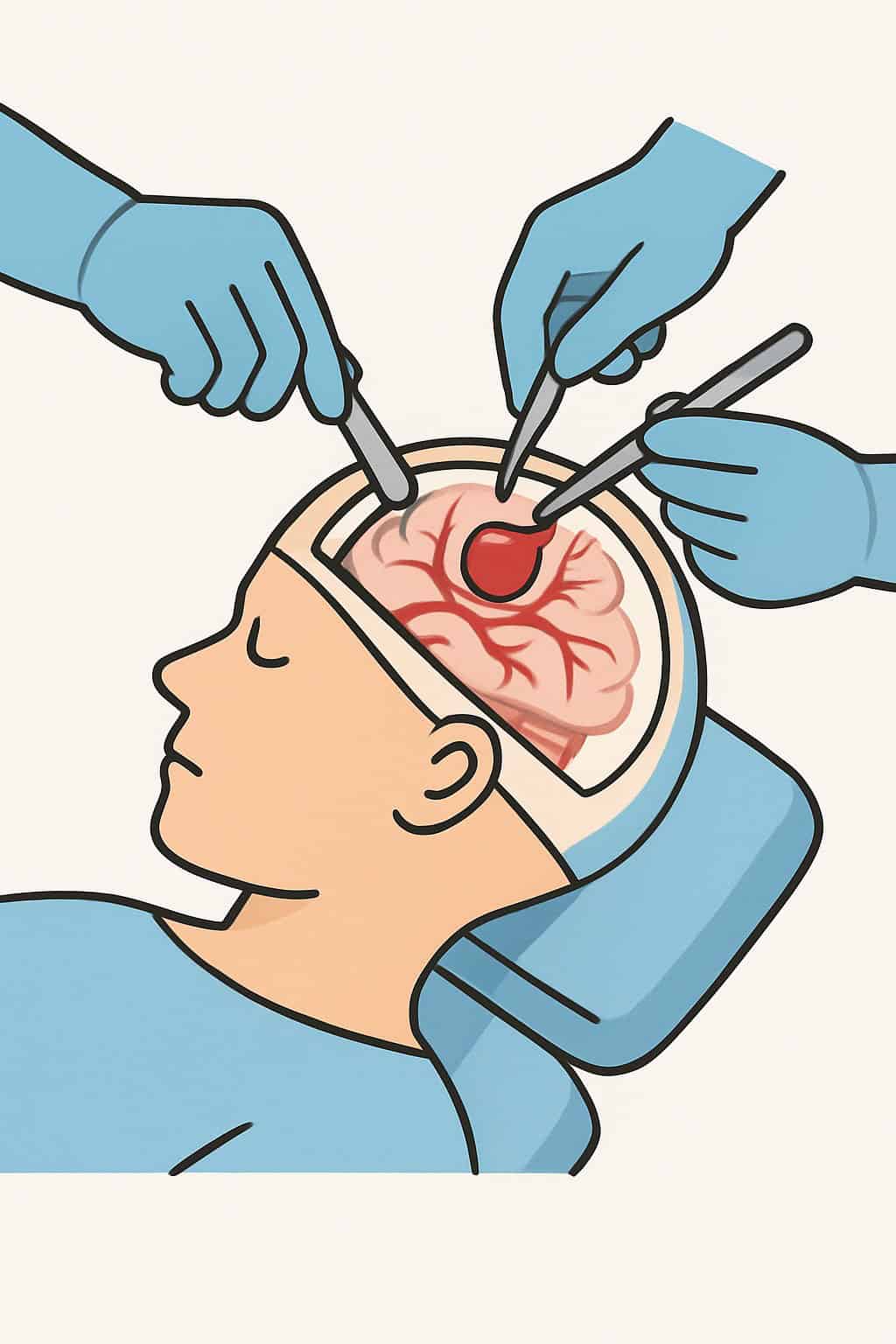
Cerebral aneurysm repair by craniotomy is an open brain surgery to treat a bulge in a blood vessel in the brain.
Overview
Cerebral aneurysm repair by craniotomy is an open brain surgery to treat a bulge in a blood vessel in the brain. A craniotomy means the surgeon temporarily removes a small section of skull to reach the aneurysm. Under a microscope, a tiny metal clip is placed across the neck of the aneurysm to block blood flow into it. The bone is then secured back in place. This procedure is done to reduce the risk of bleeding from an aneurysm or to treat an aneurysm that has already bled. It may be chosen based on the aneurysm’s size, shape, and location, and the person’s overall health.
Also known as: Aneurysm clipping, Surgical clipping of brain aneurysm, Craniotomy for aneurysm repair, Microsurgical aneurysm repair
Preparation & Next Steps
Everything you need to know before and after your procedure
Before Care
- Complete preoperative testing as scheduled, which may include CTA, MRA, catheter angiography, blood tests, and heart evaluation
- Share a full list of all medicines and supplements, especially blood thinners and herbal products
- Follow instructions on when to stop eating and drinking before anesthesia
- Ask which regular medicines to take or hold on the day of surgery, and how to handle diabetes medicines
- Arrange transportation and a support person to help at home for the first several days
- Plan time off from work and caregiving duties; bring any forms that need signatures
- Tell the team about allergies, prior anesthesia problems, implanted devices, or sleep apnea
- Use pre-op skin cleansing as instructed; avoid hair products on the scalp near the incision
- Leave jewelry and valuables at home; bring photo ID, insurance details, and imaging discs if requested
- Set up your home with easy-to-reach supplies, a place to rest with head elevation, and trip hazards removed
After Care
- Keep the incision clean and dry; follow instructions on dressing changes and when to wash your hair
- Take medicines exactly as directed, including seizure prevention or blood pressure medicines if prescribed
- Walk short distances several times a day and increase activity slowly as tolerated
- Avoid heavy lifting, bending, and strenuous activity until your surgical team clears you
- Do not drive, operate machinery, or return to high-risk activities until cleared by your clinician
- Sleep with your head slightly elevated to help with swelling and headaches
- Watch the incision for redness, warmth, drainage, or opening and contact a clinician if these appear
- Contact a clinician right away for severe or worsening headache, new weakness or numbness, trouble speaking, vision changes, fever, neck stiffness, confusion, or a seizure
- Attend all follow-up appointments and any ordered imaging to confirm the aneurysm is secured
- Note any changes in memory, mood, or concentration and discuss them at follow-up; therapy may be recommended
Clinical Information
Important medical details about this procedure
Indications
- Ruptured intracranial aneurysm causing subarachnoid hemorrhage
- Unruptured brain aneurysm with features suggesting higher risk of rupture
- Aneurysm anatomy not suitable for endovascular treatment
- Aneurysm causing symptoms from pressure on nearby brain structures
- Growth of a known aneurysm on follow-up imaging
Alternatives
- Endovascular coil embolization
- Flow-diverting stent or intrasaccular devices (endovascular)
- Observation with regular imaging
- Risk-factor management such as blood pressure control and tobacco cessation
Risks
- Bleeding or stroke
- Infection or poor wound healing
- Seizures
- Brain swelling or fluid buildup (hydrocephalus)
- Vasospasm (narrowing of brain arteries) after a rupture
- Weakness, numbness, speech or vision changes
- Memory or thinking changes
- Anesthesia-related risks
- Blood clots in the legs or lungs
Contraindications
- Severe medical instability that makes anesthesia unsafe
- Active infection that increases surgical risk
- Uncorrected bleeding or clotting disorders
- Aneurysm anatomy where clipping is not feasible or carries excessive risk
- Frailty or other factors where risks outweigh potential benefits
Recovery Timeline
What to expect during your recovery
Hospital stay is often several days for unruptured aneurysms and longer after a rupture. Fatigue, headaches, and scalp tenderness are common early on. Many people resume light activities within weeks, with recovery continuing for several months.
Typical Range
28–84 days
Return to Work
28–56 days
Recovery Milestones
Sit up and take short assisted walks on the unit as allowed
Stitches or staples removed; do light household tasks that do not strain
Increase daily walking; gentle stretching; avoid heavy lifting
Return to desk work part-time or full-time if cleared
Gradual return to moderate exercise and more complex tasks if cleared
Frequently Asked Questions
Common questions and expert answers about this procedure
What happens during cerebral aneurysm repair by craniotomy?
What happens during cerebral aneurysm repair by craniotomy?
The surgeon makes a small opening in the skull, exposes the aneurysm under a microscope, and places a tiny metal clip across its neck to stop blood flow into the bulge. The bone is secured back in place and the scalp is closed.
How is clipping different from endovascular coiling?
How is clipping different from endovascular coiling?
Clipping is open surgery through the skull to place a clip on the aneurysm neck. Coiling is done from inside the blood vessel using catheters and tiny coils. Choice depends on aneurysm size, shape, location, and overall health.
Will my head be shaved?
Will my head be shaved?
Many centers shave only a small strip of hair along the incision. The amount can vary based on the approach.
How long will I be in the hospital?
How long will I be in the hospital?
Many people stay several days after clipping for an unruptured aneurysm. After a rupture or if complications occur, the stay is often longer.
Can I get an MRI if I have an aneurysm clip?
Can I get an MRI if I have an aneurysm clip?
Most modern clips are made of materials that are MRI-conditional. Imaging staff should verify the exact clip model before MRI. Carry your implant card if you have one.
What symptoms are common after surgery?
What symptoms are common after surgery?
Headache, fatigue, scalp numbness, jaw soreness, and swelling near the incision are common early on. Thinking or memory can be slower for a time and often improve as healing continues.
Will I need therapy after surgery?
Will I need therapy after surgery?
Some people benefit from physical, occupational, or speech therapy, especially after a rupture or if new neurologic changes are present.
What follow-up imaging is typical?
What follow-up imaging is typical?
Your team may order CTA, MRA, or catheter angiography to confirm the aneurysm is fully secured. The schedule varies by case and local practice.
References
Medical literature and sources