%20--%3e%3csvg%20version='1.0'%20id='Layer_1'%20xmlns='http://www.w3.org/2000/svg'%20xmlns:xlink='http://www.w3.org/1999/xlink'%20x='0px'%20y='0px'%20viewBox='0%200%20755.52%20814.35'%20style='enable-background:new%200%200%20755.52%20814.35;'%20xml:space='preserve'%3e%3cstyle%20type='text/css'%3e%20.st0{fill:%231ae5ce;stroke:%231ae5ce;stroke-width:7;stroke-miterlimit:10;}%20.st1{fill:%23FFFFFF;stroke:%231ae5ce;stroke-width:7;stroke-miterlimit:10;}%20.st2{fill:%231ae5ce;stroke:%23FFFFFF;stroke-width:7;stroke-miterlimit:10;}%20.st3{fill:%23FFFFFF;stroke:%23FFFFFF;stroke-width:6;stroke-miterlimit:10;}%20%3c/style%3e%3cg%20id='Dark_Logo_00000159431215648494653180000015900878925932721032_'%3e%3cpath%20id='shield_00000152259091539869183100000001926543869452564382_'%20class='st0'%20d='M711.13,173.42%20c-3.37-49.07-38.92-44.9-75.96-52.18c-67.4-13.25-130.47-34.47-192.36-63.92c-22.48-10.7-41.88-25.74-65.05-26.28%20c-23.17,0.54-42.58,15.59-65.05,26.28c-61.89,29.45-124.95,50.68-192.36,63.92c-37.04,7.28-72.59,3.11-75.96,52.18%20c-1.55,22.6,0.34,46.4,1.05,68.92c5.99,190.78,52.91,345.39,206.27,466.46c29.71,23.46,74.51,55.8,108.84,70.75%20c5.99,2.61,11.7,3.73,17.21,3.75c5.51-0.02,11.22-1.14,17.21-3.75c34.33-14.95,79.12-47.3,108.84-70.75%20c153.37-121.07,200.28-275.68,206.27-466.46C710.79,219.82,712.68,196.02,711.13,173.42z'/%3e%3cpath%20id='magnifyingglass_00000073685934697636024790000000342567780940956808_'%20class='st1'%20d='M648.78,624.21l-96.64-104.65%20c34.89-40.63,55.98-93.46,55.98-151.21c0-128.27-103.98-232.24-232.24-232.24S143.63,240.08,143.63,368.35%20s103.98,232.24,232.24,232.24c48.87,0,94.21-15.11,131.62-40.89l97.18,105.24c11.25,12.18,30.24,12.93,42.42,1.69l0,0%20C659.27,655.38,660.03,636.39,648.78,624.21z'/%3e%3ccircle%20id='ellipse_00000129904010550392394720000017056154833629780114_'%20class='st2'%20cx='375.87'%20cy='368.35'%20r='181.21'/%3e%3cpath%20id='dollarsign_00000057140127156649725250000003772530148495155891_'%20class='st3'%20d='M362.91,492.03v-23.91%20c0-2.01-1.58-3.69-3.59-3.77c-18.49-0.78-37.12-5.4-49.4-11.83c-1.75-0.92-2.53-3.01-1.76-4.84l5.87-13.89%20c0.86-2.02,3.23-2.88,5.2-1.89c12.94,6.52,30.45,11.44,49.18,11.44c26.02,0,43.6-12.73,43.6-30.43c0-17.08-14.29-27.63-41.4-36.95%20c-37.37-12.42-60.46-26.7-60.46-53.72c0-24.97,20.29-44.11,52.22-49.51c1.8-0.31,3.11-1.89,3.11-3.72v-24.35%20c0-2.09,1.69-3.78,3.78-3.78h15.16c2.09,0,3.78,1.69,3.78,3.78v22.71c0,2.01,1.58,3.67,3.58,3.77c17.85,0.92,30.88,4.75,40.61,9.1%20c1.92,0.86,2.79,3.09,1.94,5.01l-6.08,13.6c-0.85,1.91-3.09,2.77-4.99,1.91c-8.37-3.8-22.38-8.95-42.75-8.95%20c-28.21,0-38.84,14.28-38.84,26.7c0,16.15,13.56,24.22,45.44,35.4c37.74,13.04,56.79,29.19,56.79,56.82%20c0,23.85-19.05,46.23-54.78,52.3c-1.8,0.31-3.11,1.89-3.11,3.72v25.28c0,2.09-1.69,3.78-3.78,3.78h-15.53%20C364.6,495.81,362.91,494.12,362.91,492.03z'/%3e%3c/g%3e%3c/svg%3e)
Anterior cervical discectomy and fusion Orthopedic Surgery
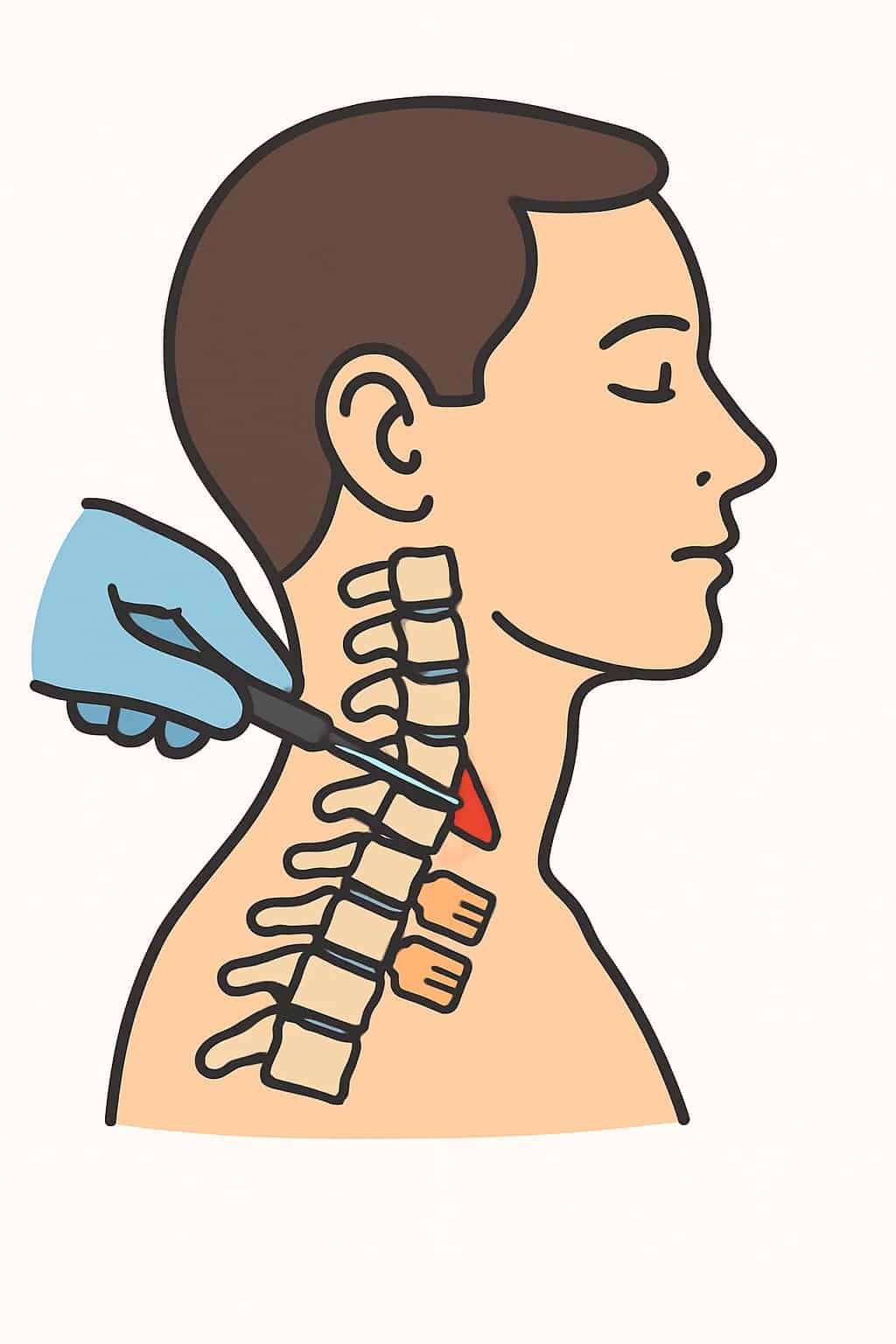
Anterior cervical discectomy and fusion is a neck surgery done through a small incision in the front of the neck.
Overview
Anterior cervical discectomy and fusion is a neck surgery done through a small incision in the front of the neck. The surgeon removes a damaged disc to relieve pressure on the spinal cord or nerve roots. A spacer or bone graft is placed in the disc space, often secured with a small plate and screws, so the two vertebrae can grow together. It is commonly done to ease arm pain, numbness, or weakness caused by a pinched nerve in the neck. It may also be used for spinal stenosis, degenerative disc disease, or instability when nonsurgical care has not helped.
Also known as: ACDF, Cervical fusion, Anterior cervical fusion
Preparation & Next Steps
Everything you need to know before and after your procedure
Before Care
- Complete the preoperative evaluation, including review of MRI, CT, or X-rays and any lab tests requested by the care team
- Provide a current list of medicines and supplements; ask how to manage blood thinners, diabetes medicines, and herbal products before surgery
- Avoid nicotine exposure; stopping smoking and vaping lowers the risk of nonunion and wound problems
- Follow surgery center instructions about eating and drinking before anesthesia, including when to stop food and liquids
- Arrange a responsible adult for a ride home and help for the first day or two
- Bathe or shower the night before with the cleanser provided or recommended to reduce skin bacteria
- Plan time off from work and set up a safe home area with essentials at waist height to limit reaching and lifting
- Bring a photo ID, insurance information, and any brace or collar if issued ahead of time
- Tell the team about prior neck surgery, swallowing or voice issues, and sleep apnea; bring your CPAP if used
- Confirm questions about the procedure, implants, and expected hospital stay during the consent process
After Care
- Keep the incision clean and dry; follow instructions on when to remove the dressing and how to shower
- Use any prescribed collar or brace as directed by the surgical team, if one is recommended
- Walk short, frequent distances and gradually increase activity as tolerated
- Avoid heavy lifting, overhead reaching, or twisting of the neck until cleared by the clinician
- Take pain medicines only as instructed; some teams limit NSAIDs after fusion, so verify what is allowed
- If swallowing is uncomfortable, choose softer foods and take small sips until it improves
- Prevent constipation by staying hydrated and using fiber-rich foods; ask about stool softeners if needed
- Do not drive while taking opioid pain medicines and until neck movement is comfortable and permitted by the care team
- Attend follow-up visits for incision checks and imaging to monitor fusion progress
- Contact your care team for fever, increasing neck or throat swelling, trouble breathing or swallowing that worsens, drainage or redness at the incision, severe headache, or new or worsening numbness, tingling, or weakness
Clinical Information
Important medical details about this procedure
Indications
- Cervical radiculopathy (pinched nerve) with arm pain, numbness, or weakness
- Cervical myelopathy (spinal cord compression) with coordination or balance problems
- Cervical disc herniation not improving with conservative care
- Cervical spondylosis or degenerative disc disease causing nerve compression
- Spinal stenosis in the neck
- Segmental instability after trauma or degeneration
- Recurrent disc herniation at the same level
Alternatives
- Physical therapy and activity modification
- Nonsteroidal anti-inflammatory medicines (NSAIDs) if appropriate
- Epidural steroid injections
- Cervical disc replacement (artificial disc) in selected cases
- Posterior cervical foraminotomy
- Observation and time with symptom management
- Pain management strategies, including neuropathic pain medicines
Risks
- Infection or bleeding
- Injury to a nerve or the spinal cord
- Hoarseness or voice changes from nerve irritation
- Trouble swallowing (dysphagia), usually temporary
- Nonunion (pseudarthrosis) where the bones do not fuse
- Hardware problems such as screw or plate loosening
- Adjacent segment degeneration above or below the fusion
- Dural tear with spinal fluid leak
- Anesthesia-related risks and blood clots
- Airway swelling or breathing difficulty
Contraindications
- Active local or systemic infection
- Uncontrolled bleeding disorder or use of blood thinners that cannot be managed
- Severe osteoporosis affecting implant fixation
- Allergy to implant materials that cannot be addressed
- Medical conditions that make general anesthesia too risky
Recovery Timeline
What to expect during your recovery
Many people go home the same day or after one night. Soreness and mild trouble swallowing are common early. Light activities often resume over 2 to 6 weeks, while bone fusion continues for several months.
Typical Range
14–90 days
Return to Work
14–42 days
Recovery Milestones
Walk short distances indoors with support as needed
Incision care and gradual increase in walking time
Increase daily walking and light household tasks without lifting
Return to desk or light-duty work if cleared by the care team
Begin guided stretching and strengthening if prescribed
Progressive return to higher-impact activities when approved
Frequently Asked Questions
Common questions and expert answers about this procedure
What is done during ACDF?
What is done during ACDF?
A small incision is made in the front of the neck, the damaged disc is removed to free the nerve or spinal cord, and a spacer or bone graft plus a small plate and screws are placed so the bones can fuse.
How long does the surgery take and what anesthesia is used?
How long does the surgery take and what anesthesia is used?
Most ACDF surgeries take about 1 to 3 hours and are done under general anesthesia. Times vary based on how many levels are treated.
Will I need a neck collar after surgery?
Will I need a neck collar after surgery?
Some surgeons use a soft or rigid collar, especially after multilevel fusion. The choice depends on the specific case and implants used.
How will this affect my neck movement?
How will this affect my neck movement?
The fused level no longer moves. For a single-level fusion, overall neck motion usually changes only a little because the other levels still move.
When can I drive again?
When can I drive again?
Driving typically waits until you are off opioid pain medicines and can turn your head comfortably and safely. Timing varies and is confirmed at follow-up.
What side effects are common early on?
What side effects are common early on?
Sore throat, hoarseness, and trouble swallowing are common in the first days to weeks and usually improve over time.
Are there alternatives to fusion?
Are there alternatives to fusion?
Options may include physical therapy, medicines, injections, posterior foraminotomy, or cervical disc replacement in selected cases.
References
Medical literature and sources