%20--%3e%3csvg%20version='1.0'%20id='Layer_1'%20xmlns='http://www.w3.org/2000/svg'%20xmlns:xlink='http://www.w3.org/1999/xlink'%20x='0px'%20y='0px'%20viewBox='0%200%20755.52%20814.35'%20style='enable-background:new%200%200%20755.52%20814.35;'%20xml:space='preserve'%3e%3cstyle%20type='text/css'%3e%20.st0{fill:%231ae5ce;stroke:%231ae5ce;stroke-width:7;stroke-miterlimit:10;}%20.st1{fill:%23FFFFFF;stroke:%231ae5ce;stroke-width:7;stroke-miterlimit:10;}%20.st2{fill:%231ae5ce;stroke:%23FFFFFF;stroke-width:7;stroke-miterlimit:10;}%20.st3{fill:%23FFFFFF;stroke:%23FFFFFF;stroke-width:6;stroke-miterlimit:10;}%20%3c/style%3e%3cg%20id='Dark_Logo_00000159431215648494653180000015900878925932721032_'%3e%3cpath%20id='shield_00000152259091539869183100000001926543869452564382_'%20class='st0'%20d='M711.13,173.42%20c-3.37-49.07-38.92-44.9-75.96-52.18c-67.4-13.25-130.47-34.47-192.36-63.92c-22.48-10.7-41.88-25.74-65.05-26.28%20c-23.17,0.54-42.58,15.59-65.05,26.28c-61.89,29.45-124.95,50.68-192.36,63.92c-37.04,7.28-72.59,3.11-75.96,52.18%20c-1.55,22.6,0.34,46.4,1.05,68.92c5.99,190.78,52.91,345.39,206.27,466.46c29.71,23.46,74.51,55.8,108.84,70.75%20c5.99,2.61,11.7,3.73,17.21,3.75c5.51-0.02,11.22-1.14,17.21-3.75c34.33-14.95,79.12-47.3,108.84-70.75%20c153.37-121.07,200.28-275.68,206.27-466.46C710.79,219.82,712.68,196.02,711.13,173.42z'/%3e%3cpath%20id='magnifyingglass_00000073685934697636024790000000342567780940956808_'%20class='st1'%20d='M648.78,624.21l-96.64-104.65%20c34.89-40.63,55.98-93.46,55.98-151.21c0-128.27-103.98-232.24-232.24-232.24S143.63,240.08,143.63,368.35%20s103.98,232.24,232.24,232.24c48.87,0,94.21-15.11,131.62-40.89l97.18,105.24c11.25,12.18,30.24,12.93,42.42,1.69l0,0%20C659.27,655.38,660.03,636.39,648.78,624.21z'/%3e%3ccircle%20id='ellipse_00000129904010550392394720000017056154833629780114_'%20class='st2'%20cx='375.87'%20cy='368.35'%20r='181.21'/%3e%3cpath%20id='dollarsign_00000057140127156649725250000003772530148495155891_'%20class='st3'%20d='M362.91,492.03v-23.91%20c0-2.01-1.58-3.69-3.59-3.77c-18.49-0.78-37.12-5.4-49.4-11.83c-1.75-0.92-2.53-3.01-1.76-4.84l5.87-13.89%20c0.86-2.02,3.23-2.88,5.2-1.89c12.94,6.52,30.45,11.44,49.18,11.44c26.02,0,43.6-12.73,43.6-30.43c0-17.08-14.29-27.63-41.4-36.95%20c-37.37-12.42-60.46-26.7-60.46-53.72c0-24.97,20.29-44.11,52.22-49.51c1.8-0.31,3.11-1.89,3.11-3.72v-24.35%20c0-2.09,1.69-3.78,3.78-3.78h15.16c2.09,0,3.78,1.69,3.78,3.78v22.71c0,2.01,1.58,3.67,3.58,3.77c17.85,0.92,30.88,4.75,40.61,9.1%20c1.92,0.86,2.79,3.09,1.94,5.01l-6.08,13.6c-0.85,1.91-3.09,2.77-4.99,1.91c-8.37-3.8-22.38-8.95-42.75-8.95%20c-28.21,0-38.84,14.28-38.84,26.7c0,16.15,13.56,24.22,45.44,35.4c37.74,13.04,56.79,29.19,56.79,56.82%20c0,23.85-19.05,46.23-54.78,52.3c-1.8,0.31-3.11,1.89-3.11,3.72v25.28c0,2.09-1.69,3.78-3.78,3.78h-15.53%20C364.6,495.81,362.91,494.12,362.91,492.03z'/%3e%3c/g%3e%3c/svg%3e)
Carpal tunnel release (wrist ligament release) Orthopedic Surgery
Carpal tunnel release is a surgery that relieves pressure on the median nerve in the wrist.
Overview
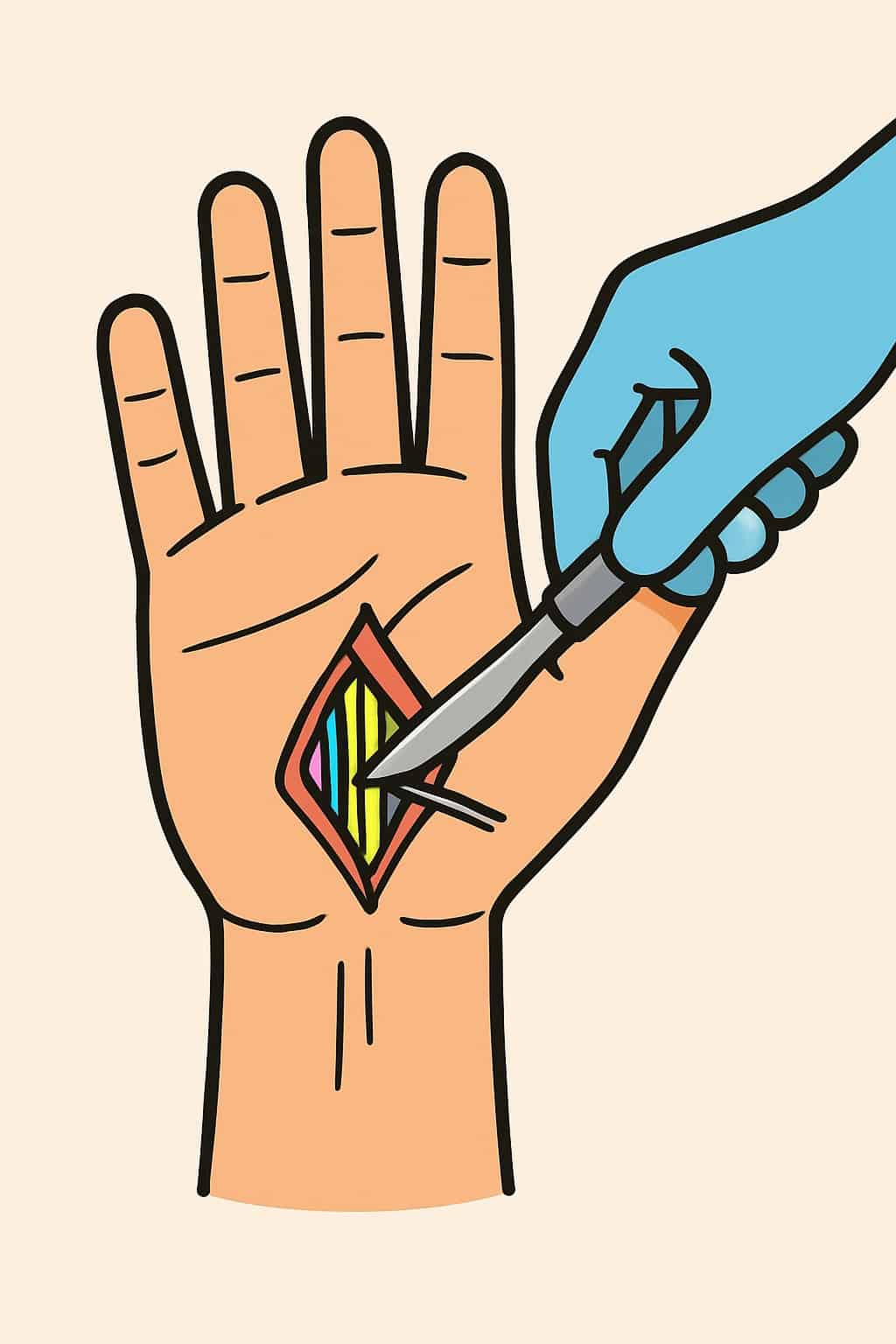
Carpal tunnel release is a surgery that relieves pressure on the median nerve in the wrist. A tight space in the wrist, called the carpal tunnel, can squeeze the nerve and cause numbness, tingling, pain, or weakness in the hand. During the procedure, the surgeon cuts the transverse carpal ligament (a band of tissue across the palm side of the wrist). This opens more space in the tunnel and lowers pressure on the nerve. The surgery can be done through a small open cut or with an endoscope (a thin camera) using one or two tiny cuts. It is commonly an outpatient procedure, often with local anesthesia.
Also known as: Carpal tunnel surgery, Transverse carpal ligament release, Median nerve decompression, Open carpal tunnel release, Endoscopic carpal tunnel release
Preparation & Next Steps
Everything you need to know before and after your procedure
Before Care
- Expect a preoperative evaluation; some centers verify nerve tests and review prior non-surgical treatments.
- Share a complete list of medicines and supplements, including blood thinners; the care team will advise on any adjustments.
- Confirm which hand will be treated and arrange transportation if sedation is planned.
- Follow any instructions about eating or drinking based on the anesthesia plan.
- Plan time off work and help at home for the first few days while the hand is protected.
- Remove rings and jewelry from the hand and wrist before the procedure.
- Keep the skin clean and avoid lotions or heavy creams on the wrist on surgery day.
- Bring a list of allergies and prior reactions to anesthesia or medicines.
- Ask how dressings, a splint, or a sling will be used after surgery so you can prepare supplies at home.
After Care
- A bulky dressing or light splint is often used at first; keep it clean and dry as instructed.
- Elevate the hand above heart level and move the fingers gently to reduce swelling, unless told otherwise.
- Use prescribed or over-the-counter pain medicines as directed by your care team.
- Avoid heavy gripping, pushing, or lifting until cleared; light hand use for daily tasks usually increases over days to weeks.
- Keep the incision area clean; stitches are commonly removed about 10–14 days after surgery.
- Perform hand and finger range-of-motion exercises as taught to limit stiffness.
- Watch for drainage, spreading redness, fever, or worsening pain at the incision, and contact a clinician if these appear.
- Report increasing numbness, loss of finger movement, or color changes in the hand to the clinic.
- Confirm the timing of follow-up visits and any therapy referrals.
- Protect the scar from irritation; scar massage or desensitization may be introduced when the incision is healed, per clinician guidance.
Clinical Information
Important medical details about this procedure
Indications
- Carpal tunnel syndrome with numbness, tingling, burning, or pain in the thumb, index, middle, and part of the ring finger
- Hand weakness or dropping objects
- Symptoms that wake you at night or persist during the day
- Symptoms not improving with splinting, activity changes, or injections
- Nerve test results showing significant median nerve compression
Alternatives
- Wrist splinting, especially at night
- Activity and ergonomic changes
- Nonsteroidal anti-inflammatory drugs (NSAIDs) for short-term relief
- Corticosteroid injection into the carpal tunnel
- Hand therapy or nerve-gliding exercises
- Treating contributing conditions (for example, diabetes or thyroid disease management)
Risks
- Infection or poor wound healing
- Bleeding or blood clots
- Injury to nerves, blood vessels, or tendons
- Stiffness, scar tenderness, or pillar pain (soreness beside the incision)
- Persistent or recurrent symptoms
- Allergic reaction or problems related to anesthesia
- Complex regional pain syndrome (chronic pain and swelling)
Contraindications
- Active infection at or near the wrist
- Uncontrolled bleeding disorder or use of blood thinners without a plan
- Severe medical conditions that make surgery unsafe
- Inability to cooperate with the procedure without appropriate anesthesia support
Recovery Timeline
What to expect during your recovery
Soreness and swelling often improve over the first few weeks. Many people resume light daily activities in 1–2 weeks, while grip strength and full comfort may continue to improve for several months.
Typical Range
14–56 days
Return to Work
7–56 days
Recovery Milestones
Elevate hand and perform gentle finger motion to reduce swelling
Light self-care with the operated hand as comfort allows; avoid heavy gripping
Suture removal and transition to smaller dressing if used
Return to desk-based work when pain is controlled and hand can be protected
Gradual return to heavier tasks or manual work as cleared by the care team
Progressive strengthening; continued improvement in grip and pinch
Frequently Asked Questions
Common questions and expert answers about this procedure
What is the difference between open and endoscopic carpal tunnel release?
What is the difference between open and endoscopic carpal tunnel release?
Both cut the wrist ligament to relieve pressure on the nerve. Open uses a small incision in the palm; endoscopic uses a camera through one or two tiny incisions. Outcomes are similar, with some people noticing faster early recovery after endoscopic surgery.
Is this an outpatient procedure?
Is this an outpatient procedure?
Yes, it is commonly done as outpatient surgery. Many cases use local anesthesia with or without light sedation.
How long does the surgery take?
How long does the surgery take?
The operative time is often under 30 minutes, but total time at the facility is longer due to preparation and recovery.
When will numbness go away?
When will numbness go away?
Some people notice relief quickly, while others improve over weeks to months. Long-standing severe compression may recover more slowly.
Will I need hand therapy?
Will I need hand therapy?
Many people recover with home exercises. Therapy may be recommended if stiffness, swelling, or weakness limits progress.
Will there be a scar?
Will there be a scar?
Yes. An open approach leaves a small scar in the palm; endoscopic scars are smaller at the wrist or palm. Scar tenderness usually fades with time.
Can symptoms come back after surgery?
Can symptoms come back after surgery?
Recurrence can happen but is uncommon. Some people have persistent symptoms if the nerve was severely affected before surgery or if other conditions contribute.
Can both hands be treated?
Can both hands be treated?
Both hands can be treated, either staged weeks apart or sometimes during the same visit, depending on the plan and daily needs.
References
Medical literature and sources