%20--%3e%3csvg%20version='1.0'%20id='Layer_1'%20xmlns='http://www.w3.org/2000/svg'%20xmlns:xlink='http://www.w3.org/1999/xlink'%20x='0px'%20y='0px'%20viewBox='0%200%20755.52%20814.35'%20style='enable-background:new%200%200%20755.52%20814.35;'%20xml:space='preserve'%3e%3cstyle%20type='text/css'%3e%20.st0{fill:%231ae5ce;stroke:%231ae5ce;stroke-width:7;stroke-miterlimit:10;}%20.st1{fill:%23FFFFFF;stroke:%231ae5ce;stroke-width:7;stroke-miterlimit:10;}%20.st2{fill:%231ae5ce;stroke:%23FFFFFF;stroke-width:7;stroke-miterlimit:10;}%20.st3{fill:%23FFFFFF;stroke:%23FFFFFF;stroke-width:6;stroke-miterlimit:10;}%20%3c/style%3e%3cg%20id='Dark_Logo_00000159431215648494653180000015900878925932721032_'%3e%3cpath%20id='shield_00000152259091539869183100000001926543869452564382_'%20class='st0'%20d='M711.13,173.42%20c-3.37-49.07-38.92-44.9-75.96-52.18c-67.4-13.25-130.47-34.47-192.36-63.92c-22.48-10.7-41.88-25.74-65.05-26.28%20c-23.17,0.54-42.58,15.59-65.05,26.28c-61.89,29.45-124.95,50.68-192.36,63.92c-37.04,7.28-72.59,3.11-75.96,52.18%20c-1.55,22.6,0.34,46.4,1.05,68.92c5.99,190.78,52.91,345.39,206.27,466.46c29.71,23.46,74.51,55.8,108.84,70.75%20c5.99,2.61,11.7,3.73,17.21,3.75c5.51-0.02,11.22-1.14,17.21-3.75c34.33-14.95,79.12-47.3,108.84-70.75%20c153.37-121.07,200.28-275.68,206.27-466.46C710.79,219.82,712.68,196.02,711.13,173.42z'/%3e%3cpath%20id='magnifyingglass_00000073685934697636024790000000342567780940956808_'%20class='st1'%20d='M648.78,624.21l-96.64-104.65%20c34.89-40.63,55.98-93.46,55.98-151.21c0-128.27-103.98-232.24-232.24-232.24S143.63,240.08,143.63,368.35%20s103.98,232.24,232.24,232.24c48.87,0,94.21-15.11,131.62-40.89l97.18,105.24c11.25,12.18,30.24,12.93,42.42,1.69l0,0%20C659.27,655.38,660.03,636.39,648.78,624.21z'/%3e%3ccircle%20id='ellipse_00000129904010550392394720000017056154833629780114_'%20class='st2'%20cx='375.87'%20cy='368.35'%20r='181.21'/%3e%3cpath%20id='dollarsign_00000057140127156649725250000003772530148495155891_'%20class='st3'%20d='M362.91,492.03v-23.91%20c0-2.01-1.58-3.69-3.59-3.77c-18.49-0.78-37.12-5.4-49.4-11.83c-1.75-0.92-2.53-3.01-1.76-4.84l5.87-13.89%20c0.86-2.02,3.23-2.88,5.2-1.89c12.94,6.52,30.45,11.44,49.18,11.44c26.02,0,43.6-12.73,43.6-30.43c0-17.08-14.29-27.63-41.4-36.95%20c-37.37-12.42-60.46-26.7-60.46-53.72c0-24.97,20.29-44.11,52.22-49.51c1.8-0.31,3.11-1.89,3.11-3.72v-24.35%20c0-2.09,1.69-3.78,3.78-3.78h15.16c2.09,0,3.78,1.69,3.78,3.78v22.71c0,2.01,1.58,3.67,3.58,3.77c17.85,0.92,30.88,4.75,40.61,9.1%20c1.92,0.86,2.79,3.09,1.94,5.01l-6.08,13.6c-0.85,1.91-3.09,2.77-4.99,1.91c-8.37-3.8-22.38-8.95-42.75-8.95%20c-28.21,0-38.84,14.28-38.84,26.7c0,16.15,13.56,24.22,45.44,35.4c37.74,13.04,56.79,29.19,56.79,56.82%20c0,23.85-19.05,46.23-54.78,52.3c-1.8,0.31-3.11,1.89-3.11,3.72v25.28c0,2.09-1.69,3.78-3.78,3.78h-15.53%20C364.6,495.81,362.91,494.12,362.91,492.03z'/%3e%3c/g%3e%3c/svg%3e)
Carpal Tunnel Release Orthopedic Surgery
Carpal tunnel release is a surgery to relieve pressure on the median nerve in the wrist.
Overview
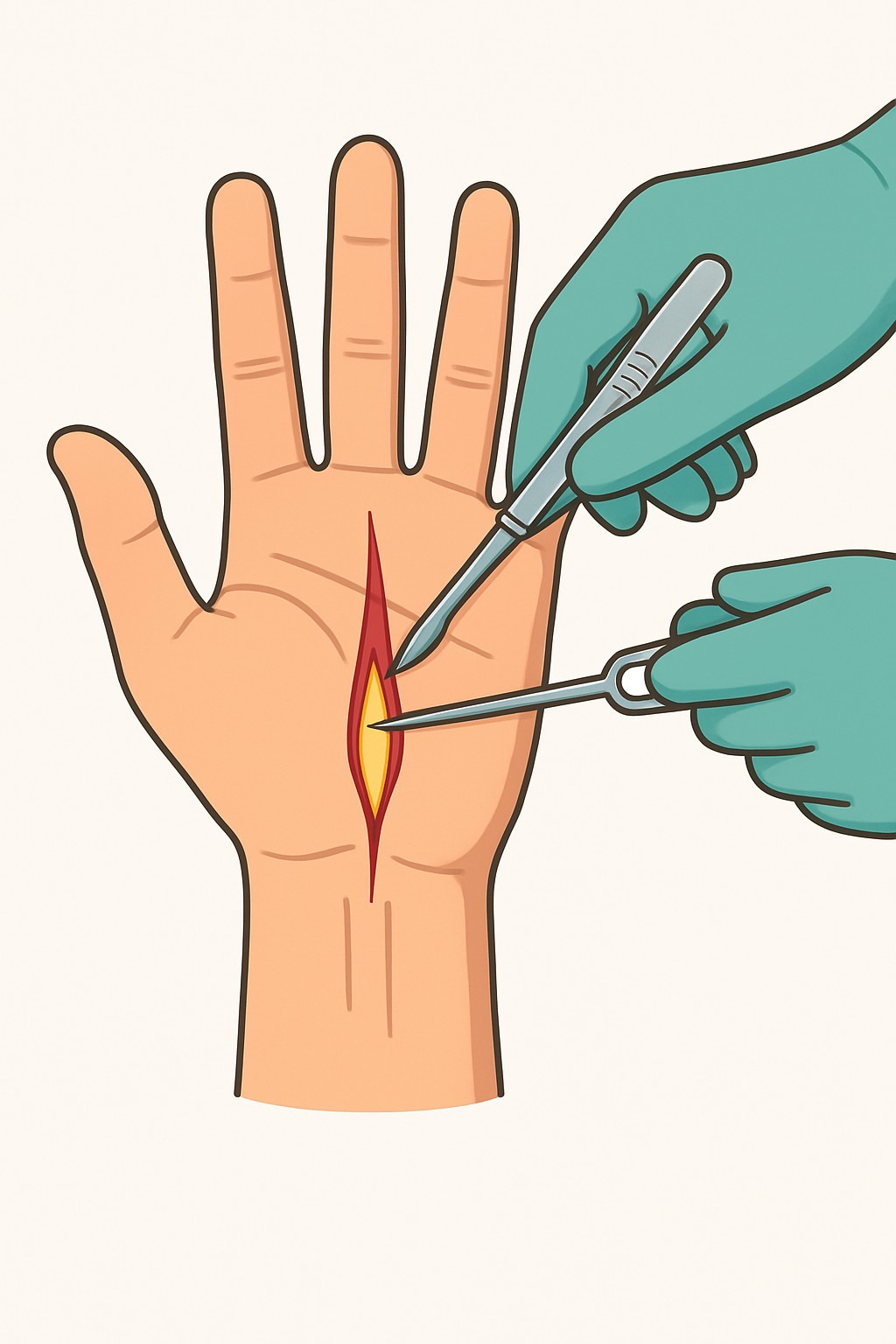
Carpal tunnel release is a surgery to relieve pressure on the median nerve in the wrist. The surgeon cuts the transverse carpal ligament to open the carpal tunnel and create more space for the nerve and tendons. It is usually done as an outpatient procedure using local anesthesia with or without sedation. Techniques include open surgery through a small palm incision or endoscopic surgery using a tiny camera and instruments.
Also known as: Carpal tunnel surgery, Carpal tunnel decompression, CTR
Preparation & Next Steps
Everything you need to know before and after your procedure
Before Care
- Confirm the diagnosis and discuss open versus endoscopic approaches with your surgical team
- Review current medicines, supplements, and allergies; ask if any should be adjusted before surgery
- Ask about fasting instructions if sedation is planned and confirm arrival time and location
- Arrange a ride home if sedation or regional anesthesia is planned
- Plan time off work based on job duties; desk work often returns sooner than heavy manual work
- Set up your home to limit heavy gripping and lifting for the first couple of weeks
- Prepare a clean, easy-to-remove dressing or bandage supplies if instructed
- Wear loose sleeves or clothing that can be rolled up without pressure on the wrist
- Complete any requested tests or paperwork such as consent forms or preoperative clearance
- Check insurance requirements for prior authorization and understand potential out-of-pocket costs
After Care
- Keep the dressing clean and dry as instructed and protect the incision from soaking until cleared
- Move fingers gently and often to reduce stiffness and swelling unless told otherwise
- Elevate the hand above heart level at intervals for the first few days to limit swelling
- Use cold packs wrapped in cloth for short periods if recommended for comfort
- Take pain medicines only as directed by your care team; avoid exceeding labeled doses
- Avoid heavy gripping, pushing, or lifting until your clinician says it is safe
- Follow instructions on splint or brace use if one was provided
- Watch for increased redness, warmth, drainage, fever, or worsening numbness and contact the clinic if these appear
- Attend follow-up visits for incision check and possible suture removal
- Ask your care team when you can drive safely, return to work, and resume sports or hobbies
Clinical Information
Important medical details about this procedure
Indications
- Carpal tunnel syndrome with numbness, tingling, or hand pain
- Night symptoms that wake you up
- Weakness or dropping objects
- Thenar muscle wasting
- Abnormal nerve conduction studies
- Symptoms that persist despite splinting or injections
Alternatives
- Wrist splinting, especially at night
- Activity and ergonomic changes
- Nonsteroidal anti-inflammatory medicines
- Corticosteroid injection into the carpal tunnel
- Hand therapy or occupational therapy
- Workstation and tool modifications
Risks
- Infection or poor wound healing
- Bleeding or hematoma
- Nerve or vessel injury
- Persistent or recurrent symptoms
- Scar tenderness or pillar pain near the incision
- Stiffness or reduced grip strength during recovery
- Complex regional pain syndrome
- Problems related to anesthesia
Contraindications
- Active infection at or near the surgical site
- Uncorrected bleeding disorder
- Inability to safely receive anesthesia or sedation
- Severe medical instability that makes outpatient surgery unsafe
Recovery Timeline
What to expect during your recovery
Most people have reduced night numbness soon after surgery, with soreness and hand weakness improving over weeks. Grip strength and full use often return gradually over 1 to 3 months, while nerve recovery can continue for longer.
Typical Range
14–90 days
Return to Work
7–56 days
Recovery Milestones
Elevate hand at intervals and perform gentle finger motion
Light daily activities with the operative hand as tolerated
Desk work or school tasks if pain is controlled and incision care is manageable
Suture removal and incision check per clinic schedule
Gradually increase gripping and lifting within comfort and guidance
Return to heavier manual work when cleared by the clinician
Resume most activities without restrictions as symptoms allow
Frequently Asked Questions
Common questions and expert answers about this procedure
What is the difference between open and endoscopic carpal tunnel release?
What is the difference between open and endoscopic carpal tunnel release?
Open uses a small palm incision; endoscopic uses a camera through one or two tiny incisions. Both cut the ligament to relieve pressure. Choice depends on anatomy, surgeon experience, and your goals.
Is this an outpatient procedure?
Is this an outpatient procedure?
Yes, most surgeries are done in an ambulatory center or hospital and you go home the same day.
What kind of anesthesia is used?
What kind of anesthesia is used?
Many cases use local anesthesia with or without light sedation. Some use regional blocks. General anesthesia is less common.
How soon will my symptoms improve?
How soon will my symptoms improve?
Night numbness often improves early. Tingling and weakness can take weeks, and nerve recovery may continue for months, especially if symptoms were severe or long-standing.
Will I need physical or hand therapy?
Will I need physical or hand therapy?
Some people benefit from supervised exercises to reduce stiffness and regain strength. Your care team may recommend home exercises, formal therapy, or both.
Can carpal tunnel syndrome come back after surgery?
Can carpal tunnel syndrome come back after surgery?
Recurrence is uncommon but possible. Scar tissue, incomplete release, or new wrist strain can contribute. Ongoing ergonomics and symptom awareness help reduce risk.
When can I drive again?
When can I drive again?
Driving is generally allowed when you can grip the wheel safely, react quickly, and are not taking sedating pain medicines. Ask your care team for timing based on your progress.
Will there be a scar and tenderness?
Will there be a scar and tenderness?
Yes, a small scar is expected. Some people have temporary pillar pain or sensitivity near the incision, which usually improves over time.