%20--%3e%3csvg%20version='1.0'%20id='Layer_1'%20xmlns='http://www.w3.org/2000/svg'%20xmlns:xlink='http://www.w3.org/1999/xlink'%20x='0px'%20y='0px'%20viewBox='0%200%20755.52%20814.35'%20style='enable-background:new%200%200%20755.52%20814.35;'%20xml:space='preserve'%3e%3cstyle%20type='text/css'%3e%20.st0{fill:%231ae5ce;stroke:%231ae5ce;stroke-width:7;stroke-miterlimit:10;}%20.st1{fill:%23FFFFFF;stroke:%231ae5ce;stroke-width:7;stroke-miterlimit:10;}%20.st2{fill:%231ae5ce;stroke:%23FFFFFF;stroke-width:7;stroke-miterlimit:10;}%20.st3{fill:%23FFFFFF;stroke:%23FFFFFF;stroke-width:6;stroke-miterlimit:10;}%20%3c/style%3e%3cg%20id='Dark_Logo_00000159431215648494653180000015900878925932721032_'%3e%3cpath%20id='shield_00000152259091539869183100000001926543869452564382_'%20class='st0'%20d='M711.13,173.42%20c-3.37-49.07-38.92-44.9-75.96-52.18c-67.4-13.25-130.47-34.47-192.36-63.92c-22.48-10.7-41.88-25.74-65.05-26.28%20c-23.17,0.54-42.58,15.59-65.05,26.28c-61.89,29.45-124.95,50.68-192.36,63.92c-37.04,7.28-72.59,3.11-75.96,52.18%20c-1.55,22.6,0.34,46.4,1.05,68.92c5.99,190.78,52.91,345.39,206.27,466.46c29.71,23.46,74.51,55.8,108.84,70.75%20c5.99,2.61,11.7,3.73,17.21,3.75c5.51-0.02,11.22-1.14,17.21-3.75c34.33-14.95,79.12-47.3,108.84-70.75%20c153.37-121.07,200.28-275.68,206.27-466.46C710.79,219.82,712.68,196.02,711.13,173.42z'/%3e%3cpath%20id='magnifyingglass_00000073685934697636024790000000342567780940956808_'%20class='st1'%20d='M648.78,624.21l-96.64-104.65%20c34.89-40.63,55.98-93.46,55.98-151.21c0-128.27-103.98-232.24-232.24-232.24S143.63,240.08,143.63,368.35%20s103.98,232.24,232.24,232.24c48.87,0,94.21-15.11,131.62-40.89l97.18,105.24c11.25,12.18,30.24,12.93,42.42,1.69l0,0%20C659.27,655.38,660.03,636.39,648.78,624.21z'/%3e%3ccircle%20id='ellipse_00000129904010550392394720000017056154833629780114_'%20class='st2'%20cx='375.87'%20cy='368.35'%20r='181.21'/%3e%3cpath%20id='dollarsign_00000057140127156649725250000003772530148495155891_'%20class='st3'%20d='M362.91,492.03v-23.91%20c0-2.01-1.58-3.69-3.59-3.77c-18.49-0.78-37.12-5.4-49.4-11.83c-1.75-0.92-2.53-3.01-1.76-4.84l5.87-13.89%20c0.86-2.02,3.23-2.88,5.2-1.89c12.94,6.52,30.45,11.44,49.18,11.44c26.02,0,43.6-12.73,43.6-30.43c0-17.08-14.29-27.63-41.4-36.95%20c-37.37-12.42-60.46-26.7-60.46-53.72c0-24.97,20.29-44.11,52.22-49.51c1.8-0.31,3.11-1.89,3.11-3.72v-24.35%20c0-2.09,1.69-3.78,3.78-3.78h15.16c2.09,0,3.78,1.69,3.78,3.78v22.71c0,2.01,1.58,3.67,3.58,3.77c17.85,0.92,30.88,4.75,40.61,9.1%20c1.92,0.86,2.79,3.09,1.94,5.01l-6.08,13.6c-0.85,1.91-3.09,2.77-4.99,1.91c-8.37-3.8-22.38-8.95-42.75-8.95%20c-28.21,0-38.84,14.28-38.84,26.7c0,16.15,13.56,24.22,45.44,35.4c37.74,13.04,56.79,29.19,56.79,56.82%20c0,23.85-19.05,46.23-54.78,52.3c-1.8,0.31-3.11,1.89-3.11,3.72v25.28c0,2.09-1.69,3.78-3.78,3.78h-15.53%20C364.6,495.81,362.91,494.12,362.91,492.03z'/%3e%3c/g%3e%3c/svg%3e)
Closed treatment of humerus fracture (no manipulation) Orthopedic Surgery
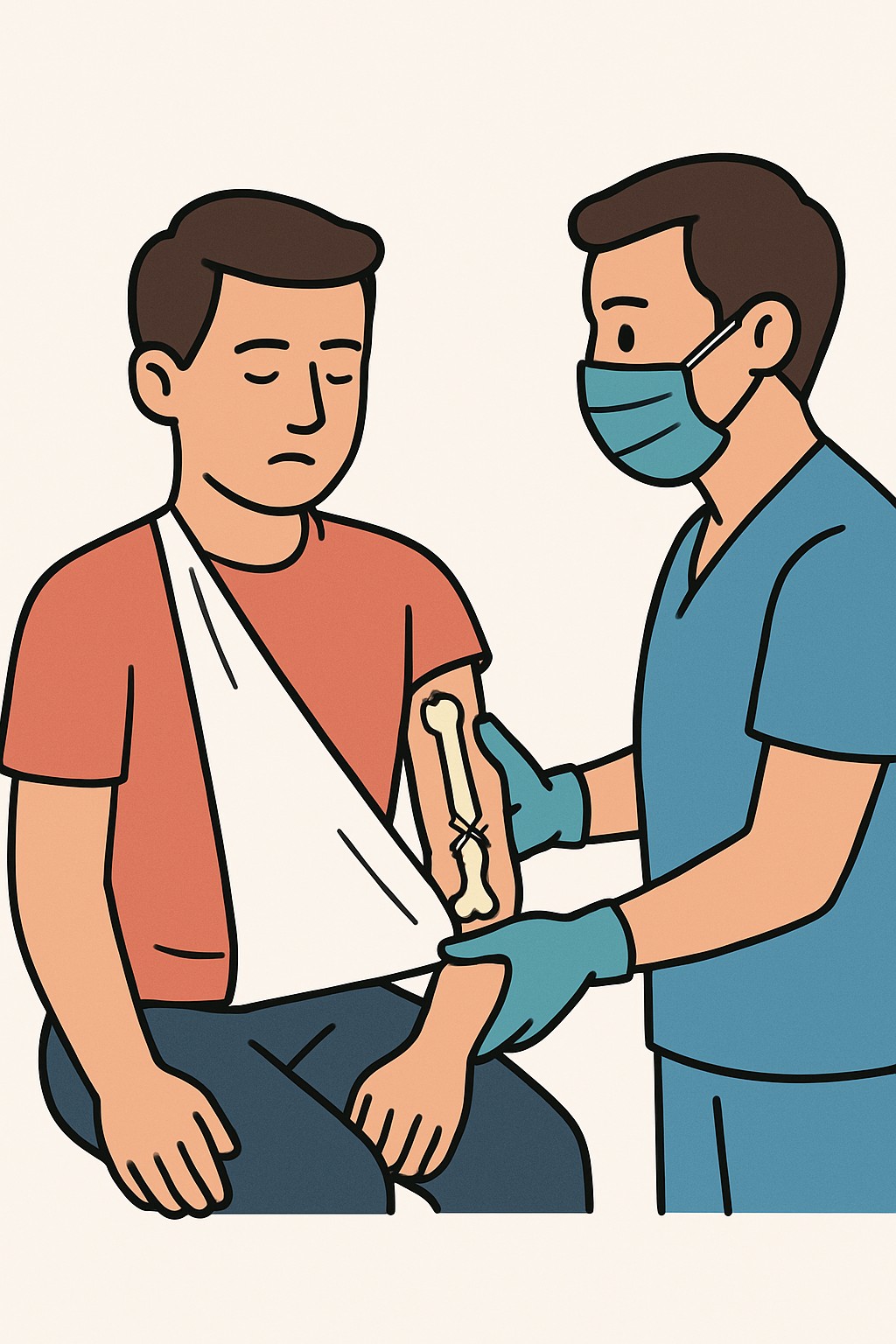
Closed treatment of a humerus fracture without manipulation means the bone is allowed to heal without surgery and without physically moving the broken pieces into a new position.
Overview
Closed treatment of a humerus fracture without manipulation means the bone is allowed to heal without surgery and without physically moving the broken pieces into a new position. The skin is not cut, and no instruments go into the body. Care usually includes a sling, splint, cast, or functional brace to support the arm while the bone heals. Follow-up visits and X-rays check that the bone stays aligned and healing progresses.
Also known as: Nonoperative humerus fracture care, Conservative treatment of humerus fracture, Sling or splint for humerus fracture
Preparation & Next Steps
Everything you need to know before and after your procedure
Before Care
- Bring prior X-rays or imaging reports if available, plus your ID and insurance card
- Wear a loose, short-sleeved or front-opening shirt to fit over a sling or splint
- Remove rings, watches, or bracelets from the injured arm to prevent constriction
- Carry an up-to-date list of your medicines and allergies
- Plan a ride; driving may not be safe with an injured arm or while on certain pain medicines
- Ask the clinic if new X-rays will be taken and allow extra time for imaging
- Avoid lotions or powders on the upper arm where a splint or brace may be placed
- Discuss work or activity needs so restrictions can be documented for your employer or school
After Care
- Use the sling, splint, cast, or brace as instructed to protect the fracture
- Keep the immobilized area clean and dry; cover it during bathing to avoid moisture
- Elevate the arm and apply ice wrapped in a cloth for short periods to reduce swelling
- Gently move fingers, wrist, and elbow that are not immobilized to limit stiffness
- Do not lift, push, or pull with the injured arm until cleared by your care team
- Check skin daily around the edges of the splint or cast for redness or sores
- Follow the prescribed plan for pain medicines and avoid mixing with alcohol
- Attend all follow-up visits; repeat X-rays are often done to confirm healing and alignment
- Ask about when to begin range-of-motion and strengthening exercises
- Contact a clinician for increasing pain, numbness or tingling, pale or blue fingers, fever, a loose or tight cast, or new drainage or odor
Clinical Information
Important medical details about this procedure
Indications
- Nondisplaced or minimally displaced humerus fracture
- Stable fracture pattern on X-ray
- Swelling and pain after a fall or direct blow to the upper arm
- Patients for whom surgery is not required or not preferred
Alternatives
- Closed reduction with casting or splinting (if alignment needs correction)
- Surgical fixation (plates and screws or intramedullary nail)
- Functional bracing with early motion
- Pain management and physical therapy during and after immobilization
Risks
- Loss of alignment with need for reduction or surgery
- Delayed union or nonunion (bone heals slowly or does not heal)
- Malunion (heals in less than ideal position)
- Stiffness in the shoulder, elbow, or wrist
- Skin irritation or pressure sores under a cast or splint
- Nerve irritation, including radial nerve symptoms
- Blood clots or complex regional pain syndrome (uncommon)
Contraindications
- Open fracture or severe soft tissue injury
- Fracture with poor alignment or instability on imaging
- Neurovascular compromise that needs urgent intervention
- Fracture-dislocation or multiple injuries needing operative stabilization
- Failure of nonoperative care during follow-up
Recovery Timeline
What to expect during your recovery
Bone healing often takes several weeks. Many humerus fractures managed without manipulation heal over about 6 to 12 weeks, with motion and strength building gradually over time.
Typical Range
42–84 days
Return to Work
Same day
Recovery Milestones
Use sling or splint; control swelling; move fingers to prevent stiffness
Begin gentle motion of nearby joints that are not immobilized as allowed
Gradually increase arm and shoulder or elbow motion per follow-up guidance
Progress light daily use and start gentle strengthening when approved
Advance activities as comfort and healing allow
Frequently Asked Questions
Common questions and expert answers about this procedure
What does closed treatment without manipulation mean?
What does closed treatment without manipulation mean?
The bone is supported with a sling, splint, cast, or brace and monitored as it heals. No surgery is done and the bone is not manually repositioned.
How is the arm supported?
How is the arm supported?
Depending on the fracture location and stability, a sling, splint, cast, or functional brace may be used to keep the bone aligned while it heals.
Will I need follow-up X-rays?
Will I need follow-up X-rays?
Yes. Follow-up visits commonly include X-rays to check alignment and healing progress.
How long will I wear a sling or brace?
How long will I wear a sling or brace?
Support devices are often used for several weeks. The exact duration depends on fracture type, healing on X-rays, and comfort.
When can I start moving the arm?
When can I start moving the arm?
Gentle motion of joints not immobilized usually starts early. Shoulder or elbow motion begins when the fracture is stable enough on exam and X-rays.
Could the bone heal in a less than ideal position?
Could the bone heal in a less than ideal position?
It can. Some alignment changes are acceptable and still function well, but significant shifts may need reduction or surgery.
What happens if the bone does not heal?
What happens if the bone does not heal?
If X-rays show delayed healing or nonunion, options may include continued protection, bone stimulation, or surgery, depending on the case.
Is this approach right for all humerus fractures?
Is this approach right for all humerus fractures?
No. Open fractures, unstable patterns, or injuries with nerve or blood vessel problems often need reduction or surgical fixation.
References
Medical literature and sources