%20--%3e%3csvg%20version='1.0'%20id='Layer_1'%20xmlns='http://www.w3.org/2000/svg'%20xmlns:xlink='http://www.w3.org/1999/xlink'%20x='0px'%20y='0px'%20viewBox='0%200%20755.52%20814.35'%20style='enable-background:new%200%200%20755.52%20814.35;'%20xml:space='preserve'%3e%3cstyle%20type='text/css'%3e%20.st0{fill:%231ae5ce;stroke:%231ae5ce;stroke-width:7;stroke-miterlimit:10;}%20.st1{fill:%23FFFFFF;stroke:%231ae5ce;stroke-width:7;stroke-miterlimit:10;}%20.st2{fill:%231ae5ce;stroke:%23FFFFFF;stroke-width:7;stroke-miterlimit:10;}%20.st3{fill:%23FFFFFF;stroke:%23FFFFFF;stroke-width:6;stroke-miterlimit:10;}%20%3c/style%3e%3cg%20id='Dark_Logo_00000159431215648494653180000015900878925932721032_'%3e%3cpath%20id='shield_00000152259091539869183100000001926543869452564382_'%20class='st0'%20d='M711.13,173.42%20c-3.37-49.07-38.92-44.9-75.96-52.18c-67.4-13.25-130.47-34.47-192.36-63.92c-22.48-10.7-41.88-25.74-65.05-26.28%20c-23.17,0.54-42.58,15.59-65.05,26.28c-61.89,29.45-124.95,50.68-192.36,63.92c-37.04,7.28-72.59,3.11-75.96,52.18%20c-1.55,22.6,0.34,46.4,1.05,68.92c5.99,190.78,52.91,345.39,206.27,466.46c29.71,23.46,74.51,55.8,108.84,70.75%20c5.99,2.61,11.7,3.73,17.21,3.75c5.51-0.02,11.22-1.14,17.21-3.75c34.33-14.95,79.12-47.3,108.84-70.75%20c153.37-121.07,200.28-275.68,206.27-466.46C710.79,219.82,712.68,196.02,711.13,173.42z'/%3e%3cpath%20id='magnifyingglass_00000073685934697636024790000000342567780940956808_'%20class='st1'%20d='M648.78,624.21l-96.64-104.65%20c34.89-40.63,55.98-93.46,55.98-151.21c0-128.27-103.98-232.24-232.24-232.24S143.63,240.08,143.63,368.35%20s103.98,232.24,232.24,232.24c48.87,0,94.21-15.11,131.62-40.89l97.18,105.24c11.25,12.18,30.24,12.93,42.42,1.69l0,0%20C659.27,655.38,660.03,636.39,648.78,624.21z'/%3e%3ccircle%20id='ellipse_00000129904010550392394720000017056154833629780114_'%20class='st2'%20cx='375.87'%20cy='368.35'%20r='181.21'/%3e%3cpath%20id='dollarsign_00000057140127156649725250000003772530148495155891_'%20class='st3'%20d='M362.91,492.03v-23.91%20c0-2.01-1.58-3.69-3.59-3.77c-18.49-0.78-37.12-5.4-49.4-11.83c-1.75-0.92-2.53-3.01-1.76-4.84l5.87-13.89%20c0.86-2.02,3.23-2.88,5.2-1.89c12.94,6.52,30.45,11.44,49.18,11.44c26.02,0,43.6-12.73,43.6-30.43c0-17.08-14.29-27.63-41.4-36.95%20c-37.37-12.42-60.46-26.7-60.46-53.72c0-24.97,20.29-44.11,52.22-49.51c1.8-0.31,3.11-1.89,3.11-3.72v-24.35%20c0-2.09,1.69-3.78,3.78-3.78h15.16c2.09,0,3.78,1.69,3.78,3.78v22.71c0,2.01,1.58,3.67,3.58,3.77c17.85,0.92,30.88,4.75,40.61,9.1%20c1.92,0.86,2.79,3.09,1.94,5.01l-6.08,13.6c-0.85,1.91-3.09,2.77-4.99,1.91c-8.37-3.8-22.38-8.95-42.75-8.95%20c-28.21,0-38.84,14.28-38.84,26.7c0,16.15,13.56,24.22,45.44,35.4c37.74,13.04,56.79,29.19,56.79,56.82%20c0,23.85-19.05,46.23-54.78,52.3c-1.8,0.31-3.11,1.89-3.11,3.72v25.28c0,2.09-1.69,3.78-3.78,3.78h-15.53%20C364.6,495.81,362.91,494.12,362.91,492.03z'/%3e%3c/g%3e%3c/svg%3e)
Hardware removal (deep implant) Orthopedic Surgery
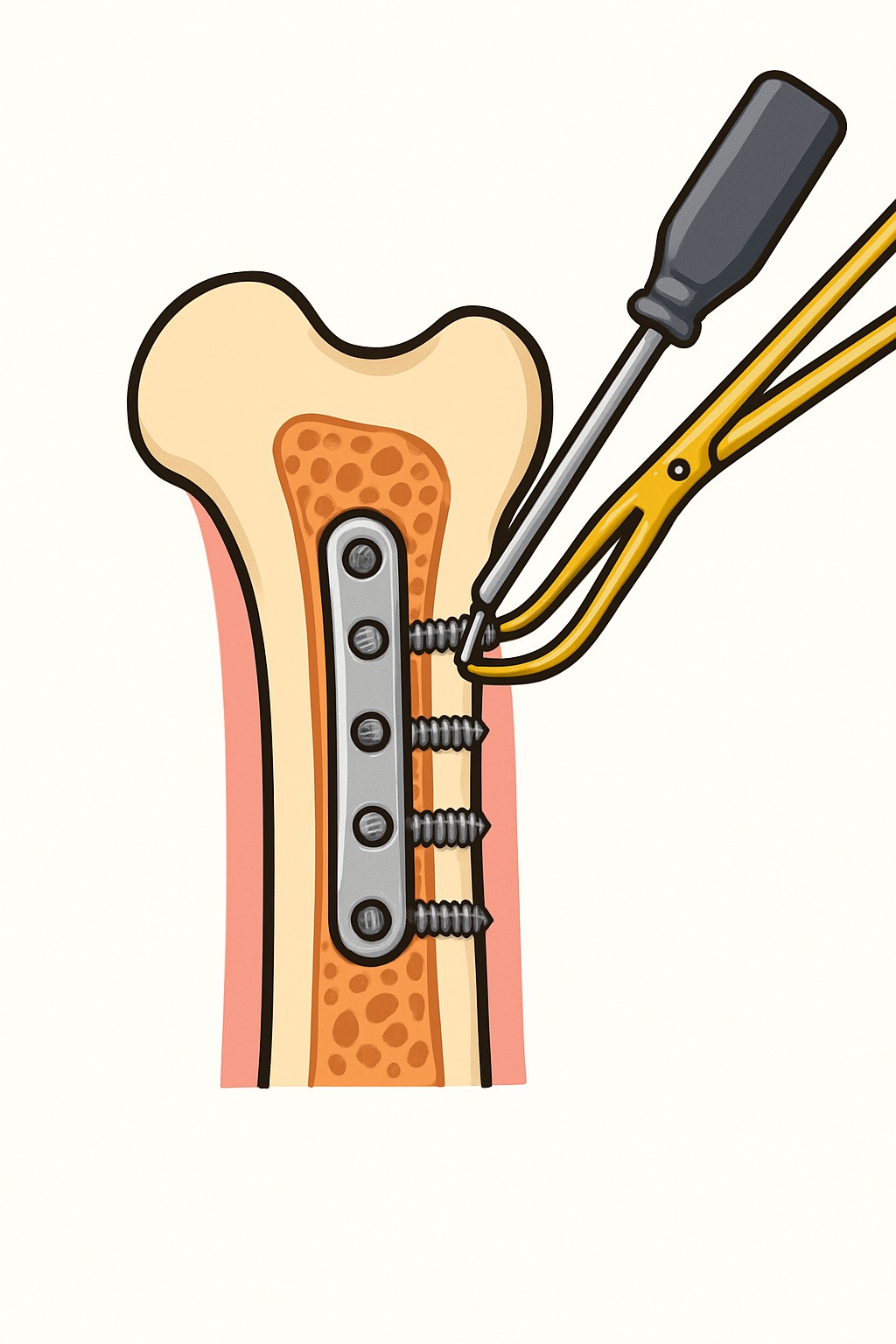
Hardware removal (deep implant) is a surgical procedure to take out metal devices that were placed deep in the body, such as plates, screws, rods, or wires used to stabilize bones.
Overview
Hardware removal (deep implant) is a surgical procedure to take out metal devices that were placed deep in the body, such as plates, screws, rods, or wires used to stabilize bones. The surgery is done through an incision over the prior surgical site, often using X-ray guidance to locate the implants. People may have hardware removed when it causes pain, irritation, or soft-tissue problems, if there is infection, if the implant has broken, or when the bone has healed and the hardware is no longer needed. Recovery is usually shorter than the original operation, but activity limits may be advised while tissues and bone adjust after removal.
Also known as: Orthopedic hardware removal, Deep implant removal, Implant removal surgery
Preparation & Next Steps
Everything you need to know before and after your procedure
Before Care
- Confirm the surgical plan and which implants are being removed; bring prior operative notes or implant cards if available
- Complete any requested imaging (such as X-rays) so the team can locate hardware and plan the approach
- Provide a current list of all medicines and supplements, and review blood thinners, diabetes medicines, and allergies with the surgical team
- Follow anesthesia instructions about when to stop eating and drinking before surgery
- Arrange a responsible adult for transportation home and help the first 24 hours if outpatient
- Set up your home with basic supplies, a clean place to rest, and a safe path to move around
- Do not apply lotions or shaving to the surgical area unless instructed; plan to wear loose clothing that fits over dressings
- Ask the team how dressings, bathing, weight bearing, and work restrictions will be handled after surgery
After Care
- Keep the incision clean and dry as instructed; change dressings only as directed
- Take pain medicines only as prescribed or recommended by your care team; avoid non-prescribed dose changes
- Elevate the limb and use ice packs as instructed to reduce swelling
- Follow guidance about weight bearing and range of motion; start gentle movement when allowed to reduce stiffness
- Inspect the incision daily for increasing redness, warmth, swelling, drainage, or opening
- Call a clinician for fever, chills, severe or worsening pain, numbness, color changes, or trouble moving the limb
- Watch for signs of blood clots such as new calf pain or swelling, and for chest pain or shortness of breath; contact a clinician promptly
- Attend scheduled follow-up visits and any recommended imaging to confirm healing
- Keep a simple log of pain levels, mobility, and any concerns to discuss at follow-up
- Avoid soaking the incision (baths, pools, hot tubs) until it is fully healed and you are cleared
Clinical Information
Important medical details about this procedure
Indications
- Pain or irritation from hardware after bone healing
- Prominent or palpable hardware causing discomfort
- Infection involving the implant
- Implant failure such as loosening or breakage
- Tendon or soft-tissue irritation from hardware position
- Need for access to the area for another procedure
Alternatives
- Observation and monitoring without surgery
- Physical therapy and activity modification
- Protective padding or braces for irritation points
- Medicines for pain and inflammation
- Image-guided injections for soft-tissue symptoms
Risks
- Infection at the surgical site
- Bleeding or blood clots
- Nerve or vessel injury
- Fracture during or after removal
- Scar tissue and stiffness
- Incomplete removal if parts are difficult to extract
- Anesthesia-related risks
Contraindications
- Bone not fully healed or implant still needed for stability
- Poor skin or soft-tissue condition over the site
- Uncontrolled medical conditions that increase surgical risk
Recovery Timeline
What to expect during your recovery
Most people notice improvement within days, with soreness and swelling decreasing over 1 to 2 weeks. Activity often increases over several weeks while soft tissues and bone adapt after removal.
Typical Range
14–56 days
Return to Work
7–21 days
Recovery Milestones
Protect incision, elevate limb, and manage swelling and pain
Light daily activities; gentle range of motion as allowed
Return to desk work if approved; continue walking and basic tasks
Gradually increase activity; avoid high-impact loads until cleared
Resume higher-demand activities when your clinician confirms it is safe
Frequently Asked Questions
Common questions and expert answers about this procedure
Is hardware always removed after bones heal?
Is hardware always removed after bones heal?
No. Many implants can safely stay in place. Removal is considered for symptoms, infection, implant problems, or specific needs.
What kind of anesthesia is used?
What kind of anesthesia is used?
Hardware removal is often done with general anesthesia. Some cases may use regional anesthesia with sedation, depending on the site and plan.
Will removal weaken my bone?
Will removal weaken my bone?
Bone holes left by screws and hardware can temporarily reduce bone strength. Activity limits are often recommended for a period after surgery.
Can all hardware be removed?
Can all hardware be removed?
Often yes, but scar tissue or stripped or broken parts can make removal difficult. Sometimes a small piece may be left if removing it would cause harm.
How long is the surgery and do I go home the same day?
How long is the surgery and do I go home the same day?
Time varies by location and number of implants. Many people go home the same day, but some stay overnight based on recovery and medical needs.
Will I have a new scar?
Will I have a new scar?
The surgeon usually reuses or extends the prior incision. There will be a scar that tends to fade over time.
What problems should I watch for after surgery?
What problems should I watch for after surgery?
Increasing redness, swelling, drainage, fever, severe pain, numbness, or new calf swelling or chest pain are reasons to contact a clinician.
Do metal detectors still go off after removal?
Do metal detectors still go off after removal?
If all hardware is removed, detectors are less likely to alarm. If some metal remains, alarms are still possible.
References
Medical literature and sources