%20--%3e%3csvg%20version='1.0'%20id='Layer_1'%20xmlns='http://www.w3.org/2000/svg'%20xmlns:xlink='http://www.w3.org/1999/xlink'%20x='0px'%20y='0px'%20viewBox='0%200%20755.52%20814.35'%20style='enable-background:new%200%200%20755.52%20814.35;'%20xml:space='preserve'%3e%3cstyle%20type='text/css'%3e%20.st0{fill:%231ae5ce;stroke:%231ae5ce;stroke-width:7;stroke-miterlimit:10;}%20.st1{fill:%23FFFFFF;stroke:%231ae5ce;stroke-width:7;stroke-miterlimit:10;}%20.st2{fill:%231ae5ce;stroke:%23FFFFFF;stroke-width:7;stroke-miterlimit:10;}%20.st3{fill:%23FFFFFF;stroke:%23FFFFFF;stroke-width:6;stroke-miterlimit:10;}%20%3c/style%3e%3cg%20id='Dark_Logo_00000159431215648494653180000015900878925932721032_'%3e%3cpath%20id='shield_00000152259091539869183100000001926543869452564382_'%20class='st0'%20d='M711.13,173.42%20c-3.37-49.07-38.92-44.9-75.96-52.18c-67.4-13.25-130.47-34.47-192.36-63.92c-22.48-10.7-41.88-25.74-65.05-26.28%20c-23.17,0.54-42.58,15.59-65.05,26.28c-61.89,29.45-124.95,50.68-192.36,63.92c-37.04,7.28-72.59,3.11-75.96,52.18%20c-1.55,22.6,0.34,46.4,1.05,68.92c5.99,190.78,52.91,345.39,206.27,466.46c29.71,23.46,74.51,55.8,108.84,70.75%20c5.99,2.61,11.7,3.73,17.21,3.75c5.51-0.02,11.22-1.14,17.21-3.75c34.33-14.95,79.12-47.3,108.84-70.75%20c153.37-121.07,200.28-275.68,206.27-466.46C710.79,219.82,712.68,196.02,711.13,173.42z'/%3e%3cpath%20id='magnifyingglass_00000073685934697636024790000000342567780940956808_'%20class='st1'%20d='M648.78,624.21l-96.64-104.65%20c34.89-40.63,55.98-93.46,55.98-151.21c0-128.27-103.98-232.24-232.24-232.24S143.63,240.08,143.63,368.35%20s103.98,232.24,232.24,232.24c48.87,0,94.21-15.11,131.62-40.89l97.18,105.24c11.25,12.18,30.24,12.93,42.42,1.69l0,0%20C659.27,655.38,660.03,636.39,648.78,624.21z'/%3e%3ccircle%20id='ellipse_00000129904010550392394720000017056154833629780114_'%20class='st2'%20cx='375.87'%20cy='368.35'%20r='181.21'/%3e%3cpath%20id='dollarsign_00000057140127156649725250000003772530148495155891_'%20class='st3'%20d='M362.91,492.03v-23.91%20c0-2.01-1.58-3.69-3.59-3.77c-18.49-0.78-37.12-5.4-49.4-11.83c-1.75-0.92-2.53-3.01-1.76-4.84l5.87-13.89%20c0.86-2.02,3.23-2.88,5.2-1.89c12.94,6.52,30.45,11.44,49.18,11.44c26.02,0,43.6-12.73,43.6-30.43c0-17.08-14.29-27.63-41.4-36.95%20c-37.37-12.42-60.46-26.7-60.46-53.72c0-24.97,20.29-44.11,52.22-49.51c1.8-0.31,3.11-1.89,3.11-3.72v-24.35%20c0-2.09,1.69-3.78,3.78-3.78h15.16c2.09,0,3.78,1.69,3.78,3.78v22.71c0,2.01,1.58,3.67,3.58,3.77c17.85,0.92,30.88,4.75,40.61,9.1%20c1.92,0.86,2.79,3.09,1.94,5.01l-6.08,13.6c-0.85,1.91-3.09,2.77-4.99,1.91c-8.37-3.8-22.38-8.95-42.75-8.95%20c-28.21,0-38.84,14.28-38.84,26.7c0,16.15,13.56,24.22,45.44,35.4c37.74,13.04,56.79,29.19,56.79,56.82%20c0,23.85-19.05,46.23-54.78,52.3c-1.8,0.31-3.11,1.89-3.11,3.72v25.28c0,2.09-1.69,3.78-3.78,3.78h-15.53%20C364.6,495.81,362.91,494.12,362.91,492.03z'/%3e%3c/g%3e%3c/svg%3e)
Hardware removal surgery (removal of implanted plate/rod) Orthopedic Surgery
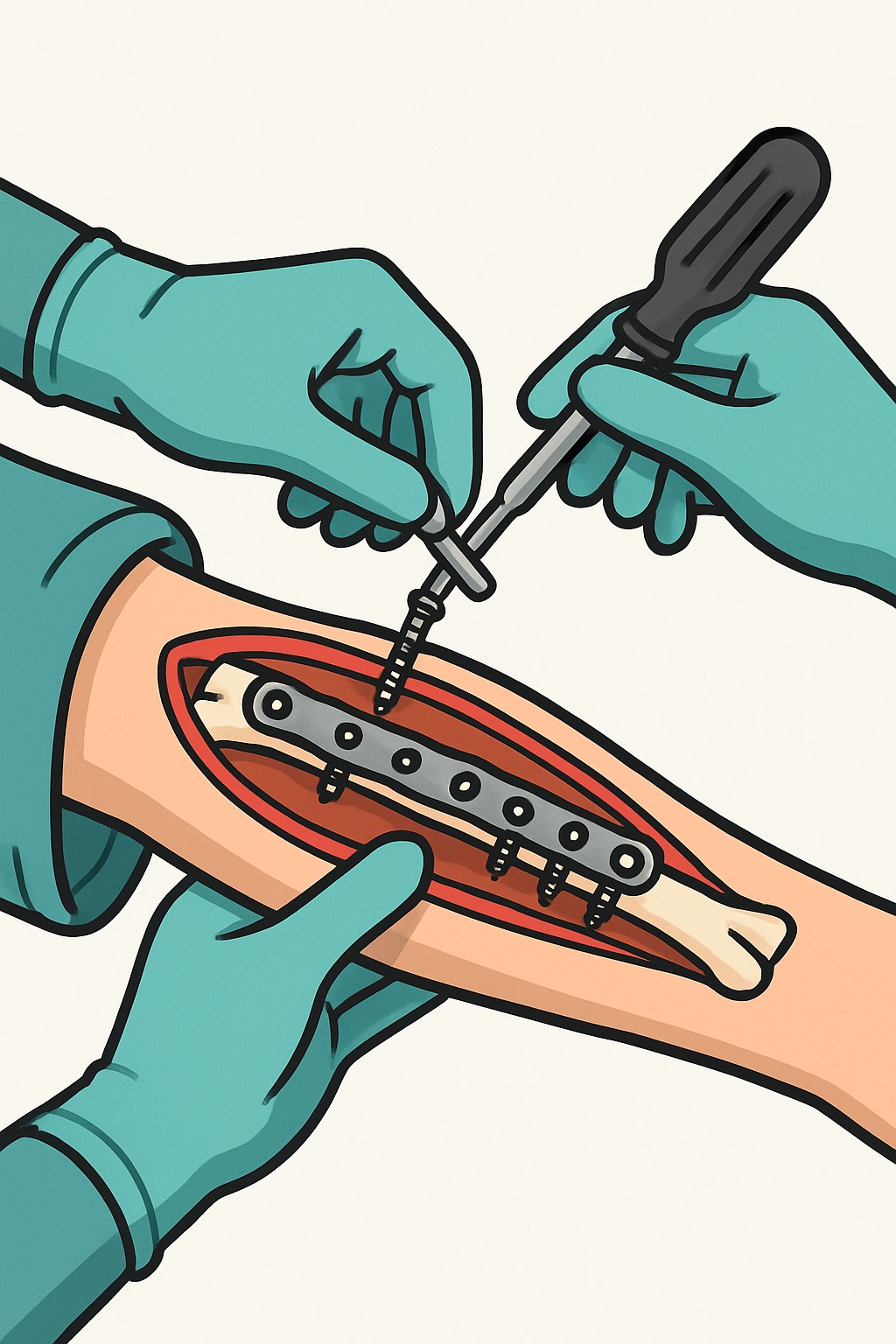
Hardware removal surgery is an operation to take out metal implants such as plates, screws, rods, or wires that were placed to hold bones or joints in position.
Overview
Hardware removal surgery is an operation to take out metal implants such as plates, screws, rods, or wires that were placed to hold bones or joints in position. The surgeon reopens the prior incision, finds each piece of hardware, and removes it, often using live X-ray imaging for guidance. This procedure is done when hardware causes problems like pain, irritation, infection, broken parts, or when it is no longer needed for bone stability. In some cases, removal is considered for children as they grow or to allow a future procedure in the same area. Not all implants need to be removed.
Also known as: Orthopedic hardware removal, Implant removal, Plate removal, Rod removal, Screw removal
Preparation & Next Steps
Everything you need to know before and after your procedure
Before Care
- Confirm imaging has been done to show the location and type of hardware; bring any implant card or prior operative notes if available
- Share all medicines and supplements you take, including blood thinners and over-the-counter products
- Discuss allergies, especially to metals like nickel, chromium, or cobalt
- Complete any requested pre-op labs, imaging, or medical clearance appointments
- Ask about fasting instructions and which medicines to take the morning of surgery
- Arrange a ride home and help at home for the first day as needed
- Plan time off work and any needed paperwork for job or school
- Prepare your home by setting up a resting area, ice packs, and clear walking paths
- Bring comfortable, loose clothing that fits over the bandage or splint
- Check insurance authorization and ask the facility how billing is handled for the surgeon, facility, and anesthesia
After Care
- Keep the incision dressing clean and dry until you receive instructions on changing or removing it
- Use pain control methods as directed by your care team; many people also use rest, elevation, and ice
- Move the limb gently within comfort and any activity limits provided at discharge
- Protect the limb from heavy impact or twisting until the bone around former screw holes regains strength
- Walk with an assistive device (such as crutches) if provided and shown how to use it
- Resume showering only when cleared; avoid soaking the incision until healed
- Do not drive until you can safely control the vehicle and are not taking sedating pain medicines
- Attend follow-up visits for wound check and possible stitch removal
- Contact a clinician if you notice increasing redness, warmth, swelling, drainage, fever, numbness, or pain that is not improving
- Ask when to restart exercise, sports, or heavy work activities based on healing
Clinical Information
Important medical details about this procedure
Indications
- Pain or irritation from prominent hardware
- Tendon or nerve irritation near the implant
- Infection involving hardware
- Allergy or sensitivity to metal components
- Broken or loosened hardware
- Implant interfering with planned future surgery
- Planned removal after healing in certain pediatric cases
Alternatives
- Observation and watchful waiting
- Physical therapy or activity modification
- Padding, bracing, or shoe/orthotic adjustments for prominence
- Medicines or injections for pain and inflammation
- Treating infection with antibiotics and surgical cleaning while retaining hardware when appropriate
- Hardware revision or replacement instead of complete removal
Risks
- Bleeding or infection
- Injury to nerves, blood vessels, or tendons
- Fracture during or after removal, especially around screw holes
- Scar tissue and stiffness
- Pain not fully relieved or symptoms returning
- Anesthesia-related risks
- Need for additional surgery
Contraindications
- Fracture or fusion not yet healed where hardware still provides stability
- Poor overall medical condition or high anesthesia risk
- Severely fragile bone where removal could cause fracture
- Compromised skin or soft tissue coverage over the site
Recovery Timeline
What to expect during your recovery
Recovery varies with the location and amount of hardware removed. Many cases are outpatient with return to light daily tasks within days, while higher-impact activities may wait several weeks until the bone is stronger.
Typical Range
Same day
Return to Work
Same day
Recovery Milestones
Go home the same day in many cases after recovery room monitoring
Elevate the limb and use ice to reduce swelling as instructed
Walk short distances and do gentle movements within comfort
Increase routine activities as cleared by your care team
Consider higher-impact exercise or heavy labor once bone strength has returned and you are cleared
Frequently Asked Questions
Common questions and expert answers about this procedure
What is hardware removal surgery?
What is hardware removal surgery?
It is an operation to take out metal implants such as plates, screws, rods, or wires that were placed in a prior procedure to support bones or joints.
How is the surgery performed?
How is the surgery performed?
The surgeon reopens the old incision, locates each implant, and removes it using special tools, often with live X-ray guidance. The wound is cleaned and closed.
Is removal always necessary?
Is removal always necessary?
No. Many implants can stay in place without causing problems. Removal is considered when there is pain, irritation, infection, broken hardware, or a future surgery planned.
Will my bone be weaker after removal?
Will my bone be weaker after removal?
Bone around former screw holes can be temporarily weaker. Activity is often limited for several weeks while the holes fill in and strength improves.
What type of anesthesia is used?
What type of anesthesia is used?
General anesthesia or regional anesthesia (numbing the limb) is commonly used. Many procedures are done as day surgery.
Will all the hardware be taken out?
Will all the hardware be taken out?
Usually the goal is to remove the parts causing problems. Some pieces may be left if removal would be risky or if they are deeply embedded.
How long is the recovery?
How long is the recovery?
Recovery depends on the body part and amount of hardware removed. Light activities may resume within days, while higher-impact tasks can take weeks.
What are the main risks?
What are the main risks?
Risks include infection, bleeding, nerve or vessel injury, fracture during or after removal, stiffness, and pain that may not fully resolve.
References
Medical literature and sources