%20--%3e%3csvg%20version='1.0'%20id='Layer_1'%20xmlns='http://www.w3.org/2000/svg'%20xmlns:xlink='http://www.w3.org/1999/xlink'%20x='0px'%20y='0px'%20viewBox='0%200%20755.52%20814.35'%20style='enable-background:new%200%200%20755.52%20814.35;'%20xml:space='preserve'%3e%3cstyle%20type='text/css'%3e%20.st0{fill:%231ae5ce;stroke:%231ae5ce;stroke-width:7;stroke-miterlimit:10;}%20.st1{fill:%23FFFFFF;stroke:%231ae5ce;stroke-width:7;stroke-miterlimit:10;}%20.st2{fill:%231ae5ce;stroke:%23FFFFFF;stroke-width:7;stroke-miterlimit:10;}%20.st3{fill:%23FFFFFF;stroke:%23FFFFFF;stroke-width:6;stroke-miterlimit:10;}%20%3c/style%3e%3cg%20id='Dark_Logo_00000159431215648494653180000015900878925932721032_'%3e%3cpath%20id='shield_00000152259091539869183100000001926543869452564382_'%20class='st0'%20d='M711.13,173.42%20c-3.37-49.07-38.92-44.9-75.96-52.18c-67.4-13.25-130.47-34.47-192.36-63.92c-22.48-10.7-41.88-25.74-65.05-26.28%20c-23.17,0.54-42.58,15.59-65.05,26.28c-61.89,29.45-124.95,50.68-192.36,63.92c-37.04,7.28-72.59,3.11-75.96,52.18%20c-1.55,22.6,0.34,46.4,1.05,68.92c5.99,190.78,52.91,345.39,206.27,466.46c29.71,23.46,74.51,55.8,108.84,70.75%20c5.99,2.61,11.7,3.73,17.21,3.75c5.51-0.02,11.22-1.14,17.21-3.75c34.33-14.95,79.12-47.3,108.84-70.75%20c153.37-121.07,200.28-275.68,206.27-466.46C710.79,219.82,712.68,196.02,711.13,173.42z'/%3e%3cpath%20id='magnifyingglass_00000073685934697636024790000000342567780940956808_'%20class='st1'%20d='M648.78,624.21l-96.64-104.65%20c34.89-40.63,55.98-93.46,55.98-151.21c0-128.27-103.98-232.24-232.24-232.24S143.63,240.08,143.63,368.35%20s103.98,232.24,232.24,232.24c48.87,0,94.21-15.11,131.62-40.89l97.18,105.24c11.25,12.18,30.24,12.93,42.42,1.69l0,0%20C659.27,655.38,660.03,636.39,648.78,624.21z'/%3e%3ccircle%20id='ellipse_00000129904010550392394720000017056154833629780114_'%20class='st2'%20cx='375.87'%20cy='368.35'%20r='181.21'/%3e%3cpath%20id='dollarsign_00000057140127156649725250000003772530148495155891_'%20class='st3'%20d='M362.91,492.03v-23.91%20c0-2.01-1.58-3.69-3.59-3.77c-18.49-0.78-37.12-5.4-49.4-11.83c-1.75-0.92-2.53-3.01-1.76-4.84l5.87-13.89%20c0.86-2.02,3.23-2.88,5.2-1.89c12.94,6.52,30.45,11.44,49.18,11.44c26.02,0,43.6-12.73,43.6-30.43c0-17.08-14.29-27.63-41.4-36.95%20c-37.37-12.42-60.46-26.7-60.46-53.72c0-24.97,20.29-44.11,52.22-49.51c1.8-0.31,3.11-1.89,3.11-3.72v-24.35%20c0-2.09,1.69-3.78,3.78-3.78h15.16c2.09,0,3.78,1.69,3.78,3.78v22.71c0,2.01,1.58,3.67,3.58,3.77c17.85,0.92,30.88,4.75,40.61,9.1%20c1.92,0.86,2.79,3.09,1.94,5.01l-6.08,13.6c-0.85,1.91-3.09,2.77-4.99,1.91c-8.37-3.8-22.38-8.95-42.75-8.95%20c-28.21,0-38.84,14.28-38.84,26.7c0,16.15,13.56,24.22,45.44,35.4c37.74,13.04,56.79,29.19,56.79,56.82%20c0,23.85-19.05,46.23-54.78,52.3c-1.8,0.31-3.11,1.89-3.11,3.72v25.28c0,2.09-1.69,3.78-3.78,3.78h-15.53%20C364.6,495.81,362.91,494.12,362.91,492.03z'/%3e%3c/g%3e%3c/svg%3e)
Hip Revision Surgery Orthopedic Surgery
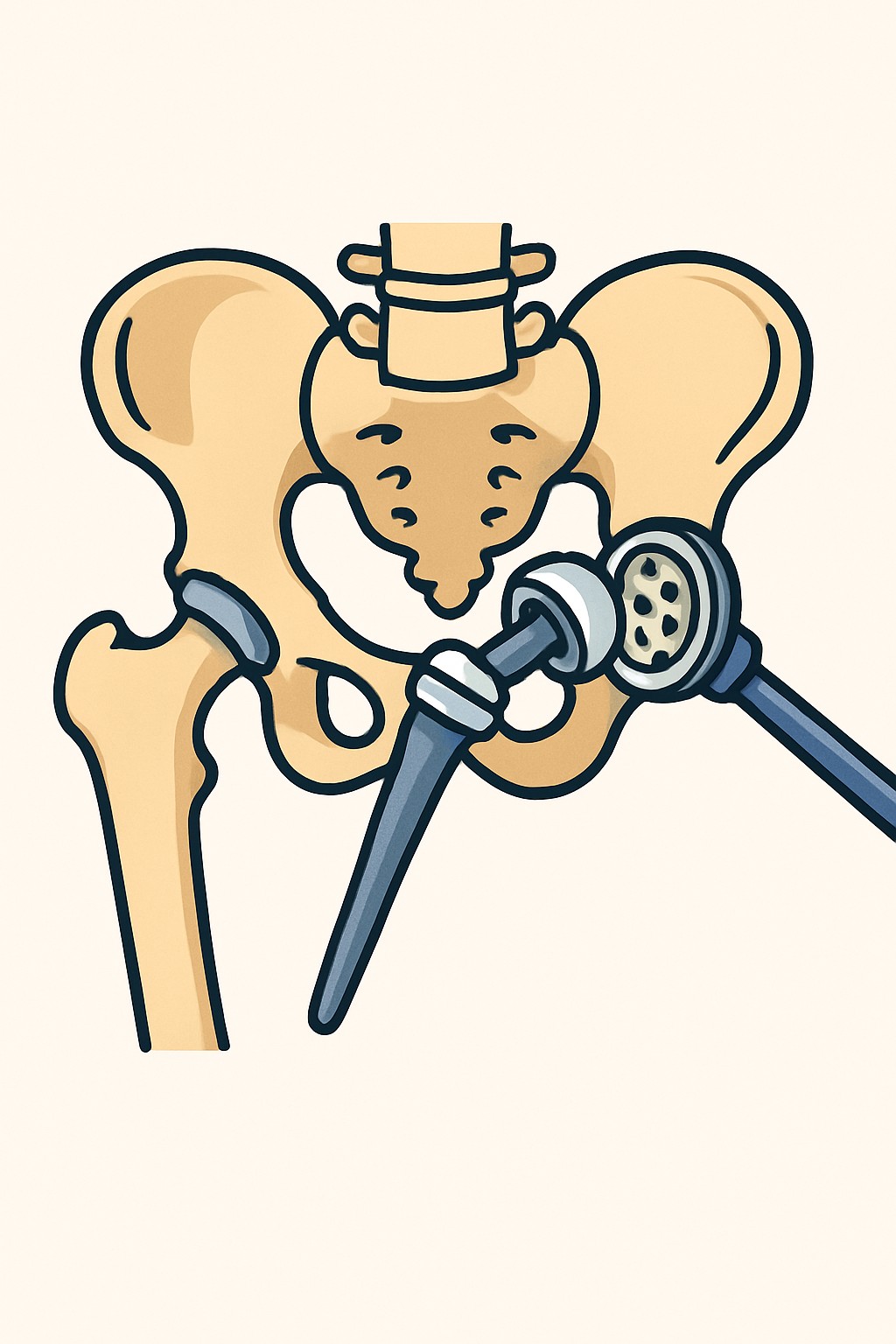
Hip revision surgery is an operation to repair or replace parts of a previous hip replacement that are no longer working well.
Overview
Hip revision surgery is an operation to repair or replace parts of a previous hip replacement that are no longer working well. The surgeon removes worn, loose, damaged, or infected components and places new ones. This procedure is done to reduce pain, improve stability and function, and address problems such as loosening, wear, fracture, or infection around the artificial hip.
Also known as: Revision total hip arthroplasty, Revision THA, Hip replacement revision
Preparation & Next Steps
Everything you need to know before and after your procedure
Before Care
- Complete a preoperative evaluation and any ordered labs, imaging, or heart testing
- Discuss all medicines, supplements, and allergies; confirm which to pause or continue per the care team
- Follow hospital instructions on when to stop eating and drinking before anesthesia
- Ask about infection prevention steps such as antiseptic showers or nasal swabs if recommended
- Address dental problems or other active infections before surgery when advised
- Plan home arrangements: clear walking paths, prepare sleeping area, and set up needed supplies
- Arrange transportation for surgery day and help at home for the first several days
- Confirm what assistive devices will be needed after surgery, such as a walker or raised toilet seat
- Do prehab exercises if provided to strengthen muscles and practice safe movements
- Avoid tobacco and limit alcohol; ask about support resources if needed
After Care
- Keep the incision clean and dry as instructed; do not apply creams or soak the wound unless told
- Take prescribed medicines as directed by the care team, including blood clot prevention if ordered
- Use ice and elevate the leg to help with swelling, following instructions from the care team
- Follow weight-bearing and movement precautions given by the surgeon or therapist
- Attend physical therapy and practice safe walking with your assistive device
- Increase walking and daily activities gradually, as tolerated
- Check the incision daily for increasing redness, warmth, drainage, or opening and contact the clinic if these occur
- Contact the care team if you develop fever, chills, worsening pain not helped by medicines, new calf swelling, shortness of breath, or chest pain
- Keep follow-up appointments for exam, suture or staple removal, and imaging as scheduled
- Maintain a list of your implant details and carry it to future medical and dental visits
Clinical Information
Important medical details about this procedure
Indications
- Painful or loose hip implant
- Recurrent hip dislocation
- Wear of the plastic or bearing surface
- Periprosthetic joint infection
- Fracture around the implant
- Bone loss (osteolysis) or poor fixation
- Implant breakage or malposition
Alternatives
- Activity changes and physical therapy for mild symptoms
- Mobility aids such as cane or walker
- Medicines for pain and inflammation
- Hip injections for temporary symptom relief
- Observation if symptoms are stable and function is acceptable
- Two-stage treatment with temporary spacer for infection cases
Risks
- Infection of the joint or wound
- Blood clots in the legs or lungs
- Hip dislocation or instability
- Fracture of the bone during or after surgery
- Nerve or blood vessel injury
- Leg length difference or limp
- Ongoing pain or stiffness
- Need for another revision in the future
- Anesthesia side effects and bleeding
Contraindications
- Active infection that has not been treated
- Serious uncontrolled heart, lung, or bleeding conditions
- Poor skin or soft tissue condition at the surgical site
- Severe malnutrition or inability to heal
- Inability to participate in postoperative rehabilitation
Recovery Timeline
What to expect during your recovery
Recovery after hip revision is often slower than after a first hip replacement. Many people use a walker or cane for several weeks and improve over 2 to 3 months. Strength and endurance can continue to improve for many months.
Typical Range
42–84 days
Return to Work
28–90 days
Recovery Milestones
Sit up, stand with help, and take short assisted walks in the hospital
Walk short distances at home with a walker; practice stairs with support
Transition to a cane as balance improves; increase household activities
Resume light desk work when comfortable and off sedating pain medicines
Return to most daily activities; continue therapy for strength and gait
Progress to higher levels of endurance and function as cleared by the care team
Frequently Asked Questions
Common questions and expert answers about this procedure
How is hip revision surgery different from my first hip replacement?
How is hip revision surgery different from my first hip replacement?
Revision fixes or replaces parts of a previous implant. It can take longer, may need specialized parts or bone graft, and often has a longer recovery.
Why would someone need a hip revision?
Why would someone need a hip revision?
Common reasons include loosening, wear, infection, repeated dislocation, fracture around the implant, or broken components.
How long does the surgery usually take?
How long does the surgery usually take?
Time varies with complexity, but many revisions take about 2 to 4 hours. Cases with infection or major bone loss can take longer.
How long will I stay in the hospital?
How long will I stay in the hospital?
Many people stay a few days. Some need a short stay at a rehab facility if extra support or therapy is required.
Will I need physical therapy?
Will I need physical therapy?
Yes, therapy is common to help with walking, strength, and safe movements. It often starts in the hospital and continues at home or outpatient.
When can I drive after hip revision?
When can I drive after hip revision?
Driving usually resumes when pain is controlled without sedating medicines and you can safely move the leg, often several weeks after surgery.
How long do revision implants last?
How long do revision implants last?
Lifespan varies by factors such as bone quality, activity level, and implant type. Many last for years, but some may need future procedures.
Will I need blood thinners after surgery?
Will I need blood thinners after surgery?
Medicines to lower clot risk are commonly used after hip surgery. The type and duration depend on individual risk and the care plan.
References
Medical literature and sources