%20--%3e%3csvg%20version='1.0'%20id='Layer_1'%20xmlns='http://www.w3.org/2000/svg'%20xmlns:xlink='http://www.w3.org/1999/xlink'%20x='0px'%20y='0px'%20viewBox='0%200%20755.52%20814.35'%20style='enable-background:new%200%200%20755.52%20814.35;'%20xml:space='preserve'%3e%3cstyle%20type='text/css'%3e%20.st0{fill:%231ae5ce;stroke:%231ae5ce;stroke-width:7;stroke-miterlimit:10;}%20.st1{fill:%23FFFFFF;stroke:%231ae5ce;stroke-width:7;stroke-miterlimit:10;}%20.st2{fill:%231ae5ce;stroke:%23FFFFFF;stroke-width:7;stroke-miterlimit:10;}%20.st3{fill:%23FFFFFF;stroke:%23FFFFFF;stroke-width:6;stroke-miterlimit:10;}%20%3c/style%3e%3cg%20id='Dark_Logo_00000159431215648494653180000015900878925932721032_'%3e%3cpath%20id='shield_00000152259091539869183100000001926543869452564382_'%20class='st0'%20d='M711.13,173.42%20c-3.37-49.07-38.92-44.9-75.96-52.18c-67.4-13.25-130.47-34.47-192.36-63.92c-22.48-10.7-41.88-25.74-65.05-26.28%20c-23.17,0.54-42.58,15.59-65.05,26.28c-61.89,29.45-124.95,50.68-192.36,63.92c-37.04,7.28-72.59,3.11-75.96,52.18%20c-1.55,22.6,0.34,46.4,1.05,68.92c5.99,190.78,52.91,345.39,206.27,466.46c29.71,23.46,74.51,55.8,108.84,70.75%20c5.99,2.61,11.7,3.73,17.21,3.75c5.51-0.02,11.22-1.14,17.21-3.75c34.33-14.95,79.12-47.3,108.84-70.75%20c153.37-121.07,200.28-275.68,206.27-466.46C710.79,219.82,712.68,196.02,711.13,173.42z'/%3e%3cpath%20id='magnifyingglass_00000073685934697636024790000000342567780940956808_'%20class='st1'%20d='M648.78,624.21l-96.64-104.65%20c34.89-40.63,55.98-93.46,55.98-151.21c0-128.27-103.98-232.24-232.24-232.24S143.63,240.08,143.63,368.35%20s103.98,232.24,232.24,232.24c48.87,0,94.21-15.11,131.62-40.89l97.18,105.24c11.25,12.18,30.24,12.93,42.42,1.69l0,0%20C659.27,655.38,660.03,636.39,648.78,624.21z'/%3e%3ccircle%20id='ellipse_00000129904010550392394720000017056154833629780114_'%20class='st2'%20cx='375.87'%20cy='368.35'%20r='181.21'/%3e%3cpath%20id='dollarsign_00000057140127156649725250000003772530148495155891_'%20class='st3'%20d='M362.91,492.03v-23.91%20c0-2.01-1.58-3.69-3.59-3.77c-18.49-0.78-37.12-5.4-49.4-11.83c-1.75-0.92-2.53-3.01-1.76-4.84l5.87-13.89%20c0.86-2.02,3.23-2.88,5.2-1.89c12.94,6.52,30.45,11.44,49.18,11.44c26.02,0,43.6-12.73,43.6-30.43c0-17.08-14.29-27.63-41.4-36.95%20c-37.37-12.42-60.46-26.7-60.46-53.72c0-24.97,20.29-44.11,52.22-49.51c1.8-0.31,3.11-1.89,3.11-3.72v-24.35%20c0-2.09,1.69-3.78,3.78-3.78h15.16c2.09,0,3.78,1.69,3.78,3.78v22.71c0,2.01,1.58,3.67,3.58,3.77c17.85,0.92,30.88,4.75,40.61,9.1%20c1.92,0.86,2.79,3.09,1.94,5.01l-6.08,13.6c-0.85,1.91-3.09,2.77-4.99,1.91c-8.37-3.8-22.38-8.95-42.75-8.95%20c-28.21,0-38.84,14.28-38.84,26.7c0,16.15,13.56,24.22,45.44,35.4c37.74,13.04,56.79,29.19,56.79,56.82%20c0,23.85-19.05,46.23-54.78,52.3c-1.8,0.31-3.11,1.89-3.11,3.72v25.28c0,2.09-1.69,3.78-3.78,3.78h-15.53%20C364.6,495.81,362.91,494.12,362.91,492.03z'/%3e%3c/g%3e%3c/svg%3e)
Knee Arthroscopy (Meniscectomy) Orthopedic Surgery
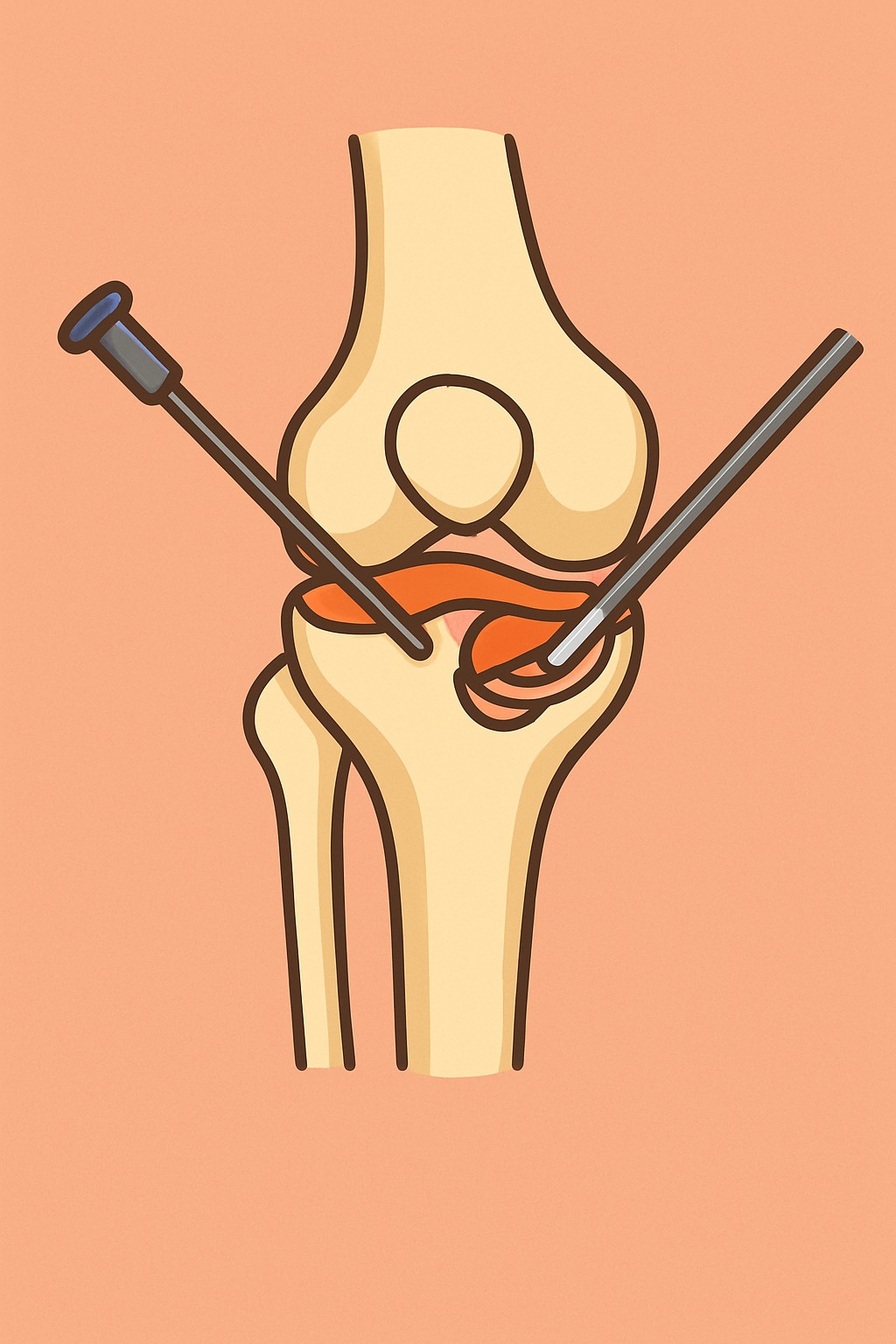
Knee arthroscopy (meniscectomy) is a minimally invasive procedure that uses a small camera and instruments inserted through tiny cuts to treat a torn meniscus, the shock-absorbing cartilage in the knee.
Overview
Knee arthroscopy (meniscectomy) is a minimally invasive procedure that uses a small camera and instruments inserted through tiny cuts to treat a torn meniscus, the shock-absorbing cartilage in the knee. In a meniscectomy, the damaged portion of the meniscus is trimmed or removed; most procedures are partial meniscectomies to preserve as much healthy tissue as possible. It is usually done as an outpatient procedure to help reduce pain, catching, or locking and to improve knee function when symptoms persist despite non-surgical care or when the tear is not repairable.
Also known as: Arthroscopic meniscectomy, Knee scope, Partial meniscectomy, Meniscus surgery, APM
Preparation & Next Steps
Everything you need to know before and after your procedure
Before Care
- Complete the preoperative visit and any labs or imaging requested by the care team
- Discuss all medicines and supplements with the clinician, including blood thinners and diabetes medicines
- Follow fasting instructions if anesthesia is planned
- Arrange an adult to drive you home and stay with you the first day
- Plan time off work and help at home for the first few days
- Bring prior knee imaging and wear loose clothing that fits over a bulky dressing
- Set up your home with a safe path, a place to elevate the leg, and ice packs
- Avoid shaving the operative leg; the team will prepare the skin to reduce infection risk
- Tell the clinic about any new illness, fever, skin rash, or open wounds before the procedure
- Confirm insurance details, arrival time, and when to stop eating or drinking
After Care
- Keep the dressing clean and dry; follow instructions on when you may shower and when to change the dressing
- Elevate the leg and use ice packs as directed to help with swelling
- Use crutches or a cane if provided until walking is comfortable and steady
- Take pain medicines only as directed by the care team; avoid alcohol while taking sedating pain medicines
- Do ankle pumps and gentle range-of-motion exercises as instructed to reduce stiffness
- Resume weight bearing and activities gradually based on comfort and the care plan
- Avoid soaking the incisions (baths, pools, hot tubs) until cleared
- Watch for increased redness, drainage, fever, worsening pain, calf swelling, or shortness of breath and contact the care team promptly
- Attend scheduled follow-up to review healing and start or progress physical therapy
- Store and dispose of any leftover opioid pain medicines safely
Clinical Information
Important medical details about this procedure
Indications
- Symptomatic meniscus tear with pain, swelling, or mechanical locking/catching
- Symptoms that continue after a period of non-surgical treatment
- Tears that are unlikely to heal with repair (for example, degenerative or complex tears)
- Mechanical blockage preventing full knee motion
Alternatives
- Activity modification and rest
- Physical therapy and home exercise program
- Over-the-counter pain relievers as tolerated
- Knee brace or support
- Corticosteroid injection for temporary symptom relief
- Watchful waiting with symptom monitoring
- Arthroscopic meniscus repair when the tear pattern and blood supply allow repair
Risks
- Infection
- Bleeding or bruising
- Blood clots (deep vein thrombosis)
- Stiffness or reduced range of motion
- Nerve or blood vessel injury
- Persistent pain or swelling
- Progression of knee osteoarthritis after meniscectomy
- Need for additional procedures
- Side effects from anesthesia
Contraindications
- Active skin or joint infection
- Severe, advanced knee osteoarthritis where arthroscopy is unlikely to help symptoms
- Uncontrolled medical conditions that make anesthesia unsafe
- Inability to participate in basic rehabilitation or lack of support for recovery
- Acute injuries requiring different reconstructive surgery (for example, certain fractures)
Recovery Timeline
What to expect during your recovery
Most people walk the same day and see steady improvement over several weeks. Many return to desk work within 1 to 2 weeks, with higher-impact activity taking several weeks longer.
Typical Range
7–42 days
Return to Work
3–14 days
Recovery Milestones
Walk short distances with support as needed and elevate the leg to reduce swelling
Increase weight bearing indoors as comfortable and begin gentle knee motion
Drive short trips when walking is comfortable and not taking sedating pain medicines
Return to desk or light-duty work if pain and swelling are controlled
Add low-impact cardio such as cycling or elliptical as tolerated
Progress to jogging and sport-specific drills if strength and motion have returned
Frequently Asked Questions
Common questions and expert answers about this procedure
What is the difference between meniscectomy and meniscus repair?
What is the difference between meniscectomy and meniscus repair?
Meniscectomy trims or removes the torn portion of the meniscus; repair stitches the tear to preserve tissue. Repair is used when the tear type and location have blood supply to heal.
How long does the procedure take?
How long does the procedure take?
The surgical time is often under one hour, but total time at the facility is longer due to check-in, anesthesia, and recovery.
What kind of anesthesia is used?
What kind of anesthesia is used?
General anesthesia or regional anesthesia (such as a spinal or nerve block) is commonly used, sometimes with light sedation.
Will the whole meniscus be removed?
Will the whole meniscus be removed?
Usually only the damaged portion is trimmed to keep as much healthy meniscus as possible. Total meniscectomy is uncommon.
Do all meniscus tears need surgery?
Do all meniscus tears need surgery?
No. Many tears improve with rest, physical therapy, and time. Surgery is considered when symptoms persist or there is mechanical locking.
When can I return to sports?
When can I return to sports?
Low-impact activity may resume in a few weeks, with higher-impact drills typically later. Timing varies based on healing, strength, and the plan made with the care team.
Will this increase arthritis risk?
Will this increase arthritis risk?
Loss of meniscus tissue can increase stress on knee cartilage, and osteoarthritis can progress over time, especially after larger tissue removal.
Will I need physical therapy?
Will I need physical therapy?
Many people benefit from supervised or guided exercises to restore motion, strength, and balance after surgery.
References
Medical literature and sources