%20--%3e%3csvg%20version='1.0'%20id='Layer_1'%20xmlns='http://www.w3.org/2000/svg'%20xmlns:xlink='http://www.w3.org/1999/xlink'%20x='0px'%20y='0px'%20viewBox='0%200%20755.52%20814.35'%20style='enable-background:new%200%200%20755.52%20814.35;'%20xml:space='preserve'%3e%3cstyle%20type='text/css'%3e%20.st0{fill:%231ae5ce;stroke:%231ae5ce;stroke-width:7;stroke-miterlimit:10;}%20.st1{fill:%23FFFFFF;stroke:%231ae5ce;stroke-width:7;stroke-miterlimit:10;}%20.st2{fill:%231ae5ce;stroke:%23FFFFFF;stroke-width:7;stroke-miterlimit:10;}%20.st3{fill:%23FFFFFF;stroke:%23FFFFFF;stroke-width:6;stroke-miterlimit:10;}%20%3c/style%3e%3cg%20id='Dark_Logo_00000159431215648494653180000015900878925932721032_'%3e%3cpath%20id='shield_00000152259091539869183100000001926543869452564382_'%20class='st0'%20d='M711.13,173.42%20c-3.37-49.07-38.92-44.9-75.96-52.18c-67.4-13.25-130.47-34.47-192.36-63.92c-22.48-10.7-41.88-25.74-65.05-26.28%20c-23.17,0.54-42.58,15.59-65.05,26.28c-61.89,29.45-124.95,50.68-192.36,63.92c-37.04,7.28-72.59,3.11-75.96,52.18%20c-1.55,22.6,0.34,46.4,1.05,68.92c5.99,190.78,52.91,345.39,206.27,466.46c29.71,23.46,74.51,55.8,108.84,70.75%20c5.99,2.61,11.7,3.73,17.21,3.75c5.51-0.02,11.22-1.14,17.21-3.75c34.33-14.95,79.12-47.3,108.84-70.75%20c153.37-121.07,200.28-275.68,206.27-466.46C710.79,219.82,712.68,196.02,711.13,173.42z'/%3e%3cpath%20id='magnifyingglass_00000073685934697636024790000000342567780940956808_'%20class='st1'%20d='M648.78,624.21l-96.64-104.65%20c34.89-40.63,55.98-93.46,55.98-151.21c0-128.27-103.98-232.24-232.24-232.24S143.63,240.08,143.63,368.35%20s103.98,232.24,232.24,232.24c48.87,0,94.21-15.11,131.62-40.89l97.18,105.24c11.25,12.18,30.24,12.93,42.42,1.69l0,0%20C659.27,655.38,660.03,636.39,648.78,624.21z'/%3e%3ccircle%20id='ellipse_00000129904010550392394720000017056154833629780114_'%20class='st2'%20cx='375.87'%20cy='368.35'%20r='181.21'/%3e%3cpath%20id='dollarsign_00000057140127156649725250000003772530148495155891_'%20class='st3'%20d='M362.91,492.03v-23.91%20c0-2.01-1.58-3.69-3.59-3.77c-18.49-0.78-37.12-5.4-49.4-11.83c-1.75-0.92-2.53-3.01-1.76-4.84l5.87-13.89%20c0.86-2.02,3.23-2.88,5.2-1.89c12.94,6.52,30.45,11.44,49.18,11.44c26.02,0,43.6-12.73,43.6-30.43c0-17.08-14.29-27.63-41.4-36.95%20c-37.37-12.42-60.46-26.7-60.46-53.72c0-24.97,20.29-44.11,52.22-49.51c1.8-0.31,3.11-1.89,3.11-3.72v-24.35%20c0-2.09,1.69-3.78,3.78-3.78h15.16c2.09,0,3.78,1.69,3.78,3.78v22.71c0,2.01,1.58,3.67,3.58,3.77c17.85,0.92,30.88,4.75,40.61,9.1%20c1.92,0.86,2.79,3.09,1.94,5.01l-6.08,13.6c-0.85,1.91-3.09,2.77-4.99,1.91c-8.37-3.8-22.38-8.95-42.75-8.95%20c-28.21,0-38.84,14.28-38.84,26.7c0,16.15,13.56,24.22,45.44,35.4c37.74,13.04,56.79,29.19,56.79,56.82%20c0,23.85-19.05,46.23-54.78,52.3c-1.8,0.31-3.11,1.89-3.11,3.72v25.28c0,2.09-1.69,3.78-3.78,3.78h-15.53%20C364.6,495.81,362.91,494.12,362.91,492.03z'/%3e%3c/g%3e%3c/svg%3e)
Knee arthroscopy with meniscectomy Orthopedic Surgery
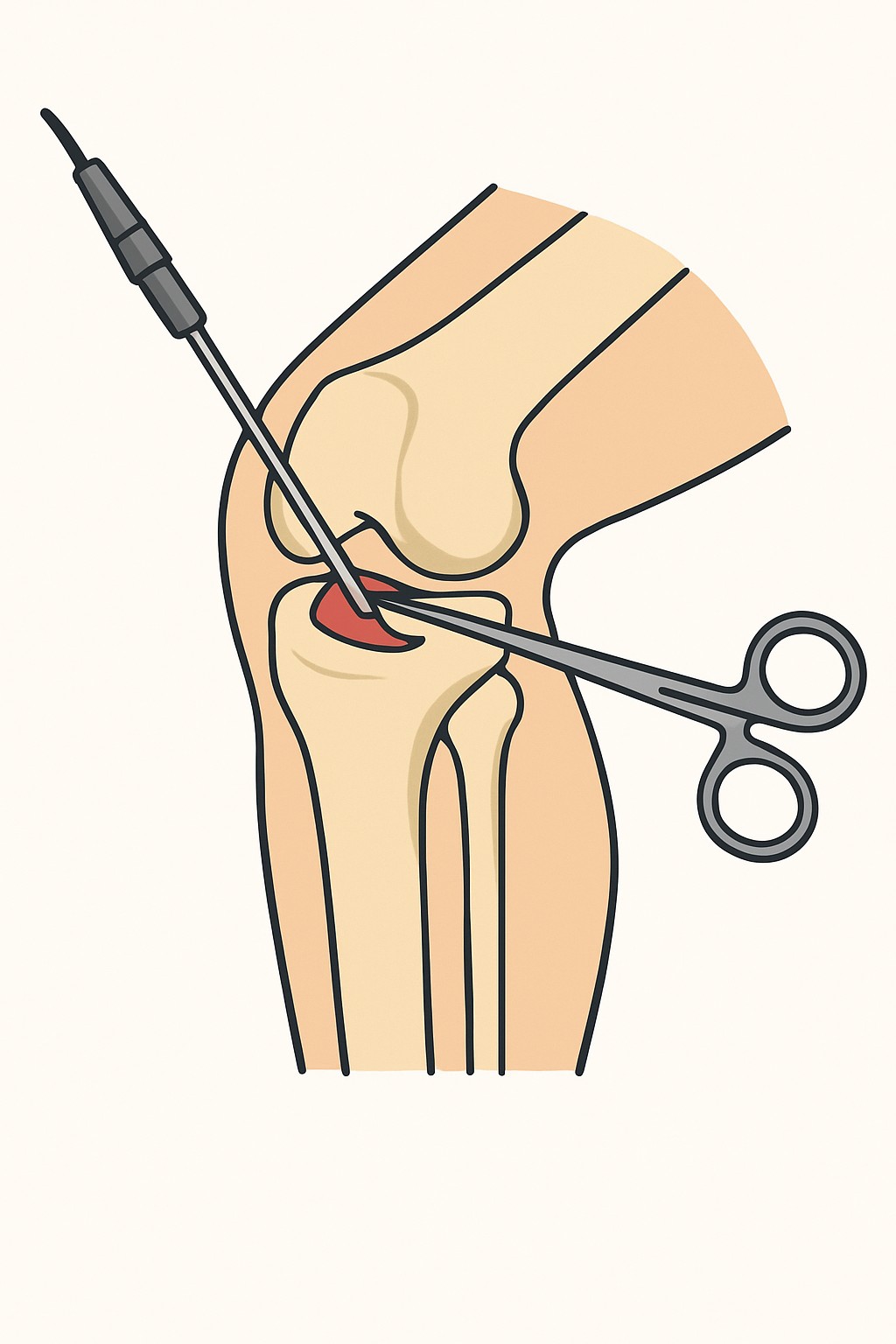
Knee arthroscopy with meniscectomy is a minimally invasive procedure that uses a small camera and instruments through tiny cuts to treat a torn meniscus.
Overview
Knee arthroscopy with meniscectomy is a minimally invasive procedure that uses a small camera and instruments through tiny cuts to treat a torn meniscus. The surgeon removes the damaged part of the meniscus while trying to keep as much healthy tissue as possible. It is usually done as an outpatient procedure. The goal is to reduce pain and catching, improve knee function, and help you return to daily activities.
Also known as: Arthroscopic partial meniscectomy, APM, Knee scope meniscus surgery
Preparation & Next Steps
Everything you need to know before and after your procedure
Before Care
- Complete pre-op evaluation and any requested labs or imaging
- Review all medicines and supplements with the care team, including blood thinners
- Follow the facility’s instructions on fasting if anesthesia is planned
- Arrange a responsible adult for a ride home and help the first day
- Set up your home with ice packs, a safe walking path, and a place to elevate the leg
- Confirm what assistive devices you may need, such as crutches
- Wear loose clothing that fits over a knee bandage
- Share allergies, prior anesthetic issues, and recent illnesses with the team
- Ask about expected time off work, driving limits, and activity restrictions
After Care
- Keep dressings clean and dry; follow the team’s instructions on when to change them
- Elevate the leg and use ice as instructed to help reduce swelling
- Bear weight and use crutches as directed by your care team
- Do the prescribed range-of-motion and muscle activation exercises
- Take pain medicines only as instructed by your care team; avoid new medicines without checking
- Monitor the incisions for redness, warmth, drainage, or opening
- Contact the clinic for fever 100.4 F (38 C) or higher, worsening pain, or increasing swelling
- Report calf pain or swelling, sudden chest pain, or shortness of breath to your care team
- Keep follow-up appointments to check healing and adjust your activity plan
- Ask when it is safe to drive, return to work, and resume sports based on progress
Clinical Information
Important medical details about this procedure
Indications
- Meniscus tear causing pain, catching, or locking
- Bucket-handle or displaced tear blocking motion
- Symptoms that do not improve after a period of non-surgical care
- Tears not suitable for repair based on location, pattern, or tissue quality
Alternatives
- Activity modification and time
- Physical therapy and home exercise program
- Ice, compression, elevation
- Over-the-counter pain relievers as directed by a clinician
- Knee bracing
- Corticosteroid injection for short-term symptom relief
- Meniscus repair (when the tear is repairable)
Risks
- Bleeding or infection
- Blood clots in the leg
- Knee stiffness or swelling
- Persistent pain or symptoms
- Nerve or blood vessel injury
- Anesthesia-related effects
- Increased risk of knee osteoarthritis over time after tissue removal
Contraindications
- Active skin or joint infection
- Uncontrolled bleeding or blood-thinner use not managed
- Severe medical conditions that make anesthesia unsafe
- Advanced diffuse knee arthritis where meniscectomy is unlikely to help
- Poor wound healing risk that is not optimized
Recovery Timeline
What to expect during your recovery
Many people walk with assistance the first few days and return to light daily tasks within 1 to 2 weeks. Return to higher-impact activity often takes several weeks, depending on job demands and rehab progress.
Typical Range
14–42 days
Return to Work
3–42 days
Recovery Milestones
Rest, elevate, and begin gentle ankle pumps and quad sets
Short walks at home; gradual range-of-motion exercises
Wean off crutches as gait and pain allow
Return to desk work if comfortable; avoid prolonged standing
Light cycling or pool work if wounds are healed and swelling is controlled
Progress to jogging, cutting, and sport drills when cleared by the care team
Frequently Asked Questions
Common questions and expert answers about this procedure
What is removed during a meniscectomy?
What is removed during a meniscectomy?
Only the torn and unstable meniscus tissue is trimmed. Surgeons aim to keep as much healthy meniscus as possible.
Is this an outpatient procedure?
Is this an outpatient procedure?
Yes, most people go home the same day after recovery from anesthesia.
How long does the surgery take?
How long does the surgery take?
The arthroscopy usually takes under an hour, but total time at the facility is longer due to prep and recovery.
Will I need crutches?
Will I need crutches?
Many people use crutches for a few days for comfort and safety, then gradually walk without them as pain and swelling improve.
When can I drive?
When can I drive?
Driving is typically allowed when you can brake safely, have good control of the leg, and are not taking sedating pain medicines.
What is the difference between meniscectomy and repair?
What is the difference between meniscectomy and repair?
Meniscectomy removes the torn portion; repair stitches the tear to heal. Repair is used when the tear type and location are suitable.
Does removing meniscus tissue cause arthritis?
Does removing meniscus tissue cause arthritis?
Losing meniscus tissue can increase joint stress over time, which may raise the risk of knee osteoarthritis.
What if my symptoms improve without surgery?
What if my symptoms improve without surgery?
Some tears calm down with time, therapy, and activity changes. Non-surgical care is a common first step when appropriate.
References
Medical literature and sources